Driving without music playing feels so unnatural. Even if it's just to run some errands for 15 minutes worth of driving, I can't leave without picking up a CD or two for the ride. And for whatever reason, I don't like driving with the car windows up all the way -- it just feels weird. Even when it's cold I leave them open a crack. One, it keeps me more in touch with my surroundings, and more importantly, two, I get to annoy people with the music I'm playing.
Ever since the music culture died during the '90s, the average listener bristles at care-free, feel-good music, as well as more introspective or downer music that is more about vulnerability rather than the trend of the '90s and 2000s of mopey or bitter or outraged music. The culture overall has just become a lot more fake, especially in social relations. People are too afraid or too prudish or too something to show how they feel, whether good or bad. Good-times pictures on Facebook show kabuki faces, not real facial expressions, and bad-times pictures on MySpace show this-is-my-hardest-teen-angst poses.
Naturally then, real music is going to rub these people the wrong way, and there's nothing more satisfying than disturbing someone who needs to lighten the fuck up. As a bonus, if you run into the minority who do appreciate real music, you'll put a big smile on their face, like "Oh thank god someone's still playing some good songs around here!"
It only rarely goes as far as me getting some kind of acknowledgment from the people within earshot, but over the past couple years it has happened quite a few times. Everyone has memories of where they were when they heard a song that carved the memory onto their brain. With such a moribund music culture out there, I now get that feeling based on positive "audience" response when I'm out driving around.
Here is a close to complete list of these episodes. I may be overlooking one here or there, but it's hard to forget those fleeting connecting-with-strangers moments. Obviously this method of detecting what music is crowd-pleasing will have plenty of false negatives, where I'm playing something good and everyone likes it but for whatever reason doesn't send an acknowledging look. However, it won't produce false positives -- if a total stranger is willing to exchange a knowing, appreciate look, that's just the tip of the iceberg of fans of the song, who aren't always going to be so forward.
Actually, first it's worth looking at what never gets a response, no matter how often I've played it in however broad a variety of settings. Rock music from the '60s and early '70s never gets a nod or anything from Baby Boomers who grew up on it, let alone people who heard it much later. It's not that it gets sneers or eye-rolls, as if I were to play Eminem or Korn, but I was surprised at how neutral the reactions always are. This includes any of the Velvet Underground albums, Lou Reed's Transformer album, Rubber Soul by The Beatles, compilation albums by The Beach Boys, The Byrds, and The Searchers, and Electric Warrior and The Slider by T. Rex.
The appraisal of the public seems to be that these are good musicians who did pioneering work, but that perhaps a bit more of their fame that is comfortable to admit out loud is due to their laying the ground for better music groups. It's like how you study a little bit of Pollaiuolo in an art history class before you dig deep into Michelangelo. There seems to be a similar appraisal of New Hollywood movies like The Graduate, which were a nice experimental waking up from a slumber, but that still can't compare to the non-stop excitement once the industry began hitting its stride, here as well, during the mid-1970s and lasting through the early 1990s.
Also, none of the original independent rock ("college rock," "college radio," etc.) ever gets acknowledged. The Jesus and Mary Chain, Camper Van Beethoven, The Replacements, The Dead Milkmen, Echo and the Bunnymen, Love and Rockets, Tones on Tail, etc. The audience for that music was mostly college students who thought of themselves as artistic, non-conformist, bla bla bla -- in other words, they used music almost entirely as a tribal or individual marker of their awesome uniqueness, and hardly at all because they liked the music itself. In typical narcissistic fashion, they and their present-day counterparts have thrown their former idols under the bus and have kept moving on to some other new crop of "obscure bands" to signal their non-mainstreaminess. I used to play a good amount of the "post-punk revival" music from the mid-2000s, but that never got any responses either.
Now on to what has played well, with a remark or two about the episode.
- "Round and Round" by Ratt. Pulling out of the parking lot at the local supermarket. A couple that's in their early-mid 30s and dressed in the long black trench coat look of the '90s hears this and smiles genuinely, like this is what they listened to when they were pubescent or slightly before. "Dang, hardass music used to actually sound hardass," I could hear them thinking to themselves.
- "Lucky Star" by Madonna. Leaving the parking lot of a nearby shopping center. A group of two or three couples in their later 30s through mid 40s is crossing in front, when one woman spontaneously breaks into a dance and strut halfway through crossing.
- "Get Into the Groove" by Madonna. Entering the shopping center parking lot. A group of Gen X-ers is sitting around an outside table, and one woman begins to bounce and pump her arms around. However, I couldn't see her eyes since she had sunglasses on, so it was difficult to tell if she was responding in mockery or not.
- "The Power of Love" by Huey Lewis & the News. Pulling into a parking space at the shopping center. I must have been blasting this one so loud that the couple in the pickup just to my right heard it through their closed windows. The woman's face lit up like a little girl whose lost teddy bear turns up out of the blue after weeks of fruitless searching. They were in their late 30s or early 40s.
- "Social Disease" by Bon Jovi. Out for a cruise on a 7 or 8-lane drag. A guy driving along my right side has his windows down just like I do, since it's summer. He looks over and, not wanting to get all gushy or anything, looks back ahead but starts bobbing his head back and forth. He was about 40 and Slippery When Wet must have been his cruising-for-chicks soundtrack when he was in high school. (He still had long hair in the back, and about top-of-the-ear length in front, not a mullet.)
- "Don't Dream It's Over" by Crowded House. I don't have this on CD, but when I saw Adventureland in the theater there was a group of five or six people in their later 30s sitting nearby. When this song comes on, it's set against the background of "summer love" and "summer nights," which is laying it on a bit thick. Still, one guy in the group couldn't help himself and started singing along -- not meta-ironically, but like it was streaming over the radio during the final few twilight weeks of the school year.
- "Children of the Damned" by Iron Maiden. Parking almost in front of an indie coffeeshop, where two groups of people are lounging on the outdoor patio. There's a group of two metalheads, about 35 years old, one of whom shrieks out "Children of the daaaaaaaamned!!!" and smiles when I get out of my car. In general, heavy metal fans are the most loyal, so the chances of this happening are high if you happen to find one, although they are small in total numbers.
- Several songs by Michael Jackson, especially from Bad. I don't have clear memories of any specific episodes here because it's pretty common, although the reactions tend not to be so memorable -- non-toothy smiles, a look over the shoulder, that kind of thing.
- "We Belong" by Pat Benatar. Pulling into the supermarket parking lot. Two guys in their mid-late 30s get out of their car about the same time, and one says "We belong to the night!" in a self-conscious vampire kind of voice.
- "The Ballad of Wendell Scott" by Mojo Nixon and Skid Roper. Here's a slight exception to the "college rock doesn't go well" rule, although it was all construction workers, who certainly never heard the song before. They were just glad to hear some fast-paced, yee-haw getaway music during their lunch break.
- "Heaven is a Place on Earth" by Belinda Carlisle. Slowly prowling around the shopping center parking lot, which is packed. Ahead about 30 feet are two Gen X women, like late 30s, walking with their backs to my car. Once one of them recognizes the song, she doesn't just look over her shoulder but spins her entire upper body around and is too transported to a better place to notice that her eyes are bugging out and her jaw has dropped wide open. Then just as soon as she does so, she regains her composure and they resume their stroll. She very willingly lost her virginity to this song over Christmas vacation, 1987, probably as a junior in high school with an older boyfriend who had come home from college.
Her hair is dark grey, and she's still wearing it in one of those shortish '80s hairdos -- not cropped like Madonna or in a bob, more like Sandy Duncan back then. She and the friend are dressed in contemporary yuppie uniforms, though. Looking at someone who was her age and so wrapped up in furthering her career, you'd never suspect that she was such a wild teenager. But that was back when youthful craziness was nearing its peak in the population, so even people who are by inclination more strait-laced were pulled into the larger youth rebellion.
- "Automatic" by Prince. Leaving a popular nearby park. A group of four gay men in their later 30s are passing in front, and one of them breaks into a kind of a shuffle halfway through the crosswalk. He gets really nervous and self-conscious, though, and tries to continue walking normally.
- "My Best Friend's Girl" by The Cars. Slowing down at a stop sign, and a group of pedestrians on the sidewalk (in their 40s) look over and smile a little bit.
- "Mediate" by INXS. Coming to a stop behind a line of cars at a red light. I'm next to the sidewalk, and two women in their late 30s are walking toward one of the main government buildings -- a courthouse or something -- and are in lawyer chick skirt suits. Being lawyers, they're not as cool as the girl who beamed to Belinda Carlisle, but one of them does turn her head over her shoulder and mixes "Hey, I remember that song!" with "Oh god, it's that song again..." Her high school boyfriend must have played Kick as his make-out music (or at least "Need You Tonight," which comes right before this one), and she grew a little tired of it after awhile.
It's odd that every week '80s night is packed with college kids, yet no young people ever respond to the same music outside the club. It seems like it's more of a goof for a good number of the people there, not something they really like deep down. Michael Jackson is different, of course -- everyone knows and likes his songs -- but overall music is not central to their lives.
And no, it has nothing to do with the fact that they didn't hear those songs when they first came out. Kids my age weren't born when "Bohemian Rhapsody" came out, but we heard it from the Wayne's World movie and loved it right away. Anyone who was in fifth grade when that movie came out still holds that as one of their "don't let it end" songs from their childhood, before everything started changing in middle school.
Unfortunately the most positive reactions have been from people who were at least a good five or tens years older than me, which doesn't bode well for finding people to relate to musically even within my age group. Most of your core musical tastes are in place by around 20, so in order to avoid taking indie / alternative / emo seriously (or nu metal, gangsta rap, etc.), you had to have been born before 1975 or so. Born from 1976 through 1985, you might have heard good music on the radio when you were a child, but it probably didn't play much of a role in your adolescence, when music matters much more. Born after 1985, there's nothing good left to hear even in childhood, let alone as a teenager.
Returning to the lack of response from older Baby Boomers, they were adolescents when rock music was still maturing, so they have a decent ear for it but let the peak stage pass them by as they entered their later 20s and 30s. If you were 20 during the mid-'70s when it really gets going, though, rock music of any kind still resonates really well with you. So people born between, roughly, 1955 and 1975 know the score and appreciate just about anything worth appreciating. They're the ones you want to talk to about music. Hopefully some of them are writing things down, since they're the only group that really knows anything. It would be a shame for them to enter their forgetful years in a few decades without having recorded what it was all about for posterity.

February 14, 2011

February 11, 2011
We're running with the shadows of the night
Who knew there were so many versions of this song? Thank god for YouTube.*
Here is the immortal recording by Pat Benatar. Searching for this one turned up another by Helen Schneider and -- I couldn't believe it! -- one by Rachel Sweet. There's even a 2008 hit recording by Ashley Tisdale for the Millennials.
Obviously the post-1992 version is the mediocre one of the bunch, but it's better than 99% of the junk during this period, whether original or covers. She has no emotional depth in her voice, which makes sense because as someone born in 1985 she came of age during falling-crime times and recorded it during these times as well. You need to feel close to the brink to get the right emotional inflection for this song. It sounds like she's playing dress-up or playing in a blackface show almost. And notice how in the video she hams it up by locking her legs and bending over Betty Boop style, as well as making a grinding motion with her hips. Too self-conscious and in-control-of-herself for a song about letting go and throwing yourself into the rush of life.
The Helen Schneider version is pretty good as far as the instrumentation and vocals go, but emotionally she sounds a bit too cocky (echoed by her facial expressions). This is what some people in the YouTube comments are picking up on when they say it may be a bit too masculine, but it's not masculine vs. feminine that matters, it's that this song isn't supposed to be one where you feel overly confident and secure.
That's why the Rachel Sweet and Pat Benatar versions come out the best. You need just the right balance between guts and anxiety to get into the action of this song. All other great songs in the genre, even the more masculine power-driven ones like Kenny Loggins' "Danger Zone" and Bon Jovi's "Livin' on a Prayer," strike this balance. If you feel too confident, there's no edge-of-your-seat tension about how the cosmic event will unfold, and if you're too insecure you'll just sit it out on the sidelines and let it pass you by.
I like Pat's version more than Rachel's because there's a bit more yearning in hers, like she's truly hungry to jump into one of life's Big Moments, which they emphasize in the video by showing her dreaming of flying into Nazi territory and kicking butt. Also there's the slight but powerful difference in the words to the chorus: Pat says "running with" the shadows of the night, while Rachel says "running through." "Through" makes it sound like the surroundings are static, and that the two people are above-it-all, like superheroes who move so fast that everyone else seems to be frozen in place. "With" makes it sound like the surroundings themselves are not just alive but racing along too, a nice touch of the pathetic fallacy to strengthen the turbulent drive of the song.
All this writing makes me want to go out for a cruise.
* We still need to be careful when blindly praising new technologies like this, since if it were 1983 I would be spending lots of my free time in a variety of record stores and talking to people who knew everything, and so would probably have had the same chance of finding this information out and for roughly the same search cost.
Here is the immortal recording by Pat Benatar. Searching for this one turned up another by Helen Schneider and -- I couldn't believe it! -- one by Rachel Sweet. There's even a 2008 hit recording by Ashley Tisdale for the Millennials.
Obviously the post-1992 version is the mediocre one of the bunch, but it's better than 99% of the junk during this period, whether original or covers. She has no emotional depth in her voice, which makes sense because as someone born in 1985 she came of age during falling-crime times and recorded it during these times as well. You need to feel close to the brink to get the right emotional inflection for this song. It sounds like she's playing dress-up or playing in a blackface show almost. And notice how in the video she hams it up by locking her legs and bending over Betty Boop style, as well as making a grinding motion with her hips. Too self-conscious and in-control-of-herself for a song about letting go and throwing yourself into the rush of life.
The Helen Schneider version is pretty good as far as the instrumentation and vocals go, but emotionally she sounds a bit too cocky (echoed by her facial expressions). This is what some people in the YouTube comments are picking up on when they say it may be a bit too masculine, but it's not masculine vs. feminine that matters, it's that this song isn't supposed to be one where you feel overly confident and secure.
That's why the Rachel Sweet and Pat Benatar versions come out the best. You need just the right balance between guts and anxiety to get into the action of this song. All other great songs in the genre, even the more masculine power-driven ones like Kenny Loggins' "Danger Zone" and Bon Jovi's "Livin' on a Prayer," strike this balance. If you feel too confident, there's no edge-of-your-seat tension about how the cosmic event will unfold, and if you're too insecure you'll just sit it out on the sidelines and let it pass you by.
I like Pat's version more than Rachel's because there's a bit more yearning in hers, like she's truly hungry to jump into one of life's Big Moments, which they emphasize in the video by showing her dreaming of flying into Nazi territory and kicking butt. Also there's the slight but powerful difference in the words to the chorus: Pat says "running with" the shadows of the night, while Rachel says "running through." "Through" makes it sound like the surroundings are static, and that the two people are above-it-all, like superheroes who move so fast that everyone else seems to be frozen in place. "With" makes it sound like the surroundings themselves are not just alive but racing along too, a nice touch of the pathetic fallacy to strengthen the turbulent drive of the song.
All this writing makes me want to go out for a cruise.
* We still need to be careful when blindly praising new technologies like this, since if it were 1983 I would be spending lots of my free time in a variety of record stores and talking to people who knew everything, and so would probably have had the same chance of finding this information out and for roughly the same search cost.
Female bonding movies absent during violent times, surge during safe times
In the comments to an earlier post about the degradation of romantic comedies into chick flicks during falling-crime times, someone mentioned the rise of a certain type of chick flick that I hadn't thought of -- the female bonding movie. That's probably the most extreme example of a cultural work that depicts sex segregation.
I googled around for a list of I-can't-even-write-it kind of movies, and found this one with 201 entries. Aside from two movies from 1937 and 1945 (both part of the falling-crime era of 1934-1958, by the way), all of them are from 1980-2010. I don't know how recently it was updated. Here is how these 199 movies were released over time:

There is a consistently low level during the high-crime times of the 1980s and very early 1990s. After the crime rate peaked in 1992, the culture began sissifying itself, and part of that was the re-segregation of the sexes, as I explained in the romantic comedies post. It's like after the end of the Jazz Age (another piece of soaring crime history), when females began to shut themselves in the kitchen and felt more like vacuuming the living room carpet in high heels rather than driving cars around to look for boys, dancing to wild music, and smoking and drinking. Sure enough, the recent falling-crime period is when this sort of movie exploded in numbers.
The picture would be more accurate if I weighted each movie by how much money it brought in at the box office, adjusted for inflation. That would tell us how much money people paid in a certain year to see this genre in the theater, not just how many such movies were made. But that's extra work, and the picture is already clear.
These movies are one counter-example to the tendency during falling-crime times for people to become infantilized, as they perceive a safer and more predictable world and put everything off until much later. Even pre-pubescent girls have some interest in boys -- especially like the ones I went to school with when crime was soaring, but even the ones today. No, the social world inhabited by the characters in these female bonding movies is more like that of a post-menopausal woman -- not wanting much excitement, seeing only a small number of people socially, and all of them females instead of noisy, smelly, and bothersome males. Again, even elementary school girls want to mix in with the boys to some degree, even though they too think we're made of slime and snails and puppy-dog tails.
Another big reason why females bond a lot more during falling-crime times is that they've abandoned their promiscuous ways from rising-crime times. It's hard to bond when you're competing more aggressively for male attention, but easy when you respect each other's claims on who belongs to who.
But just wait till the crime rate inevitably enters the upward phase of its cycle in the next 5 to 25 years, and girls will realize that they can't get through real life by sequestering themselves away from boys, and that it's not enough to just keep a few gay pet-friends. Plus we'll happily see an end to these menopausal group-hug movies and a return of out-of-control girls eager to play with the boys.
I googled around for a list of I-can't-even-write-it kind of movies, and found this one with 201 entries. Aside from two movies from 1937 and 1945 (both part of the falling-crime era of 1934-1958, by the way), all of them are from 1980-2010. I don't know how recently it was updated. Here is how these 199 movies were released over time:

There is a consistently low level during the high-crime times of the 1980s and very early 1990s. After the crime rate peaked in 1992, the culture began sissifying itself, and part of that was the re-segregation of the sexes, as I explained in the romantic comedies post. It's like after the end of the Jazz Age (another piece of soaring crime history), when females began to shut themselves in the kitchen and felt more like vacuuming the living room carpet in high heels rather than driving cars around to look for boys, dancing to wild music, and smoking and drinking. Sure enough, the recent falling-crime period is when this sort of movie exploded in numbers.
The picture would be more accurate if I weighted each movie by how much money it brought in at the box office, adjusted for inflation. That would tell us how much money people paid in a certain year to see this genre in the theater, not just how many such movies were made. But that's extra work, and the picture is already clear.
These movies are one counter-example to the tendency during falling-crime times for people to become infantilized, as they perceive a safer and more predictable world and put everything off until much later. Even pre-pubescent girls have some interest in boys -- especially like the ones I went to school with when crime was soaring, but even the ones today. No, the social world inhabited by the characters in these female bonding movies is more like that of a post-menopausal woman -- not wanting much excitement, seeing only a small number of people socially, and all of them females instead of noisy, smelly, and bothersome males. Again, even elementary school girls want to mix in with the boys to some degree, even though they too think we're made of slime and snails and puppy-dog tails.
Another big reason why females bond a lot more during falling-crime times is that they've abandoned their promiscuous ways from rising-crime times. It's hard to bond when you're competing more aggressively for male attention, but easy when you respect each other's claims on who belongs to who.
But just wait till the crime rate inevitably enters the upward phase of its cycle in the next 5 to 25 years, and girls will realize that they can't get through real life by sequestering themselves away from boys, and that it's not enough to just keep a few gay pet-friends. Plus we'll happily see an end to these menopausal group-hug movies and a return of out-of-control girls eager to play with the boys.
February 10, 2011
Will we fall into dystopia because of our sin or corporate/political evils?
During an informal chat today where two of us were recommending movies to a third, the other recommender remarked that Back to the Future Part II was "so bad" that lots of people stayed away from Part III when it came out. I reflexively defended Part II, but I hadn't thought in detail about what makes it so good. It was not as great as the first, but it's still a very good movie, and now that I've been forced to think of reasons why, it seems that it's because it's a dark and reflective middle movie between two more uplifting and carefree movies. Kind of like The Empire Strikes Back or the second movement in the Emperor Concerto.
But wait a second -- I usually hate dystopian movies. What makes all those other ones so bad, at least as far as the dystopian theme goes, however well they may work on other levels? I'm thinking of Blade Runner, The Matrix, etc. (I didn't see the entire thing, but I've heard V for Vendetta was like these as well.) These stories go wrong in showing a world that is awful because there is some kind of foreign parasite making the host population sick, almost always some kind of corporate interest or totalitarian political group, although sometimes it really is a foreign species like Planet of the Apes.
The conquered-by-invaders ones aren't that bad because they're real -- have human groups never been enslaved by invaders before? Anything that pushes our Us vs. Them buttons is already halfway to being a captivating story. Unfortunately we don't define our tribes or ethnic groups as citizens vs. rulers or workers vs. managers, so the corporate/political dystopias don't work that way. Well, if these parasites didn't land from outer space or something, just where did they come from?
It seems like a deus ex machina, only an unexplained and implausible source of ruin at the beginning of the story. At best, it's something smug that barely rises above this kind of initial narration:
The unchecked corporate greed stories aren't any more convincing -- why are they given free reign? Well, the politicians fell asleep at the wheel, or were bought off by the corporations, or the masses were brainwashed by laissez-faire propagandists, etc.
What makes these corporate/political stories fail is that they project the inborn human tendency toward sinning onto some evil, caricatured Other. The solution to our problems is clear and calls for no deep change to ourselves -- we just have to band together and drive out the Other, then evil will go away. If only we can rein in those greedy business owners, if only we can vote those Republicans out of office, if only we can bump off the politburo.
Back on planet Earth, we move closer toward dystopia because of the average person's greed, pride, hubris, ambition, and other flaws, both subtle and gross. Tally these sins up across the great mass of normal people, and soon quantity has a quality all its own. Corporations have to operate within the limits, whether written down or tacit, that the multitude sets. If the general population is highly vindictive, then managers cannot just fire whoever they want. In India, that could get the manager killed by angry workers. The same goes for political rulers. In a democracy, going against the general will would just get them voted out of office. In a pre-democratic society the well-to-do and a good deal of the commoners are armed and will simply kill off any leaders who aren't to their liking.
But if the multitude itself continues to indulge in its sins, what's going to stop them? Each person can change their behavior, of course, but there's no outside check on their course toward damnation. Obviously this is the path toward ruin in the real world, and the best dystopian or apocalyptic or post-apocalyptic stories take this for granted. There is a moral message that you yourself have to change (and so do all other sinners) in order to avoid the nightmare future. It's more painful for us to swallow, but we are aware that it's for our own good and appreciate stories that go this route instead of patronizing us by saying that we've been brainwashed by corporations or politicians, that we just have to wake up from the lie and things will be all hunky-dory.
Starting with Back to the Future Part II, how did the alternate 1985 -- the ruined one -- come to be? Marty himself, a normal and usually well behaved guy, gave into temptation and decided to use the time machine for greed, although Doc Brown throws away the sports almanac once he learns about it. Without that decision, old Biff would never have known about the time machine or gotten the idea to do the same thing to enrich his own younger self. No corporations who tempted Marty into it, no politicians who regulated him into it, no academic experts who lied to him, or anything like that. Just plain old human sin.
In fact, when he goes back to 1955 to recover the almanac from young Biff, does he count his blessings that Biff won't be able to take over the town, and then go ahead with his original plan? I mean, hey, he's not an evil guy like Biff, so what harm could come of him giving the book to himself in 1985? By the end of the movie, Marty's learned the lesson of checking his greed and hubris about how under-control he has things; he decides to burn the almanac so that no one may alter history by becoming a gambling big-shot. A less moral person would still arrogantly say, "Hey, as long as it doesn't fall into the wrong hands..." But with something that powerful, everybody's hands are the wrong hands.
All of the other good dystopian stories share this focus on the sins of the average person. Long before movies, there were the cautionary tales from mythology and folklore, then later the emphasis on sin and the apocalypse within near Eastern monotheistic religions, and finally the Faustian bargain and Paradise Lost stories toward the end of pre-industrial Europe.
Once industrialization begins, things get messy because suddenly there is a vast bureaucracy and huge corporations for the writer to blame if they wanted to. As I've explained at length before, during rising-crime times we go into tragic mode and during falling-crime times into trivial mode. So the most bleak and dystopian stories from the Victorian era, when the homicide rate was plummeting, will be of the blame-the-evil-Other sort. Sure enough, that's Dickens' picture of industrial England in a nutshell. If only the corporate masters and political rulers would do the right thing, the masses would be fine.
The next great period of falling crime was roughly the mid-1930s through the late 1950s, and dystopias from that time are also pretty bad. Nineteen Eighty-Four, which everyone creams their jeans over, doesn't focus enough on the inborn tendency toward sin in every human being; it's more of the "boo totalitarians" stuff. That book, and the movie Brazil, do show wonderfully just how degraded language becomes when we embrace bureaucracy, but even here they put too much blame on the Ministry of Bla and not enough on common speakers. In reality, it's the average speaker who is making our language more politically correct and clogged with indecipherable acronyms: they're perfectly free to speak otherwise.
Thank god that violence started spiraling out of control throughout the Western world from roughly 1960 to 1990, or else we wouldn't have gotten the rude awakening that we so sorely needed about what truly leads to dystopia. (There was a smaller and less widespread wave of violence from roughly 1900 to 1935, and we did learn some lessons there, for instance the hubris of the ordinary and eager men who enlisted for World War I.)
So let's briefly remind ourselves of what the good recent dystopian stories were, and introduce them to those who never saw them. (You never know with Millennials -- last semester I made a reference to the original Dirty Harry movie in a seminar on violence, and none of the other grad students had seen it.)
- The Terminator and Terminator 2: Judgment Day. Well-meaning normal people make more and more sophisticated machines, and in the background well-meaning normal consumers crave these products. Before long the machines become self-aware and in control of themselves, and proceed to wipe out most of the human race.
- Alien and Aliens. Film nerds put these in the "corporate dystopia" category, but they must have never watched them. There is zero focus on corporate greed, no portrayal of blond-haired blue-eyed executives who just don't care about the costs, etc. It's true that corporations want to terraform distant planets and bring back exotic species to make a profit, but that's not what gets the colonists and marines into a world of shit. Rather, it's the same hubris that led WWI soldiers into the trenches, and Vietnam soldiers into the jungle. There's a great scene in Aliens where Hudson is bragging on and on about how sophisticated the weaponry is among his team of "ultimate badasses." Same with the colonists, although they are not shown -- the planet looks forbidding, but hey, it's nothing that a little engineering and men in white coats can't handle. Both learn too late that they'd bitten off more than they could chew and were not humble enough when they began their adventures.
- Total Recall. The dystopia on Mars is like that of the Alien series. There's also the dystopia of the lotus-eating public who'd rather live in a dream world rather than face the joys and sorrows of the real world. Again the corporate stuff is minimal -- it's clear that their actions are all driven by what the average person is craving and dying to pay for.
- RoboCop. This is another one that film nerds throw in the "corporate dystopia" bin without thinking about it. While the police have been privatized, it's clear that this was a response to the desires of the multitude -- they'd seen crime growing out of control and put their faith in the men in white coats: All We Have to Do is privatize the police, and bingo, they'll use a little engineering and solve the problem of crime. A Clockwork Orange goes in this direction as well.
Then there are contemporary dystopia movies, which weren't very hard to imagine once it became clear duing the 1970s and '80s that all the various attempts to tame the violence had failed.
- Taxi Driver. Aside from a few new pieces of technology like refrigeration and cars, not to mention somewhat different clothing styles like pants with buttons, a lot of this movie looks like Jesus of Nazareth. There is virtually no whining about politicians, pointy-headed academics, corporate bosses, Hollywood executives, or whatever. New York City is spiraling down the toilet, and it's all their own fault for indulging in such sinful choices. It's not as uplifting as the story of Jesus because only one person (aside from the anti-hero himself) is saved, and we don't get the sense that more and more people will start to change themselves in order to pull the city away from the brink of damnation.
- The loose cannon / vigilante crime movies, such as the Dirty Harry and Lethal Weapon series. Here there is a focus on how broken the system is, particularly how handicapped it is by red tape -- Miranda rights, diplomatic immunity, and so on. However, they don't blame this on a bunch of renegade politicians, but instead on the larger popular zeitgeist that had begun to move in the more liberal, rehabilitating direction during the days when the majority voted for Great Society politicians. This is not like the Dickensian poo-poo-ing of the ideological or party enemy, since the Lethal Weapon series was made well into the Reagan and then the Bush administrations.
- Most dead teenager horror movies. The ones who lead more sinful lives get butchered by a maniac, while the ones who are virtuous survive -- simple as that. The Friday the 13th movies, Carrie, and on and on and on.
- Abandoned children movies, popular when divorce rates and child abuse was more commonplace. Some of the dead teenager horror movies fall into this category, where the kids are picked off not necessarily because they've sinned but because they're vulnerable after being left unprotected or thrown out by their sinful parents and careless grown-ups in general. Not because of corporate greed or totalitarian rulers. The original Nightmare on Elm Street is more in this vein, even though it has elements of the "they sinned and must die" type too. A Nightmare on Elm Street Part 3 is even more in the Hansel and Gretel direction: it features a bunch of kids whose parents push them out into a mental ward because of their embarrassing personality disorders, and most of the grown-ups look the other way when they cry out that they're being hunted in their dreams.
I'm sure there are more, but that's good enough. Since the crime rate started declining after 1992, we've had mostly morally stunted dystopian stories, and we'll have to wait until the crime rate shoots up again to get some more better ones. But at least there are enough already in existence to rely on for guidance in the meantime.
But wait a second -- I usually hate dystopian movies. What makes all those other ones so bad, at least as far as the dystopian theme goes, however well they may work on other levels? I'm thinking of Blade Runner, The Matrix, etc. (I didn't see the entire thing, but I've heard V for Vendetta was like these as well.) These stories go wrong in showing a world that is awful because there is some kind of foreign parasite making the host population sick, almost always some kind of corporate interest or totalitarian political group, although sometimes it really is a foreign species like Planet of the Apes.
The conquered-by-invaders ones aren't that bad because they're real -- have human groups never been enslaved by invaders before? Anything that pushes our Us vs. Them buttons is already halfway to being a captivating story. Unfortunately we don't define our tribes or ethnic groups as citizens vs. rulers or workers vs. managers, so the corporate/political dystopias don't work that way. Well, if these parasites didn't land from outer space or something, just where did they come from?
It seems like a deus ex machina, only an unexplained and implausible source of ruin at the beginning of the story. At best, it's something smug that barely rises above this kind of initial narration:
When those couch potatoes in Kansas finally managed to vote the Republicans into control of the House, Senate, and White House, it only took three years before we ended up in the world you see here. Yeah, I know -- real nice place, isn't it? But mister, you ain't seen the half of it...
The unchecked corporate greed stories aren't any more convincing -- why are they given free reign? Well, the politicians fell asleep at the wheel, or were bought off by the corporations, or the masses were brainwashed by laissez-faire propagandists, etc.
What makes these corporate/political stories fail is that they project the inborn human tendency toward sinning onto some evil, caricatured Other. The solution to our problems is clear and calls for no deep change to ourselves -- we just have to band together and drive out the Other, then evil will go away. If only we can rein in those greedy business owners, if only we can vote those Republicans out of office, if only we can bump off the politburo.
Back on planet Earth, we move closer toward dystopia because of the average person's greed, pride, hubris, ambition, and other flaws, both subtle and gross. Tally these sins up across the great mass of normal people, and soon quantity has a quality all its own. Corporations have to operate within the limits, whether written down or tacit, that the multitude sets. If the general population is highly vindictive, then managers cannot just fire whoever they want. In India, that could get the manager killed by angry workers. The same goes for political rulers. In a democracy, going against the general will would just get them voted out of office. In a pre-democratic society the well-to-do and a good deal of the commoners are armed and will simply kill off any leaders who aren't to their liking.
But if the multitude itself continues to indulge in its sins, what's going to stop them? Each person can change their behavior, of course, but there's no outside check on their course toward damnation. Obviously this is the path toward ruin in the real world, and the best dystopian or apocalyptic or post-apocalyptic stories take this for granted. There is a moral message that you yourself have to change (and so do all other sinners) in order to avoid the nightmare future. It's more painful for us to swallow, but we are aware that it's for our own good and appreciate stories that go this route instead of patronizing us by saying that we've been brainwashed by corporations or politicians, that we just have to wake up from the lie and things will be all hunky-dory.
Starting with Back to the Future Part II, how did the alternate 1985 -- the ruined one -- come to be? Marty himself, a normal and usually well behaved guy, gave into temptation and decided to use the time machine for greed, although Doc Brown throws away the sports almanac once he learns about it. Without that decision, old Biff would never have known about the time machine or gotten the idea to do the same thing to enrich his own younger self. No corporations who tempted Marty into it, no politicians who regulated him into it, no academic experts who lied to him, or anything like that. Just plain old human sin.
In fact, when he goes back to 1955 to recover the almanac from young Biff, does he count his blessings that Biff won't be able to take over the town, and then go ahead with his original plan? I mean, hey, he's not an evil guy like Biff, so what harm could come of him giving the book to himself in 1985? By the end of the movie, Marty's learned the lesson of checking his greed and hubris about how under-control he has things; he decides to burn the almanac so that no one may alter history by becoming a gambling big-shot. A less moral person would still arrogantly say, "Hey, as long as it doesn't fall into the wrong hands..." But with something that powerful, everybody's hands are the wrong hands.
All of the other good dystopian stories share this focus on the sins of the average person. Long before movies, there were the cautionary tales from mythology and folklore, then later the emphasis on sin and the apocalypse within near Eastern monotheistic religions, and finally the Faustian bargain and Paradise Lost stories toward the end of pre-industrial Europe.
Once industrialization begins, things get messy because suddenly there is a vast bureaucracy and huge corporations for the writer to blame if they wanted to. As I've explained at length before, during rising-crime times we go into tragic mode and during falling-crime times into trivial mode. So the most bleak and dystopian stories from the Victorian era, when the homicide rate was plummeting, will be of the blame-the-evil-Other sort. Sure enough, that's Dickens' picture of industrial England in a nutshell. If only the corporate masters and political rulers would do the right thing, the masses would be fine.
The next great period of falling crime was roughly the mid-1930s through the late 1950s, and dystopias from that time are also pretty bad. Nineteen Eighty-Four, which everyone creams their jeans over, doesn't focus enough on the inborn tendency toward sin in every human being; it's more of the "boo totalitarians" stuff. That book, and the movie Brazil, do show wonderfully just how degraded language becomes when we embrace bureaucracy, but even here they put too much blame on the Ministry of Bla and not enough on common speakers. In reality, it's the average speaker who is making our language more politically correct and clogged with indecipherable acronyms: they're perfectly free to speak otherwise.
Thank god that violence started spiraling out of control throughout the Western world from roughly 1960 to 1990, or else we wouldn't have gotten the rude awakening that we so sorely needed about what truly leads to dystopia. (There was a smaller and less widespread wave of violence from roughly 1900 to 1935, and we did learn some lessons there, for instance the hubris of the ordinary and eager men who enlisted for World War I.)
So let's briefly remind ourselves of what the good recent dystopian stories were, and introduce them to those who never saw them. (You never know with Millennials -- last semester I made a reference to the original Dirty Harry movie in a seminar on violence, and none of the other grad students had seen it.)
- The Terminator and Terminator 2: Judgment Day. Well-meaning normal people make more and more sophisticated machines, and in the background well-meaning normal consumers crave these products. Before long the machines become self-aware and in control of themselves, and proceed to wipe out most of the human race.
- Alien and Aliens. Film nerds put these in the "corporate dystopia" category, but they must have never watched them. There is zero focus on corporate greed, no portrayal of blond-haired blue-eyed executives who just don't care about the costs, etc. It's true that corporations want to terraform distant planets and bring back exotic species to make a profit, but that's not what gets the colonists and marines into a world of shit. Rather, it's the same hubris that led WWI soldiers into the trenches, and Vietnam soldiers into the jungle. There's a great scene in Aliens where Hudson is bragging on and on about how sophisticated the weaponry is among his team of "ultimate badasses." Same with the colonists, although they are not shown -- the planet looks forbidding, but hey, it's nothing that a little engineering and men in white coats can't handle. Both learn too late that they'd bitten off more than they could chew and were not humble enough when they began their adventures.
- Total Recall. The dystopia on Mars is like that of the Alien series. There's also the dystopia of the lotus-eating public who'd rather live in a dream world rather than face the joys and sorrows of the real world. Again the corporate stuff is minimal -- it's clear that their actions are all driven by what the average person is craving and dying to pay for.
- RoboCop. This is another one that film nerds throw in the "corporate dystopia" bin without thinking about it. While the police have been privatized, it's clear that this was a response to the desires of the multitude -- they'd seen crime growing out of control and put their faith in the men in white coats: All We Have to Do is privatize the police, and bingo, they'll use a little engineering and solve the problem of crime. A Clockwork Orange goes in this direction as well.
Then there are contemporary dystopia movies, which weren't very hard to imagine once it became clear duing the 1970s and '80s that all the various attempts to tame the violence had failed.
- Taxi Driver. Aside from a few new pieces of technology like refrigeration and cars, not to mention somewhat different clothing styles like pants with buttons, a lot of this movie looks like Jesus of Nazareth. There is virtually no whining about politicians, pointy-headed academics, corporate bosses, Hollywood executives, or whatever. New York City is spiraling down the toilet, and it's all their own fault for indulging in such sinful choices. It's not as uplifting as the story of Jesus because only one person (aside from the anti-hero himself) is saved, and we don't get the sense that more and more people will start to change themselves in order to pull the city away from the brink of damnation.
- The loose cannon / vigilante crime movies, such as the Dirty Harry and Lethal Weapon series. Here there is a focus on how broken the system is, particularly how handicapped it is by red tape -- Miranda rights, diplomatic immunity, and so on. However, they don't blame this on a bunch of renegade politicians, but instead on the larger popular zeitgeist that had begun to move in the more liberal, rehabilitating direction during the days when the majority voted for Great Society politicians. This is not like the Dickensian poo-poo-ing of the ideological or party enemy, since the Lethal Weapon series was made well into the Reagan and then the Bush administrations.
- Most dead teenager horror movies. The ones who lead more sinful lives get butchered by a maniac, while the ones who are virtuous survive -- simple as that. The Friday the 13th movies, Carrie, and on and on and on.
- Abandoned children movies, popular when divorce rates and child abuse was more commonplace. Some of the dead teenager horror movies fall into this category, where the kids are picked off not necessarily because they've sinned but because they're vulnerable after being left unprotected or thrown out by their sinful parents and careless grown-ups in general. Not because of corporate greed or totalitarian rulers. The original Nightmare on Elm Street is more in this vein, even though it has elements of the "they sinned and must die" type too. A Nightmare on Elm Street Part 3 is even more in the Hansel and Gretel direction: it features a bunch of kids whose parents push them out into a mental ward because of their embarrassing personality disorders, and most of the grown-ups look the other way when they cry out that they're being hunted in their dreams.
I'm sure there are more, but that's good enough. Since the crime rate started declining after 1992, we've had mostly morally stunted dystopian stories, and we'll have to wait until the crime rate shoots up again to get some more better ones. But at least there are enough already in existence to rely on for guidance in the meantime.
February 8, 2011
The dissolution of the romantic comedy and the spread of the chick flick: A case study of growing male-female segregation
Males and females relate more closely with each other -- sometimes non-sexually -- when the violence level begins to soar, whereas they pull apart from each other when the world gets safer. Some examples of this pattern that I've detailed before are that young people have more sex-segregated social circles since roughly the mid-'90s, they don't mingle with the other sex very much even where they're supposed to like a house party or a dance club, many girls' only male friends are gay, and they use phrases like "bros before hoes" or "we came together, we're leaving together."
During the '60s through the '80s, it was the other way around, and it wasn't just that guys began hounding a bunch of unwilling females into hanging out -- those girls were incredibly boy-crazy and wanted to spend lots of time around boys. In rising-crime times, girls have a greater need for male protectors, they become more promiscuous, and they have a higher level of excitement-seeking, which requires that they hang around boys more -- girls being the boring sex. Naturally the guys are only too happy to oblige them.
I have a hard time explaining how closely overlapping boys' and girls' culture used to be during dangerous times, and how separated they are now. One easy way out is to just show them movies, TV shows, or whatever, from both eras and look at how different the portrayal of reality is. In teen comedies, there is only minimal sex segregation in Fast Times at Ridgemont High (1982), Weird Science (1985), and Saved by the Bell (1989-'93); a good deal of it in Dazed and Confused (1993), and Clueless (1995); and near total segregation in American Pie (1999), Mean Girls (2004) -- minus the gay friend, who doesn't count as a guy friend -- and Superbad (2007).
A more convincing, although less vivid, way is to look past the portrayal of boys and girls hanging out together or remaining apart, and ask whether the males and females in the audience -- real people -- were brought together by the movie or not. Of course, war movies are designed for males, and hey-world-getta-loada-me movies are meant for females (and gays), so we have to find a genre that could at least potentially bring the sexes together. That is the romantic comedy -- there's enough raunchy or slapstick humor, and maybe even some action or adventure, to keep the guy happy, while for girls there's enough focus on social relations, sharing feelings, and triumphing over that other jealous ugly bitch to snag the dream guy.
Before getting quantitative, even the most fleeting glance at romantic comedies from the rising-crime times of 1959-1992 vs. those from the falling-crime times of 1993-present throws their differences into stark relief. Indeed, the more recent examples of the genre are more appropriately called "chick flicks," a phrase that doesn't even show up in Google's vast archive of digital books until the mid-'90s (the first instance in the NYT is 1995). I don't know what the guy-oriented versions like Knocked Up are called -- doofus comedies?
At any rate, these types that are so strongly geared to one sex while making the other gnash their teeth were virtually unknown among the popular examples from rising-crime times, right up through When Harry Met Sally in 1989 and even My Cousin Vinny from as late as 1992. There's only one great romantic comedy from falling-crime times, and it only missed the cutoff by one year -- 1993's Groundhog Day (perhaps the best example of the genre). It's also important to remember that in the later part of the 1970s and '80s, a lot of hit movies successfully combined a variety of genres in a way that has totally died during falling-crime times. So there are a lot of romantic comedies that you might not recognize as such, given that the primary genre may be action or science fiction -- Ghostbusters, The Karate Kid, Back to the Future, Stripes, Spaceballs, The Princess Bride, and even Labyrinth to some extent.
Now for some hard data. Box Office Mojo has a romantic comedy category sorted by how much money they made, not adjusted for inflation, which makes most of them recent movies (at least at the higher ranks). So rather than look at all nearly 400 entries, most of which would be made after 1992, I took the top 50 from the earlier 1979-1992 period and top 50 from the later 1993-2010 period. This makes the sample sizes equal, and it allows both periods to showcase their best -- or at least most popular-at-the-time -- examples.
Using box office revenue to select which movies to include is better for our purposes than to use something like critics' ratings. I'm making a claim about what resonated with people, and what was widely consumed, not necessarily what critics like the most. To see how well the movies appeal to males and females, I took the average score for each sex at the IMDb website. Below I show the change in the distributions for these scores separately by sex, for the male-female difference, and the change in the male-female correlation.
First, how each sex rated movies from the two time periods. Females are the left two graphs, males the right two. The rising-crime period movies are on top, the falling-crime ones below. I multiplied the 1-10 scores at IMDb by 10 to make it easier for me to enter into Excel (no decimal points).

The average male score did not change (60.4 to 60.6), while the average female score did somewhat (63.4 to 65.1). If anything, females have benefited more on average from newer romantic comedies. Also look at how much wider the distributions for both sexes became -- there are a lot more movies that males rate really high and really low, and the same for females. That suggested to me that those rated really high were geared toward one sex (the one that rated it really high) and bored or disgusted the other sex (the one that rated it really low). That would predict that the male-female differences would be larger for the recent period.
Sure enough, that's just what happened. Here is the average female score minus the average male score, which shows how female-oriented the movie is:

The average F-M difference from the earlier period is 3.0, and 4.5 from the later period. That may be only a 0.15 difference in the original 1-10 scores, but it's still there. Also look at how much wider the later distribution is: compared to zero instances from the earlier period, there are a good handful of movies that females rate on average 1 or 2 points higher on the 1-10 scale, as well as a few that males rate higher than females (unusual for the genre).
Another way to see the greater divergence is to look at the correlation between male and female scores for a given movie:

The points in the earlier period are much more tightly bunched around the line of best fit, meaning that you could almost perfectly predict male scores from female scores, whereas there's a more noisy relationship in the later period. The correlation for the rising-crime period is +0.95, while for the falling-crime period it is "only" +0.88 -- still very high, but at the same time showing how males and females agree less than they used to about how good a romantic comedy movie was. Also remember that even small differences in the average can have big effects in the tails of a distribution, like movies that are very polarizing.
The red line tells us what the predicted female score is, given how the males scored it. Look at the right side of the red line -- this is where males scored it above-average. If the dots are above the line, that's good news -- females liked it even more than expected -- while if they're below, that's bad news -- males like it a lot and females don't really dig it. Then look at the left side of the line, where males scored it below-average. If the dots are below the line, that's good news -- females also thought it was terrible, but were even harsher -- while if they're above, that's bad news -- males hated it and females liked it.
There isn't very much bad news in the earlier period, which agrees with everything else we've seen -- romantic comedies brought the sexes together. But look at the later period: out of just 50 movies, there are 3 big outliers. One of them, Norbit, is scored equally poorly (3.7) by males and females. But the other two are ones where males were put to sleep while females at least stayed awake or even liked them -- Sex and the City 2 (no surprise: 3.5 among males vs. 5.3 among females), and, yep, Sex and the City the first one (4.8 among males vs. 6.9 among females). The data do not lie -- that whole franchise embodies just about everything that's gone to hell in male-female relations.
Every way of looking at the numbers shows the same overall picture: while romantic comedies used to be an agreeable common space for guys and girls, the plummeting level of violence has predictably driven men and women farther apart, with most of the gains going to females. The fact that we have no phrase for the male version of a chick flick tells us how less common a male-oriented romantic comedy is compared to a female-oriented one.
Don't get me wrong: I'm not going to agitate for more male-oriented romantic comedies just to "even the score," like those insecure ads from Burger King or the Miller Lite man laws campaign. In fact, anything using "man" as an adjective proves how castrated it already is -- you don't need to refer to a '78 Trans Am as a "man car" because it speaks for itself. Only something limp like a messenger bag stands in need of a defense like being called a "man bag" or "man purse."
No, I've been sick of the segregation of the sexes ever since it began in the early-mid-'90s. It began as a heated war that cooled into mere isolationism, but it's all the same to me and anyone else who remembers how much boys and girls used to play with each other, when the world was still growing more dangerous and unstable and uncertain. I'll only be happy again when we return to that carnivalesque thrill of co-mingling -- Leslie Burke, Pat Benatar, Kelly Kapowski -- not if guys end up winning some tiresome battle of the sexes. Although even that would certainly be better than today's world where the mixed-sex spaces like romantic comedies, which used to please both guys and girls, have become biased toward the more boring sex.
During the '60s through the '80s, it was the other way around, and it wasn't just that guys began hounding a bunch of unwilling females into hanging out -- those girls were incredibly boy-crazy and wanted to spend lots of time around boys. In rising-crime times, girls have a greater need for male protectors, they become more promiscuous, and they have a higher level of excitement-seeking, which requires that they hang around boys more -- girls being the boring sex. Naturally the guys are only too happy to oblige them.
I have a hard time explaining how closely overlapping boys' and girls' culture used to be during dangerous times, and how separated they are now. One easy way out is to just show them movies, TV shows, or whatever, from both eras and look at how different the portrayal of reality is. In teen comedies, there is only minimal sex segregation in Fast Times at Ridgemont High (1982), Weird Science (1985), and Saved by the Bell (1989-'93); a good deal of it in Dazed and Confused (1993), and Clueless (1995); and near total segregation in American Pie (1999), Mean Girls (2004) -- minus the gay friend, who doesn't count as a guy friend -- and Superbad (2007).
A more convincing, although less vivid, way is to look past the portrayal of boys and girls hanging out together or remaining apart, and ask whether the males and females in the audience -- real people -- were brought together by the movie or not. Of course, war movies are designed for males, and hey-world-getta-loada-me movies are meant for females (and gays), so we have to find a genre that could at least potentially bring the sexes together. That is the romantic comedy -- there's enough raunchy or slapstick humor, and maybe even some action or adventure, to keep the guy happy, while for girls there's enough focus on social relations, sharing feelings, and triumphing over that other jealous ugly bitch to snag the dream guy.
Before getting quantitative, even the most fleeting glance at romantic comedies from the rising-crime times of 1959-1992 vs. those from the falling-crime times of 1993-present throws their differences into stark relief. Indeed, the more recent examples of the genre are more appropriately called "chick flicks," a phrase that doesn't even show up in Google's vast archive of digital books until the mid-'90s (the first instance in the NYT is 1995). I don't know what the guy-oriented versions like Knocked Up are called -- doofus comedies?
At any rate, these types that are so strongly geared to one sex while making the other gnash their teeth were virtually unknown among the popular examples from rising-crime times, right up through When Harry Met Sally in 1989 and even My Cousin Vinny from as late as 1992. There's only one great romantic comedy from falling-crime times, and it only missed the cutoff by one year -- 1993's Groundhog Day (perhaps the best example of the genre). It's also important to remember that in the later part of the 1970s and '80s, a lot of hit movies successfully combined a variety of genres in a way that has totally died during falling-crime times. So there are a lot of romantic comedies that you might not recognize as such, given that the primary genre may be action or science fiction -- Ghostbusters, The Karate Kid, Back to the Future, Stripes, Spaceballs, The Princess Bride, and even Labyrinth to some extent.
Now for some hard data. Box Office Mojo has a romantic comedy category sorted by how much money they made, not adjusted for inflation, which makes most of them recent movies (at least at the higher ranks). So rather than look at all nearly 400 entries, most of which would be made after 1992, I took the top 50 from the earlier 1979-1992 period and top 50 from the later 1993-2010 period. This makes the sample sizes equal, and it allows both periods to showcase their best -- or at least most popular-at-the-time -- examples.
Using box office revenue to select which movies to include is better for our purposes than to use something like critics' ratings. I'm making a claim about what resonated with people, and what was widely consumed, not necessarily what critics like the most. To see how well the movies appeal to males and females, I took the average score for each sex at the IMDb website. Below I show the change in the distributions for these scores separately by sex, for the male-female difference, and the change in the male-female correlation.
First, how each sex rated movies from the two time periods. Females are the left two graphs, males the right two. The rising-crime period movies are on top, the falling-crime ones below. I multiplied the 1-10 scores at IMDb by 10 to make it easier for me to enter into Excel (no decimal points).

The average male score did not change (60.4 to 60.6), while the average female score did somewhat (63.4 to 65.1). If anything, females have benefited more on average from newer romantic comedies. Also look at how much wider the distributions for both sexes became -- there are a lot more movies that males rate really high and really low, and the same for females. That suggested to me that those rated really high were geared toward one sex (the one that rated it really high) and bored or disgusted the other sex (the one that rated it really low). That would predict that the male-female differences would be larger for the recent period.
Sure enough, that's just what happened. Here is the average female score minus the average male score, which shows how female-oriented the movie is:

The average F-M difference from the earlier period is 3.0, and 4.5 from the later period. That may be only a 0.15 difference in the original 1-10 scores, but it's still there. Also look at how much wider the later distribution is: compared to zero instances from the earlier period, there are a good handful of movies that females rate on average 1 or 2 points higher on the 1-10 scale, as well as a few that males rate higher than females (unusual for the genre).
Another way to see the greater divergence is to look at the correlation between male and female scores for a given movie:

The points in the earlier period are much more tightly bunched around the line of best fit, meaning that you could almost perfectly predict male scores from female scores, whereas there's a more noisy relationship in the later period. The correlation for the rising-crime period is +0.95, while for the falling-crime period it is "only" +0.88 -- still very high, but at the same time showing how males and females agree less than they used to about how good a romantic comedy movie was. Also remember that even small differences in the average can have big effects in the tails of a distribution, like movies that are very polarizing.
The red line tells us what the predicted female score is, given how the males scored it. Look at the right side of the red line -- this is where males scored it above-average. If the dots are above the line, that's good news -- females liked it even more than expected -- while if they're below, that's bad news -- males like it a lot and females don't really dig it. Then look at the left side of the line, where males scored it below-average. If the dots are below the line, that's good news -- females also thought it was terrible, but were even harsher -- while if they're above, that's bad news -- males hated it and females liked it.
There isn't very much bad news in the earlier period, which agrees with everything else we've seen -- romantic comedies brought the sexes together. But look at the later period: out of just 50 movies, there are 3 big outliers. One of them, Norbit, is scored equally poorly (3.7) by males and females. But the other two are ones where males were put to sleep while females at least stayed awake or even liked them -- Sex and the City 2 (no surprise: 3.5 among males vs. 5.3 among females), and, yep, Sex and the City the first one (4.8 among males vs. 6.9 among females). The data do not lie -- that whole franchise embodies just about everything that's gone to hell in male-female relations.
Every way of looking at the numbers shows the same overall picture: while romantic comedies used to be an agreeable common space for guys and girls, the plummeting level of violence has predictably driven men and women farther apart, with most of the gains going to females. The fact that we have no phrase for the male version of a chick flick tells us how less common a male-oriented romantic comedy is compared to a female-oriented one.
Don't get me wrong: I'm not going to agitate for more male-oriented romantic comedies just to "even the score," like those insecure ads from Burger King or the Miller Lite man laws campaign. In fact, anything using "man" as an adjective proves how castrated it already is -- you don't need to refer to a '78 Trans Am as a "man car" because it speaks for itself. Only something limp like a messenger bag stands in need of a defense like being called a "man bag" or "man purse."
No, I've been sick of the segregation of the sexes ever since it began in the early-mid-'90s. It began as a heated war that cooled into mere isolationism, but it's all the same to me and anyone else who remembers how much boys and girls used to play with each other, when the world was still growing more dangerous and unstable and uncertain. I'll only be happy again when we return to that carnivalesque thrill of co-mingling -- Leslie Burke, Pat Benatar, Kelly Kapowski -- not if guys end up winning some tiresome battle of the sexes. Although even that would certainly be better than today's world where the mixed-sex spaces like romantic comedies, which used to please both guys and girls, have become biased toward the more boring sex.
February 7, 2011
The great stagnation of inventions, in two charts
Tyler Cowen wrote an article about stagnant growth in the standard of living for people in the developed world, which he develops at greater length in an e-book that I have not read, called The Great Stagnation (link in the article). If you search the Marginal Revolution website for "TGS," you'll find lots of links to responses to his overall thesis, namely that sometime in the mid-1970s the dizzying growth in our standard of living that began with the industrial revolution had started to plateau.
I have not read all of them, but have browsed them, and read a fair number of comments in those posts. A lot of the focus is on technological innovation, admittedly just one piece of how well we have it, but still an important one -- and certainly a more easily quantifiable one. Cowen's critics grasp for recent examples of new gadgets that are surely just as dazzling and enriching as yesterday's doodads were.
However, nothing that I've read has made that explicit comparison -- is the iPhone really as revolutionary, against the recent background, as the telephone was, against its recent background? No way, Jose. Most techie geeks, like geeks in general, are completely uninterested in history, and so lack any frame of reference for today's stream of novel doohickies. It should be obvious, and Cowen in that NYT article even points out several such improvements in the standard of living that totally swamp the adoption of the internet or Skype or containerization -- electricity, the automobile (the railroad for that matter), and so on. Always seeking shelter from the real world, techie geeks are incapable of appreciating how much greater life became after the introduction during the 19th C. of something as seemingly mundane as matches.
To quantify the obvious, I went to the book 1001 Inventions That Changed the World (see the link for details on who wrote it and their methods, or pick up a copy). I tallied the number of inventions important enough to make it into this book and smoothed these data with a 10-year moving average. For most of recorded history before the industrial revolution, there's a very low and steady rate of inventions made each year, so I only plot from 1700 onward (click to enlarge):

You can clearly see how runaway the rate of invention was when the industrial revolution got going. However, even by 1900 that rate had leveled off -- the peaks after 1900 are not taller than the one around 1880, and the troughs are not consitently or substantially higher than the one around 1890. Still, you can see a mini-boom in inventions from about 1920 to 1970 -- the age of the transistor, the computer, and most of the things we consider hi-tech. There is also a very clear steady downturn starting around 1985 -- probably not coincidentally after Bell Labs, a powerhouse of 20th C. invention, had to close down when AT&T was busted up.
As Cowen mentions, even during periods of long-term increase in inventions, there are still cycles up and down around that trend. Nevertheless, it looks like even that secular trend upward has been reached by now, and we will only be cycling around that plateau level.
By the way, the recent decline cannot be blamed on it taking awhile to recognize monumental inventions. First, there are decline periods far into the past as well, so we don't need to appeal to a "blindness to recent inventions" bias. Second, the bias obviously goes the other way -- techie geeks who compile lists of the Top 100 Awesomest Inventions always over-hype the very recent past. Therefore, such lists will always give a fair number of false positives for the recent past -- declaring something important when it will turn out to be trivial -- but never a false negative -- overlooking something that is earth-shaking.
Another way to understand it is to ask, How far would we have to zoom out in time in order for The Great Stagnation to disappear? Instead of lumping inventions in year-by-year bins, I lumped them into decades -- still the recent decline shows up. How about half-century bins? Now there is no recent downturn, but a plateau effect still remains. 75-year bins? No again. Only when we look at how many inventions were made per *century* does the growth look as strong during "recent" times compared to the next-most-recent times (i.e. growth during the 20th compared to the 19th C.):

If you squint, you can see that even here the slope is a little shallower for the most recent period than the next-most-recent period, but it's close enough to declare no plateau, let alone a decline, in recent times. However, this is not what the critics are arguing -- that 20th C. growth was just as impressive as 19th C. growth. They're trying, and failing, to show how frenetic growth has been during the past several decades compared to the earlier decades.
A final, non-quantitative way to think about how little things have changed in the big picture since the 1970s or '80s is to do a thought experiment: think of some invention after the cutoff year and ask how radically it could have changed history if it had been introduced 100 or however many years ago. Then do that for an invention a bit earlier than the cutoff date. Better yet, take a handful of inventions on either side, then compare which set could have more dramatically altered the course of history. Sending cell phones into a world with only landline phones (not even cordless ones, without answering machines, and without the ubiquity of pay phones for on-the-go communication) would not change things as radically as sending the telephone into a world with only letter writing and no high-powered means of transportation to deliver them.
Or imagine traveling back in time and showing the average person what shiny new toys you've got in the future, and ask how amazed they would be. Even as recently as 1985, when Back to the Future was made, someone living 30 years earlier would have been astounded by a portable music player (or "personal stereo," as Walkmans used to be called) and a camcorder, which Doc Brown calls something like a portable television studio. (This would be even more dramatic by sending 1955's technology to a 1925 consumer, of course.)
But then take something fairly common from 2010 like a phone that can take pictures on-the-go and show it to someone from 1980 -- meh, that's kind of neat, but we can already make phone calls just about anywhere and anytime we want, and we already have affordable cameras and even instant cameras. It's a cool improvement, but we were hoping for flying cars, X-ray specs, virtual reality -- something in the realm of "just imagine the possibilities."
There's a lot more to say about the topic of stagnation since the '70s or '80s, and you can search this blog for "Malthusian" to find some relevant earlier posts. But the rate of trailblazing invention isn't too hard to quantify, making that prong of Cowen's argument a rather open-and-shut case. Still it's worth illustrating with graphs and qualitatively since most people who get worked into a tizzy over the stagnation idea have no conception whatsoever of what life used to be like much earlier than when they were kids.
I have not read all of them, but have browsed them, and read a fair number of comments in those posts. A lot of the focus is on technological innovation, admittedly just one piece of how well we have it, but still an important one -- and certainly a more easily quantifiable one. Cowen's critics grasp for recent examples of new gadgets that are surely just as dazzling and enriching as yesterday's doodads were.
However, nothing that I've read has made that explicit comparison -- is the iPhone really as revolutionary, against the recent background, as the telephone was, against its recent background? No way, Jose. Most techie geeks, like geeks in general, are completely uninterested in history, and so lack any frame of reference for today's stream of novel doohickies. It should be obvious, and Cowen in that NYT article even points out several such improvements in the standard of living that totally swamp the adoption of the internet or Skype or containerization -- electricity, the automobile (the railroad for that matter), and so on. Always seeking shelter from the real world, techie geeks are incapable of appreciating how much greater life became after the introduction during the 19th C. of something as seemingly mundane as matches.
To quantify the obvious, I went to the book 1001 Inventions That Changed the World (see the link for details on who wrote it and their methods, or pick up a copy). I tallied the number of inventions important enough to make it into this book and smoothed these data with a 10-year moving average. For most of recorded history before the industrial revolution, there's a very low and steady rate of inventions made each year, so I only plot from 1700 onward (click to enlarge):

You can clearly see how runaway the rate of invention was when the industrial revolution got going. However, even by 1900 that rate had leveled off -- the peaks after 1900 are not taller than the one around 1880, and the troughs are not consitently or substantially higher than the one around 1890. Still, you can see a mini-boom in inventions from about 1920 to 1970 -- the age of the transistor, the computer, and most of the things we consider hi-tech. There is also a very clear steady downturn starting around 1985 -- probably not coincidentally after Bell Labs, a powerhouse of 20th C. invention, had to close down when AT&T was busted up.
As Cowen mentions, even during periods of long-term increase in inventions, there are still cycles up and down around that trend. Nevertheless, it looks like even that secular trend upward has been reached by now, and we will only be cycling around that plateau level.
By the way, the recent decline cannot be blamed on it taking awhile to recognize monumental inventions. First, there are decline periods far into the past as well, so we don't need to appeal to a "blindness to recent inventions" bias. Second, the bias obviously goes the other way -- techie geeks who compile lists of the Top 100 Awesomest Inventions always over-hype the very recent past. Therefore, such lists will always give a fair number of false positives for the recent past -- declaring something important when it will turn out to be trivial -- but never a false negative -- overlooking something that is earth-shaking.
Another way to understand it is to ask, How far would we have to zoom out in time in order for The Great Stagnation to disappear? Instead of lumping inventions in year-by-year bins, I lumped them into decades -- still the recent decline shows up. How about half-century bins? Now there is no recent downturn, but a plateau effect still remains. 75-year bins? No again. Only when we look at how many inventions were made per *century* does the growth look as strong during "recent" times compared to the next-most-recent times (i.e. growth during the 20th compared to the 19th C.):

If you squint, you can see that even here the slope is a little shallower for the most recent period than the next-most-recent period, but it's close enough to declare no plateau, let alone a decline, in recent times. However, this is not what the critics are arguing -- that 20th C. growth was just as impressive as 19th C. growth. They're trying, and failing, to show how frenetic growth has been during the past several decades compared to the earlier decades.
A final, non-quantitative way to think about how little things have changed in the big picture since the 1970s or '80s is to do a thought experiment: think of some invention after the cutoff year and ask how radically it could have changed history if it had been introduced 100 or however many years ago. Then do that for an invention a bit earlier than the cutoff date. Better yet, take a handful of inventions on either side, then compare which set could have more dramatically altered the course of history. Sending cell phones into a world with only landline phones (not even cordless ones, without answering machines, and without the ubiquity of pay phones for on-the-go communication) would not change things as radically as sending the telephone into a world with only letter writing and no high-powered means of transportation to deliver them.
Or imagine traveling back in time and showing the average person what shiny new toys you've got in the future, and ask how amazed they would be. Even as recently as 1985, when Back to the Future was made, someone living 30 years earlier would have been astounded by a portable music player (or "personal stereo," as Walkmans used to be called) and a camcorder, which Doc Brown calls something like a portable television studio. (This would be even more dramatic by sending 1955's technology to a 1925 consumer, of course.)
But then take something fairly common from 2010 like a phone that can take pictures on-the-go and show it to someone from 1980 -- meh, that's kind of neat, but we can already make phone calls just about anywhere and anytime we want, and we already have affordable cameras and even instant cameras. It's a cool improvement, but we were hoping for flying cars, X-ray specs, virtual reality -- something in the realm of "just imagine the possibilities."
There's a lot more to say about the topic of stagnation since the '70s or '80s, and you can search this blog for "Malthusian" to find some relevant earlier posts. But the rate of trailblazing invention isn't too hard to quantify, making that prong of Cowen's argument a rather open-and-shut case. Still it's worth illustrating with graphs and qualitatively since most people who get worked into a tizzy over the stagnation idea have no conception whatsoever of what life used to be like much earlier than when they were kids.
February 6, 2011
From running wild to supervised play dates
Here is the prevalence of the term "play date" in Google's digitized book library (restricted to American English since this seems to be an American phrase), and here is the same from just the NYT:

The first time it appears in the newspaper of record is 1988 and takes off after that. More or less the same pattern shows up in the Ngram data.
When I first started cataloging the trends related to the crime rate about a year ago, I noted that most of the ones involving a retreat from public spaces happened before the crime rate peaked in 1992 -- more like the late '80s. For example, video game arcade revenues peaked in 1988 and went into steady decline afterward; park attendance steadily fell after the late '80s; how much people trust others (as reported by General Social Survey respondents) peaked then as well. So here's another example -- parents started removing their kids from an unsupervised world several years before the crime rate peaked.
In large part, it is this retreat from the public sphere, and locking yourself and your family indoors, that causes the crime rate to plummet. After all, if you're not out and about, then impulsive, opportunistic criminals cannot target you or your property like cars, cash, shoes, etc. They would have to plan it all out in detail far ahead of time and travel who knows how far to get you, and that's antithetical to an impulsive mugger or rapist. And with everyone locked indoors, there are far fewer people who can step on each others' toes at a bar (or wherever) and gradually escalate it into a brawl or murder.
As someone who was part of the last generation to grow up without micro-managing parents, I find the concept of a play date not only silly but bewildering. I get that parents are paranoid and want to keep their kids out of public spaces, but it's worse than them merely limiting the amount of time that kids can spend unsupervised -- even when they are allowed to go over to a friend's house, it has to be scheduled sometimes weeks in advance and monitored all the while by grown-ups. When I was in elementary school, it was no more complicated than:
Often my mom wasn't even home to be notified -- either at work or MBA night classes -- but I went out anyway, never leaving a note or anything silly like that. If she got home and didn't see me there, obviously I was at a friend's house, at the park or the pool, hanging out at the mini-mall, or something else not worth worrying about. I'd only call home if I got invited to stay for dinner, so she could take that into account when making dinner back home.
Browsing through some of those NYT articles, several things strike me as particularly depressing about kids' lives once the helicopter parents got going:
- Although some of the kids profiled are 2 or 3 years old, where play dates may make sense since they can't even speak fluently yet, a good fraction of them were 8, 9, 10, and even 11 years old and in sixth grade. When I was 10, me and my friends roamed the neighborhood streets with no supervision as part of our summer job -- yep, just out of fourth grade and already working for a living. I really wonder about these third and fourth graders who require play dates to see other people their age -- do their parents still wipe their asses for them too?
- On the whole, the Millennial kids are not pushing back against their helicopter parents. It would be sad enough if the parents were doing what they've been doing, but it's much worse to see kids just sitting there and taking it. They clearly share a good deal of the blame, buncha pussies. Not that parents were hyper-controlling during the '60s through the '80s, but do you know what we did when they went too far in restricting our freedom? -- we disobeyed them! And sure, maybe we sometimes went too far in disobeying them, but that boundary line of what's right and wrong can only be figured out by trial-and-error on both the kids' and parents' side. It's not something like the multiplication tables or the ABCs that can be neatly distilled and packaged for the kids to absorb -- they have to make their own decisions, some of which they may regret, in order to learn where the boundaries of acceptable behavior lie.
- Play dates make kids even more reliant on their parents as a means of transportation. If two kids want to hang out, they usually set up something loose like "after school" if they plan it during recess, or "in a little bit" if they plan it over the phone. Even if they set a precise target like 4:00, there's no real penalty to the one going out if he shows up late, and the host kid won't be put out. Hey, they're just kids; they don't believe in promptness. Their parents, however, do, and the one sending out her kid would be mortified if he showed up late -- she might as well be tardy herself. Wanting to avoid this embarrassment and resultant shunning at all costs, she insists that she chauffeur her kid over there, rather than allow him to get there by himself.
Whenever I wanted to go to a friend's house, all I did was hop on my bike and since everyone lived within a 10-minute ride, it was no sweat off my back. During the past 15 to 20 years, though, letting kids ride their bikes would only encourage their independence, so that had to go. Awhile ago I showed how bike riding had changed (during the late '80s / early '90s) from something that young people did to something that 20-something SWPL types and middle-aged endurance dorks took over.
- Childless yuppie couples have extended the play date idea to their own substitute children, namely their pets. (Dogs only; cats have too much dignity to be subjected to this manipulative crap.)
Just think about it -- at some point these bubble boys will be running the country, both the government and businesses, and then we're really fucked.
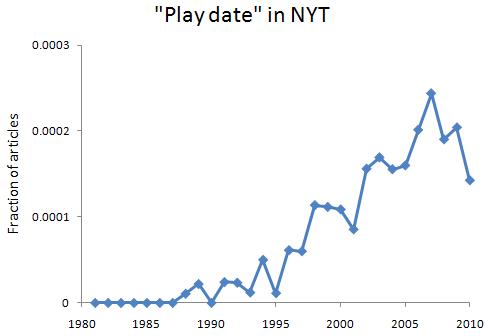
The first time it appears in the newspaper of record is 1988 and takes off after that. More or less the same pattern shows up in the Ngram data.
When I first started cataloging the trends related to the crime rate about a year ago, I noted that most of the ones involving a retreat from public spaces happened before the crime rate peaked in 1992 -- more like the late '80s. For example, video game arcade revenues peaked in 1988 and went into steady decline afterward; park attendance steadily fell after the late '80s; how much people trust others (as reported by General Social Survey respondents) peaked then as well. So here's another example -- parents started removing their kids from an unsupervised world several years before the crime rate peaked.
In large part, it is this retreat from the public sphere, and locking yourself and your family indoors, that causes the crime rate to plummet. After all, if you're not out and about, then impulsive, opportunistic criminals cannot target you or your property like cars, cash, shoes, etc. They would have to plan it all out in detail far ahead of time and travel who knows how far to get you, and that's antithetical to an impulsive mugger or rapist. And with everyone locked indoors, there are far fewer people who can step on each others' toes at a bar (or wherever) and gradually escalate it into a brawl or murder.
As someone who was part of the last generation to grow up without micro-managing parents, I find the concept of a play date not only silly but bewildering. I get that parents are paranoid and want to keep their kids out of public spaces, but it's worse than them merely limiting the amount of time that kids can spend unsupervised -- even when they are allowed to go over to a friend's house, it has to be scheduled sometimes weeks in advance and monitored all the while by grown-ups. When I was in elementary school, it was no more complicated than:
Hey Mom, I'm going over to Robbie's house.
OK, have fun!
Often my mom wasn't even home to be notified -- either at work or MBA night classes -- but I went out anyway, never leaving a note or anything silly like that. If she got home and didn't see me there, obviously I was at a friend's house, at the park or the pool, hanging out at the mini-mall, or something else not worth worrying about. I'd only call home if I got invited to stay for dinner, so she could take that into account when making dinner back home.
Browsing through some of those NYT articles, several things strike me as particularly depressing about kids' lives once the helicopter parents got going:
- Although some of the kids profiled are 2 or 3 years old, where play dates may make sense since they can't even speak fluently yet, a good fraction of them were 8, 9, 10, and even 11 years old and in sixth grade. When I was 10, me and my friends roamed the neighborhood streets with no supervision as part of our summer job -- yep, just out of fourth grade and already working for a living. I really wonder about these third and fourth graders who require play dates to see other people their age -- do their parents still wipe their asses for them too?
- On the whole, the Millennial kids are not pushing back against their helicopter parents. It would be sad enough if the parents were doing what they've been doing, but it's much worse to see kids just sitting there and taking it. They clearly share a good deal of the blame, buncha pussies. Not that parents were hyper-controlling during the '60s through the '80s, but do you know what we did when they went too far in restricting our freedom? -- we disobeyed them! And sure, maybe we sometimes went too far in disobeying them, but that boundary line of what's right and wrong can only be figured out by trial-and-error on both the kids' and parents' side. It's not something like the multiplication tables or the ABCs that can be neatly distilled and packaged for the kids to absorb -- they have to make their own decisions, some of which they may regret, in order to learn where the boundaries of acceptable behavior lie.
- Play dates make kids even more reliant on their parents as a means of transportation. If two kids want to hang out, they usually set up something loose like "after school" if they plan it during recess, or "in a little bit" if they plan it over the phone. Even if they set a precise target like 4:00, there's no real penalty to the one going out if he shows up late, and the host kid won't be put out. Hey, they're just kids; they don't believe in promptness. Their parents, however, do, and the one sending out her kid would be mortified if he showed up late -- she might as well be tardy herself. Wanting to avoid this embarrassment and resultant shunning at all costs, she insists that she chauffeur her kid over there, rather than allow him to get there by himself.
Whenever I wanted to go to a friend's house, all I did was hop on my bike and since everyone lived within a 10-minute ride, it was no sweat off my back. During the past 15 to 20 years, though, letting kids ride their bikes would only encourage their independence, so that had to go. Awhile ago I showed how bike riding had changed (during the late '80s / early '90s) from something that young people did to something that 20-something SWPL types and middle-aged endurance dorks took over.
- Childless yuppie couples have extended the play date idea to their own substitute children, namely their pets. (Dogs only; cats have too much dignity to be subjected to this manipulative crap.)
Just think about it -- at some point these bubble boys will be running the country, both the government and businesses, and then we're really fucked.
February 4, 2011
A candy bar diet when you're sick?
During the winter holidays (Thanksgiving, Christmas, and New Year's) I go off my paleo diet and eat grains (mostly in the form of pie crusts), starches (French fries), and sugars (any kind of sweet). That naturally puts me at a greater risk of getting sick, but it's a small price to pay in order to enjoy some junk food for a little bit during the year.
A couple weeks ago I ended up with bronchitis, which is typical when I get sick. I can't remember the last time I got a fever, nausea, etc. Since I was already knocked out healthwise, and since I had already blown my low-carb diet, I figured I might as well use this unique opportunity to do some self-experimentation and eat only or mostly candy bars in order to get better -- or at least not get any sicker.
Now that may sound like the stupidest idea you've ever heard, but it came from two basic facts about the link between diet and health:
1) When you get infected, the pathogens go straight for iron as their food source. One of your bodies natural defenses when you get infected is to squirrel away the iron, giving you somewhat anemic symptoms. (Many first-world do-gooders who try to spread public health in the third world see these symptoms, freak out about anemia, load them up with iron, and see them drop dead a few days later, after the pathogens just got a gigantic free meal.)
So cutting down on your consumption of iron is good. Unfortunately that eliminates a lot of animal foods that form the bulk of a paleo diet, especially liver. Sure, it would have been even healthier to try a low-iron food that wasn't also loaded with sugar, but the point remains that candy has little iron in it.
2) Infections are more numerous and last longer when you eat a lot of phytic acid, although sugar intake doesn't seem to be as strong of a factor. I am too lazy to look up the reference, but there was a dental study done decades ago (the 1920s if memory serves), where they varied the diet of subjects and checked for cavities, gum disease, etc. Those who had low sugar and low phytic acid (found in nuts, beans, and grains) did well, but so did those who only had their phytic acid cut but still were allowed some jelly and molasses. Phytic acid is a powerful antinutrient that blocks the absorption of vitamins and minerals. Sugar will screw up your metabolism, but by itself won't put you at greater risk of infection or prolonged infections in the short term.
So cutting out phytic acid is good. There are ways to trick it into leaving the nut, bean, or grain (like soaking oats or almonds for a day and letting them dry in just the right way), but nobody does that because it's too much of a hassle. Not consuming them at all is best.
By eating candy bars, I got a wheelbarrow full of sugar that would probably mess up my metabolism for a little while, but I chose candy that had little or no phytic acid in it -- ones that didn't grains like wheat or rice (there goes 100 Grand or Nestle Crunch), no nuts (there goes Almond Joy), and no pulses (there goes Payday). I did eat some that had tiny bits of almond, like Hershey nuggets with toffee and almonds, or that had "peanut butter" like Reese's Peanut Butter Cups. The main ingredient of this peanut butter is sugar, and there are hardly any peanuts in it. I did have some Baby Ruths once in awhile, and those do have whole peanuts, but I stopped that soon.
I easily ate over 100 grams of carbs -- sugars -- a day for the better part of a week to 10 days, sometimes upwards of 200 or even close to the recommended target of 300 g a day. It sure did fuck up my metabolism, as I put on a couple pounds and had both a slight headache after eating and a heavier one on waking up. I was in sugar crash mode, unlike during ketosis when you're burning only fat, so it was harder to keep going all day long without having a snack. If I had kept this up, I would certainly get the symptoms of Metabolic Syndrome, except for obesity (I cannot put on much extra fat) -- diabetes, heart disease, etc. But it wasn't long enough to really mess that stuff up.
But as far as dealing with the infection went, I did just fine. It didn't get worse (I remember from college when it got much worse), and when I went on the candy bar diet I got a bit better. It wasn't just coincidence, like I started this crazy diet once I was already getting better, as I varied it up just to make sure. A couple times I tried out a traditional Atkins kind of meal or two, and it got worse the next day, again probably because of the iron I had donated to the pathogens.
I should also mention that I drank almost only coconut milk (the watered down kind you get in cartons, not the solid stuff in cans) or cultured coconut milk (the former plus some live cultures to make it a bit thicker and like kefir). First, it makes chocolate bars taste so much better to have some kind of rich drink to go with it, and coconut milk is almost entirely made of saturated fat. It also has antiviral properties, owing to the big dose of lauric acid in coconuts, which you can't really get anywhere else at that concentration (there's some in dairy, and nothing in anything else). So I'm sure I got a big help from that too, not just the low-iron and low-phytic acid candy bars.
It probably also helped that I only ate candy that had loads of fat and especially saturated fat, not just empty sugar. Chocolate bars are one of the few places you can still get coconut oil from, which again has the antiviral lauric acid. Everything I ate was mostly milk chocolate, with a few other things mixed in (any nuts were barely there), and never something like jelly beans, Twizzlers, gummy worms, lollipops, etc. Just what all did the diet include?
Regular items:
- Reese's Peanut Butter Cups
- Hershey nuggets, milk chocolate with toffee and almonds
- Cadbury milk chocolate bar with raisins and almonds
- Toblerone milk chocolate bar
Here and there stuff:
- Oh Henry! bar (a couple days)
- Baby Ruth bars (for a day or two)
- Lindt stracciatella truffles (one day)
- Cadbury milk chocolate bar with Irish creme (one day)
- Hershey bar with almonds, and Heath bar (one day, as a substitute for the Hershey nuggets)
For old times' sake I was about to try out Butterfinger, 5th Avenue, Mr. Goodbar, and Watchamacallit. But as I mentioned a few days ago, in 2008 these brands all got stripped of milk chocolate and had a bunch of inflammatory polyunsaturated junk oils (all from vegetable sources, like soybean oil) in place of cocoa butter. I trust that shows up in the standard-of-living indexes -- real chocolate to fake chocolate, and at a higher price adjusted for inflation than in the early-mid 1990s when I last remember buying candy bars.
This was not an ideal diet -- as I mentioned, I was in sugar crash mode and got some headaches -- but when you're sick it's a hell of a lot better than the typical agricultural diet loaded with grains, nuts, beans, etc. My vegetarian (really about 90% vegan) housemate got sick at least a week before me and is still sick, while I've been pretty good for the past 5 to 7 days. With that diet, you get not only the screwed up metabolism that I got from my candy bars, but a much more vicious infection from all that phytic acid in the grains, nuts, seeds, and beans. This was mostly just to play around with my diet and see how bad things would be, since I won't get the chance to in a long while, as I rarely get sick.
And hey, someone's got to gorge on candy bars in the name of scientific research. I defy the stupidity of expert nutritional advice when I follow a hunter-gatherer sort of diet, so I might as well be the one to try going against their advice in a different direction.
I'm back on my paleo diet, though it was a tough transition -- once you eat boatloads of carbs, as most people do, it's tough to quit cold turkey unless you have really appetizing alternatives. Luckily I didn't have much time to make dinner tonight, so I just dropped by and ate in the nearby Burger King -- four bacon Buck Doubles with no bun and no ketchup, and some water to drink. Nothing like a pound of beef, four full strips of bacon, four slices of cheese, and some pickles to cure you of your sweet tooth. A couple hours ago I had some salmon salad (red salmon with bones and skin, mashed up with olive oil), a few slices of pepperoni, and some cherry peppers. Now I've got the biggest hankerin' for some Brazilian barbecue, not for more Peanut Butter Cups, delicious as they are.
A couple weeks ago I ended up with bronchitis, which is typical when I get sick. I can't remember the last time I got a fever, nausea, etc. Since I was already knocked out healthwise, and since I had already blown my low-carb diet, I figured I might as well use this unique opportunity to do some self-experimentation and eat only or mostly candy bars in order to get better -- or at least not get any sicker.
Now that may sound like the stupidest idea you've ever heard, but it came from two basic facts about the link between diet and health:
1) When you get infected, the pathogens go straight for iron as their food source. One of your bodies natural defenses when you get infected is to squirrel away the iron, giving you somewhat anemic symptoms. (Many first-world do-gooders who try to spread public health in the third world see these symptoms, freak out about anemia, load them up with iron, and see them drop dead a few days later, after the pathogens just got a gigantic free meal.)
So cutting down on your consumption of iron is good. Unfortunately that eliminates a lot of animal foods that form the bulk of a paleo diet, especially liver. Sure, it would have been even healthier to try a low-iron food that wasn't also loaded with sugar, but the point remains that candy has little iron in it.
2) Infections are more numerous and last longer when you eat a lot of phytic acid, although sugar intake doesn't seem to be as strong of a factor. I am too lazy to look up the reference, but there was a dental study done decades ago (the 1920s if memory serves), where they varied the diet of subjects and checked for cavities, gum disease, etc. Those who had low sugar and low phytic acid (found in nuts, beans, and grains) did well, but so did those who only had their phytic acid cut but still were allowed some jelly and molasses. Phytic acid is a powerful antinutrient that blocks the absorption of vitamins and minerals. Sugar will screw up your metabolism, but by itself won't put you at greater risk of infection or prolonged infections in the short term.
So cutting out phytic acid is good. There are ways to trick it into leaving the nut, bean, or grain (like soaking oats or almonds for a day and letting them dry in just the right way), but nobody does that because it's too much of a hassle. Not consuming them at all is best.
By eating candy bars, I got a wheelbarrow full of sugar that would probably mess up my metabolism for a little while, but I chose candy that had little or no phytic acid in it -- ones that didn't grains like wheat or rice (there goes 100 Grand or Nestle Crunch), no nuts (there goes Almond Joy), and no pulses (there goes Payday). I did eat some that had tiny bits of almond, like Hershey nuggets with toffee and almonds, or that had "peanut butter" like Reese's Peanut Butter Cups. The main ingredient of this peanut butter is sugar, and there are hardly any peanuts in it. I did have some Baby Ruths once in awhile, and those do have whole peanuts, but I stopped that soon.
I easily ate over 100 grams of carbs -- sugars -- a day for the better part of a week to 10 days, sometimes upwards of 200 or even close to the recommended target of 300 g a day. It sure did fuck up my metabolism, as I put on a couple pounds and had both a slight headache after eating and a heavier one on waking up. I was in sugar crash mode, unlike during ketosis when you're burning only fat, so it was harder to keep going all day long without having a snack. If I had kept this up, I would certainly get the symptoms of Metabolic Syndrome, except for obesity (I cannot put on much extra fat) -- diabetes, heart disease, etc. But it wasn't long enough to really mess that stuff up.
But as far as dealing with the infection went, I did just fine. It didn't get worse (I remember from college when it got much worse), and when I went on the candy bar diet I got a bit better. It wasn't just coincidence, like I started this crazy diet once I was already getting better, as I varied it up just to make sure. A couple times I tried out a traditional Atkins kind of meal or two, and it got worse the next day, again probably because of the iron I had donated to the pathogens.
I should also mention that I drank almost only coconut milk (the watered down kind you get in cartons, not the solid stuff in cans) or cultured coconut milk (the former plus some live cultures to make it a bit thicker and like kefir). First, it makes chocolate bars taste so much better to have some kind of rich drink to go with it, and coconut milk is almost entirely made of saturated fat. It also has antiviral properties, owing to the big dose of lauric acid in coconuts, which you can't really get anywhere else at that concentration (there's some in dairy, and nothing in anything else). So I'm sure I got a big help from that too, not just the low-iron and low-phytic acid candy bars.
It probably also helped that I only ate candy that had loads of fat and especially saturated fat, not just empty sugar. Chocolate bars are one of the few places you can still get coconut oil from, which again has the antiviral lauric acid. Everything I ate was mostly milk chocolate, with a few other things mixed in (any nuts were barely there), and never something like jelly beans, Twizzlers, gummy worms, lollipops, etc. Just what all did the diet include?
Regular items:
- Reese's Peanut Butter Cups
- Hershey nuggets, milk chocolate with toffee and almonds
- Cadbury milk chocolate bar with raisins and almonds
- Toblerone milk chocolate bar
Here and there stuff:
- Oh Henry! bar (a couple days)
- Baby Ruth bars (for a day or two)
- Lindt stracciatella truffles (one day)
- Cadbury milk chocolate bar with Irish creme (one day)
- Hershey bar with almonds, and Heath bar (one day, as a substitute for the Hershey nuggets)
For old times' sake I was about to try out Butterfinger, 5th Avenue, Mr. Goodbar, and Watchamacallit. But as I mentioned a few days ago, in 2008 these brands all got stripped of milk chocolate and had a bunch of inflammatory polyunsaturated junk oils (all from vegetable sources, like soybean oil) in place of cocoa butter. I trust that shows up in the standard-of-living indexes -- real chocolate to fake chocolate, and at a higher price adjusted for inflation than in the early-mid 1990s when I last remember buying candy bars.
This was not an ideal diet -- as I mentioned, I was in sugar crash mode and got some headaches -- but when you're sick it's a hell of a lot better than the typical agricultural diet loaded with grains, nuts, beans, etc. My vegetarian (really about 90% vegan) housemate got sick at least a week before me and is still sick, while I've been pretty good for the past 5 to 7 days. With that diet, you get not only the screwed up metabolism that I got from my candy bars, but a much more vicious infection from all that phytic acid in the grains, nuts, seeds, and beans. This was mostly just to play around with my diet and see how bad things would be, since I won't get the chance to in a long while, as I rarely get sick.
And hey, someone's got to gorge on candy bars in the name of scientific research. I defy the stupidity of expert nutritional advice when I follow a hunter-gatherer sort of diet, so I might as well be the one to try going against their advice in a different direction.
I'm back on my paleo diet, though it was a tough transition -- once you eat boatloads of carbs, as most people do, it's tough to quit cold turkey unless you have really appetizing alternatives. Luckily I didn't have much time to make dinner tonight, so I just dropped by and ate in the nearby Burger King -- four bacon Buck Doubles with no bun and no ketchup, and some water to drink. Nothing like a pound of beef, four full strips of bacon, four slices of cheese, and some pickles to cure you of your sweet tooth. A couple hours ago I had some salmon salad (red salmon with bones and skin, mashed up with olive oil), a few slices of pepperoni, and some cherry peppers. Now I've got the biggest hankerin' for some Brazilian barbecue, not for more Peanut Butter Cups, delicious as they are.
February 1, 2011
Grown folks music
Detractors of the most recent wild phase of the culture, roughly from the late 1950s through the early 1990s, claim that society had become hopelessly juvenile, going so far as to swallow the pablum about young people having a keener moral compass. Yet whether it's Stuff White People Like or conservative talk radio, it's clear that it's the culture of the past 15 to 20 years that is truly infantile.
As the violence level began falling after its 1992 peak, people perceived a much more secure society and therefore longer and safer lives. That's not without its downsides, though, like switching from tragic mode (adaptive during rising-crime times) to trivial mode (adaptive during falling-crime times). When life is short, your safety unpredictable, and the overall order of the universe unstable and crumbling more every year, several key changes happen to get you through it:
- You try to grow up sooner rather than later, since tomorrow may be too late.
- You band together more easily with others, since you can't take on such a growing threat on your own.
- More importantly as it concerns the feel of social relations, you don't hold as much of a grudge and you aren't as petty. People measure grudges as a fraction of their lifetimes, not on an absolute scale, so when life appears shorter, you hold a grudge for a shorter length of time. Plus there's the looming threat that you have to attend to that gives you an extra incentive to reconcile your differences and get back to protecting yourselves and kicking the bad guys' asses.
In short, during times of soaring violence levels people become more mature, while during falling-crime times they revert to a life of neverending temper tantrums.
That's all by way of introducing what I meant to talk about first -- the disappearance of music for grown-ups since the early-mid 1990s. This happened as well in movies, TV shows, kids books, etc., but I'm just going over music now.
Again how many times do we have to hear some lazy and ignorant critic (whether paid or volunteer) slam the popular music of the late '50s through the early '90s as childish, bratty, bla bla bla? Before reminding ourselves of what music from that time really sounded like, why don't we first take a look at how inspiringly mature pop music has been since the mid-'90s? When rock music died and was replaced by alternative, emo, and indie, all we got was whining about how much it hurts to not get enough attention from the other kids at school, or a bunch of screaming rejects making a caricature of teen angst, or singer-songwriter cutesiness that sounds like the dude hasn't even gone through puberty yet (like John Mayer or Pete Yorn).
As for egocentric and materialistic music, this has been the era of bling-bling, rainin' dolla billz on dem hoez, she's got me spendin', don'tcha wish your girlfriend was hot like me, etc. The whiny angsty music from white musicians is just another, more passive-aggressive form of brattiness.
The so-called childishness of music from wild times was directed more at the wider youth rebellion and questioning, then abandoning, of values that the adults of the time had tried to sell young people. But as I pointed out before, those values served an adaptive purpose only during the falling-crime times of the mid-1930s through most of the 1950s when these adults adopted them. When the level of violence began soaring out of control by 1959, young people were living in a totally different world, and those values were no longer useful. Just try them out and see how well they work.
Young people gave the older values the benefit of the doubt for awhile, until about halfway through the crime wave, and by the mid-1970s it was clear from personal experience and reporting from the rest of the country that what the advice-givers had preached was out-of-date. Probably the clearest example of that was the Vietnam War, which the grown-ups said would be won the way we won World War II -- not to worry. Other galvanizing examples involve the faith in bureaucracy and experts in social engineering broadly that carried the day from the New Deal and Eisenhower eras, but that people saw falsified before their very eyes with the Great Society programs and price controls as a response to the 1973 oil crisis.
So, the "don't trust anyone over 30" attitude, and the broader overturning of New Deal - Eisenhower sacred cows were perfectly understandable. (And of course now that crime has been falling for nearly 20 years, the return to those older values is just as understandable.)
And now for a corrective of the clueless claims of childishness in pop music from wild times. Anything sappy or wide-eyed in that gee-golly-gosh way is out. So is bratty and preachy stuff, as well as anything that tries to depict the real world in overly black-and-white terms. To be included, there must be some sign that the creator and audience have experienced enough of the real world to know better -- remorse over lost love, reluctance to fall for someone and get hurt again, compromising (however unwillingly) rather than throwing a fit, helping out those who are counting on you, and in general the ambiguity of real life and the need to figure it out case-by-case and on-the-fly. The tempo is slower and the instrumentation more stripped-away, making it feel more honest.
These are all just off the top of my head, though I've tried to make sure they were chart hits, or at least on albums that charted well, to ensure that they represent what resonated with a large chunk of people back then. They're more from the mid-'70s through late '80s both because the shift toward maturity was strongest then and because I know the material better (and so is also more rock oriented). I stopped at the round number of 10. Feel free to add others in the comments.
"In Too Deep" by Genesis
"Man in the Mirror" by Michael Jackson
"Making Believe" by Emmylou Harris
"Wrapped Around Your Finger" by The Police
"Song to the Siren" by This Mortal Coil
"With or Without You" by U2
"Avalon" by Roxy Music
"Total Eclipse of the Heart" by Bonnie Tyler
"Little Red Corvette" by Prince
"Reptile" by The Church
As the violence level began falling after its 1992 peak, people perceived a much more secure society and therefore longer and safer lives. That's not without its downsides, though, like switching from tragic mode (adaptive during rising-crime times) to trivial mode (adaptive during falling-crime times). When life is short, your safety unpredictable, and the overall order of the universe unstable and crumbling more every year, several key changes happen to get you through it:
- You try to grow up sooner rather than later, since tomorrow may be too late.
- You band together more easily with others, since you can't take on such a growing threat on your own.
- More importantly as it concerns the feel of social relations, you don't hold as much of a grudge and you aren't as petty. People measure grudges as a fraction of their lifetimes, not on an absolute scale, so when life appears shorter, you hold a grudge for a shorter length of time. Plus there's the looming threat that you have to attend to that gives you an extra incentive to reconcile your differences and get back to protecting yourselves and kicking the bad guys' asses.
In short, during times of soaring violence levels people become more mature, while during falling-crime times they revert to a life of neverending temper tantrums.
That's all by way of introducing what I meant to talk about first -- the disappearance of music for grown-ups since the early-mid 1990s. This happened as well in movies, TV shows, kids books, etc., but I'm just going over music now.
Again how many times do we have to hear some lazy and ignorant critic (whether paid or volunteer) slam the popular music of the late '50s through the early '90s as childish, bratty, bla bla bla? Before reminding ourselves of what music from that time really sounded like, why don't we first take a look at how inspiringly mature pop music has been since the mid-'90s? When rock music died and was replaced by alternative, emo, and indie, all we got was whining about how much it hurts to not get enough attention from the other kids at school, or a bunch of screaming rejects making a caricature of teen angst, or singer-songwriter cutesiness that sounds like the dude hasn't even gone through puberty yet (like John Mayer or Pete Yorn).
As for egocentric and materialistic music, this has been the era of bling-bling, rainin' dolla billz on dem hoez, she's got me spendin', don'tcha wish your girlfriend was hot like me, etc. The whiny angsty music from white musicians is just another, more passive-aggressive form of brattiness.
The so-called childishness of music from wild times was directed more at the wider youth rebellion and questioning, then abandoning, of values that the adults of the time had tried to sell young people. But as I pointed out before, those values served an adaptive purpose only during the falling-crime times of the mid-1930s through most of the 1950s when these adults adopted them. When the level of violence began soaring out of control by 1959, young people were living in a totally different world, and those values were no longer useful. Just try them out and see how well they work.
Young people gave the older values the benefit of the doubt for awhile, until about halfway through the crime wave, and by the mid-1970s it was clear from personal experience and reporting from the rest of the country that what the advice-givers had preached was out-of-date. Probably the clearest example of that was the Vietnam War, which the grown-ups said would be won the way we won World War II -- not to worry. Other galvanizing examples involve the faith in bureaucracy and experts in social engineering broadly that carried the day from the New Deal and Eisenhower eras, but that people saw falsified before their very eyes with the Great Society programs and price controls as a response to the 1973 oil crisis.
So, the "don't trust anyone over 30" attitude, and the broader overturning of New Deal - Eisenhower sacred cows were perfectly understandable. (And of course now that crime has been falling for nearly 20 years, the return to those older values is just as understandable.)
And now for a corrective of the clueless claims of childishness in pop music from wild times. Anything sappy or wide-eyed in that gee-golly-gosh way is out. So is bratty and preachy stuff, as well as anything that tries to depict the real world in overly black-and-white terms. To be included, there must be some sign that the creator and audience have experienced enough of the real world to know better -- remorse over lost love, reluctance to fall for someone and get hurt again, compromising (however unwillingly) rather than throwing a fit, helping out those who are counting on you, and in general the ambiguity of real life and the need to figure it out case-by-case and on-the-fly. The tempo is slower and the instrumentation more stripped-away, making it feel more honest.
These are all just off the top of my head, though I've tried to make sure they were chart hits, or at least on albums that charted well, to ensure that they represent what resonated with a large chunk of people back then. They're more from the mid-'70s through late '80s both because the shift toward maturity was strongest then and because I know the material better (and so is also more rock oriented). I stopped at the round number of 10. Feel free to add others in the comments.
"In Too Deep" by Genesis
"Man in the Mirror" by Michael Jackson
"Making Believe" by Emmylou Harris
"Wrapped Around Your Finger" by The Police
"Song to the Siren" by This Mortal Coil
"With or Without You" by U2
"Avalon" by Roxy Music
"Total Eclipse of the Heart" by Bonnie Tyler
"Little Red Corvette" by Prince
"Reptile" by The Church
Subscribe to:
Posts (Atom)