Showing posts with label Television. Show all posts

July 28, 2025

Japanese steppe culture: Ruling clans with the piebald horse as totem animal, and ritual horse sacrifice

Following the previous post, we'll look at another sort of "creation" myth from Japan -- the origin myth of ritual impurity, and therefore, of ritual purification measures to counter-act it (the basis of Shinto practices). This myth provides 2 links to horse culture from the Eastern Steppe. It's from the Nihon Shoki, though not the Kojiki, from the earliest writings in Japanese (early 8th C AD).

The god responsible for introducing ritual impurity into the world is Susanoo, the impetuous storm god. The target of his ire in this story is his sister, the sun goddess Amaterasu. He takes the Heavenly Piebald Colt (Ame no Fuchikoma), and flays it alive -- starting with its back end, and working toward the head. The text uses a specific term to emphasize that this is a "backwards flaying" ("sakahagi"), not a standard flaying that starts at the head and works its way toward the tail.

This is a form of ritual impurity, since he has not killed the colt first (e.g., by slitting its throat), and since he's removing the skin in backwards order.

He then hurls the colt in through a hole in the roof of Amaterasu's weaving hall, where one of her maidens is so startled by the desecration that she runs into the spinning shuttle at her loom, which hits her in the genitals, causing her to begin bleeding from there. This is the origin of menstrual bleeding, another form of ritual impurity. Amaterasu then goes into hiding in the Heavenly Rock-Cave Door (Ame no Iwayato), in a form of menstrual seclusion. Susanoo also defecates in her palace, another form of ritual impurity.

This story reveals that the myth-makers of Japan were intimately familiar with horse sacrifices -- how they were supposed to be performed, and therefore, which actions would constitute desecration, defilement, and impurity.

I don't know about every culture that practiced horse sacrifice, but the Cheremis people (AKA Mari) began flaying the horse from the head, then ending at the tail. Of course its throat was slit first, not flayed alive. And it was a colt, not an adult horse (the Japanese term "koma" means specifically "colt," combining the words for "child" and "horse").

The whole ordeal is described in grisly detail in the Finno-Ugric portion of The Mythology of All Races, which I referred to in the previous post. Incidentally, from my reading of their myth and ritual, the Cheremis seem to be mostly Indo-European culturally, despite speaking a Uralic language -- much like the Hungarians, Estonians, and Finns. They live along the Volga River in Russia, a little ways north of the Steppe.

How would the creators of the Nihon Shoki know so much about horse sacrifice, and why would they want to use that as such a crucial example of Susanoo's causing ritual impurity? He also destroys Amaterasu's rice fields, but it's not described in cruel gut-wrenching detail like flaying a horse backwards while still alive. They really wanted to emphasize the importance of horses, and of horse sacrifices, in their culture.

A mainly agrarian culture would not care so much about defiling the horse sacrifice ritual -- and probably would not even refer to such a ritual, since there was never any such thing in their culture. It occupies center stage in the Japanese narrative because they hailed from a nomadic horse-centric culture before arriving in Korea and Japan -- which in that part of the world, means the Eastern Steppe.

Its similarity to the Cheremis horse sacrifice ritual suggests a common ritual all across the Steppe, whether the practitioners were Indo-European, Uralic, Altaic, or otherwise.

* * *


However, the Japanese myth's emphasis on the piebald / skewbald / spotted / etc. color pattern of the horse, narrows down which range of the Steppe they originated from.

First, tribes or clans or chiefdoms being associated with particular color patterns of their horses is mainly an Eastern Steppe phenomenon, from the Turkic tribes all the way to Glorious Nippon. It makes their favored breed of horse into a totem animal for the social unit.

Amaterasu is not just any ol' goddess in the foundational texts of Japanese culture -- she is the deity through whom the Japanese imperial family traces their bloodline. So this means that the piebald horse is a totem animal for the ruling clan of Japan.

Where else is the piebald horse the totem animal for a ruling clan? Why, where else, and when else? -- in the Xiongnu confederation during the late 1st millennium BC, and several of its off-shoots after its break-up.

And not just any ol' clan within the Xiongnu, but their ruling clan, the Luandi, whose name likely derives from "piebald horse".

Then there was the Alat tribe, whose name also likely means "piebald horse", a Turkic tribe who also belonged to the Xiongnu, and were either related to the Luandi, or identical to them, or perhaps they coincidentally shared the same totem animal due to there only being so many color patterns to choose from, and due to every clan preferring a horse rather than some other species for their totem animal.

The same situation must have been true for the ruling tribe or clan among the Yayoi-like people who arrived in southern Korea and then Japan. Their totem animal was also the piebald horse, whether their clan was related to the Luandi or Alat by lineage, or just sharing a totem animal by happenstance. In either case, it places the continental component of the future Japanese culture among the Xiongnu confederation during the 1st millennium BC -- not Southeast Asia, not the far Arctic north, not during the 1st millennium AD, etc.

As with the horse sacrifice portion of the myth, specifying the color pattern of the heavenly horse reveals that the myth-makers of Japan were intimately familiar with Eastern Steppe practices for choosing a totem animal, like including its color pattern instead of a broadly defined breed or species name alone.

I don't think the Alat tribe being Turkic means that the ruling clan of the Yayoi-like people were Turkic. They could have been Mongolic or Tungusic. Making the horse your totem animal, and emphasizing its color pattern, was common among all of those Altaic speech communities.

And perhaps the Yayoi-like population was not ethnically homogeneous -- there could have been Turkic, Mongolic, Tungusic, Uralic, or other groups among them. All sorts of people mixed with each other on the Eastern Steppe. Perhaps they only homogenized when they landed in Japan and were defined by a new ethnic opposition, between the various continental arrivals and the native Emishi / Ainu.

* * *


Over the past 10 years in Japan, there has been an insanely popular media franchise called Uma Musume ("Horse Girl") Pretty Derby, mostly based on an anime series and related video games, which revolve around a group of horse-human girls training to compete in horse-girl races. Yes, like in a traditional horse-racing track. They look mostly human, with horse ears, and as a side project devote themselves to singing and dancing on stage as idols.

This is yet another case of the horse-centric origins of Japanese culture re-asserting themselves in the modern age, after having lied dormant or secondary for many centuries.

But by now, horse racing is a very popular sport in Japan, and has been for decades. It's so popular that Lui, a vtuber from Hololive, hosts regular watching parties / informal betting streams as the major Japanese horse races are being broadcast. She can't re-broadcast the sound and image of the race on her own stream, due to copyright, but even just as a watching party, she gets close to 10K live viewers, judging from the one she held a few days ago (pretty good numbers for livestreams).

And as the very beginnings of Japanese literature show, their fascination with horses is neither new nor imported from the West. And far from viewing them as only a neat form of entertainment, they hold them to be one of the most sacred animals in creation, a testament to their origins in the Eastern Steppe, and the OG badass nomadic steppe empire in particular, the Xiongnu.

March 5, 2025

Treehouses, and friends entering your 2nd-story room through the window, as tropes from the rising-harmony phase of the 50-year civil stability cycle

While preparing a post on friends vs. frenemies during the rising-harmony vs. rising-strife phases of Turchin's 50-year cycle in civic cohesion vs. breakdown, I came across one of the fondest memories that late Gen X-ers have of the peak of social harmony circa the mid-'90s -- friends entering each other's rooms through the bedroom window, rather than going through the usual doors on the ground floor.

To clarify, this rarely happened in real life and is mainly a trope from pop culture. And yet, even as a pop culture trope, it didn't exist long before the '90s, and ceased afterwards. Pop culture is dynamic, not static, and it reflects the broader zeitgeist -- not only within the cultural domains, but in the IRL social domains like families, friends, communities, and so on.

In order to pay proper homage to this cultural phenomenon, and to understand it properly, and to trace its origins or spiritual ancestors, I'm putting together this standalone post instead of relegating it to the comment thread.

First, as a summary for those who remember or as a whirlwind tour for those poor unfortunate souls who weren't part of that world, here is a compilation video of the trope from Slate's YouTube channel. It's not meant to be exhaustive, and I will add more examples below and in the comments as I come across them.

We have to clearly delineate what the trope is -- it's not the very broad definition from TV Tropes or IMDB, where it's merely entering the home through a window. That covers criminals breaking & entering, or spies and snoops, frenemies trying to sabotage each other, etc.

But more importantly, this *does not* cover an existing romantic couple, or between two people where there's already romantic tension or sexual intent -- that trope is already fairly well established. For example, Romeo observing Juliet on her balcony, serenades in the same spatial position, princes scaling the walls of a tower to reach the princess' window a la Rapunzel, and many other fairly old and pre-American examples.

The distinctly all-American 20th-century trope covers friends, acquaintances, peers, and similar relationships. They might escalate into romantic relationships, or they might not, that's not crucial. And since it's about friendship and camaraderie, it is not restricted to an opposite-sex pair -- it could be two guy friends, or two girl friends, or a mixed-sex pair.

A few further examples:

Here is a short compilation just from Clarissa Explains It All (1991-'94), to emphasize how frequently this trope appeared in that show -- just about every episode, often multiple times per episode. Whenever Sam meets up with Clarissa at her home, there's a thud of the ladder against the window, Clarissa says "Hi Sam," a leitmotif guitar chord strums, and he enters.

Here is an example from a '95 episode of Boy Meets World, where friends Cory and Topanga start to declare their romantic feelings for each other. At other times in the show, guy friends Cory and Shawn enter through the window. It's not just for mixed-sex or potentially romantic partners.

Here is an example from a '94 episode of Married with Children, where Bud is paid a visit by an acquaintance, the niece of his next-door neighbor, and things escalate from there. (In the same clip, one of Kelly's bf du jour guys accidentally climbs up the same ladder, thinking it's her room, before being told it's the next window over.)

Here is a pic from Doogie Howser (unknown year, but '89 or the early '90s) showing Doogie's best friend Vinnie entering through the window. Another guy friend example.

Unfortunately, the show that probably started, but at the very least was the first popularizer of this trope -- Saved by the Bell -- doesn't have any video clips or images of the many times that friends entered through the bedroom window. But it was common, for both same-sex friends like Zack and Screech, and mixed-sex friends like Zack and Jessie.

Doogie Howser is the other contender for first example, since it and Saved by the Bell both began airing in the fall of '89, a couple years ahead of Clarissa and Boy Meets World. I'd have to start watching my Saved by the Bell DVDs to see when the first instance was, but there's a 1st season clip of Screech being pushed out the open window by Zack in a panic. So I'm guessing the trope began in its 1st season. IDK about Doogie Howser, and won't watch episodes just to see.

In any case, Saved by the Bell was by far the more popular and influential of the two, not just among teen shows of the time, but their legacy ever since. So for the time being, I'm going to declare it the originator of this trope. Earlier examples of "entering through the window" from the '80s involved romantic couples, like A Nightmare on Elm Street and Heathers. Maybe those could be considered proto-examples.

Saved by the Bell, in fact, might be the originator of so-called postmodern TV comedy shows, with frequent and lengthy addresses to the audience (breaking the 4th wall), cut-away imagination sequences, cut-away homages / pastiches of classic and contempo pop culture, and other self-aware / meta-commentary techniques that would come to define comedy shows of the '90s and even the 21st century.

How long did the trope last? Not really beyond the '90s, except as a target for send-up and pastiche as in Kickass (2010), or as a callback to the original show during a sequel show (like Girl Meets World from the mid-2010s). The last major show to do it was Dawson's Creek from the late '90s -- the examples were frequent, involving various friends, not necessarily romantic in tone, and still participating in the trend itself, without being a self-aware reference or allusion. And that was a popular / influential teen show.

The most notable later example is not a TV show or movie at all, but the iconic music video for "You Belong with Me" by Taylor Swift from 2008. Admittedly, the two mixed-sex neighbors don't enter each other's rooms, but they do socially interact, emotionally connect, and play supportive roles in each other's lives, across the narrow gap between their homes. They start out not romantically involved, "just friends," although it does eventually escalate to romance, after the girl-next-door gets rid of her mean-girl rival (his current, then ex-gf).

I appreciate the honesty of this video for acknowledging that the peak of social harmony was over by the 2000s, so it would've been inauthentic to LARP as teens from 1993 and directly enter each other's rooms through the window. The interaction across the gap while still in their separate rooms conveys the same spirit, albeit at a lower intensity since friends, and the sexes, are no longer as close as they used to be back in the '90s. And it is still their personal rooms where they're connecting -- not their living rooms, kitchens, rec rooms, etc., so the intimacy and just-the-two-of-us-ness is preserved.

Cute. ^_^

Also worth noting that she takes the initiative in their relationship: she's the first to start communicating through notes between their windows, at the dance she tracks him down, and most importantly she is the first one to show him her note that says "I love you", and he only shows his note saying the same thing after she has already done so. Very '90s vibe -- the song could easily make a good soundtrack for a "Pete and Ellen" compilation video using scenes from The Adventures of Pete and Pete.

* * *


This is a very '90s trope, and it's no coincidence that appeared and spread around the peak of social harmony. How did it channel the harmonious social mood?

It's mainly about the directness of the friends' interactions -- they don't have to knock at the front door, then wait in the living room, then hang out for a snack in the kitchen, and then ultimately wind up in the privacy of the person's personal room. It's not as though those various checkpoints along the way always led toward a hanging-out session in the personal room -- they're all various places where the guest can be turned away.

Knocking on the front door? Maybe they'll be ignored by someone pretending not to be home, or they'll be greeted at the door, but not invited in -- "I'm kinda busy right now..." Or maybe defused by hanging out on the front porch / patio for a bit, and once the convo is over, time to head on back home, without even stepping foot inside.

Hanging out in the living room, perhaps while watching some TV? Well, that's a great big time-suck and energy-exhauster right there. You can while away hours vegging out on the living room couch in front of the TV. After getting your fill of that activity, it's time to head on back home, without going to the personal room.

Sitting down at the kitchen table for a little snack or maybe doing some homework together? Well, you can have a brief little chat there, and after the homework is done, and the meal is starting to fill your belly, might as well head on home, without going to the personal room.

Ditto for a trip to the basement rec room, gamer station, or dad's den / man cave. It diverts the social energy into an activity like playing games, and after you've spent an hour or so doing that, you're feeling a little exhausted, might as well head on home.

There's just something about hanging out in the personal room that you can't get from those other spaces -- especially those that don't even let you inside, like chatting on the front porch, shooting hoops in the driveway, and so on.

It's more intimate, more private, the door is closed and it's just the best buds in their own little world, whereas the rest of the household may show up in the other non-personal spaces in the home, like the living room, kitchen, or basement rec room. Hell, if it's an outside space, the general public might show up unannounced!

Nothing is cozier, socially and spatially defended against outside forces and surveillance, than hanging out in the personal room. There's not even a distinct and dedicated material thing there to define your activity, like the couch or TV in the living room, or the fridge and table in the kitchen, or the video game console or pool table in the rec room. It's just the person's bed -- which as friends you won't be sharing -- and their closet and clothing-related furniture, and various personal thingies strewn about.

And that's just it -- it lacks any other material purpose that could divert your attention away from just hanging out, having a convo, sharing secrets, giving advice, venting frustrations, coming up with plans, and in general opening up to and supporting each other. No distractions.

The material things that are present, heighten the sense of intimacy and personal closeness -- that's the bed the person sleeps in, that's the closet where their clothes are stored, that's their book collection they browse while bored-in-their-room-alone, and so on. The person is opening themselves up just by letting you be around these personal things, more so than by merely inviting you inside their home while remaining in a non-private room with distractions that could divert the interaction away from interpersonal bonding.

So, by entering the personal room directly via the window to the outside, all these other non-private spaces are avoided, and none of the social energy is dissipated by the room-specific material focal objects. And there is virtually no chance of just being sent away, unlike at the other checkpoints -- the visitor is taking a literal physical risk of falling and injuring themselves or dying, by appearing at the second-story window -- you can't send such a vulnerable person away!

Oh, forgot to mention -- the window is always above the ground floor! That introduces the physical risk, and what makes it a costly and therefore honest signal, of the visitor's need to come in, preventing any chance of rejection. A visitor who isn't a close friend isn't going to take those physical risks, only to appear rude and presumptuous to the resident -- so the only person who ever makes these trips is a close and trusted friend.

Aside from saving all the social energy for the close bonding space, it also clears away any sense of the two friends playing petty and pointless games with each other, to assert dominance or put the other in their place, etc. The entrance to the personal room is direct, immediate, and unquestioned. No need to jump through any hoops (other than climbing up there, of course), pass inspections, receive permission slips, or other manner of checking off boxes on an application form, as though you were being hired for a job rather than invited to hang out by a friend.

I deny the claim that it's related to doing an end-run around parental supervision -- often enough, the parents aren't even home at the time, nor are any other siblings or household members. But if you're just watching TV in the living room, supposedly all alone, those parents or siblings could show up at any moment and spoil the intimacy, given how close the living room is to the doors, and given its expectation as a non-private space, so whoever shows up won't think anything about going right to the living room where you're already hanging out on the couch. Ditto for doing homework or having a snack at the kitchen table.

If you entered an otherwise empty home through those rooms, your privacy could be interrupted before you get to the personal room. By heading straight to the personal room, you're not bypassing an existing third party in the home -- you're removing even the potential future interruption, by not slow-rolling your presence through various non-private rooms in the home, even when no one else is home for the time being.

In these various ways, it's intensifying or elevating the guest-host relationship, where guests are never turned away, but hosts are never put upon or betrayed by those guests. But it's a small number involved -- just those two, not multiple guests coming over for dinner or having a place to sleep. It's the two friends, with the rest of the world kept outside (even if they're inside the same home -- outside of the personal room, at any rate).

It's camaraderie, but also intimacy, not the bonds among a large team of people (which may be shown in other ways in the TV show).

The roles are complimentary rather than identical -- a guest, and a host. And although seemingly setting up a dominance hierarchy with a requester at the mercy of the space-controller, the unquestioned and unconditional access levels this potential hierarchy, and emphasizes the egalitarian nature of social relations when harmony rather than strife and competition is the norm. Roles are complimentary, but egalitarian.

* * *


So far, so good -- but remember, there's a cycle at work here. It's not enough to show how the social mood and pop culture were related during the most recent peak of social harmony -- ideally, we'd observe a similar match from the peak before that one (roughly the second half of the '20s through the mid-'40s). And even more ideally, a similar decline in the trope during the previous rising-strife phase (roughly the late '40s through the early '70s, tied together by the strands of second-wave feminism, African-American civil rights, and students vs. the school authorities).

Well, there's no 100% match to the Radio Days environment -- no pop culture trope of friends entering each other's personal rooms through the window. But there was a closely related one, so closely related, in fact, that the '90s trope incorporated a key element of it that was not needed for the purposes of "friends entering a 2nd-story window" -- but *was* necessary to signal its spiritual origins in the earlier trope born in the '30s and '40s.

I tried to think of what other scenarios and architectural forms the "friends entering through the window" trope resembled, so I could check their origins and cyclic popularity. At first I was misled by the "scaling the castle / tower walls" scenario -- again, that's mainly in the context of a princess and her suitor, not friends. And it also relies on the external walls being a defensive obstruction, and bypassing parental supervision, and the personal room being a prison cell rather than a sanctuary, and so on.

Then it hit me -- the rooms from the '90s were like treehouses! Then it all fell into place. But before analyzing the similarities, let's note one similarity that is not necessary structurally, and only serves as a reference to the earlier example.

Quite often, including the most iconic examples like Clarissa Explains It All and Saved by the Bell, outside the window is a huge tree, visible through the window, lying no more than 10 feet away. In the '90s trope, the tree is not typically used as the means of ascending the walls -- usually it's a ladder, as in Clarissa. Why is this huge tree trunk and large branches and abundant foliage taking up most of the view through the window to the outside?

They could have left the space blank -- blue skies, sunsets, warm sunlight, etc. could be pouring in. They could have put some remote natural landscape, like rolling hills and mountains, as is typical for California where these shows tend to be filmed. They could have made the view of the neighboring house (a la the Taylor Swift video).

Even if there was a tree in view, they don't have to make it so massive and place it so close to the window -- why, it's like the room practically sits within the tree itself. But that's just it! They're making the room look like a treehouse, and none of the other choices for "what's outside the window" would have given it a treehouse vibe.

The ladder that the visitor climbs up to the window is not a scheming mechanism used to counteract a defensive obstacle in warfare or imprisonment -- it's just this trope's version of an entry staircase that leads to a door on the ground floor, or an even grander exterior staircase that leads to a 2nd-story door. Or more to the point, like the ladder used to enter a treehouse -- and it usually was a ladder, not a climbing rope or a spiral staircase around the tree trunk or whatever else.

Climbing a ladder, 5 feet away from a massive tree trunk, to enter a residential sanctuary among close friends -- that's a treehouse. The only twist in the '90s version is that the treehouse is not attached to the outdoor tree, but belongs to the indoor section of the house. It's an internal treehouse, or a home within the home. After all, this room has its own entrance to the outside world, its own staircase of sorts connecting the ground to the entrance -- it's a smaller home, nested within a larger home.

The personal mini-home may not have a stove, sink, shower, TV set, laundry machines, and other things that are necessary to consider it a full home. Then again, neither does a treehouse. But this room is also a home of its own in its spatial and social relation to the outside world and to people who live outside the household.

Also, both a treehouse and the '90s teen room hit on the theme of social harmony in assuming a lack of paranoia by the dwellers, regarding the general public. Couldn't some random stranger, perhaps one with malicious motives, just plop the ladder against the wall, and barge through the unlocked / open window? There's no security guard or other checkpoint to ensure that this doesn't happen.

So the tropes are clearly saying that the dwellers do not expect such anti-social behavior to be common or even existent at all. Once the trope starts to fade from popularity, that is therefore a signal of the fraying trust among strangers or community members or neighbors. Suddenly, the mood becomes, "You never know who might climb that ladder into your window".

That is not connected to the crime rate, BTW, since the late '80s and early '90s were the peak of the homicide rate in America, right when this trope was born and spread like crazy. Also right around the origin of helicopter parenting. The previous trope, of treehouses, was born during a falling-crime period (the mid-to-late '30s, as discussed below). So there's no similarity between the two trope's relation to the crime rate.

And just as in the '90s teen room, the treehouse has a primary dweller or owner, and everyone else is a visitor -- potentially setting up a hierarchy, but entry into the treehouse is unquestioned, and the owner does not lord it over the requester. It's physically risky to climb up the ladder, lest you fall and injure yourself, so there's the same honest signal of need to enter.

There's a similar level of seclusion and intimacy, at least for treehouses that have a roof / ceiling and walls enclosing all the space between the floor and the ceiling. A few examples, mainly from circa 1960, are *not* houses in that sense, but more like a perch with only a floor and some low guard-rails (more on that later).

In addition to their physical / architectural seclusion, there's the presumption of social seclusion in that parents and other members of the household or the general public don't have an open invitation to just barge on in and interrupt the hanging-out session. At most, they can knock on the door, give a quick message like "dinner's in 15 minutes," and then leave them alone again.

Last but not least, the relationship among those who frequent the space is friends, peers, acquaintances, etc., perhaps same-sex and perhaps mixed-sex, not the obligatory mixed-sex pair for a "scaling the castle walls to the princess' room" trope. Even if there's a mixed-sex pair in the treehouse, it implies nothing about their romantic or sexual interaction -- only that they're close friends, acquaintances, etc., which may -- or may not -- lead to something more. It's a sanctuary for friends, not a makeshift motel for lovers -- exactly like the '90s teen room.

* * *


Having established not only the analogy between the '90s teen room and the treehouse, but the additional and unnecessary element of the massive tree right outside the window, which clearly makes the '90s teen room a revival of the treehouse concept, let's explore the origins and changing popularity of the treehouse trope.

As hard as it may be to believe about an architectural form, there is almost no history of treehouses, at least not easily available over the internet. Not even online references to books that are relevant.

In true midwit fashion, most "histories" of the treehouse lie that the treehouse has been a constant presence in human dwellings from ancient, even prehistoric times, up to the present, and universally present in every culture around the world.

That's obvious BS -- otherwise they would fill in all the gaps between "21st century America" and "Ancient Egypt" or whatever other remote example they point to. Did America have treehouses in the 19th C, 18th, 17th, 16th? Nobody will say.

Well, I will say it -- there don't seem to be treehouses in America until the early 20th C, right as we're undergoing our ethnogenesis into a new and distinct culture from our Euro forefathers, after wrapping up our integrative civil war (as always).

As for IRL structures, I can't find any references to when it began, although presumably there are off-hand mentions of them in newspapers from the 1910s or '20s or so. Unlike detached houses or apartment buildings or schools or churches, backyard treehouses were not pre-fab and did not involve architectural firms and contracted construction crews. So they were not big business, and left less of a money trail and paper trail. They were a labor of love by the father, maybe some other male relatives or neighbors.

That leaves us with pop culture portrayals of treehouses. I had a hunch that these would go back to the Midcentury or earlier, so I didn't bother with TV Tropes, which has poor coverage of that period. Instead, I went to IMDb and searched for TV shows and movies that have been tagged with "treehouse", which gives this list.

This relies on someone tagging the entry with this particular tag, so there are false negatives -- examples with a treehouse that have not been tagged with that term on their IMDb entry. But these taggers are pretty obsessive, and their range is pretty broad across time. So this'll have to be the best overview of the history of the trope in pop culture.

There are no examples whatsoever before the '30s. The first one, Our Blushing Brides, has a very elaborate full home in the treetops, for an adult bachelor courting an adult woman -- not this trope. The next one, So This Is Africa, is set on safari -- treehouse as the primitive residence of jungle-dwellers, not a modern American sanctuary for friends.

But then we hit the jackpot -- a short film in the "Our Gang" series (later known as Little Rascals), called "Hi, Neighbor!" from 1934. You can watch the full episode here. Around 1:40, several friends are rounding up their peers, and pay a visit to one who is inside his treehouse. And this has 99% of the elements that the later mature form would have.

It has a roof and walls, not just a floor and guard rails, it has a clear entrance opening to separate interior from exterior, not to mention some other openings with shades of a sort (animal hides). It's mostly made from wood planks, but animal hides as well. It's located up in a tree, with a means of getting up and down (a rope, not a ladder), and this tree is located in the yard of his house in a typical suburban residential neighborhood.

The only minor differences are the use of the rope instead of ladder to climb up, and the wooden planks of the walls being stacked vertically instead of laid horizontally. The mature form would take the "horizontal wooden slabs" inspiration from log cabins, another distinctive American building type, and equally rugged and home-made and down-to-earth (and yet up in the air), rather than pre-fab or urban or sophisticated.

The social relations are the same as in later examples -- there's a primary dweller or owner of the treehouse, but anyone is free to visit him at any time, if they're a friend. This example doesn't show the other friends climbing up there with the owner, but given their ongoing bonds of friendship, and the others' familiarity with this spot to call on their friend, it is implied that they sometimes hang out in his treehouse, without having to show it on camera.

And it fits the theme of the series overall, which follows a group of friends or peers or neighborhood kids, who feel part of a single collective social unit that is not related to each other -- "Our Gang".

Moreover, there are early hints at what other aspects of American identity the treehouse was channeling -- the owner has a pet monkey hanging out with him in the treehouse, there are animal hides as window coverings and doors / curtains, and he lets out a primitive nonsense call to announce his descent...

Much like Tarzan! That's right, the treehouse stems directly from Tarzan and the grandfather of American mythology, Edgar Rice Burroughs. American identity is that we are part caveman, and part spaceman -- perhaps cavemen traveling to outer space, or perhaps cavemen who were visited and guided by an outer space civilization. But cavemen, at any rate, and Tarzan is one of the earliest avatars of this facet of our identity.

Interestingly, though, early film portrayals of Tarzan do not show him living in what we now consider a prototypical treehouse. See this review of the changing nature of his treehouse in film portrayals. The first novel in the Tarzan series came out in 1912, but as late as the first two movies where he's played by Johnny Weismuller, from '32 and '34, his tree "house" is more of a perch or platform in the treetops, without a clear roof or walls or door. It's not until Tarzan Escapes from '36 that it becomes a proper house in the treetops.

Also, Tarzan's treehouse is not shown as the gathering-place or social sanctuary for a group of friends, peers, and acquaintances -- but his domestic space with his mate, Jane. So it's in the romantic vein rather than friendship vein. And if anything, it post-dates the "treehouse for friends," which debuted in the 1934 short from Our Gang.

Nevertheless, the parallels are clear -- the neighborhood friends, whether male or female, are a bunch of little Tarzans and Janes, so their living space must also be in the trees, and requires a roof and walls and entrances just like any house. So the makers of Our Gang were not directly imitating a treehouse from Tarzan-related pop culture, since that came a few years later in Tarzan-world. But they were channeling the Tarzan lifestyle and identity, then applying it to contemporary suburban America -- with the primitive roots being only half-obscured by modernity, and the other half proudly displayed in full view!

Wow, it all traces back to Our Gang -- why didn't I think of that to begin with?! I'm just not that immersed in pre-WWII culture, I guess. At least it clicked once I saw it, but I should've suspected it would trace back to them.

After a questionable example in the Disney animated short "Orphans' Picnic," where the house is more the tree trunk itself, with a hole bored into it and a little wooden plank platform outside, the next major example of a proper house built in the treetops -- and set in contempo America -- is also an animated short. In the Mighty Mouse series, "Wolf! Wolf!" from 1944 shows Mighty Mouse's main home being a treehouse, although we don't know if it's the focus of a peer group.

I can't find a video clip or still image, but in the live-action movie The Yearling from 1946, there's a treehouse that the protag sleeps in overnight. IDK if it's the focus for a peer group, though.

In the final major example from the '40s, and rounding out the maturation of the trope, is the Disney animated short "Donald's Happy Birthday" from 1949, with all the elements of what we now consider a treehouse. The only wrinkle is that its owners are three brothers (Huey, Dewey, and Louie), and it's shown as their own sanctuary, not necessarily one for a broader friend circle. But given that these brothers are also each others' closest friends, it doubles as a friend-based building too.

From there, the trope begins to fade in prominence, until the next major example of the TV show Dennis the Menace, which ran from '59 to '63. I used to watch that all the time on Nickelodeon in the '80s, when they still showed classic Midcentury shows. And I do remember him having a treehouse, or at least that fitting in with his world.

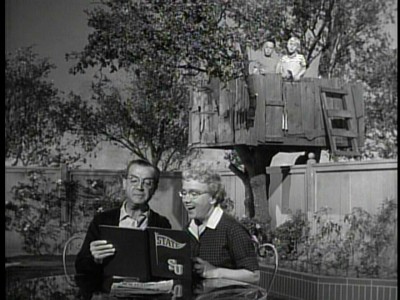
But it's not exactly a house anymore -- see this pic. It does have a floor, and low walls that only go up to waist height on children, but not walls that go over the kids' heads, and no ceiling or roof. It's a fairly open structure, more like a stand or perch or nest. And so, the door is more of a part of the low wall that swings open, like the gate of a residential fence, not an opening in a wall that separates an enclosed space from the outside world. It is built in a treetop and does use a ladder for climbing up. And it does involve friends (same-sex) -- that's his pal Tommy up there with him.

Still, you can see how less of a secluded sanctuary it is compared to the examples from the '30s and '40s. But then, that's only to be expected, giving the rising levels of social strife during the '50s and '60s, even somewhat beginning in the late '40s. Just cuz 1960 wasn't at the explosive peak of chaos of 10 years later, doesn't mean it was a harmonious stress-free kumbayah circle. I'll be revisiting this fact for other domains of society later. Suffice it to say that it was less socially harmonious than the '30s and '40s.

There's even an entire episode from 1960 about his tree house ("Dennis' Tree House"), which makes it into a social obstacle instead of a source of harmony. The treehouse is built right on the boundary with the yard of his neighbor, Mr. Wilson, who is upset that it might scare the birds away and he won't be able to enjoy his hobby of bird-watching. Things work out in the end, but it's part of a trend of the rising-strife phase that portrayed treehouses as sources of problems rather than unalloyed wholesomeness.

In a 1956 episode of Lassie ("The Tree House"), two friends Jeff and Porky get excited about building a treehouse and becoming blood-brothers -- seemingly off to a good start on the whole "treehouse as sanctuary for friends" theme. It's built in Jeff's yard with the help of his family. Unlike in Dennis the Menace, this is a proper treehouse with a roof, walls, doors, ladder, etc.

But then when they both spend the night in it, they bring their dogs along, and Porky's dog won't stop howling, keeping Jeff awake all night and making him so angry that he kicks out both the dog and his supposed blood-brother and guest Porky. When Jeff goes to apologize the next day for being a poor host / blood-brother, he finds the interior of the treehouse has been trashed, and assumes Porky did it as revenge -- more anti-social paranoia and suspiciousness and bad faith.

Later, there's a loud noise coming from the treehouse, and when Jeff goes to investigate -- there's a bear inside trashing the place even more. So that's what trashed the place before, not Porky -- but still, setting up the treehouse as a space that's vulnerable to roaming nomadic outsiders, including animals. Jeff's mom says no more treehouse. But it turns out the bear was escaped from the circus, not a wild one, so the mom says it's OK again. That makes no sense, there could still be wild bears or other troublesome animals roaming around that could climb up the ladder -- but the paranoid point has already been made. Beware! Caution! Risk!

The last of these problematizing examples is from 1970, from The Brady Bunch ("What Goes Up..."). In it, there's another proper treehouse, but it is still portrayed as a source of danger -- Bobby tries to climb up into it, but falls and sprains his ankle, leading him to develop a fear of heights on top of it.

What happened to treehouses just being wholesome sanctuaries for friends? Well, '56, '60, and '70 were all part of the rising-strife phase of the cycle. It wasn't the harmonious '30s and '40s anymore. So anything that might bring people together socially, like a treehouse sanctuary, had to be cast in a more negative and threatening light, as though it might introduce more strife than it would relieve. Not just physically, like scaring away the birds or posing a risk of falling injuries, but sowing the seeds of suspicion and resentment despite the promise of bringing camaraderie and appreciation, like driving a wedge between supposed blood-brothers.

* * *


It wasn't until after the peak of social chaos circa 1970 that that wary attitude began to wane, and treehouses regained their wholesome innocent pro-social connotations. Only a few years after the Brady Bunch episode, there was a renaissance of rural-themed TV shows, epitomized by The Waltons and Little House on the Prairie.

In a first-season episode of The Waltons (from '73), their treehouse makes its debut and would become a familiar fixture in their environment for years. It's a proper treehouse, not problematized, and since the show is set in the Depression, it revives the original wave of treehouse-mania from the '30s and '40s.

Our Gang was renamed Little Rascals, and given an animated format in 1982, which not only included a treehouse as a gathering spot for the friend circle, it was emphasized by being included in the intro sequence, to set the premise and sense of place and tone.

And from there, treehouses began to explode in popularity, although more so in movies that were set in the past, like Stand by Me and The Sandlot. Both of those are set in the early '60s, and so a proper treehouse and thriving friend circle would've been anachronistic for that time -- it would've been more appropriate for a movie set in the '30s or '40s. But still, by that time they were starting to swirl together all sorts of "pre-1968" periods of 20th-century America. A little bit of the '30s, a little bit of the late '50s or early '60s, always an unintended dash of the year in which it was made, it's all good.

Dennis the Menace was made into a movie in 1993, and it upgraded the treehouse to a proper one, again unlike the era in which the original TV show was made. Little Rascals was made into a movie the next year, although without a prominent treehouse.

The Simpsons had a treehouse in their backyard as a gathering spot for friends, and although I don't know when its first appearance was, the "Treehouse of Horror" series for Halloween began in 1990. The only episode from '89 was the very first one, so unless it's in that episode, it first appeared sometime in '90.

The revival of the wholesome and non-threatening treehouse trope during the '80s and '90s reflected the rising-harmony phase of the cycle, before merging with or enhancing the new trope of "teen's room as treehouse within the home itself".

After the '90s, the treehouse trope begins to fade once again, not to mention picking up the connotation of danger and threats, right back to Lassie and Dennis the Menace and The Brady Bunch. But that's only natural, as the social mood swung away from harmony and toward strife once again, and anything that would cement social bonds among friends would have to come under suspicion and then get eliminated altogether.

However, now that the pendulum is finally swinging back toward harmony, as of the past couple years, maybe treehouses, teen's room as a treehouse within the home, or some new variation on this perennial American theme will emerge -- assuming we still had a thriving pop culture production sector, which we do not at all. American culture -- meaning, all-American, appealing to and paid attention to by all -- has been extinct since 2020.

But in whatever fragmented niche-demo remains of American-ish culture that remain going forward, we're likely to see a gradual revival of this theme, likely peaking in the early 2040s.

Maybe in video games? Minecraft is still thriving, despite coming out in 2010, so perhaps treehouses will become the hot new thing to build. Mumei made a cozy little one for herself a couple years ago, Fauna made the huge sun-obscuring World Tree during that time (which was not just a tree, but had home-like architecture at the top), so... maybe it's the start of a new trend?

It'll probably be more visible in new games, where there's a prominent treehouse built into it, but it'll be some niche indie thing that not the whole world knows about, or something. But the urge to hang out with friends in treehouses -- or their present-day descendants, perhaps in a form not yet invented -- will become overpowering in the next two decades. Plenty of time for it to find some kind of realization in the cultural realm.

Look forward to seeing what it is, while still knowing in advance it won't top, as it were, the examples from the '30s and '40s or the '80s and '90s. ^_^

February 17, 2025

The truce in the battle of the sexes during peaks of social harmony, 1940s and 1990s, halfway between peaks of social chaos circa 1920, 1970, and 2020

A topic I've been exploring lately relates to the 50-year cycle that Peter Turchin uncovered in social chaos and civil breakdown in American history, with eruptions circa 1970, 1920, 1870, missing one in 1820, and 1770. On that basis he predicted another eruption circa 2020 -- boy, was he right on the money.

He does mention the opposite values of these chaotic eruptions -- low-points for civil breakdown, or in other words, peaks of social harmony. The Era of Good Feelings in the 1820s was halfway between the breakdowns of the 1770s and 1870s. The Gay Nineties were halfway between the breakdowns of the 1870s and circa 1920.

It's misleadingly called the WWII era, since it began well before the war did (certainly before America's involvement in it), but the '30s and first half of the '40s, even the late '20s, were another such period. Woody Allen dubbed the period Radio Days. Also the period in which A Christmas Story is set. Or the contempo setting of It's a Wonderful Life. Whatever we call it, it was halfway between the breakdowns of circa 1920 and 1970.

Well, we just went through another breakdown circa 2020, which leaves the halfway point between it and the previous one before that, 1970, circa 1995. And really, harmony had been on the upswing by the late '70s, lasting throughout the '80s, and peaking in the first half of the '90s.

Chaos, breakdown, disorder, riots, etc. -- far more attention-grabbing for historians. The phases of greater harmony, stability, order, and calm, tend to go unnoticed.

Because this cycle pertains to such a foundational aspect of society -- order vs. disorder -- it affects so many domains of societal life. Riots vs. calmness is an obvious one. I'm interested in surveying how broadly this cycle touches our lives.

A perennial topic of discourse is the battle of the sexes, which has reached a fever pitch in the last 5, 10, 15 years. I think we're past the worst part of it, but it's still raging.

And before focusing on the harmonious phase, it does help to start with the chaotic phase, since its symptoms are so much more intense and easy to discern.

During the most recent chaotic phase, circa the late '90s through the early 2020s, and exploding during the woketard 2010s, there are too many symptoms to list briefly. #MeToo, Slutwalk, toxic masculinity, incels, gay BFFs / fag hags, fujoshi fanfic (girl imagining herself as a male in a homoerotic male-male fantasy), redpill, Game / pickup artists, porn based on degradation or humiliation (for either sex), and on and on down the line. Guys and girls could not have inhabited more separate, and more mutually hostile social environments.

In terms of waves of feminism, this is associated with the Fourth Wave.

During the previous eruption of chaos in the late '60s and early '70s, there was the Second Wave of feminism. Mostly focused on abortion, but also women's liberation in general, free love, bra-burning, equal pay for equal work, divorce, and the birth of what's called radical feminism i.e. the bitter man-hating abolish all gender roles type. That included the SCUM Manifesto, i.e. the Society for Cutting Up Men, by the whackjob who shot Andy Warhol, Valerie Solanas -- this was before feminazis sanctified gay men as their protective cockblocking eunuchs against the forces of toxic heterosexual masculinity.

During the previous eruption of chaos before that, was the breakdown of the late 1910s and early '20s. That coincided with the First Wave of feminism, specifically the Suffragette movement. Along with the chaotic social mood generally, this movement of feminism had been growing since the turn of the 20th century, it just hit its peak circa 1920 (when the US granted women the right to vote).

You may have noticed a skipped-over wave of feminism -- the Third Wave. That term applies to the '90s and the early 2000s, during a period of relative social calm rather than upheaval, as opposed to the other three waves coinciding with civil breakdowns.

Well, Third Wave feminism doesn't really exist, and feminists admit it -- its hallmark was its lack of cohesion politically, and lack of coherence conceptually. It's more of a placeholder term for "whatever feminists were up to in the '90s". And it's premised upon women of the '80s and '90s having won so many things during the previous two waves, so what was left for the '90s?

One of the major books of the Third Wave, Susan Faludi's Backlash ('91), is more about the past than the present -- the backlash against the Second Wave after the peak of social chaos had been reached, by the late '70s and throughout the '80s and into the early '90s.

The other major book, which *was* more about the present than a backlash against the previous wave, was The Beauty Myth by Naomi Wolf (also '91). Like the Third Wave in general, its premise is how many material, legal, and other gains have already been won due to the First and Second Waves. Now with women seemingly having it all, they find themselves searching for that last little bit of perfection that cannot be allocated to them by laws or corporate policies -- beauty, namely cosmetic surgery, fashion victimhood, eating disorders, and the like. The idea was, let's try to liberate ourselves from that self-imposed / mass-mediated oppression, and focus more on our worth as people who are not paragons of beauty.

OK, if that's feminism, then there was a Third Wave of it in the '90s. But it's not a movement, not political, and not seeking to up-end society like the other three waves did. Crucially, it was not man-hating or man-blaming or seeking a redress of grievances from the offending male sex. All feminists are at least somewhat man-hating and man-blaming, but the Third Wavers were pretty tame and calm, relative to the radicals of the Second and Fourth waves on either side of them.

The most you could point to in the '90s was in its second half, after the peak of social harmony had been reached, and the pendulum began to swing once again toward chaos and breakdown -- but had only just begun to shift. These developments were the embryonic forms of Fourth Wave feminism that would rear their ugly heads for real during the woketard 2010s.

Things like The Vagina Monologues ('96) and the associated V-Day ('98) which warped Valentine's Day into a day of raising awareness about violence against women, and even the whole Girl Power phenomenon ("chicks before dicks", to counter "bros before hoes"), associated with the Spice Girls and their Millennial audience.

Also the rise of gay BFFs, gay eunuchs, fag hags, and fujoshi fanfic -- Will & Grace, Sex and the City, and by the early 2000s, the first gay kiss in primetime in an episode of Dawson's Creek (2000), and in the music video for "Beautiful" by Christina Aguilera (2002), and the bitter emo girl + messy gay BFF duo in Mean Girls (2004).

Suddenly, boys and girls were beginning to split apart, although this rift would not reach its yawning maximum until circa 2020. But it was quite a gear-shift or phase-change compared to the first half of the '90s, the '80s, and the late '70s.

So, one of the hallmarks of that harmonious phase was the relative absence of a feminist movement, especially of the man-hating and man-blaming and man-lobbying type that we usually require for something to be a true feminist movement.

The last time there was such a relative absence of feminism was the second half of the '20s (after women's suffrage was fait accompli, as well as discredited by their lobbying for the 18th Amendment to ban alcohol, which got repealed by the 21st Amendment in '33), all of the '30s, and at least the first half of the '40s.

You know the WWII era was barren of feminism when all they can point to, desperately, is the Rosie the Riveter ad campaign, or the fact that women joined the military as WACs and WAVES in their cute wool nurse's capes, to support the men in the war effort, in their typical female capacity. This was not man-hating, man-blaming, or man-lobbying for societal upheaval. So women could join the emergency war effort -- big deal, that's not radical at all, and tellingly it was not won by protests, violence, or other forms of coordinated confrontation against the power structure.

Much like the second half of the '90s, the second half of the '40s saw the very embryonic forms that would eventually become Second Wave feminism, like the 1949 publication of The Second Sex by Simone de Beauvoir, followed some time later in '63 by Betty Friedan's The Feminine Mystique.

I will go into greater detail on other cultural correlates of these harmonious phases, when the battle of the sexes ground to a halt. But for now, just to get the ball rolling, this brief overview of the timeline of various waves of feminism should give you the overall picture.

I promise those details will be more exciting and relatable than the history of feminism! But we have to start somewhere uncontroversial, like organized man-hating, man-blaming, and man-lobbying. And of course, the pair movement of womanizing, woman-hating, woman-blaming, and woman-hectoring. But the male version is not an organized or academic affair, so it doesn't leave as rich of a paper trail as the female version.

And in any case, females are the choosy sex in human beings, so generally speaking, what they say goes, regarding how close or distant the sexes will be with each other. The fine-detailed surveys will also focus more on how women change or cycle over time, although I will note how men change or cycle over time in the same ways.

January 20, 2025

RIP David Lynch, who mythologized the normies of Edenic Americana, through saturated dreamy naturalism

Following up on a series of comments starting here on the topic of "cool vs. weird," and another series starting here on the topic of the 50-year cycle in social cohesion vs. chaos -- and its cultural correlates -- I explored David Lynch's role in American cultural history, on the occasion of his recent death. I'll just paste the comments here, to get the ball rolling on a new post.

* * *


RIP David Lynch, who produced most of his works during this wholesome period, and was always more cool than weird -- as were his creations.

If Twin Peaks had been weird and normie-shocking and taboo-violating and ugly or anti-aesthetic, there would never have been "Peaks mania". It was so widespread, I still vividly remember the day in 3rd or 4th grade, when a girl who sat at our little group of 4 desks pushed together, spontaneously burst out with

"Have you guys seen Twin Peaks???!??!?!??!!!! :DDDDDD"

None of us had, but her older sibling or parents were into it, and she watched along with them. We could tell how excited she was, so we believed it must be REALLY COOL, so tell us, what's it about? What makes it so cool? She couldn't really put it into words, and looked dejected after awhile, like, "Yeah, my 3rd-grade brain cannot convey the awesomeness of this show to my fellow 3rd-graders..."

But I always took that to heart, and watched it in earnest when it was shown in reruns on Bravo during the '90s or y2k (back when Bravo was like the Criterion Collection cable channel). I think I was reminded of it by some guy in our freshman dorm -- *not* a counter-cultural type, but a boarding school preppy -- was gushing over it, playing the opening theme song, etc. "You HAVE to watch it, whenever you can!"

Artsy-fartsy types loved it, too, but it was a surprise hit sensation due to its immediate appeal to normies. Nor does it depict counter-cultural types, or Bohemian urban niche environments -- exactly the opposite from someone like Woody Allen, who is primarily popular among art-y types.

It pains me to see Twin Peaks and other related works become hijacked by sub-cultures during the "weird instead of cool" phase of the cycle. Yeah, their predecessors liked it, too, but they didn't try to hijack or gatekeep it, or taint the association with it in a way that would repel normies from gushing over it as well, like their normie predecessors did back in the early '90s.

The elements of gore, violence, occult, etc. are played for sublime threat value, not for shock value or taboo-violation value. And they're balanced or heightened with elements of the beautiful -- the total babes he selected for the cast, the stunning locations, the striking rich colors and dramatic lighting, and the rest of it all.

Really his only weird / ugly / body-horror movie was Eraserhead, from '77.

The Elephant Man, from just 3 years later, was not like that at all, despite the subject being a disfigured freakshow attraction. I checked that out from the local library ALL THE TIME in kindergarten, when Blue Velvet had only just come out.

Yes, it was possible to "be into David Lynch before it was cool" back in the '80s, even for a Midwestern kindergartener who didn't even know his name. That movie was just too cool to not watch again and again and again. The things you could have imprinted on as an impressionable child in the good ol' days...

If only that girl in 3rd grade had told me that Twin Peaks was made by the same guy who made The Elephant Man, I would've been sold right away! And not had to wait until nearly 10 years later to track it down on cable -- and later, on DirectConnect.

Along with respect for taboos, goes respect for the holy and sacred and spiritual, which he incorporated into his work like few other art-school directors. And for the same reasons, his being one of the most all-American directors in the history of the medium.

Now that our cultural identity as Americans has largely matured, further down the line the dictionary definition of "Americana" will simply be David Lynch's '80s and '90s channeling of the late '50s and early '60s.

It isn't canonically American if it isn't in a David Lynch movie or TV show!

Very admirable role, to not only contribute so much primary material to American culture, but to serve as one of its main canonizers at the secondary level as well. RIP.

Delving further into Lynch's place in the "weird vs. cool" divide.

Surrealism, dreams / dreaminess, alternate dimensions, paranormal phenomena, etc. -- not weird in themselves. Not ugly, disgusting, disorienting, alienating, sacrilegious, profane, obscene, and so on.

The main way that surrealism *can* be taken in a weird direction is warped perception, hallucinations -- in the sense of trippy out-of-the-ordinary sensory perception, not just "such a thing couldn't exist here" like a person sitting on a wall or ceiling. Lynch never went with blurred vision, melting shapes, undulating lines of perspective within the spatial frame, kaleidoscopic ballets of pure shapes, and so on.

His surrealism is more of an "alternate reality" type, where the rules and nature of sensory perception remain the same as we ordinarily feel them. Perceptual naturalism.

So where does the alternate-ness come from, then? It ties into his pervasive tone of mystery, secrets, exploring the dim hidden crypts of reality. You can't immediately make sense of what you're encountering -- the space is too barren, the space seems to have no entrance and no exit, a person is sitting silent and looking at you but not saying anything, when they speak it's in a language you don't understand, or you understand that language but it's in concealed in cryptic riddles that invite you to solve and unlock their secret meaning, and so on.

Which is not to say it's off-putting or repulsive or dread-inducing -- it can go that extreme, but fundamentally it's more about cryptic meanings, which *can* be solved and understood, but not in the way you're used to determining the meaning of things.

The closest analogy to the sensation these alternate realities produce is discovering a treasure trove of communication in a language you don't speak and can't even decipher just yet, but which sparks your curiosity to decode it and learn to communicate in this unfamiliar language. You're hoping it's something mystical and BIG, not just ancient trade regulations or something boring and mundane like that...

We've all been in situations where we can't speak the language. As long as it's temporary, it's not so alienating -- before long, we'll be back to where we *do* speak the language effortlessly. And while we're in the foreign-speaking place, we can still try to figure out a pidgin to interact with this fascinating exotic world.

That's why he ties it so much into dreams -- dreams are fleeting and temporary. You'll wake up before too long, so even if you're having a nightmare, it's not a chronic condition. You're still grounded in the safe familiar waking world of your everyday environment. You're not permanently crossing over, climbing through the looking glass, whisked away by some cosmic force that may never whisk you back, etc.

Maybe you will -- maybe this is the big sleep, not just a single night's nightmare. But dreams are not inherently permanent, they are typically fleeting acute "conditions".

So, Lynchian surrealism is more about curiosity, exploring, a sense of adventure, going on a quest, solving a mystery, unlocking secrets. Fun, exciting, stimulating, inspiring -- not ugly, off-putting, demoralizing, degrading, or queering / weirding / warping. Especially not at the perceptual level, which would induce nausea and other disgust reflexes. Semantically disorienting, but never physically sea-sickening.

How about his famously "quirky" cast of characters? Isn't quirky synonymous with weird, misfit, etc? No, it just means they're not identical clones of each other, they all have their own distinct fingerprints, voices, faces, and yes personalities.

It's "all the colors of the rainbow" diversity, where each band of color is perceptually distinct, but all are equally natural examples of "color". There's not a standard color vs. marginal, misfit, outcast colors. There's no antagonism between the colors.

So I'd rather use the term "colorful characters" rather than "quirky," which can sometimes be conflated with weird, affected, etc.

That's the other thing -- colors don't strive to construct their own persona as being orange, green, etc. Their colors are just what they naturally are -- not carefully curated constructions and affectations performed for a real or imagined audience of spectators and evaluators. Lynchian "quirkiness" of characters is always unpretentious, naturalistic, and uninhibited. That's why they seem "extra" -- they're holding nothing back, concealing nothing, lacking artifice, uninhibited by anxieties about how they'll be perceived or accepted vs. rejected, etc.

I would call these personalities "highly saturated" if we're sticking with the "colorful" metaphor. They're not phony or affected colors, they just seem out of the ordinary due to how rich and saturated the pigment is -- almost realer than real -- since the artist did not dilute the pigment before applying it to the canvas.

These colorful characters are VIVID, not ostentatious or garish or caricatured or grotesque. Not campy either -- vivid.

So in this way he's emphasizing what is natural, not playing up the artificial. Celebratory naturalism, adulating naturalism -- not warping people into weird caricatured mask-wearers.

And so his characters are the opposite of affected, neurotic, performative theatre kids who curate an aura of being quirky, twee, or le sad and depressed, or whatever else. You've never met LESS neurotic characters in the history of the world's cultures...

Why are they so uninhibited, so lacking in artifice, so carefree inhabiting their distinct personalities? Cuz they aren't misfits, weirdos, etc., but belong to a community that accepts and values them simply for being members of the in-group. Like a great big single family, they are loved and appreciated unconditionally, so they are free to be themselves instead of having to construct a persona based on what will please some conditionally-loving fickle-taste audience or jury panel.

Not just among small-town folk either -- Mulholland Drive shows the same close-knit-ness of Angelenos broadly. Not to say there's never any conflict or antagonism or drama -- there's conflict within any family. Just to say that Angelenos treat each other like members of an extended family, not transactionally (and if a character does behave that way, it marks them as evil, misfit, threatening to the order, etc.).

You might even say Lynch's characters, their environment, and their social communities are Edenic -- Edenic Americana. There was temptation, conflict, etc. in the Garden of Eden, too -- Edenic doesn't imply free from threats or dangers or temptations.

But they live in a primeval, wholesome paradise, and the drama and conflict involves their loss of innocence through temptation and experience with not-so-wholesome elements (perhaps hostile invaders of their paradise, perhaps seductive antagonists who they succumb to through their own sinful free will).

This is another reason why his characters seem dialed-up -- they are more in the allegorical direction than the documentary / verite direction. They're Edenic, mythological, legendary, even though they're portrayed as inhabiting contemporary America. Mythological naturalism, legend-making naturalism.

Brief aside to say that Lynch never indulged in making anti-heroes, or glamorizing threats to the social order. The harmony and closely-knit fabric of the social order represented Edenic paradise, and whatever threatens to tear that to shreds is portrayed as an unalloyed evil, sometimes as a literal demon from a demonic dimension.

He never glorified weirdos, misfits, and anti-social types. At most, maybe gave them a seductive coolness, like leather-jacket-wearing, muscle-car-driving Frank Booth. But that was always undercut by exploring their own seedy underbelly (not just that of the wholesome small town) -- a raving nut who couldn't have fun without taking weird drugs, sexually crippled by perverse taboo-violating fetishes, deeply insecure, and ultimately pathetic, not someone anyone would want to emulate as le dark misunderstood anti-hero. Like other Lynchian characters, he's certainly colorful and vivid and memorable -- but not glorified or shown aspirationally.

You can instantly spot who misunderstands and hijacks Lynch's "quirkiness" by whether, when Lynch comes up in conversation, they chime in with "Heineken? Fuck that shit! Pabst Blue Ribbon!" or "A damn fine cup of coffee!"

Agent Cooper is equally colorful, vivid, and memorable -- but not the insecure, pathetic, LARP-y weirdo villain. *He* is the one that's glorified, and shown aspirationally. A modern day role model -- Lynch was a proud Eagle Scout, after all.

There was little in the way of moral ambiguity and other theatre-kid pretentiousness in the tone and themes -- there was good, and there was evil, and the creator was clearly on the side of the good guys. To choose otherwise would make the social order vulnerable to corruption and dissolution. He wanted to uphold and preserve it, and to express his gratitude at all the Edenic wonders that it provided to its dependents.

Another brief aside to emphasize that none of this morality was even crypto-Christian, let alone openly. That would have been too Olde Worlde LARP-y. If anything, it was part of New Age spirituality and morality -- how very American of him, yet again.

Ditto for the sacred music that accompanies this morality and narrative -- distinctly 20th-century American styles like jazz, R&B, blues, gospel, rock n roll, even synth-y New Age. The Twin Peaks theme song *was* included on the original definitive New Age compilation CD, Pure Moods.

I've brought this issue up before, but characters must be likeable and relatable and normie or at least normie-friendly / normie-aspiring, if their plight is to be felt by the audience. We don't care if an angry-at-everyone, self-focused, hyper-competitive brat suffers. All those taboo-violating, filthy-club-inhabiting gay weirdos from Cruising? Hard to feel sorry for them getting serial-murdered. They're already so debased, hardly human anymore.

That's why violence and other threats in Lynch's worlds are so poignant -- they're targeting the relatively innocent Edenic normies, who belong to a community, look attractive (naturally, not as in vain looks-maxxers), love others and are loved by others. THAT is a real loss.

When directors emphasize weirdos, misfits, anti-social types, competers, grade-grubbers, attention-whores, and other self-promoting types, and make them the victims, they're trying to force us into caring about people who don't care about us and would actively cut us down if given the power to. Sorry, no sympathy for the devil or his demonic minions, no matter how hamfistedly a grown-up misfit director tries to hector us into praising those who should be condemned.

Lynch allowed us to bemoan the loss of those who deserved to still be here. Moral naturalism, ethical naturalism, not moral inversionism.

Seduction, allure, glamor, temptation, and sin were other pervasive themes in his work. Ties into the beautiful, and the Edenic, and the loss of innocence, but also the mysterious, the cryptic, the puzzling -- that's another kind of attractive, enticing seduction. Irresistible, possibly to our own downfall, but an all-too-human desire.

Things that are weird, ugly, cursed, warped, unnatural, repulsive, etc. -- are *not* tempting, *not* alluring, *not* inviting us to stray from our normie path. Even when threats to the social order are shown, they have to have a kind of glamor or beauty, at least superficially and initially.

What could possibly tempt us to stray from our already beautiful Edenic paradise? -- something even more beautiful, more concentratedly beautiful, beauty in a form we haven't yet experienced hence exotic.

There is the occasional ugly revolting outsider threat (like the dumpster demon in Mulholland Drive), but those are rare. Ugliness, gore, splatter, filth, scat -- very rare in Lynch's rendering of the evil side of the universe. Also rare in his depiction of their evil effects on the good side -- no torture-porn gruesomeness done to the victims.

This places him in square opposition to the puritanical strain of American culture, especially as it arose during the late '90s and after, with torture porn that originated with David Fincher's Seven (1995), where ugly disgusting gruesome tortures are meted out to sinners in order for the punishment to fit the crime. See this earlier post.

Lynch is part of the Dark Age-oriented empathy toward sinners approach, emphasizing the seductiveness and superficial appeal of sin, understanding and trying to coax would-be sinners away from falling into temptation. As opposed to the puritanical discipline-and-punish approach of the humanist, Renaissance, Scientific Revolution, Enlightenment eras, where sinners get what they deserve, reap what you sow, etc., and where they get appropriate torturing punishments (which did not exist in the Dark Ages), witch-hunted (from the Scientific Rev era, not the Dark Ages), and so on and so forth.

There are no revenge fantasies, fan-fic, or other forms of self-aggrandizement in Lynch's work, unlike in many other favorites of the art-y crowd (like Woody Allen, to pick on him again somewhat, but he really is a good foil for Lynch).

He doesn't create these worlds in order to escape the perceived injustice of this world, into a better, just world where he comes out on top of his rivals or antagonists. Not masturbatory.

It's not escapist -- in a way it's embedding yourself even further within this reality, by not treating it in a documentary / verite way, but also not as some horrible unjust prison to escape from. It's dignifying this world, its characters, and its environment -- and even elevating them to legendary, mythological, allegorical significance. That's devoting yourself even more to this world.

So it's really not so fantastical after all, the "extra"-ness or intensity comes from imagining our world to be even more real than it really is, to be more whatever-it-is than it really is. Not "super"-natural, that has other connotations -- ultra-naturalism, maybe.

And again, those brief visits to and from alternate realities or spaces, are treated entirely naturalistically -- you visit such-and-such coordinates on a map, and presto, you're transported to the Black Lodge. It's like traveling via wormhole, in a "heavy on the science" sci-fi space story.

Just as Lynch does not denigrate the normies as enemies of the weird, he does not downplay this world as a bland flavor that should be left behind for a more fantastical razzle-dazzle escape-pod. He mythologizes the normies, as well as their worldly environment. Nobody to seek revenge against, no place to flee or escape from. Somebody to be treasured, and some place worth embedding yourself further into.

October 9, 2024

Halloween mega-post / thread: horror movies, music, video games, sublime aesthetics, vtuber recommendations, ancient Indo-European origins of trick-or-treating, etc.

Let's just get the Halloween season ball rolling by thanking Holo honey Raora for hosting a watchalong for a classic horror movie, The Thing! (The canonical 1982 version.) Irys also did a watchalong for it last year...

So does that mean that Raora is a daddy's girl like Irys? It's rare for girls to have cool tastes, usually only guys do. Ame also watched a lot of classic "guy's movies," but she's a bit on the tomboy side, whereas Irys and Raora are very girly.

So where do they get their preference for cool-guy culture? From wanting to bond with their dad! Their dad is a guy, and has guy tastes, so if they want to bond with him, they'll have to develop a taste for guy movies, guy music, and so on. Raora has fondly mentioned her dad quite a bit, more so than her mom or her sister, so I think she might be a daddy's girl -- very rare, and very appreciated! ^_^

On the Holo JP side, I'm pretty sure that the Koronator is a daddy's girl -- she's mentioned the two of them bonding over classic video games while she was growing up. Marine must be a daddy's girl -- she has fondly mentioned him quite a bit on stream (he thinks Choco is pretty, he has some rules for marrying Marine, etc.). And it sounds like Lui is closer to her dad than to her mom (who is more like Lui's brother), so I think she's a daddy's girl too. And they all have cool tastes! And they're not tomboys, so they found an interest in cool things so that they'd have something to bond with their dad over. ^_^

And those are only the ones I know about -- perhaps there are others, but I just haven't seen clips or heard them talk about their families on stream before. It seems like there are a lot more daddy's girls in Glorious Nippon than in other countries. And Japanese girls *do* have cooler tastes than girls from other countries.

Probably because their men are cooler -- descendants of samurai, ninjas, pirates, and warrior-monks (yes, Japanese Buddhist monks could marry and have children). In China and Korea, the dominant classes were scholar-bureaucrats and literally castrated eunuchs, along with the military. Girls are more likely to want to bond with their dad when he has an exciting personality, which comes from leading an exciting lifestyle (not the life of a scholar-bureaucrat).

Even among the non-warriors, Japanese men were more likely to be hunters and fishermen than the Chinese and Koreans were, because Japan is so mountainous that arable land is relatively less common, so intensive agriculture is not as common as it is in China and Korea. And fishing is just another form of hunting -- more adventurous, setting off into the unknown, having to fight against hostile natural forces.

If the fish are migratory like salmon, then fishing is more like pastoralism, and the fishermen are tending to a herd of underwater livestock, much like the Pacific Northwest Indian tribes -- which makes them a lot cooler, resembling pastoralists (risk-taking, badass, culture of honor) instead of intensive agriculturalists (boring, predictable, hardscrabble).

Mongolian girls also have cool tastes, like practicing horse-mounted archery for fun! Your daughters would be cool, too, if they looked up to their fathers as the descendants of Genghis Khan! Hehe.

I'll be posting more post-length comments in the comments section shortly, just wanted to get the ball rolling...

April 25, 2024

Names and American ethnogenesis, from Dark Age revivals to purely New World creations

I still have plenty to cover in American architecture, but I hit on something pretty big that's worth exploring first. This is not exhaustive -- the big picture, with plenty of details, and as usual more to appear in the comments section.

I've covered names before on the blog, over 10 years ago, looking at trends over time, linking the rise of unique names with the status-striving cycle (vs. egalitarian times, when people feel compelled to give their kids the same names, so no one sticks out like a diva), and other matters.

But now we'll look at the role that given names play within the process of ethnogenesis. Strikingly, Americans began breaking from their British / European / Western / Olde Worlde roots right after landing in the New World -- *not* after the integrative civil war had wrapped up, which is when all other forms of cultural evolution take a distinctly, newly constructed American turn.

Already in the 17th-century, Puritans were giving their kids unique names by the standards of their cousins and ancestors back in Britain -- Prudence, Humility, Chastity, and other "virtue" names. Some of them have stuck, like Faith, Hope, Grace, and Felicity.

Benjamin Franklin, born in 1706, was given a name light-years ahead of its time, even in America, let alone back in Europe, where it was still distinctly Jewish -- 100 years after Franklin's birth, Benjamin Disraeli was the only Euro statesman with that name, and he was Jewish. And Franklin was not an outlier -- two other Benjamins signed the Declaration of Independence, Benjamin Harrison V and Benjamin Rush.

A quick look over the other Founding Fathers (signers of the Declaration of Independence, Articles of Confederation, or the Constitution), reveals all sorts of names that were unusual by contempo Euro standards -- Daniel (x3), Nathaniel (x2), Caesar, Titus, Abraham (x2), Josiah, Gunning, Jacob, Stephen (way ahead of its time), Richard (x5), Jared, Rufus, Arthur, etc.

As for US presidents, unusual names are already apparent with those born in the late 1700s and early 1800s, and it never stopped -- Zachary, Millard, Franklin, Abraham, Ulysses, Chester, Grover, Benjamin, Theodore, Woodrow, Warren, Calvin, Herbert, Franklin again, Dwight, Richard (more common in America by that time, but still not a typical Euro name), Gerald, Ronald, Donald, and Barack (Barry while growing up -- but even Barack, with its weak initial vowel, sounds more like a typically all-American 20th-century name like Brock, Rock, Doc, Spock, etc.)

Masculine names are far more conservative in their trends than feminine names, so the fact that this critical break with the Olde Worlde shows up in early male leaders is quite a testament to how eager we were to fashion a new identity for ourselves once we began adapting to a whole new environment in America.

Why do names defy the usual pattern of a new cultural identity being constructed only after the integrative civil war? Perhaps not as much cohesion is required to introduce new names into circulation via your own flesh-and-blood offspring. It's not like putting together Elizabethan stage plays, Viennese symphonies, or monumental architecture. Your children going to get a name no matter what it is, why not use the opportunity to make it a new one? It's cost-free and doesn't require much teamwork to make it happen, unlike the major cultural products like buildings, dramas, and paintings.

It seems like dialectal variation should behave the same way -- it costs you nothing to introduce a new sound pattern. But it does require lots of cohesion, since all the other members of your speech community must agree to the new sound pattern for it to catch on. Such cohesion only comes about from intense asabiya being born on a meta-ethnic frontier, and the outcome of an integrative civil war, when there is a strong sense of a new Us being fashioned, not just the old Us vs. Them -- but one Us vs. another Us, to determine who among the varied Us gets to set the new standard.

Names are not quite as demanding on cohesion -- not everyone has to give their kids the same new name, whereas everyone does have to pronounce the vowels in "cot" and "caught" the same, if that's to be a new sound pattern. Probably the other members of the community, when they hear a new name, think "Huh, that's a little odd-sounding... but all the other cues tell me it's a member of Team Us, so I guess that's just a new name that some of Us are giving Our kids, better make an exceptional note of it and put it on the safe-list."

Whereas if they hear a funny-sounding name, and all the other cues point to it being a member of Team Them, the strange name is just another aspect of Them-ness, and to blacklist the name as belonging to Outsiders. The other cues being grooming, clothing, subsistence mode, religion, language, totem symbols, folk customs, food traditions, music, dance, and the rest of it.

* * *


Within the general population, Americans have been even more eager to fashion a new cultural identity for themselves, separate from Olde Worlde roots (especially Euro / Western, with Ancient Saharo-Arabian being a possible exception). Right up through the end of the American Century, the top 50 names for baby girls in 1999 included purely American creations, chosen for sounding too exotic for Euro ears, like Samantha, Madison, Jessica, Alyssa, Kayla, Brianna, Grace, Destiny, Brittany, Amber, Savannah, Danielle, Brooke, and Sierra.

Quibblers will claim that Jessica comes from Shakespeare, after the character in The Merchant of Venice. But that was not a real person's name, only a character's name in a stage play. And in the play, it's the name of a Venetian, not an English speaker. It never caught on after that -- and Shakespeare in general, and that play in particular, have always been popular. It was only used on rare occasion, by offbeat parents who wanted to show how cultured or unique they were.

The true reason for Jessica's rise in popularity is its sound similarity to already popular names -- the skyrocketing Jennifer, along with recently trendy names ending in "-ica" like Veronica and Monica, and the appeal of making a feminine form of the popular male name Jesse. Jennifer and/or Jessica also spun-off the name Jenna circa the 1970s and '80s, which is *not* from Shakespeare, but does sound like an already popular name, whether Jennifer or Jessica or both. Jenna then spawned rhyme-mates McKenna / Kenna and Sienna.

There's another character in The Merchant of Venice named Nerissa, and yet that name has never become popular -- outside of the same rare offbeat parents, and the cultured individual who chose the stage name for the Hololive vtuber Nerissa Ravencroft.

To the extent that Nerissa is appealing enough to become the stage name for a major entertainment brand like Hololive, it is due to being a member of a rhyming class of names -- Melissa, Alyssa, Kissa, etc. In fact, it's a minimal mutation of Melissa, changing the initial nasal to another nasal, and the medial liquid to another liquid. Phonology, not semantics and referents, are what drive the evolution in names.

Portia, another character from the same play, caught on somewhat better than Nerissa, but it's not clear that it's due to that character, instead of the prestigious car manufacturer's name, Porsche, pronounced the same in American English. In fact, the spelling variant Porsha is another trendy American name -- and as usual, the midwits who spin their BS folk etymologies behind names, claim that it's a German word meaning "offering". Nope -- it's just a typically American-sounding name, regardless of any false cognates it may have in the world's myriad languages or its literatures or its luxury brands.

No one behaves according to what a name "means" across the zillions of false cognates it may have somewhere out there -- it's how it *sounds* that drives our behavior.

This is because names are not a private affair -- they serve as shibboleths in a social context, identifying members of Us from members of Them. If you don't recognize anyone's names, you must be dealing with Them. If their names are already known, or familiar-sounding enough, you must be dealing with Us. Shibboleths are about pronunciation and sound, not meaning or substance. I don't care what your name alludes to -- it sounds totally weird to my ears, so you must be an outsider, to be treated like one.

As America separated itself from its British, Euro, Western, and Olde Worlde roots, the names belonging to the latter groups became contaminated-sounding -- too Them, not sufficiently Us. Hence the present situation, where the top 50 baby girls names for 2023 include not only many of those from 1999 listed above -- but wait, there's more!, like Ava, Mia, Chloe, Avery, Addison (rhymed from Madison), Zoe (rhyming with Chloe), Layla (rhymed from the already popular Kayla, not descended from or alluding to its false cognate in Arabic), Brooklyn, and Maya (with lower-ranking but still popular rhyme-mates Kaia, Gaia, probably Raya, Vaya, and who knows what else next).

Gotta love the absolutely desperate cluelessness of the semantic-focused spin-meisters at thebump.com (as in, baby bump), who claim that the name Kaia has Scandinavian, Estonian, Greek, Japanese, Hawaiian, and Hebrew roots -- a post hoc rationalization for everybody! Nope -- it simply rhymes with the already popular Maya, and doesn't sound Euro, so it's suitably American.

I got a pleasant chuckle from hearing Dasha on Red Scare saying she was eager to have a baby boy so she could name him Honor, with the usual wahmen's rationalization about it being semantic -- a latter-day virtue name. But nope, it's simply a rhyming variant of the already popular Connor. She was so eager and bubbly while spinning the rationalization, though, that I hate to "decode" what was really guiding her decision -- typical male-brain always trying to analyze things, just let a girl feel her feelings, sheesh! ^_^

BTW, we can probably add McKenzie to the pure American creation list -- it's tempting to think of it as adopting a surname to a given name, but it also comes in the non-surname form of Kenzie, without the Celtic patronymic prefix "Mc / Mac". The same goes for McKenna, which comes in the non-surname form of Kenna.

Ultimately these all trace back to the earlier popular name Mikayla, which may be a purely new creation, or a novel feminine form of the male name Michael -- but in any case, where the initial sounds of "mik" are not a patronymic prefix at all. Mikayla comes in a rhyming pair with Kayla, and that supposed shortening does not involve dropping a patronymic prefix -- so we don't need to assume that process is happening either with McKenna to Kenna, or McKenzie to Kenzie.

Also, the supposed Celtic surnames are tightly constrained by phonotactics -- there are a zillion Celtic surnames that begin with Mc / Mac, and yet the three most popular ones belong to popular rhyming classes. Mikayla, Kayla, Layla, Shayla, Jayla, etc. And Kenna, Jenna, Sienna, etc. (Kenna may also be a novel feminine form of the recently popular male name Ken.) And even Kenzie is a close rhyme for the popular late-20th-C girl's name Lindsey.

The stressed vowel is produced a little higher in the mouth for Lindsey, but given the tendency for Western American dialects to lower front vowels (e.g., Valley Girls pronouncing "bitch" as "betch"), maybe they were already pronouncing Lindsey as "Lendsey", making Kenzie a perfect rhyme for it after all.

I'll only briefly reiterate Stanley Lieberson's important finding that naming trends do not follow appearances in popular culture, but rather the opposite -- some name is already climbing from obscurity into prominence, and the culture creators sense that just as well as their everyman audience does, so they choose it for their cultural work. They're two sides of the same coin, not one causing the other.

There are a few exceptions, IIRC, but in general it is pure post hoc rationalization to point to some pop culture character that came out before a name became super-popular and say, that figure made the name popular. It was already becoming popular before the character, and the character's creator was jumping on the bandwagon just as much as real-life mothers were.

Just as one example, Wikipedia, citing one of those dumdum baby name sites, claims that Kayla's popularity was due to a character by that name who debuted in 1982 on Days of Our Lives, a popular American soap opera TV show. In reality, Kayla's popularity was already shooting through the roof before 1982 -- it ranked #578 in '81, up from #594 in '80, way up from #678 in '79 and #677 in '78, up from #694 in '77, way up from #854 at the start of the '70s.

It did shoot up big-time during '82, when it ranked #132, but this is just how exponential growth and decay works -- it builds slow, then goes really fast, then slows down / tapers off, then gently declines, then crashes, then mellows out. That is a completely endogenous process, it doesn't get some external injection of oomph just before entering its steep-climb phase. And Kayla's growth was already well under way before a soap opera writer jumped on the bandwagon at the right time.

Good culture creators do not influence the everyday lives of millions of people -- they have an intuitive knack for spotting what is already in demand, and delivering it to the audience. Someone senses that the name Kayla is building steam among real-life mothers -- well, if that's what they want, then that's what they'll get, a new (fictional) person in their lives named Kayla.

* * *


That brings us to regional variation within America. As usual, the main source of cultural innovation is along the meta-ethnic frontier with the Indians, Mexicans, and somewhat the Japanese -- out West. Back-East names are more conservative, notwithstanding the Puritans' novel virtue names. Back then, Puritans *were* on the meta-ethnic frontier with Indians -- but over time, that frontier shifted further and further out West, leaving East Coasters to favor Euro-LARP-ing names more than West Coast Americans do.

Here is a data visualization from over 10 years ago, demonstrating the pattern that everyone always finds with names in America. The distinctive, new, all-American, non-Euro names are born from the Midwest to the Pacific Coast. Even within the Deep South, Louisiana or Mississippi is more likely to spawn a new popular name than Georgia or South Carolina.

Take just one salient example, the quintessentially American name Brittany. It was rhymed from the already popular Whitney, not the false cognate from the name of a region in Northwestern France, which pronounces the "a" vowel, unlike the American girl's name, which is pronounced BRIT-nee, where the "a" is silent, and where the stressed syllable is first rather than last, just like Whitney. The spelling variant Britney, as in Britney Spears, makes this clear.

At its peak of popularity, circa 1980, it was most distinctive of Utah and a broad swath of states from the Plains and Rocky Mountains region, and only somewhat distinctive of states east of the Mississippi River (Britney Spears was an outlier for being born in Mississippi).

This geographic gradient reflects the general pattern -- constructing a new identity is done by those closest to the meta-ethnic frontier, where they are being shaped into a whole new people by their conflict with the meta-ethnic nemesis, and must cohere very intensely into a new Us in order to fend off and perhaps even conquer Them.

The standard dialect in American and Canadian English is Western -- East Coast dialects sound the most harshly non-standard, whether Yankee or Confederate. And so the pattern goes with names, a linguistic element that is also strongly based on sound / phonology for determining how standard it is. It's a shibboleth.

* * *


I'll wrap up with a discussion of a very broad and in-depth discovery I made in the comments to the previous post, about America being a Dark Age culture out of sync with the Old World timeline, which left the Dark Ages behind circa 1300 -- but was part of a previous Dark Age before circa 700 BC, with Classical eras from 700 BC to 300 AD and from 1300 AD to present.

I explained this cycle by referring to the relative dominance of nomadism vs. sedentarism, with much of Eurasia being united by the Steppe as a source of nomadism, putting them all on the same timeline and cycle. Nomadic dominance leads to weak central states, and other aspects of Dark Purity cultures. Sedentary dominance leads to strong central states, and other aspects of Enlightened Perversion cultures.

But there are notable exceptions that spun off from the Eurasian landmass -- America and Japan, which remained a Dark Age / feudal culture until very recently, and arguably remains one, just like America.

(As a timely reminder of America's weak central state, look at who is sent to deal with all the anti-Zionist protests on college campuses right now -- not a federal organization like the US Army, FBI, etc., but city-level forces like the NYPD or state-level ones like the Texas National Guard, under the authority of mayors or governors, who are like regional counts, dukes, or barons from the feudal Dark Ages, not the president or any other federal official, who are like the king and central royal court from the Dark Ages. In Europe, where central states are stronger, they would send in a national-level gendarmerie like Spain's Guardia Civil for protests erupting around the nation.)

Looking over the names of American presidents, and having delved into the European Dark Ages so much recently, I can't help but be struck by three presidents having names that end in "-ald", as though they were a Frankish or Viking chieftain named Theobald or Grimwald.

This is one domain of naming trends where substance, meaning, and allusion do come into play -- not at the level of individual names, which are tightly constrained by sound patterns, but broad sources of inspiration to draw from, while obeying the all-important sound patterns. Not every name can be a totally original coinage.

In the 19th century, in the Old World itself, there was a general backlash against the centuries-long consolidation of central states and their overly rigid and dehumanizing / domesticating cultures. The Romantic movement, the Gothic novel, the Grimm brothers collecting and publishing fairytales, a Gothic revival in architecture (technically part of the civilizing phase of the cycle, but the earliest stage of it, and so feeling more thankfully barbarian in comparison to Neoclassical), Wagnerian operas about the Dark Ages and Bronze Age mythologies of Germanic peoples, and so on and so forth.

This didn't last very long in Europe as a major cultural phenomenon, not making it out of the 19th century, but it does still linger as a minority tendency. It was more of a temporary pressure relief valve for all that stultifying order and domestication that had been building up since 1300 -- not an endless new trail they were going to blaze.

Heavy metal bands that tap into Britain's Stonehenge era will always be more popular in America, a bona fide Dark Age feudal society. And as the Old World empires all bit the dust in the early 20th C, most of them fell under American vassalage (except for China), and so they adopted some degree of our very eager indulging in the Dark Age cultures of the Olde Worlde.

In names, this backlash and Dark Age revival showed up in old Germanic names making a comeback within Europe itself -- in Britain, Albert, Herbert, and other -berts, along with Robert, which never fell totally out of fashion after the Dark Ages. The first and only British prime minister to have such a neo-bert name, other than Robert, was H. H. Asquith -- Herbert Henry -- born in 1852. Among royalty, Prince Albert (husband to Queen Victoria) was born in 1819, and several generations of his male descendants were named Albert as well.

America would take that revival and make it permanent, with Herbert Hoover, Gerald Ford, Ronald Reagan, and Donald Trump.

Elsewhere in Europe, Engelbert made a 19th-C comeback in the eastern German-speaking lands, including places in their sphere like Slovenia. Oswald made a brief comeback in Eastern Europe as well.

But in America, not only did we elevate the popularity of Robert to all-time heights during the early-mid 20th century, and maintain other lesser ones such as Albert, Herbert, Norbert, and Gilbert, we enshrined this Dark Age suffix as a full name unto itself -- Bert / Burt. For real people like Burt Lancaster and Burt Reynolds, this may have been a nickname for Burton, but that's still a nickname that no British Burtons had used before. And in the case of Bert from Sesame Street's Bert & Ernie duo, it was spelled like the suffix and was not a shortened form of Burton / Berton / Bertram / etc.

The open-ended productive use of -bert continues outside of existing -bert names, into American novelty names in pop culture. There's icons like the Dilbert comic strip, the Q*bert video game character (a very rare American-created, rather than Japanese, arcade game from the Golden Age), the name Goobert that the most popular English vtuber, Gawr Gura (alias Gooba), gives to some of the characters she plays as in video games, as well as fellow Hololive EN vtuber Fauna naming her sourdough starter culture Doughbert. All part of her love for fantastical fairytale forest culture. Back when men had real names like Dagobert, Rigobert, and Humbert. ^_^

(The protag from Lolita, Humbert Humbert, is supposed to be stereotypically Euro, and a fish out of water in America, and yet he has a very American name -- a Dark Age Germanic -bert name. The only finishing touch to Americanize it would be shortening it to a monosyllabic nickname like Hum.)

Born around the same time as the first -bert prime minister was the first -ald, Archibald Primrose. In the late 19th and early 20th centuries, two separate Harold prime ministers were born, Macmillan and Wilson. (Harold was Harald in the Dark Ages.)

Sidenote: Boris Johnson has a Dark Age name, after the greatest of the Bulgarian emperors, from the 9th century, who is responsible for Christianizing Eastern Europe, bringing literacy to them, and establishing the foundation for Slavic liturgies.

I think the -ald ending is not as productive in American English cuz it's not such a well-formed syllable, lacking an initial consonant. Maybe just -bald or -wald would work, but -bald has a false cognate with negative associations. And we're familiar enough with German toponyms that -wald sounds too much like the name of a place, not a person. IDK.

Aside from these Germanic names from the Dark Age, there are several others originally from Greek -- meaning Byzantine, not Hellenic. We're Dark Age, so must our Greek inspirations -- either Byzantine or Bronze Age.

Christopher and Stephen were only common during the Dark Ages in Europe, going into decline during the Renaissance and falling into total oblivion after then. But in the 20th C., there can be no more all-American names than Chris and Steve (the most ubiquitous Boomer name). As pointed out earlier, America was *really* early on the Stephen trend, with a signer of the Declaration of Independence being a Stephen. In fact, although he went by Grover in adulthood, the late 19th-century president Cleveland was born and raised as Stephen.

The last and only British ruler named Stephen was king during the 12th century, during their empire's integrative civil war (the Anarchy), as the English were consolidating their initial victory over their meta-ethnic nemesis (the Vikings / Danelaw, who were expelled by the Norman Conquest).

Then there are Bronze Age Greek names like Jason, that were never that popular even during Hellenic Greece. Nor was it popular during the Dark Ages. There's one Italian born in the 1400s named Giasone (del Maino), and another born in the 1500s (De Nores). Otherwise, almost all Jasons of any note are Americans born in the 1800s and after. It's so iconically American that it has been chosen as a rhyming inspiration -- for Mason, Payson, Grayson, Chayson, Kayson, Brayson, etc.

There are so many Greek names from the Classical era that we are famililar with -- Socrates, Aristotle, Plato, Aeschylus, Sophocles, Archimedes, Euclid, and the list goes on and on -- yet we have decided to entirely ignore them, preferring instead the monster-battling heroes of the pre-Classical era, or the heroic Christian martyrs of the Byzantine / Dark Age era. Nothing could be less appealing to American honor-culture sensibilities than "being good at math and philosophy" or "being a theater kid".

Speaking of "monster-battling" -- Bronze Age epithets like Homer's "swift-footed Achilles" fell into disfavor during the Classical era. Too concrete, and therefore animalistic or barbaric. The Romans did include a descriptive term like "august" within their 17 other elements of a full name, but that dilutes its power. And like "august," they weren't so concretely physical.

It just doesn't pack a punch like Charles the Bald, a 9th-century Carolingian emperor, whose own father was the emperor Louis the Pious. Or the 12th-century Holy Roman Emperor Frederick Barbarossa / Rotbart -- Redbeard. Or the 10th-century Viking king, Harald Bluetooth. Or the 7th-century Byzantine emperor Justinian II the Slit-nosed. Or the 12th-century British king, Richard the Lionheart. Or back to Boris of the 9th-century Bulgarian Empire -- known as The Baptizer. And on and on and on...

Well, leave it to a neo-Dark Age culture like America, where our politicians are now known as Crooked Hillary Clinton, Lyin' Ted Cruz, Sleepy Joe Biden, etc. During Trump's first primary campaign, I pointed out that he descended from literal Vikings -- the clan MacLeod, whose namesake was a Viking ruler named Ljotr. At least that's the tradition, it could be a case of legitimizing one's group by means of an illustrious legendary foreign founder, much like the Rurikid dynasty in Russia claiming descent from a non-existent, legendary Viking ancestor.

Whether he has authentic Norse DNA in his veins or not, Trump surely is a Dark Age feudal leader of a weak central state, and he knows what buttons to push to resonate with its cultural values. And weak central state people love nothing more than blunt epithets. See also the once-common Italian-American practice of blunt epithets like Fat Tony, Danny No-Shoes, Jimmy Too-Short, etc. Or African-American rappers and gang members using epithets like Fat Joe, Megan Thee Stallion, etc.

Europeans haven't named leading figures "fat" since the days of Louis the Fat (also, the Fighter), a 12th-century king of the Franks. Maybe there are a few straggler examples into the 13th or 14th centuries, but once the proto-Renaissance showed up during the 1300s, it was all over for blunt epithets.

I'll bet that's a very broad phenomenon, but I don't have time to look into Dark Age Middle Eastern, South Asian, Central Asian, or Chinese cultures right now.

I'll bet Japan loved blunt and concrete epithets from about 1200 or 1300 onward, perhaps right up to the present day. The most popular vtuber in Japan, Marine, has a family name Houshou, meaning "treasure bell/chime", which seems to function more like a concrete descriptive epithet, and not a family name indicating who her parents are. Likewise, Korone is known by the epithet in place of a family name, Inugami, meaning "dog(gy)-god".

So when translating their full names into English, instead of Marine Houshou, it's Marine the Treasure-bell. And instead of Korone Inugami, it's Korone the Doggy-god, like good ol' Dark Age epithets. ^_^

Although the English Hololive girls don't have this format for their names, as members of Dark Age America and Canada, some of them do make epithets of their own, like Gura referring to herself as the Shark, Mumei as the Owl, Bae as the Rat, etc.

Without getting further into the Dark Age weeds, I'll just note that Geoffrey (later, Jeffrey) and Richard were common Dark Age Germanic names that were resurrected and made super-common in America during the 20th century.

Also, Arthurian legendary names. Not just Arthur, but Morgan, Guinevere / Jennifer (and similar-sounding names like Gwendolyn, Gwen, and Gwyneth, which most Americans pronounce as Gweneth, all of which also hint at the character Gawain), Elaine, Lynnette, Taliesin (Frank Lloyd Wright's headquarters), and perhaps not Lancelot -- but Lance! That has to be the connection. Monosyllabic shortening -- of what other possible longer name? Gotta be from Lancelot, given how much we're obsessed with Camelot. Some of these, but not all, were part of the limited 19th-century Romantic backlash in Europe, but we made them permanent, or are entirely responsible for (like Lance).

Speaking of Frank Lloyd Wright, and the Franks, that given name was confined to the Dark Ages until resurrected in America during the 19th century, including the birth of the Father of Modern and American architecture himself. Post-Dark Age Euros only used variations like Francis, Francisco, Francois, Francesco, etc. -- not Frank itself, or even the related Franklin, which was also resurrected in America during the 19th century, including the greatest president in our history, the New Deal trailblazer himself, Franklin Delano Roosevelt.

The name Frank just sounds too, well, frank, to domesticated sophisticates, so they could only preserve it in the frilly-and-gay embellishment Francis, Francois, etc. In America, nothing could sound more embarrassingly prissy than the name Francis, in place of the honorable alternative Frank. I think San Francisco would sound -- and then become -- less gay if it were renamed San Franco!

I have no idea if there's a case of convergent evolution between American names and Euro Dark Age names, in the same way that our similar environments have produced similar architectural styles (closed-solid-heavy slabs and caves and fortresses). There may be something there, but I haven't looked into it yet. Maybe later, in the comments. That would require cross-cultural confirmation as well, and I really doubt I'll get into the evolution of popular name sound patterns all across Eurasia, from the Bronze Age to present.

But just based on how Frank went to Francis / Francois / etc., then back to Frank in America, there could be something to how prissy-and-sissy names sound during the 1000 years of the cycle when sedentarism is dominant over nomadism. Francis has changed the hard "k" into a sibilant "s", then added a high-front vowel (connoting things that are small, weak), and another "s" after it.

I mean, you can totally make up a barbarian name -- and yet instantly recognize it as barbarian. Conan, Thundarr, Krull, Chewbacca, etc. Only some of that is semantic association with known, existing barbarian names. Some of that has to be purely an effect of sound symbolism, e.g. the absence of high-front vowels and sibilants (at least voiceless ones like "s" and "sh" -- "z" is "zh" are OK).

Alfred, Dagobert, Harald, Arthur -- no high-front vowels, no sibilants (especially voiceless ones). Just a brief impression, without a systematic survey, but may be something there...