Showing posts with label Archaeology. Show all posts

April 14, 2026

Eastern Steppe culture in Northwest America: Breaking precious copper decorated sheets for potlatches and funerals

Although I've established that the Japonic language family belongs to the broader Dene-Yeniseian family, which presently spans Siberia to the American Southwest, I had no idea what the time-frame for this relationship was, when first exploring the matter.

But upon further investigation of linguistic, mythological, and ritual relationships, I've not only uncovered further shared shibboleths, but determined that their common-ness lasted up through fairly recent times. Their common ancestor was not from 10, 20, or 100-thousand years ago. Not every element of their cultures dates back to the exact same time-period. Still, the earliest shared cultural ancestor they have goes back no earlier than 2000 BC. And in some cases the shared ancestor only goes back to between 500 BC and 300 or so AD. They could have been in lingering contact with each other through the 1st millennium AD.

This totally blows up the notion that the culture of the New World was either brought with long-distance migration from the Old World on the order of 10s of thousands of years ago, or that it evolved only in the New World after that initial wave of migration. For some New World cultures, that's true. But for others, who speak Na-Dene languages, their bodies and haplogroups may have come over 10,000 years ago, but their present-day culture did not, nor did it evolve solely in situ after settling into the Americas. There was a transmission of Siberian culture from the Old World starting as early as 2000 BC and perhaps lasting through 500 AD.

This is a great illustration of the non-correlation between genes and culture, or between migration of bodies and migration of culture. Cultural forms can spread by contagion, from one adjacent group to the next, and so on in a chain. Group A transmits it to group B, B transmits it to C, and then C to D. The fact that it is present in A, B, C, and D does NOT show that it began with A and then A migrated through all the intervening regions, leaving it behind them at each stop. In fact, it doesn't imply that A has migrated at all -- maybe they had contact with B (without, however, migrating to replace B, just interacting with neighbors), but not C, D, or any further link in the chain. And contagion is a far faster transmission process than migration of one spreader group to all regions affected -- as the phenomenon of epidemic diseases shows.

That's not to say that cultural forms spread just like epidemic diseases -- the key difference is how "susceptible" one group is to the cultural influence of another. Pathogens don't care about cultural groups or which other groups they choose as role models vs. groups they shun / avoid. Cultural transmission is not necessarily transitive either, unlike diseases -- in some cases, A influences B, and B influences C, but C rejects the influence of A (directly). In such a case, B acts as a gatekeeper between A and C, a role that does not show up in epidemic disease transmission. This is where all of the real art-and-science of cultural transmission happens -- just saying it can spread from one adjacent group to the next is not very surprising, it's what relationships must be in place for the transmission to take place, and when it will stop.

With that big-picture in mind, let's now look at some shared cultural shibboleths in Northwest America and cultures of the Eastern Steppe, including the off-shoot that wound up in Glorious Nippon. Some of these examples are from the comments in the previous post, some are ones I discovered just in the past few days.

I'm going to try breaking these up into smaller, more digestible separate posts, instead of having a long string of 250 comments on a single post.

* * *


First, we'll start with ritual. An earlier post demonstrated that ancient Japan (starting sometime before 300 AD) shared a cultural shibboleth with the Xiongnu and the Pazyryk cultures of the Eastern Steppe (and Silla, in Korea) -- breaking precious bronze mirrors as a funeral rite, and burying them as grave goods. See that post for all the details, which begin in the 3rd section.

For the time-frame, this ritual began in the mid-1st millennium BC (Pazyryk) and lasted through the mid-1st millennium AD (Kofun-era Japan). After then, the practice seems to have faded away...

But not in Northwest America, where a strikingly similar ritual lasted up through the conquest of the frontier by the Americans. Perhaps in the Old World, gradual sedentarization and civilizing influences from China led to the abandonment of this Eastern Steppe barbarian ritual, while in Northwest America there never was a sedentary mega-state civilizing influence until the white man showed up. They certainly were not in the cultural orbit of the Aztec, Maya, or Inca empires. So perhaps the Mongolians and Japanese would still be practicing this funeral rite, if there had been no China for them to interact with...

Metallurgy was never widespread in North America before European colonization. But there was a limited amount of iron and copper production in the Northwest, where the raw material was sourced from Alaska. We'll get to the mythical or not-so-mythical legend behind that, when we look at myths!

But after they began working with copper, various groups in Northwest America, not only those speaking Na-Dene languages, began to practice a ritual of breaking precious copper ceremonial shields, sometimes as part of a funeral, although sometimes as part of a potlatch. In both occasions, though, the broken fragments were buried somehow -- either under the ground or tossed into the sea, where they sank to a watery grave.

In both occasions, the "coppers" or copper shields were not very utilitarian, they were symbols of status and wealth and perhaps a connection to the supernatural and to ancestral lineages. They were decorated as art-works. They were owned and traded as decorative status symbols, with some degree of otherworldly power -- just like those bronze mirrors in the Eastern Steppe.

The main difference in the New World ritual is the shape -- they are beaten smooth and are between half a foot to several feet in length, like the Old World round mirrors, but they take the form of a T-shaped shield (again, not used as an actual shield in battle). And the adornments are also local patterns. So there was some degree of syncreticization between the Old World ritual and existing Northwest American arts-and-crafts traditions.

They don't seem to be treated as magical for their ability to collect and reflect light, as though they were mini-suns, like they were in the Old World, where they played into the solar cult of the Eastern Steppe.

We can't tell if their use at potlatches is different from their Old World context, which was funerals -- perhaps the only difference is when potlatches were held in the Old World, like mainly during a funeral, whereas in Northwest America, potlatches were held outside of funeral contexts as well. But in both cases, their breaking and burial can be viewed as a form of conspicuous wealth destruction, as an honest signal of the large amount of wealth held by the leader. In this way, it's no different from human and animal sacrifice, on the same occasions (potlatch and/or funeral) -- it's the sacrifice of precious objects, which only a wealthy household owns.

However, it's not just a vague conceptual similarity like "sacrificing precious objects" -- they are made of copper, beaten smooth into a sheet, adorned as decorative objects, used in a ceremonial context rather than a valuable object that sees real-world use, and their method of sacrifice is the same -- breaking into fragments.

Most inclusion of precious objects in a funeral or other ceremony does NOT involve breaking them or rendering them worthless as utilitarian objects, or even as decorative objects. Indeed, if they were just decorative objects made from copper, they would not seem so similar to the Eastern Steppe versions -- it's the fact that they're ceremonially sacrificed by fragmentation that jumped out at me when reading about them.

All these unnecessary / arbitrary points of similarity show that it is a shared shibboleth, not just independent variations on a universal theme.

This New World ritual goes back no further than the mid-1st millennium BC, when it is observed among the Pazyryk culture in the Eastern Steppe. It was still practiced in Japan during the early Medieval era. When was it transmitted into the Pacific Northwest? Sometime after the prerequisite adoption of copper metallurgy, which was more limited regionally and occurred later in the New World.

I'm guessing sometime at the twilight of its use in Japan, or just afterwards -- when the Siberian transmitters would have still been familiar with the ritual, but since it was no longer de rigueur in Siberia, it was not emphasized as strictly to the New World adopters. It was likely transmitted by the same Siberians who taught the New Worlders about copper in general -- "Y'know, this isn't just utilitarian stuff. Where we come from, we beat it into sheets, decorate it, and break it into fragments during major ceremonies like a funeral. You guys should do that, too!"

Maybe they specifically said to make it into a round mirror, and the New Worlders said that wasn't as relevant to their local culture, and made them into shield-like shapes instead. Or maybe since the ritual was fading away in Siberia, the Siberian transmitters didn't insist on every element being preserved -- what the hell, the ritual was dying out anyway, just give them the basic understanding, which is that copper is valuable, it can be beaten into a smooth canvas for artwork, and this valuable object can be broken into fragments for a major ceremony like a funeral.

I doubt it was too much later after it died in the Old World, since hardly anyone would still remember it in order to pass it on. Probably not 1000 AD. But also not too early, since it only began in 500 BC, and it required use of copper or bronze. So perhaps more like 300 to 700 AD, though after being transmitted, lasting right up through the "present" (closing of the American frontier circa 1900). Pacific Northwest natives never had to worry what a civilization like China might think about them sacrificing people, animals, and precious mirrors, well after the Dark Ages...

August 14, 2025

Japanese Steppe origins: Breaking precious mirrors as a burial ritual

Before getting into the main topic, I'll just link to some observations I made in the comments to the previous post -- about a Korean royal clan claiming descent from the Xiongnu. This establishes that my parallel investigation of the Steppe, and specifically Xiongnu, origins of their Japanese neighbors is already on solid ground in Southeastern Korea.

The clan that united the kingdom of Silla, which then went on to unify all of Korea, was the Kim clan from Gyeongju. Their legend of their origins is that they descend from a Xiongnu prince, who the Chinese call Jin Midi, but who they themselves call Kim Al-chi. I immediately noticed that "alchi" is one of the variant names of the Alat tribe -- the one whose name means "piebald horse" in Turkic, and who were the ruling clan of the Xiongnu confederation.

Did the unifying clan of Korea really descend from Xiongnu rulers? Well, they made this claim themselves, it's not somebody like me 2000 years later attributing it to them. And Korean scholars note how similar the grave goods are for Silla and the eastern Xiongnu.

I think the Japanese chose to make their Xiongnu origins cryptic due to the rivalry between Wa / Yamato and Silla. Yamato was on the losing side of the Tang-Goguryeo War of the 7th C, whereas Silla was on the winning side (allying with Tang China). They wouldn't try to invade Korea for many centuries after that, and wanted to distance themselves from their geopolitical rivals. Since the Xiongnu origins of the Kim clan were well known back then, the Yamato decided not to make the same claim, lest they be seen as copying Silla, or engaging in sibling rivalry.

But all the signs are there if you look.

* * *


Which brings us to the main topic of this post -- the burial rituals of the Xiongnu and other Steppe cultures of that time, as well as the early Wa culture in Japan. (And Silla, too, of course, but I'm not focusing on that.)

To reiterate an ongoing theme, we have to try to avoid using examples of convergent evolution when linking two groups together. What causes two groups to converge on the same outcome is some kind of utilitarian, economic, materially motivated force -- like getting more calories in your diet.

Group A drinks milk, and group B drinks milk -- are they descended from a common ancestor? Maybe, but maybe not -- maybe they each independently took up pastoralism, and began consuming the dairy products of their livestock. Both of them drinking milk doesn't mean they share an ancestor, it may mean that pastoralists will end up consuming dairy products, whether they share an ancestor or not.

Likewise, quite a few pastoralist groups from the Steppe practice horse sacrifice and horse burials, including Indo-European cultures from the West and Altaic cultures from the East. But that doesn't mean they share a cultural ancestor -- it may just reflect that fact that both have adopted horses, which makes horses very important, and so, what greater sacrifice could they make than sacrificing a horse?

We want to look for examples that are not steered by a cold, clinical Darwinian, economic, utilitarian incentive -- things that are more like a shibboleth. I say "po-TAY-to", you say "po-TAH-to" -- and that proves we belong to two separate cultures, whatever else we might share. Pronouncing the word either way does not help you communicate the meaning more efficiently, it is simply a random inconsequential arbitrary coin-flip that we have constructed in order to distinguish the members of group A vs. group B.

When I get to clothing and jewelry styles, we'll really see this idea take off -- what does it matter if you close your robe left-over-right or right-over-left? The robe closes just the same. But in ancient East Asia, this seemingly meaningless distinction made all the difference between who was civilized (left-over-right) and who was barbarian (right-over-left).

And yes, people in Japan at that time, and up until the Nara period (around 700 AD), were firmly committed to wearing their robes in the Northern barbarian style, just like the Xiongnu. So were the Tocharians, an Eastern Steppe group who adopted an Indo-Euro language (the only known Eastern culture to do so), but remained true to their origins in dress.

Similarly, superstitions may have a utilitarian logic to them -- in which case, it means nothing if two groups share a superstition. I was looking up Japanese superstitions, and one of them is to not whistle indoors -- it turns out, almost every culture in the world shares this superstition. Probably because everyone perceives it as rude, as though you're trying to be a band-leader in an impromptu concert that nobody asked for. So it's frowned on all over the world, and it cannot be used to prove that Russians and Japanese descend from a common ancestral culture where this superstition was born. It was born in multiple places and at various times, independently of each other. It's convergent evolution.

So when we turn to burials -- the main material trace that is left in the archaeological record for us to study in the present about cultures from the past -- we have to look for examples that look like shibboleths, not practices that many cultures could come up with on their own.

E.g., "monumental size of the grave to reflect the elite status of those buried there" -- yeah, no shit, what else are they going to do, make tiny graves for the elite and mega-tombs for the commoners?

We also have to take into account the notion of "degrees of freedom" from statistics, or how much room for variation there is. You might think, Well, mega-size doesn't show that two cultures share an ancestor, but maybe the particular shape of their mega-tombs could play the role of a shibboleth.

Only problem is -- how many 3D shapes are there to choose from for a tomb? You've got your box-like shape, your rounded mound shape, a pyramid shape, and that's about it, for a single structure. There are far, far fewer possible shapes to build a tomb in, than there are possible sound sequences to convey the meaning of "father". If two languages share a word for "father", that's highly suggestive of shared ancestry. If they both build mounded tombs, that's only slightly suggestive.

So although mounded tombs were popular throughout the Steppe in ancient times, from the West to the East, and although the most famous tombs in all of Japanese history are indeed gigantic mounds (Kofun, giving their name to the period in which they were built, roughly 300-600 AD), that is only slightly suggestive of Japan's Steppe origins.

It certainly doesn't *contradict* the claim that Japanese culture has a Steppe component -- it's in line with the claim, but it's a weaker piece of confirming evidence than some example where there's lots more room for variation and more of a shibboleth nature to it.

* * *


Enter one of the most bizarre and distinctive burial rituals in world history -- the deliberate breaking of finely crafted, highly valuable, aesthetically adorned, built-to-last mirrors. Not just putting a crack in them with a little whack from a hammer, but breaking them into at least 4 separate fragments on average. That's no accident -- especially when mirrors in the old days were made of (polished) bronze, which is much harder to fragment than glass. And these were fairly large mirrors, around 8 inches in diameter, not a little hand mirror -- something that impressive, you'd figure they would want to preserve in order to show off as a status symbol.

This is a great example because we can rule out utilitarian, Darwinian, etc. incentives for two cultures sharing this ritual. It's breaking something useful, functional, and valuable -- it's going against the utilitarian motive. Even in the figurative sense, where the grave goods are not meant to be used by the living, but by the dead in the Otherworld, breaking the mirror deprives the deceased of its use or exchange value in the afterlife.

Imagine waking up on The Other Side, surrounded by mirror fragments -- "Gee, thanks a lot for making them worth a lot less, in case I wanted to trade them for something that's only available in the Otherworld, which you couldn't provide me with during the burial. Or in case I wanted to see what I look like dead, or if I wanted to reflect light for some reason. Whose idea was it to break them into pieces?!"

A superstition about not breaking a mirror, could arise independently through convergent evolution. Mirrors are functional, utilitarian, valuable things -- don't break them, or else bad things will follow. Breaking them on purpose is the opposite -- that must be due to some unclearly motivated shared tradition.

BTW, as for the modern American superstition about "break a mirror, and you'll get 7 years of bad luck", this is claimed with absolutely no evidence to stem from "ancient Greece and Rome" -- always a telltale sign of bullshitting. We don't come from Greco or Roman cultures, even distantly. No one can point to an author of the ancient world saying it's bad luck to break a mirror, cuz you'll get 7 years of bad luck. Or some other number of years of bad luck. Or even explicitly saying that breaking a mirror is unlucky.

So the "breaking a mirror is unlucky" superstition is likely much more modern than that, from the era when mirrors became commonplace and the targets of superstitions. At that point, multiple cultures could independently come up with a superstition against breaking mirrors, in America or wherever else.

Back to the ancient Steppe -- other cultures did in fact bury their dead with the same Chinese bronze mirrors (or imitations), but without the widespread practice of breaking them. That does *not* suggest a common origin for them -- functional, valuable, finely crafted things will be sought after as grave goods no matter who they are.

As it turns out, both the Western Steppe and Han China included bronze mirrors in their grave goods, but nobody thinks they share an ancestor. They both independently figured out that these things were valuable and impressive feats of craftsmanship, so why not include them with all the other goodies in the grave?

It was only the Eastern Steppe groups that fragmented the Chinese bronze mirrors as part of their burial rituals. See this review article of the broken bronze mirror phenomenon, which surveys the Western Steppe as well as the East.

It began with the Pazyryk culture from the Altai Mountain region during the mid-1st millennium BC. They are misleadingly called "Scythian" as though they were Indo-Euro-phone, culturally Iranian, or primarily Western Steppe, none of which is true -- they seem to be proto-Turkic if anything, the western frontier of the Eastern Steppe.

This practice continued, most famously, among the Xiongnu, around the turn of the millennium...

And as fate would have it, among the Kofun burials in Glorious Nippon, in the early 1st millennium AD (and in Silla). As with the Pazyryk and Xiongnu, not all of the Chinese bronze mirrors are broken in Kofun burials, but a large number of them are -- perhaps dozens of mirrors each broken into 3 or 4 fragments on average, within a single site. And this practice was not just one fluke site, but dozens of locations all around Japan.

Nor was it done only in peripheral or culturally deviant regions of the nascent Japanese nation -- if anything, it was done in abundance at the very heart of the soon-to-be Yamato state, around Nara. See this discovery of over 100 mirrors broken into nearly 400 fragments, from the Sakurai Chausuyama Kofun near Nara, dating from the 3rd C and belonging to a very elite individual, possibly the legendary Queen Pimiko herself.

This early date is also helpful to establish that these Steppe influences of Japanese culture did not only arrive during the course of the Kofun era -- they were there before 300 AD. And it is helpful to show that these influences are not "Korean," as though they were confined only to Korea and Japan. Rather, both of them are extensions of a broader Eastern Steppe tradition, brought by Steppe people who crossed the mountains into the Korean peninsula, the first wave going further into Japan, and a second wave remaining in Korea (the Koreanic speakers).

* * *


These bronze mirrors, and mirrors in general, are so important in Japanese culture that one of the three imperial regalia -- the special material items that legitimize each emperor, which are passed on to each new holder of that office -- is an ancient bronze mirror, the Yata no Kagami. (We'll get to the Steppe origins of another of the three, the magatama or curved jade jewel-bead, in the next post.)

Mirrors have always been important in the rituals of Shinto, as symbols of the sun. It seems like the Eastern Steppe cultures view mirrors as solar symbols -- miniature suns that you can wield with your own two hands, throwing bright beams of light wherever you please, like a demi-solar-god all by yourself. The Western Steppe cultures view them more in terms of reflecting the physical likeness of a person, not as pre-industrial spotlights.

And wouldn't you know it? While browsing the Wikipedia article on "mirrors in Shinto," I nearly fell out of my chair looking at how the mirror is displayed in a typical Shinto ritual. See the center top of this image, where the mirror lies between the 4 animal statues. The mirror itself is a disc, and it's resting on a stand that is curved very much like a crescent moon

There's that distinctly Xiongnu visual shibboleth again! A solar disc, with a crescent moon underneath, opening up to the sun, which remains in use on the national flag of Mongolia. We'll see that in Kofun-era earrings, in the post on clothing styles.

Do an image search for "Shinto mirror," and you'll see all sorts of variations on this theme, but they all involve a stand that is crescent and opening up to the solar disc. I can't determine when this combination of items began, but it has endured right up through the present.

Somewhere along the way, the Steppe fixation on the "sun and moon" duo was downplayed, and the crescent shape was carved in the shape of clouds or sea waves or some abstract thing. But who ever depicts clouds as forming a shape whose border is an upward-opening crescent? Or sea-waves depicted with that same border shape? It's obviously a crescent moon, and that border shape has been preserved -- even though its interior has been (re-)decorated to distract from its moon-focused origins.

I wonder if this Shinto mirror-and-stand configuration goes back to the Xiongnu, and the smaller golden "disc with crescent" items that are found among the Xiongnu, or the identical Kofun-era earrings, are just jewelry representations of their sun-and-moon religious rituals, which would have involved one of those large bronze mirrors as the solar disc, supported by a stand in the shape of an upward-opening crescent moon. IDK, something to think about / look into.

* * *


Like many ancient facets of Japanese culture, they have been preserved or served as inspiration for even the most hi-tech and futuristic domains of contemporary Japanese culture -- like video games. In The Legend of Zelda: Twilight Princess, there's a crucial item called the mirror of twilight, and it is in the shape and color of an ancient Chinese bronze mirror -- and it also lies in 4 fragments, which must be re-assembled in order to use it as a massive light-reflector.

In an earlier game in the series, Ocarina of Time, the player uses a mirror shield to reflect beams of light in order to trigger doors opening and such. However, it doesn't resemble the ancient bronze Chinese mirrors, and does not lie in fragments. Even earlier, in A Link to the Past, the mirror shield doesn't bounce rays of light, but absorbs them. And even earlier, in The Adventure of Link, the protagonist helps a townswoman find her lost mirror and is rewarded for it -- it's not shown at all, though, let alone in an ancient Chinese form, or lying in fragments, or reflecting light rays. But these are all still part of the enduring Japanese fascination with mirrors.

* * *


Finally, what the hell *was* the reason for breaking the mirrors back then? It doesn't matter for the purposes of linking various cultures together that share the practice. But just to try to get inside their heads...

I actually came up with a similar concept as the Twilight Princess video game, before even reading about it. None of the other grave goods, whether highly valuable or not-so-valuable, are deliberately broken. They're intact, in good working order, and meant to aid the deceased in some way.

Mirrors left intact would be the same -- an aid to the deceased.

But the ones that were broken -- could have been a reflection of the corpse itself. Something that used to be a finely crafted, highly valuable, built-to-last creation -- but that now finds itself at the end of its use, decaying into pieces, losing its order and structure, never to be used again...

Until some fateful event in the future, where the dead are brought back to life, and where these mirror fragments would be supernaturally placed back together, without the awkward glue or whatever means that a person would use, but actually restored to their original state and in their original working order -- with no cracks, glue, or anything else like that to be seen.

Until that day comes, both the corpse and the mirrors will lie in their fragmented, decaying state, unable to function as they were originally created.

Maybe they didn't have the apocalyptic revival of the dead and restoration of the mirrors, as though Humpty Dumpty had been miraculously put back together again. At the very least, they could have intended the broken mirrors to stand for the broken body, broken family, broken social hierarchy, now that this elite individual has been retired from their role.

Since they viewed mirrors mainly as sun symbols, i.e. projectors of light, then a broken mirror is tantamount to a snuffed-out candle for some other culture where candles represent light projection and mini-suns.

Such an important person dying is like the sun and moon themselves going dark in the sky.

We know that ancient Altaic people used to view the sun and moon as mirrors-in-the-sky -- see the earlier post on their creation myth, which is mainly about churning the primordial sea with a divine staff in order to make land-masses out of the resulting sea-foam on the surface. One of them also mentions that during the age of creation, two mirrors were placed in the sky, which brought light to the universe -- the sun and the moon.

So, far from being a sign of disrespect toward the dead, the broken mirror was the ultimate material expression of grief from the mourners.

July 15, 2025

The steppe origins of the continental component of the Japanese people and culture: The uniquely shared Mongolian and Japanese land-creation myth

In the last comments section, I detailed many ways in which Japan looks like a horse-riding culture from the eastern Eurasian steppe. I will compile and condense those ways in a later post, and add a few crucial new ones in standalone posts, beginning with this one. But in order to provide some big-picture historical structure to this view, I should contrast it with a highly popular and sometimes controversial theory of Japanese origins, within the Japanese scholarly community and Japanese pop culture itself.

That is the so-called "horse-rider theory" of the origins of the Yamato state and its culture, proposed by Namio Egami in 1948 and elaborated / refined / altered throughout the following decades. Here is the Japanese Wikipedia entry, which you can put into Google Translate's "websites" section, to get the fuller details.

Although it sounds similar to the story I was developing in the previous comments section, it's actually quite different. Egami argued for the arrival of eastern steppe horse-riders in the 4th to 5th centuries AD, as part of the broader migrations and conquests of horse-riding nomadic pastoralists from the eastern steppe during the Eurasian Dark Ages (Huns, Bulgars, Turks, Uyghurs, Mongols, etc.). In his view, this invasion of horse-riders radically changed the previous culture of the Yayoi period -- 1st millennium BC to 300 AD -- which reflected the arrival of rice farmers into the lands of mostly hunter / gatherer / fishermen (and adzuki bean harvesters) of the earlier Jomon period (back to 10,000 or so BC).

I'm arguing that the people who arrived during the Yayoi period, who brought rice agriculture and other things along with them, were an eastern steppe people. So I'm saying the steppe origins of the Japanese people and their culture goes much deeper than Egami's theory proposes.

But wait -- isn't the steppe famous for its nomadic pastoralists who ride horses? The continental Asians who arrived in the Japanese archipelago during the Yayoi period did not practice this subsistence mode -- they brought sedentary agriculture with them, mainly rice.

Well, cultures can change their subsistence mode over time, they aren't entirely defined by it. And that includes the very region of interest, the eastern steppe. The most famous example of a people from there who spoke a language in the Altaic family (in the Tungusic sub-family), who were not nomadic pastoralists but agriculturalists -- including rice -- were the Manchus, who founded and led the Qing Empire of China in the 17th C. Their ancestors, the Jurchens, led the Jin dynasty of China, which included northern China in addition to Manchuria, mainly during the 12th C. They were also agriculturalists, not nomadic pastoralists. And their ancestors, the Mohe, were also mainly agricultralists, not nomadic pastoralists. None of these groups were small hunter-gatherer communities from northeastern Siberia.

Once upon a time, there was no rice agriculture in Manchuria -- it was "invented" in the Yellow River region, by the people who became the Han majority ethnic group in China, who spoke a Sinitic language. Because the Mohe, Jurchens, and Manchus were not small-scale hunter-gatherers, presumably they *were* nomadic pastoralists at some point before they settled down and adopted agriculture -- what other subsistence mode is there in Manchuria? So, their subsistence mode changed, from pastoralism to sedentary agriculture, under the influence of China.

The Jurchens also based their writing system on the Chinese system, despite their language being from a totally unrelated family. In fact, they maintained their Tungusic linguistic identity through much of the Qing era, albeit becoming bilingual in Chinese as well as they integrated further into the society they led. By now, most of their young people are monolingual Chinese speakers who live in China. When the Qing Empire collapsed in the 1910s, the Manchus didn't leave back to Manchuria, and they didn't ditch the Chinese language. They are heavily Sinicized by now.

The same goes for their shamanistic religion, which was maintained at least among themselves during the Qing era (they did not try to impose it on the Han majority). As with other domains of their culture, they have largely left it behind and Sinicized by now.

I can't believe that the Mohe / Jurchens / Manchus were the only cultural lineage like this in that region. Although the steppe grasslands favor nomadic pastoralism and horse-riding, that niche can get crowded -- when everybody is doing it, it pays to do something different. Maybe you have to leave for greener pastures, as it were.

And during the 1st millennium BC, that niche was already starting to feel a little full, represented by the vast confederation of tribes united by the Xiongnu, who plagued the sedentary agriculturalists of China, serving as the meta-ethnic nemesis for the incipient Han ethnogenesis. As the Han united into an empire under the threat of the Xiongnu, they eventually turned the tables and broke up the nomadic confederation.

But that was only temporary, as the Xianbei confederation would emerge to fill the steppe empire vacuum left by the broken-up Xiongnu confederation, roughly 300 BC to 300 AD, as rivals to the agricultural and Chinese-speaking Han to their south.

My hunch is that the continental Asians who migrated into the Korean peninsula and from there the Japanese archipelago, during the 1st millennium BC and early centuries AD, were an earlier example of the Mohe / Jurchen / Manchu strategy. Maybe they felt the nomadic pastoralist niche was too saturated, with too much competition, so they decided to try their hand at rice farming instead. Or maybe their tribe was kicked out of one of those many steppe confederations, and sent into exile -- so they couldn't just stay in the region, they moved all the way over into the Korean peninsula and then the Japanese islands.

Whatever the reason was, it had to have been big, since they are the only large-scale migration from Asia into the Japanese islands. Northeastern Siberia, Manchuria, Mongolia, northern China, southern China, the Ural and Altai mountains, the steppe as a whole -- various peoples have come and gone, many times over, throughout human existence. But other than the small-scale migration of primitive hunter-gatherers into the Japanese islands during prehistoric times, the arrival of the Yayoi people are the only large-scale migration into Japan ever.

Even just migrating into the Korean peninsula was a huge move -- that peninsula has not seen wave after wave of migrations either. There were some Jomon-like people in the southern region, then the Yayoi-like people arrived, and after them, the Koreans. There's a small handful of Tungusic toponyms and loanwords in Korea, and some Nivkh as well -- but really the only large-scale migrations into Korea were the Yayoi and then the Koreans who assimilated them.

Especially for nomadic pastoralists from the steppe, accustomed to wide-ranging spaces and grass as far as the eye could see, moving into the cramped and rocky terrain of Korea and Japan would have been quite the downgrade. But if they decided to give up nomadic pastoralism and adapt to their newfound environments, maybe it wouldn't be so inhospitable and uncomfortable after all. They seem to have already decided to adopt rice agriculture before they entered Korea -- as long as they could find a patch of fertile soil for growing rice, that would be enough. It would not be as romantic as the wide-open grasslands where they originally came from, but that was apparently no longer a viable option -- they had some kind of powerful motive to leave the Asian mainland behind, since they were the only group to do so.

* * *


When they met the Jomon-like people, first in southern Korea and then like crazy in the Japanese islands, the Yayoi-like people were a steppe culture, but who practiced agriculture instead of horse-based pastoralism. They spoke a language from the Altaic group -- not a Japonic language, which did not exist yet, but something from Turkic, Mongolic, or Tungusic.

As they absorbed large numbers of L2 learners from the Jomon-like people, who spoke languages related to present-day Ainu, that acted as a filter that fundamentally altered the original Altaic language, since the Ainu-like language speakers could not pronounce its sounds, and the Altaic speakers could not pronounce some of the Ainu-like sounds, their word-forming processes were different, and so on.

The resulting compromise language for the newly fused cultures was Japonic -- that is why there are no Japonic toponyms in mainland Asia aside from the southern half of the Korean peninsula. It originated in southern Korea, and it was not dropped there by a linguistic stork, nor does it go back to time immemorial -- it attended the arrival of Yayoi-like people during the 1st millennium BC. But the reason it is not a straightforward example of an Altaic language is that Ainu-like languages are sufficiently different from Altaic languages, that the pidgin / creole / synthesis / lingua franca compromise was only half-recognizable as Altaic, and half-not-Altaic.

Likewise, when the Koreans later arrived and assimilated the earlier Yayoi people, and/or the remaining Jomon people, in the Korean peninsula, they inherited the same problem. They arrived in Korea speaking an Altaic language, but they had to absorb large numbers of speakers who spoke an Ainu-like language (unassimilated Jomon), or speakers of a new language that was itself heavily filtered by the traits of Ainu-like languages -- i.e., Japonic (Yayoi and assimilated Jomon).

That is why Japonic and Koreanic are partly included in the Altaic family and partly excluded. The core languages are Turkic, Mongolic, and Tungusic. The only others that anyone entertains including are Japonic and Koreanic, but they are only somewhat entertained because they're sufficiently different -- due to the changes incurred by absorbing large numbers of Ainu-like speakers, who were present in southern Korea and Japan, but who were not present elsewhere on mainland Asia.

The same process must have affected the other domains of their culture. The Yayoi brought a largely steppe culture with them, but it was filtered through Ainu-like culture, and the resulting hybrid / synthesis / compromise / joint-collaboration for something new, was not a carbon-copy of Turkic, Mongolic, or Tungusic culture. Nor was it a carbon-copy of Ainu-like culture. There are elements from both sides, as well as entirely new elements created after the initial fusion of Yayoi and Jomon peoples.

* * *


And yet, there are telltale signs of the Yayoi's steppe origins, aside from their language. I detailed many in the previous comments section, and will list those briefly in a later post. For now, though, I'll return to the domain of mythology to uncover specifically Altaic-related cultural origins for the very earliest and most foundational forms of Japanese myths.

First, the Japanese creation myth -- hard to find a more important myth than that! Many creation myths around the world tell of the sky being separate from the watery chaos of the oceans. Both sky and water are so uniform, or rather formless, that they are more primordial than land -- land has particular shapes, arranged in particular configurations, with particular landscape features running over them, with particular plant and animal species thriving on them, and later on, particular peoples and cultures or even civilizations thriving on them.

Creating the vast expanse of sky? Bla bla bla. Creating the vast expanse of ocean? Yadda yadda yadda. Get to the good part -- how were the landmasses formed? That's where the story gets good.

Turns out, Japan has a very distinct creation myth. It is unlike the "earth diver" family of myths from Eurasia and the New World, where the creator god orders an animal (like a bird) to dive into the depths of the ocean, scoop up some earth from the very bottom, and return to the surface where it will be placed on top of the water, or on top of a large animal that floats on the water.

It is unlike the family of "giant body parts" myths, where a primordial giant's body is broken into pieces, and these form into landmasses.

Rather, the creator god, Izanagi (along with his sister-wife Izanami) dips a metal-headed spear into the primordial ocean, stirs and churns the water with it, and when he removes it from the ocean, the salty brine-y froth that drips off of the tip and lands back onto the ocean surface, becomes landmasses (specifically, those of the Japanese islands).

Although highly unique among the world's creation myths, it is not *totally* unique -- it is shared with a Mongolian creation myth, recorded by the Russian scholar / adventurer Potanin during his trek through Siberia in the 1870s, and published in his Essays on Northwest Mongolia in the early 1880s. His work was referenced in English in the 1927 mega-compendium, The Mythology of All Races, in the chapter on Finno-Ugric and Siberian myths by Holmberg, which I'm quoting from (p. 328).

In the beginning, when there was yet no earth, but water covered everything, a Lama came down from Heaven, and began to stir the water with an iron rod. By the influence of the wind and fire thus brought about, the water on the surface in the middle of the ocean thickened and coagulated into land.


The Lama element is obviously a later addition from their adoption of Tibetan Buddhism, but otherwise it is largely the same as the Japanese example. The creator god uses a tool (as opposed to his own body, an animal messenger, etc.) to stir the ocean, and the brine-y froth that results on the surface coagulates into solid land. No earth, mud, or other solid is retrieved from the depths of the ocean, no existing solid is re-cycled for solid land (like a giant's body parts). Stirring the ocean creates a brine-y froth, which hardens into landmasses.

A related myth from the times of creation, although not creating the landmasses themselves (p. 419, and still referencing Potanin).

The Altaic peoples speak of a time when there was no sun and no moon. They say that people, who then flew in the air, gave out light and warmed their surroundings themselves, so that they did not even miss the heat of the sun. But when one of them fell ill God sent a spirit to help these people. This spirit commenced by stirring the primeval ocean with a pole 10,000 fathoms long, when suddenly two goddesses flew into the sky. He also found two metal mirrors (toli), which he placed in the sky. Since then there has been light on the earth.


This is about the creation of the sun and moon in the sky, rather than landmasses on top of the ocean, and the agent is a spirit commanded by the creator god rather than the creator himself. And because the bodies formed are not lying on top of the ocean, there's no mention of the brine-y froth that results from stirring the ocean. And yet, the creation of the sun and moon somehow results from the stirring of the primordial ocean with a mythologically big pole.

This motif appears nowhere else in the mythologies of the world. It is found only in Mongolia -- and Glorious Nippon.

I haven't read the original Potanin work, so I'm not sure if the people he collected these stories from are Mongolic, Turkic, or Tungusic. Or, if they used to be Tungusic but then had switched their language to Mongolic by the time he met them. However, they're spoken about as Altaic, and in Mongolia, so they're from one of the core eastern steppe cultures that (at least by the 19th C) spoke an Altaic language. That's all that matters here -- that Japan's creation myth is very clearly genetically related to one from Mongolia.

Could one of the two sides "loaned" their creation myth to the other? No, that's ridiculous. You don't just toss out your traditional creation myth and "borrow" a new one, it's such a core part of your mythology. Only if one culture was such a huge influence on another.

But northwest Mongolia and Japan have not had any cultural contact throughout their histories. The Mongols tried to invade Japan, but their fleet was sunk by a divine wind (kamikaze). And the Japanese invaded Korea at various times, but never crossed over the mountains into Manchuria, Mongolia, and the rest of the steppe.

Plus, the Japanese myth is present in the earliest written works in Japanese -- the Nihon Shoki and the Kojiki, from the early 8th C. AD. There was no prolonged contact between them and various Altaic groups before then -- except for the Yayoi people's origins, before they entered Korea and Japan, which therefore must have been from the eastern steppe, and specifically from an Altaic-speaking culture. They descend from a common ancestor.

The Japanese love to emphasize their uniqueness, and this was no different for the 8th-century authors of the Nihon Shoki and Kojiki. If they wanted to imitate China so badly, they could have borrowed the Chinese creation myth. But they didn't. They may even have asked around -- "Psst psst, does anyone near us tell the same story of the creation of land? Anyone? Not the Mohe? Not the Nivkh? Not the Emishi? Not the Turks? Great, we get to emphasize our special uniqueness!"

Little did they know, there was a sub-region of Mongolia where they *did* tell the same unique creation myth, heheh. And thankfully, somebody uncovered this detail before a lot of that region began assimilating toward Chinese and Russian cultures.

As a final aside for this section, I note the difficulty with which these crucial facts reach present-day residents of the American Empire. Learning about Japan is easy, since we've been fascinated by them, and they have been fascinated by us, since the 19th C, and then occupied them outright after WWII. But much of the fieldwork on Siberian, steppe and far NE Asian / Arctic cultures was and still is done by Russians, who became America's geopolitical enemies during the Cold War and sadly through the present.

There was little taboo surrounding Russian scholarship or culture in 1927 (other than remnants of the first Red Scare), when that mega-compendium was published in English in America. But by the Cold War, reading Russian scholarship or being aware of their culture at all became taboo. There was only one further semi-cited reference to the Mongolian creation myth -- the 1979 popular book Primal Myths by Sproul. I haven't read it, so I'm not sure if she even cites Potanin, or just read it via the Holmberg chapter in the 1927 mega-compendium and included it in her survey of creation myths from around the world. In any case, that's the last published reference to it that still circulates on Wikipedia, Reddit, and so on, all of which are ignorant of the source material being Potanin from the 1880s.

The Holmberg chapter notes the striking similarity to the Japanese creation myth in the following sentence. Not like it's a hard comparison to make -- they're practically identical -- but it does require the knowledge of both cultures' creation myths. And these days, only the Japanese one is easy to come by -- the Mongolian one has faded into obscurity, since it was originally recorded by a Russian. In 1927, it was easy for an English-speaking scholar to come by the Russian source, since they were not taboo -- they were not Western, but there was no broad shadowban on their culture, including science and scholarship, at that point.

It was also not controversial to refer to Turkic, Mongolic, and Tungusic as "Altaic" back in 1927, or to liken Japanese and Korean to them (to a lesser degree). Much of that work was done by Russians, since they're the empire expanding into Siberia and the eastern steppe. Once Russia became rivals of America during the Cold War, suddenly the entire concept of "Altaic" cultures or languages was slandered in the American imperial sphere of influence.

Maybe Holmberg didn't think it was worth saying explicitly -- like, "Yeah, of course the Japanese creation myth is identical to the Mongolian one, where else do you think the Continental Asian part of the Japanese comes from -- Beringia? China? Malaysia? Their languages are not even remotely like Japanese. No, it comes from a fellow Altaic culture, where the Yayoi must have originated from." At any rate, it is worth saying so explicitly now, as cOnTrOvErSiAl as it may be in 21st-century America.

Rather than add further examples in the comments section as usual, I'm going to try going back to writing a series of standalone posts. The comments section this time will be for less important stuff, open thread, etc. I'd like these to be easier to find by search engines, and they can't see into the comments section.

March 5, 2025

Treehouses, and friends entering your 2nd-story room through the window, as tropes from the rising-harmony phase of the 50-year civil stability cycle

While preparing a post on friends vs. frenemies during the rising-harmony vs. rising-strife phases of Turchin's 50-year cycle in civic cohesion vs. breakdown, I came across one of the fondest memories that late Gen X-ers have of the peak of social harmony circa the mid-'90s -- friends entering each other's rooms through the bedroom window, rather than going through the usual doors on the ground floor.

To clarify, this rarely happened in real life and is mainly a trope from pop culture. And yet, even as a pop culture trope, it didn't exist long before the '90s, and ceased afterwards. Pop culture is dynamic, not static, and it reflects the broader zeitgeist -- not only within the cultural domains, but in the IRL social domains like families, friends, communities, and so on.

In order to pay proper homage to this cultural phenomenon, and to understand it properly, and to trace its origins or spiritual ancestors, I'm putting together this standalone post instead of relegating it to the comment thread.

First, as a summary for those who remember or as a whirlwind tour for those poor unfortunate souls who weren't part of that world, here is a compilation video of the trope from Slate's YouTube channel. It's not meant to be exhaustive, and I will add more examples below and in the comments as I come across them.

We have to clearly delineate what the trope is -- it's not the very broad definition from TV Tropes or IMDB, where it's merely entering the home through a window. That covers criminals breaking & entering, or spies and snoops, frenemies trying to sabotage each other, etc.

But more importantly, this *does not* cover an existing romantic couple, or between two people where there's already romantic tension or sexual intent -- that trope is already fairly well established. For example, Romeo observing Juliet on her balcony, serenades in the same spatial position, princes scaling the walls of a tower to reach the princess' window a la Rapunzel, and many other fairly old and pre-American examples.

The distinctly all-American 20th-century trope covers friends, acquaintances, peers, and similar relationships. They might escalate into romantic relationships, or they might not, that's not crucial. And since it's about friendship and camaraderie, it is not restricted to an opposite-sex pair -- it could be two guy friends, or two girl friends, or a mixed-sex pair.

A few further examples:

Here is a short compilation just from Clarissa Explains It All (1991-'94), to emphasize how frequently this trope appeared in that show -- just about every episode, often multiple times per episode. Whenever Sam meets up with Clarissa at her home, there's a thud of the ladder against the window, Clarissa says "Hi Sam," a leitmotif guitar chord strums, and he enters.

Here is an example from a '95 episode of Boy Meets World, where friends Cory and Topanga start to declare their romantic feelings for each other. At other times in the show, guy friends Cory and Shawn enter through the window. It's not just for mixed-sex or potentially romantic partners.

Here is an example from a '94 episode of Married with Children, where Bud is paid a visit by an acquaintance, the niece of his next-door neighbor, and things escalate from there. (In the same clip, one of Kelly's bf du jour guys accidentally climbs up the same ladder, thinking it's her room, before being told it's the next window over.)

Here is a pic from Doogie Howser (unknown year, but '89 or the early '90s) showing Doogie's best friend Vinnie entering through the window. Another guy friend example.

Unfortunately, the show that probably started, but at the very least was the first popularizer of this trope -- Saved by the Bell -- doesn't have any video clips or images of the many times that friends entered through the bedroom window. But it was common, for both same-sex friends like Zack and Screech, and mixed-sex friends like Zack and Jessie.

Doogie Howser is the other contender for first example, since it and Saved by the Bell both began airing in the fall of '89, a couple years ahead of Clarissa and Boy Meets World. I'd have to start watching my Saved by the Bell DVDs to see when the first instance was, but there's a 1st season clip of Screech being pushed out the open window by Zack in a panic. So I'm guessing the trope began in its 1st season. IDK about Doogie Howser, and won't watch episodes just to see.

In any case, Saved by the Bell was by far the more popular and influential of the two, not just among teen shows of the time, but their legacy ever since. So for the time being, I'm going to declare it the originator of this trope. Earlier examples of "entering through the window" from the '80s involved romantic couples, like A Nightmare on Elm Street and Heathers. Maybe those could be considered proto-examples.

Saved by the Bell, in fact, might be the originator of so-called postmodern TV comedy shows, with frequent and lengthy addresses to the audience (breaking the 4th wall), cut-away imagination sequences, cut-away homages / pastiches of classic and contempo pop culture, and other self-aware / meta-commentary techniques that would come to define comedy shows of the '90s and even the 21st century.

How long did the trope last? Not really beyond the '90s, except as a target for send-up and pastiche as in Kickass (2010), or as a callback to the original show during a sequel show (like Girl Meets World from the mid-2010s). The last major show to do it was Dawson's Creek from the late '90s -- the examples were frequent, involving various friends, not necessarily romantic in tone, and still participating in the trend itself, without being a self-aware reference or allusion. And that was a popular / influential teen show.

The most notable later example is not a TV show or movie at all, but the iconic music video for "You Belong with Me" by Taylor Swift from 2008. Admittedly, the two mixed-sex neighbors don't enter each other's rooms, but they do socially interact, emotionally connect, and play supportive roles in each other's lives, across the narrow gap between their homes. They start out not romantically involved, "just friends," although it does eventually escalate to romance, after the girl-next-door gets rid of her mean-girl rival (his current, then ex-gf).

I appreciate the honesty of this video for acknowledging that the peak of social harmony was over by the 2000s, so it would've been inauthentic to LARP as teens from 1993 and directly enter each other's rooms through the window. The interaction across the gap while still in their separate rooms conveys the same spirit, albeit at a lower intensity since friends, and the sexes, are no longer as close as they used to be back in the '90s. And it is still their personal rooms where they're connecting -- not their living rooms, kitchens, rec rooms, etc., so the intimacy and just-the-two-of-us-ness is preserved.

Cute. ^_^

Also worth noting that she takes the initiative in their relationship: she's the first to start communicating through notes between their windows, at the dance she tracks him down, and most importantly she is the first one to show him her note that says "I love you", and he only shows his note saying the same thing after she has already done so. Very '90s vibe -- the song could easily make a good soundtrack for a "Pete and Ellen" compilation video using scenes from The Adventures of Pete and Pete.

* * *


This is a very '90s trope, and it's no coincidence that appeared and spread around the peak of social harmony. How did it channel the harmonious social mood?

It's mainly about the directness of the friends' interactions -- they don't have to knock at the front door, then wait in the living room, then hang out for a snack in the kitchen, and then ultimately wind up in the privacy of the person's personal room. It's not as though those various checkpoints along the way always led toward a hanging-out session in the personal room -- they're all various places where the guest can be turned away.

Knocking on the front door? Maybe they'll be ignored by someone pretending not to be home, or they'll be greeted at the door, but not invited in -- "I'm kinda busy right now..." Or maybe defused by hanging out on the front porch / patio for a bit, and once the convo is over, time to head on back home, without even stepping foot inside.

Hanging out in the living room, perhaps while watching some TV? Well, that's a great big time-suck and energy-exhauster right there. You can while away hours vegging out on the living room couch in front of the TV. After getting your fill of that activity, it's time to head on back home, without going to the personal room.

Sitting down at the kitchen table for a little snack or maybe doing some homework together? Well, you can have a brief little chat there, and after the homework is done, and the meal is starting to fill your belly, might as well head on home, without going to the personal room.

Ditto for a trip to the basement rec room, gamer station, or dad's den / man cave. It diverts the social energy into an activity like playing games, and after you've spent an hour or so doing that, you're feeling a little exhausted, might as well head on home.

There's just something about hanging out in the personal room that you can't get from those other spaces -- especially those that don't even let you inside, like chatting on the front porch, shooting hoops in the driveway, and so on.

It's more intimate, more private, the door is closed and it's just the best buds in their own little world, whereas the rest of the household may show up in the other non-personal spaces in the home, like the living room, kitchen, or basement rec room. Hell, if it's an outside space, the general public might show up unannounced!

Nothing is cozier, socially and spatially defended against outside forces and surveillance, than hanging out in the personal room. There's not even a distinct and dedicated material thing there to define your activity, like the couch or TV in the living room, or the fridge and table in the kitchen, or the video game console or pool table in the rec room. It's just the person's bed -- which as friends you won't be sharing -- and their closet and clothing-related furniture, and various personal thingies strewn about.

And that's just it -- it lacks any other material purpose that could divert your attention away from just hanging out, having a convo, sharing secrets, giving advice, venting frustrations, coming up with plans, and in general opening up to and supporting each other. No distractions.

The material things that are present, heighten the sense of intimacy and personal closeness -- that's the bed the person sleeps in, that's the closet where their clothes are stored, that's their book collection they browse while bored-in-their-room-alone, and so on. The person is opening themselves up just by letting you be around these personal things, more so than by merely inviting you inside their home while remaining in a non-private room with distractions that could divert the interaction away from interpersonal bonding.

So, by entering the personal room directly via the window to the outside, all these other non-private spaces are avoided, and none of the social energy is dissipated by the room-specific material focal objects. And there is virtually no chance of just being sent away, unlike at the other checkpoints -- the visitor is taking a literal physical risk of falling and injuring themselves or dying, by appearing at the second-story window -- you can't send such a vulnerable person away!

Oh, forgot to mention -- the window is always above the ground floor! That introduces the physical risk, and what makes it a costly and therefore honest signal, of the visitor's need to come in, preventing any chance of rejection. A visitor who isn't a close friend isn't going to take those physical risks, only to appear rude and presumptuous to the resident -- so the only person who ever makes these trips is a close and trusted friend.

Aside from saving all the social energy for the close bonding space, it also clears away any sense of the two friends playing petty and pointless games with each other, to assert dominance or put the other in their place, etc. The entrance to the personal room is direct, immediate, and unquestioned. No need to jump through any hoops (other than climbing up there, of course), pass inspections, receive permission slips, or other manner of checking off boxes on an application form, as though you were being hired for a job rather than invited to hang out by a friend.

I deny the claim that it's related to doing an end-run around parental supervision -- often enough, the parents aren't even home at the time, nor are any other siblings or household members. But if you're just watching TV in the living room, supposedly all alone, those parents or siblings could show up at any moment and spoil the intimacy, given how close the living room is to the doors, and given its expectation as a non-private space, so whoever shows up won't think anything about going right to the living room where you're already hanging out on the couch. Ditto for doing homework or having a snack at the kitchen table.

If you entered an otherwise empty home through those rooms, your privacy could be interrupted before you get to the personal room. By heading straight to the personal room, you're not bypassing an existing third party in the home -- you're removing even the potential future interruption, by not slow-rolling your presence through various non-private rooms in the home, even when no one else is home for the time being.

In these various ways, it's intensifying or elevating the guest-host relationship, where guests are never turned away, but hosts are never put upon or betrayed by those guests. But it's a small number involved -- just those two, not multiple guests coming over for dinner or having a place to sleep. It's the two friends, with the rest of the world kept outside (even if they're inside the same home -- outside of the personal room, at any rate).

It's camaraderie, but also intimacy, not the bonds among a large team of people (which may be shown in other ways in the TV show).

The roles are complimentary rather than identical -- a guest, and a host. And although seemingly setting up a dominance hierarchy with a requester at the mercy of the space-controller, the unquestioned and unconditional access levels this potential hierarchy, and emphasizes the egalitarian nature of social relations when harmony rather than strife and competition is the norm. Roles are complimentary, but egalitarian.

* * *


So far, so good -- but remember, there's a cycle at work here. It's not enough to show how the social mood and pop culture were related during the most recent peak of social harmony -- ideally, we'd observe a similar match from the peak before that one (roughly the second half of the '20s through the mid-'40s). And even more ideally, a similar decline in the trope during the previous rising-strife phase (roughly the late '40s through the early '70s, tied together by the strands of second-wave feminism, African-American civil rights, and students vs. the school authorities).

Well, there's no 100% match to the Radio Days environment -- no pop culture trope of friends entering each other's personal rooms through the window. But there was a closely related one, so closely related, in fact, that the '90s trope incorporated a key element of it that was not needed for the purposes of "friends entering a 2nd-story window" -- but *was* necessary to signal its spiritual origins in the earlier trope born in the '30s and '40s.

I tried to think of what other scenarios and architectural forms the "friends entering through the window" trope resembled, so I could check their origins and cyclic popularity. At first I was misled by the "scaling the castle / tower walls" scenario -- again, that's mainly in the context of a princess and her suitor, not friends. And it also relies on the external walls being a defensive obstruction, and bypassing parental supervision, and the personal room being a prison cell rather than a sanctuary, and so on.

Then it hit me -- the rooms from the '90s were like treehouses! Then it all fell into place. But before analyzing the similarities, let's note one similarity that is not necessary structurally, and only serves as a reference to the earlier example.

Quite often, including the most iconic examples like Clarissa Explains It All and Saved by the Bell, outside the window is a huge tree, visible through the window, lying no more than 10 feet away. In the '90s trope, the tree is not typically used as the means of ascending the walls -- usually it's a ladder, as in Clarissa. Why is this huge tree trunk and large branches and abundant foliage taking up most of the view through the window to the outside?

They could have left the space blank -- blue skies, sunsets, warm sunlight, etc. could be pouring in. They could have put some remote natural landscape, like rolling hills and mountains, as is typical for California where these shows tend to be filmed. They could have made the view of the neighboring house (a la the Taylor Swift video).

Even if there was a tree in view, they don't have to make it so massive and place it so close to the window -- why, it's like the room practically sits within the tree itself. But that's just it! They're making the room look like a treehouse, and none of the other choices for "what's outside the window" would have given it a treehouse vibe.

The ladder that the visitor climbs up to the window is not a scheming mechanism used to counteract a defensive obstacle in warfare or imprisonment -- it's just this trope's version of an entry staircase that leads to a door on the ground floor, or an even grander exterior staircase that leads to a 2nd-story door. Or more to the point, like the ladder used to enter a treehouse -- and it usually was a ladder, not a climbing rope or a spiral staircase around the tree trunk or whatever else.

Climbing a ladder, 5 feet away from a massive tree trunk, to enter a residential sanctuary among close friends -- that's a treehouse. The only twist in the '90s version is that the treehouse is not attached to the outdoor tree, but belongs to the indoor section of the house. It's an internal treehouse, or a home within the home. After all, this room has its own entrance to the outside world, its own staircase of sorts connecting the ground to the entrance -- it's a smaller home, nested within a larger home.

The personal mini-home may not have a stove, sink, shower, TV set, laundry machines, and other things that are necessary to consider it a full home. Then again, neither does a treehouse. But this room is also a home of its own in its spatial and social relation to the outside world and to people who live outside the household.

Also, both a treehouse and the '90s teen room hit on the theme of social harmony in assuming a lack of paranoia by the dwellers, regarding the general public. Couldn't some random stranger, perhaps one with malicious motives, just plop the ladder against the wall, and barge through the unlocked / open window? There's no security guard or other checkpoint to ensure that this doesn't happen.

So the tropes are clearly saying that the dwellers do not expect such anti-social behavior to be common or even existent at all. Once the trope starts to fade from popularity, that is therefore a signal of the fraying trust among strangers or community members or neighbors. Suddenly, the mood becomes, "You never know who might climb that ladder into your window".

That is not connected to the crime rate, BTW, since the late '80s and early '90s were the peak of the homicide rate in America, right when this trope was born and spread like crazy. Also right around the origin of helicopter parenting. The previous trope, of treehouses, was born during a falling-crime period (the mid-to-late '30s, as discussed below). So there's no similarity between the two trope's relation to the crime rate.

And just as in the '90s teen room, the treehouse has a primary dweller or owner, and everyone else is a visitor -- potentially setting up a hierarchy, but entry into the treehouse is unquestioned, and the owner does not lord it over the requester. It's physically risky to climb up the ladder, lest you fall and injure yourself, so there's the same honest signal of need to enter.

There's a similar level of seclusion and intimacy, at least for treehouses that have a roof / ceiling and walls enclosing all the space between the floor and the ceiling. A few examples, mainly from circa 1960, are *not* houses in that sense, but more like a perch with only a floor and some low guard-rails (more on that later).

In addition to their physical / architectural seclusion, there's the presumption of social seclusion in that parents and other members of the household or the general public don't have an open invitation to just barge on in and interrupt the hanging-out session. At most, they can knock on the door, give a quick message like "dinner's in 15 minutes," and then leave them alone again.

Last but not least, the relationship among those who frequent the space is friends, peers, acquaintances, etc., perhaps same-sex and perhaps mixed-sex, not the obligatory mixed-sex pair for a "scaling the castle walls to the princess' room" trope. Even if there's a mixed-sex pair in the treehouse, it implies nothing about their romantic or sexual interaction -- only that they're close friends, acquaintances, etc., which may -- or may not -- lead to something more. It's a sanctuary for friends, not a makeshift motel for lovers -- exactly like the '90s teen room.

* * *


Having established not only the analogy between the '90s teen room and the treehouse, but the additional and unnecessary element of the massive tree right outside the window, which clearly makes the '90s teen room a revival of the treehouse concept, let's explore the origins and changing popularity of the treehouse trope.

As hard as it may be to believe about an architectural form, there is almost no history of treehouses, at least not easily available over the internet. Not even online references to books that are relevant.

In true midwit fashion, most "histories" of the treehouse lie that the treehouse has been a constant presence in human dwellings from ancient, even prehistoric times, up to the present, and universally present in every culture around the world.

That's obvious BS -- otherwise they would fill in all the gaps between "21st century America" and "Ancient Egypt" or whatever other remote example they point to. Did America have treehouses in the 19th C, 18th, 17th, 16th? Nobody will say.

Well, I will say it -- there don't seem to be treehouses in America until the early 20th C, right as we're undergoing our ethnogenesis into a new and distinct culture from our Euro forefathers, after wrapping up our integrative civil war (as always).

As for IRL structures, I can't find any references to when it began, although presumably there are off-hand mentions of them in newspapers from the 1910s or '20s or so. Unlike detached houses or apartment buildings or schools or churches, backyard treehouses were not pre-fab and did not involve architectural firms and contracted construction crews. So they were not big business, and left less of a money trail and paper trail. They were a labor of love by the father, maybe some other male relatives or neighbors.

That leaves us with pop culture portrayals of treehouses. I had a hunch that these would go back to the Midcentury or earlier, so I didn't bother with TV Tropes, which has poor coverage of that period. Instead, I went to IMDb and searched for TV shows and movies that have been tagged with "treehouse", which gives this list.

This relies on someone tagging the entry with this particular tag, so there are false negatives -- examples with a treehouse that have not been tagged with that term on their IMDb entry. But these taggers are pretty obsessive, and their range is pretty broad across time. So this'll have to be the best overview of the history of the trope in pop culture.

There are no examples whatsoever before the '30s. The first one, Our Blushing Brides, has a very elaborate full home in the treetops, for an adult bachelor courting an adult woman -- not this trope. The next one, So This Is Africa, is set on safari -- treehouse as the primitive residence of jungle-dwellers, not a modern American sanctuary for friends.

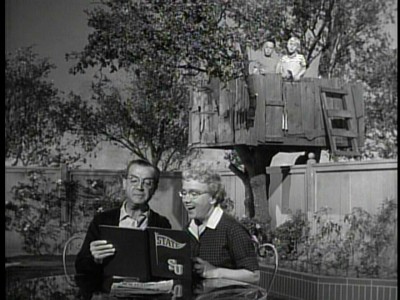
But then we hit the jackpot -- a short film in the "Our Gang" series (later known as Little Rascals), called "Hi, Neighbor!" from 1934. You can watch the full episode here. Around 1:40, several friends are rounding up their peers, and pay a visit to one who is inside his treehouse. And this has 99% of the elements that the later mature form would have.

It has a roof and walls, not just a floor and guard rails, it has a clear entrance opening to separate interior from exterior, not to mention some other openings with shades of a sort (animal hides). It's mostly made from wood planks, but animal hides as well. It's located up in a tree, with a means of getting up and down (a rope, not a ladder), and this tree is located in the yard of his house in a typical suburban residential neighborhood.

The only minor differences are the use of the rope instead of ladder to climb up, and the wooden planks of the walls being stacked vertically instead of laid horizontally. The mature form would take the "horizontal wooden slabs" inspiration from log cabins, another distinctive American building type, and equally rugged and home-made and down-to-earth (and yet up in the air), rather than pre-fab or urban or sophisticated.

The social relations are the same as in later examples -- there's a primary dweller or owner of the treehouse, but anyone is free to visit him at any time, if they're a friend. This example doesn't show the other friends climbing up there with the owner, but given their ongoing bonds of friendship, and the others' familiarity with this spot to call on their friend, it is implied that they sometimes hang out in his treehouse, without having to show it on camera.

And it fits the theme of the series overall, which follows a group of friends or peers or neighborhood kids, who feel part of a single collective social unit that is not related to each other -- "Our Gang".

Moreover, there are early hints at what other aspects of American identity the treehouse was channeling -- the owner has a pet monkey hanging out with him in the treehouse, there are animal hides as window coverings and doors / curtains, and he lets out a primitive nonsense call to announce his descent...

Much like Tarzan! That's right, the treehouse stems directly from Tarzan and the grandfather of American mythology, Edgar Rice Burroughs. American identity is that we are part caveman, and part spaceman -- perhaps cavemen traveling to outer space, or perhaps cavemen who were visited and guided by an outer space civilization. But cavemen, at any rate, and Tarzan is one of the earliest avatars of this facet of our identity.

Interestingly, though, early film portrayals of Tarzan do not show him living in what we now consider a prototypical treehouse. See this review of the changing nature of his treehouse in film portrayals. The first novel in the Tarzan series came out in 1912, but as late as the first two movies where he's played by Johnny Weismuller, from '32 and '34, his tree "house" is more of a perch or platform in the treetops, without a clear roof or walls or door. It's not until Tarzan Escapes from '36 that it becomes a proper house in the treetops.

Also, Tarzan's treehouse is not shown as the gathering-place or social sanctuary for a group of friends, peers, and acquaintances -- but his domestic space with his mate, Jane. So it's in the romantic vein rather than friendship vein. And if anything, it post-dates the "treehouse for friends," which debuted in the 1934 short from Our Gang.

Nevertheless, the parallels are clear -- the neighborhood friends, whether male or female, are a bunch of little Tarzans and Janes, so their living space must also be in the trees, and requires a roof and walls and entrances just like any house. So the makers of Our Gang were not directly imitating a treehouse from Tarzan-related pop culture, since that came a few years later in Tarzan-world. But they were channeling the Tarzan lifestyle and identity, then applying it to contemporary suburban America -- with the primitive roots being only half-obscured by modernity, and the other half proudly displayed in full view!

Wow, it all traces back to Our Gang -- why didn't I think of that to begin with?! I'm just not that immersed in pre-WWII culture, I guess. At least it clicked once I saw it, but I should've suspected it would trace back to them.

After a questionable example in the Disney animated short "Orphans' Picnic," where the house is more the tree trunk itself, with a hole bored into it and a little wooden plank platform outside, the next major example of a proper house built in the treetops -- and set in contempo America -- is also an animated short. In the Mighty Mouse series, "Wolf! Wolf!" from 1944 shows Mighty Mouse's main home being a treehouse, although we don't know if it's the focus of a peer group.

I can't find a video clip or still image, but in the live-action movie The Yearling from 1946, there's a treehouse that the protag sleeps in overnight. IDK if it's the focus for a peer group, though.

In the final major example from the '40s, and rounding out the maturation of the trope, is the Disney animated short "Donald's Happy Birthday" from 1949, with all the elements of what we now consider a treehouse. The only wrinkle is that its owners are three brothers (Huey, Dewey, and Louie), and it's shown as their own sanctuary, not necessarily one for a broader friend circle. But given that these brothers are also each others' closest friends, it doubles as a friend-based building too.

From there, the trope begins to fade in prominence, until the next major example of the TV show Dennis the Menace, which ran from '59 to '63. I used to watch that all the time on Nickelodeon in the '80s, when they still showed classic Midcentury shows. And I do remember him having a treehouse, or at least that fitting in with his world.

But it's not exactly a house anymore -- see this pic. It does have a floor, and low walls that only go up to waist height on children, but not walls that go over the kids' heads, and no ceiling or roof. It's a fairly open structure, more like a stand or perch or nest. And so, the door is more of a part of the low wall that swings open, like the gate of a residential fence, not an opening in a wall that separates an enclosed space from the outside world. It is built in a treetop and does use a ladder for climbing up. And it does involve friends (same-sex) -- that's his pal Tommy up there with him.

Still, you can see how less of a secluded sanctuary it is compared to the examples from the '30s and '40s. But then, that's only to be expected, giving the rising levels of social strife during the '50s and '60s, even somewhat beginning in the late '40s. Just cuz 1960 wasn't at the explosive peak of chaos of 10 years later, doesn't mean it was a harmonious stress-free kumbayah circle. I'll be revisiting this fact for other domains of society later. Suffice it to say that it was less socially harmonious than the '30s and '40s.

There's even an entire episode from 1960 about his tree house ("Dennis' Tree House"), which makes it into a social obstacle instead of a source of harmony. The treehouse is built right on the boundary with the yard of his neighbor, Mr. Wilson, who is upset that it might scare the birds away and he won't be able to enjoy his hobby of bird-watching. Things work out in the end, but it's part of a trend of the rising-strife phase that portrayed treehouses as sources of problems rather than unalloyed wholesomeness.

In a 1956 episode of Lassie ("The Tree House"), two friends Jeff and Porky get excited about building a treehouse and becoming blood-brothers -- seemingly off to a good start on the whole "treehouse as sanctuary for friends" theme. It's built in Jeff's yard with the help of his family. Unlike in Dennis the Menace, this is a proper treehouse with a roof, walls, doors, ladder, etc.

But then when they both spend the night in it, they bring their dogs along, and Porky's dog won't stop howling, keeping Jeff awake all night and making him so angry that he kicks out both the dog and his supposed blood-brother and guest Porky. When Jeff goes to apologize the next day for being a poor host / blood-brother, he finds the interior of the treehouse has been trashed, and assumes Porky did it as revenge -- more anti-social paranoia and suspiciousness and bad faith.

Later, there's a loud noise coming from the treehouse, and when Jeff goes to investigate -- there's a bear inside trashing the place even more. So that's what trashed the place before, not Porky -- but still, setting up the treehouse as a space that's vulnerable to roaming nomadic outsiders, including animals. Jeff's mom says no more treehouse. But it turns out the bear was escaped from the circus, not a wild one, so the mom says it's OK again. That makes no sense, there could still be wild bears or other troublesome animals roaming around that could climb up the ladder -- but the paranoid point has already been made. Beware! Caution! Risk!

The last of these problematizing examples is from 1970, from The Brady Bunch ("What Goes Up..."). In it, there's another proper treehouse, but it is still portrayed as a source of danger -- Bobby tries to climb up into it, but falls and sprains his ankle, leading him to develop a fear of heights on top of it.

What happened to treehouses just being wholesome sanctuaries for friends? Well, '56, '60, and '70 were all part of the rising-strife phase of the cycle. It wasn't the harmonious '30s and '40s anymore. So anything that might bring people together socially, like a treehouse sanctuary, had to be cast in a more negative and threatening light, as though it might introduce more strife than it would relieve. Not just physically, like scaring away the birds or posing a risk of falling injuries, but sowing the seeds of suspicion and resentment despite the promise of bringing camaraderie and appreciation, like driving a wedge between supposed blood-brothers.

* * *


It wasn't until after the peak of social chaos circa 1970 that that wary attitude began to wane, and treehouses regained their wholesome innocent pro-social connotations. Only a few years after the Brady Bunch episode, there was a renaissance of rural-themed TV shows, epitomized by The Waltons and Little House on the Prairie.

In a first-season episode of The Waltons (from '73), their treehouse makes its debut and would become a familiar fixture in their environment for years. It's a proper treehouse, not problematized, and since the show is set in the Depression, it revives the original wave of treehouse-mania from the '30s and '40s.

Our Gang was renamed Little Rascals, and given an animated format in 1982, which not only included a treehouse as a gathering spot for the friend circle, it was emphasized by being included in the intro sequence, to set the premise and sense of place and tone.

And from there, treehouses began to explode in popularity, although more so in movies that were set in the past, like Stand by Me and The Sandlot. Both of those are set in the early '60s, and so a proper treehouse and thriving friend circle would've been anachronistic for that time -- it would've been more appropriate for a movie set in the '30s or '40s. But still, by that time they were starting to swirl together all sorts of "pre-1968" periods of 20th-century America. A little bit of the '30s, a little bit of the late '50s or early '60s, always an unintended dash of the year in which it was made, it's all good.

Dennis the Menace was made into a movie in 1993, and it upgraded the treehouse to a proper one, again unlike the era in which the original TV show was made. Little Rascals was made into a movie the next year, although without a prominent treehouse.

The Simpsons had a treehouse in their backyard as a gathering spot for friends, and although I don't know when its first appearance was, the "Treehouse of Horror" series for Halloween began in 1990. The only episode from '89 was the very first one, so unless it's in that episode, it first appeared sometime in '90.

The revival of the wholesome and non-threatening treehouse trope during the '80s and '90s reflected the rising-harmony phase of the cycle, before merging with or enhancing the new trope of "teen's room as treehouse within the home itself".

After the '90s, the treehouse trope begins to fade once again, not to mention picking up the connotation of danger and threats, right back to Lassie and Dennis the Menace and The Brady Bunch. But that's only natural, as the social mood swung away from harmony and toward strife once again, and anything that would cement social bonds among friends would have to come under suspicion and then get eliminated altogether.

However, now that the pendulum is finally swinging back toward harmony, as of the past couple years, maybe treehouses, teen's room as a treehouse within the home, or some new variation on this perennial American theme will emerge -- assuming we still had a thriving pop culture production sector, which we do not at all. American culture -- meaning, all-American, appealing to and paid attention to by all -- has been extinct since 2020.

But in whatever fragmented niche-demo remains of American-ish culture that remain going forward, we're likely to see a gradual revival of this theme, likely peaking in the early 2040s.

Maybe in video games? Minecraft is still thriving, despite coming out in 2010, so perhaps treehouses will become the hot new thing to build. Mumei made a cozy little one for herself a couple years ago, Fauna made the huge sun-obscuring World Tree during that time (which was not just a tree, but had home-like architecture at the top), so... maybe it's the start of a new trend?

It'll probably be more visible in new games, where there's a prominent treehouse built into it, but it'll be some niche indie thing that not the whole world knows about, or something. But the urge to hang out with friends in treehouses -- or their present-day descendants, perhaps in a form not yet invented -- will become overpowering in the next two decades. Plenty of time for it to find some kind of realization in the cultural realm.

Look forward to seeing what it is, while still knowing in advance it won't top, as it were, the examples from the '30s and '40s or the '80s and '90s. ^_^

December 26, 2024

The Indo-European-ness of Ashkenazi Hanukkah, Rosh Hashanah, etc.

I'll get to Christmas and New Year's posting later. For now, to get a new post started, I'll begin with a narrower topic.

Earlier posts this year have reviewed the work of others, and uncovered tons of signs from my own investigations, pointing to Ashkenazi Jews being converts to Talmudic Judaism during the 2nd half of the 1st millennium AD, and coming from mixed Indo-European sources -- one East Slavic, the other East Anatolian / Armenian / Iranian -- that eventually genetically merged into a single-mode genepool, after forming a loose cultural coalition based around controlling trade routes in and around the Khazar Khaganate.

So for the Christmas season, I naturally wondered, "How much of Hanukkah came from Christmas, Nowruz, or even earlier Indo-European holidays of this time of the year?"

Before getting to the main topic of Christmas, my investigation led me to stumble upon another highly distinctive Indo-Euro tradition that Ashkenazi Jews practice, but for Rosh Hashanah -- New Year's. They bake a loaf of challah bread for the occasion, but this isn't any ordinary loaf for any ordinary occasion -- the new year is all about bringing good luck, improving over the bygone year. So for Rosh Hashanah, they bake a key -- yes, a literal metal key -- into the loaf. This is meant to be a magic charm that will bring good luck in the new year.

Recall an earlier post that surveyed this very same ritual from Ireland to Iran, including a good luck charm in the dessert for the New Year's holiday. In some of those cultures, it is tied to Christmas, like the "king cake" from Spain and France (and places influenced by them, like New Orleans in America). They bake a figurine into a cake, and whoever gets the piece with the good luck charm will have good luck in the new year!

Well, the Ashkenazi "shlissel challah" (after the Yiddish word for "key" and the Hebraized word for "loaf of bread") is not fully identical to the Indo-Euro tradition, since there's no practice of dividing up the loaf and whoever gets the portion with the metal key has good luck. Apparently, the good luck belongs to the baker of the loaf, regardless of who finds it when eating the loaf. Also, the food item is not specifically dessert.

And yet, it's impossible to ignore the striking similarities. The "baking a key into a loaf of bread" seems to go back several centuries, although perhaps not much further. I think there must be an earlier form that this ritual took, where it was a sweet baked good and not just a typical loaf of bread, and where the good luck only belonged to the individual lucky enough to get that portion of the dessert that contained the charm -- not the preparer of the food.

But somewhere along the way, this ritual was lost, and a diluted form remained in the newer shlissel challah tradition. Needless to say, Jews from the Saharo-Arabian sphere, such as Moroccan Jews, do not practice this tradition -- it's a distinctly Indo-Euro thing. And the fact that Ashkenazi shlissel challah is 90% identical to Irish Christmas pudding and Iranian samanu for Nowruz, is a powerful testament to the Indo-European-ness, rather than Saharo-Arabian-ness, of their culture.

Moving on now to Hanukkah, two of the major features of contemporary Ashkenazi Hanukkah -- gelt and the dreidel -- are fairly recent, going back maybe a few centuries in Europe, so it's hard to infer anything about Ashkenazi roots from them. Maybe they just picked it up from their European hosts, like they did with the dreidel (teetotum). Maybe they invented it themselves, but long after Ashkenazi ethnogenesis had taken mature form (like the gelt).

However, the most prominent symbol and practice -- lighting the menorah -- is more revealing, since it goes back further.

Here is a good review of the earliest Hanukkah menorahs, whether surviving examples of them, visual depictions of them in old sources, or written accounts.

The earliest accounts of them date to circa 1000 AD in Europe, followed centuries later by illustrated depictions and surviving examples. They do not trace back to Classical times, or Bronze Age times, or anything related to Second Temple Judaism and its account of the past. They're absent for most of the Dark Ages, for that matter.

That is just after the collapse of the Khazar Khaganate, though, when the Jewish converts who controlled the trade routes would have had to migrate further westward into Europe to earn a new living. 14th-century Jewish cemeteries, like the one in Erfurt, Germany, show that they had developed a culture of their own, having their own section of a cemetery, although their genepool was still bi-modal at that point.

But sometime between the fall of the Khazar Khaganate and these 14th-C. cemeteries in Germany, Ashkenazi ethnogenesis had taken off.

The lack of menorahs during most of the Dark Ages shows that, yet again, there is no evidence showing a cultural continuity from Second Temple-period Judaeans and the Ashkenazi Jews. Most notably, the Ashkenazis have never been documented as speaking a Semitic language (until some of them began LARP-ing as neo-Judaeans, moving to Palestine and reviving Hebrew), or any other member from the Saharo-Arabian family broadly. Only Indo-European ones, like Yiddish.

Moreover, the menorahs from the earliest depictions do not resemble the Temple menorah from the Classical period, which had 7 branches, with 1 in the center, and 3 pairs of symmetrical branches leading out from the center. This verbal description and visual depiction is widely attested in Classical times themselves, e.g. in the Arch of Titus from roughly 80 AD that shows the Roman removal of the Temple menorah after destroying the Temple 10 years earlier.

Re-shaping the Hanukkah menorah to take this form, but with 4 pairs of branches plus a central branch, is pretty recent, perhaps from the 19th C or so, and maybe connected to or pre-figuring the Romantic nationalist movement of Zionism.

At any rate, the early Hanukkah menorahs don't resemble the Temple menorah whatsoever. They don't have a single branch and pairs of symmetrical branches. And the structure is not a pedestal or base, with the light-bearing elements being held aloft by the branching section. Rather, the light-bearing elements were all resting flat on a single horizontal surface, like a shelf or fireplace mantle, with no branching or supporting elements underneath the shelf.

More tellingly, the earliest depictions show candles as the light-bearing element -- a practice that continues to this day, even after the change in the shape of the main supporting structure, from a shelf to a Temple-esque design.

The original Temple menorah did not use candles at all -- the end of each branch held a cup for oil, in which a wick was dipped. Even further back, in the narrative that motivates the holiday of Hanukkah, there is a miracle of oil -- which continued to burn for 8 days and nights, when supposedly there was only enough oil to burn for one. It's not a miracle of a candle that continued to burn longer than it should have -- there's no mention of candles, only oil lamps.

Throughout the Medieval period in the Saharo-Arabian sphere, including our Western contempo depiction of it, oil lamps were the defining way of portable artificial lighting.

In fact, to this day, Moroccan Jews -- who *do* come from the Saharo-Arabian sphere, and *are* documented as speaking a Semitic language historically -- use an oil lamp form of a menorah for Hanukkah, unlike the candle-based form that the Ashkenazis use.

Did anyone in the Middle East adopt candles as much as the Europeans did? Yes -- the Persians! And the Indian groups further to their east. Candles are not so ancient, but they're ancient enough -- going back to the Romans. And yet, their spread seems to have been confined to the Indo-European sphere, with Greeks and Persians and Indians adopting them, but not so much the Arabians or North Africans.

See the article on candles from the Encyclopedia Iranica for the full history of candles in Iranian culture, but the fact that it has its own entry testifies to how central they are to Iranian culture.

And -- wait, what's this? -- Iranians light candles to place on the main table during Nowruz, along with the Half-Seen items. And like the early Ashkenazi menorahs, they are not held on a branching symmetrical candelabra, just on top of the table top. Nowruz and Christmas overlap a lot due to them being "end of the year" holidays, although over the centuries, Iranian New Year's has stayed in the arrival of springtime (when the Proto-Indo-European New Year's holiday was likely held), while the Indo-Euros who adopted Christianity moved it back toward the new central holiday of Christmas, nearly at the end of their calendar year.

Candles have been central to European Christmas traditions for centuries, including placing them on the Christmas tree in the Modern era, until there were electric lights. Or the Lutheran practice of Advent candles, which are similar to the Hanukkah menorah in keeping track of the time during the late December holiday. Candlemas, in early February, is the end of Christmas / Epiphany season, transitioning into the New Year.

Candles on a Hanukkah menorah places the Ashkenazi holiday within the Indo-Euro, rather than Saharo-Arabian, traditions. But maybe it's just the Ashkenazi adopting or assimilating to practices of their Euro hosts? How do we know it goes back further and may originate outside of Europe?

Back to those Nowruz candles! Some practitioners of Nowruz include one candle for every child in the household, making the number of candles variable -- a multiple of the number of children in the home.

Wouldn't you know it? -- the Ashkenazis also tend to increase the number of candles, as a multiple of the number of children in the home! They give everyone their own individual menorah, each of which has 9 candles.

So it's not exactly the same as Nowruz, where each child only gets one candle. But the Ashkenazi child getting 9 candles is due to the invariable nature of 9 in the Hanukkah holiday -- it celebrates the 8 nights of the miracle of the oil, plus the 1 candle to help light the others. Each child must get 9 candles, not just 1, otherwise it wouldn't commemorate the 8 nights.

However, the number of candles does increase as a multiple of the number of children in the home, for both Nowruz and Ashkenazi Hanukkah. I don't know of a similar "certain number of candles per child at home" tradition in other Indo-Euro cultures during Christmas or New Year's. If it exists, it must be fairly marginal, whereas the practice is widespread enough to this day for Nowruz that it's mentioned in reviews of the holiday rituals.

And the good ol' Moroccan Jews seal up the other side of the argument -- they don't have one menorah per child, or anything that varies with the number of children at home. They only use one menorah for the entire household, no matter how many people live there.

So, Ashkenazi Hanukkah rituals more closely resemble Iranian Nowruz than Moroccan Jewish Hanukkah, aside from the indisposable elements like commemorating the number 8, artificial light-bearing things, etc.

Those Late Medieval depictions of menorahs in Europe only show them lighting 8 candles in a place that is probably a synagogue. And in that context, there's no family living there -- so they can't, in principle, vary the number of menorahs with the number of residents. Perhaps as Hanukkah became a popular holiday within the domestic setting, it met an older ritual that involved "increasing the number of lights according to the number of children". And that older ritual came from the Iranian sphere.

This is yet another sign that the source populations for that coalition that would eventually become the Ashkenazi Jews definitely included one in or around Iran.

But more than that -- I think most of their religious and sacred traditions were carried over from that Iranian source, and not from the East Slavic source that also held sway in their coalition.

I've mentioned the divide between Germanic-surnamed Ashkenazis, who seem to have a higher proportion of genetic and/or cultural background in the Iranian source, vs. the Slavic-surnamed Ashkenazis, who have less of it and more of the Slavic source.

The Iranian source seems to have been more cultured, elite, prestigious, sophisticated, with a long history of being administrators, bureaucrats, scientists, artists... and perhaps also priests. Not merely "religious officials," but priests as an elevated specialist elite stratum in society, propped up by the material surplus of a large sedentary agrarian economy.

East Slavs in the Dark Ages simply did not have that kind of economy, nor did the West Slavs for that matter. Only the South Slavs did -- namely, the Bulgarian Empire, who sponsored and spread the Cyrllic Alphabet among the previously illiterate Slavs, adopted and codified Christianity for the Slavs (including the use of Old Bulgarian, AKA "Old Church Slavonic," as the liturgical language, even for other Orthodox Slavs to this day), founded the Orthodox Slav style of churches through their proximity to the Byzantine Empire, and so on and so forth.

East Slavs were semi-nomadic, mainly peasants, no large or powerful central state ever in their history, illiterate, with a folk culture but not much of a high culture, etc. They represented the brusque, pushy, materialistic trader type. That type also exists in a civilized culture like Iran, but there's also the spiritual specialist type, who fill a permanent role of "priest".

So when it came time to come up with rituals for the new converts to Judaism, the Ashkenazis all looked at each other and decided, "Well, you Iranian types seem to know what you're doing with the whole priestly role -- why don't you handle that part of our culture-to-be? As long as we East Slavs don't find anything too fishy about it, we'll just take your civilized word for it."

This ties into the genetic data on Ashkenazi Jews, where there are certain genetic markers for the so-called "priestly bloodline" AKA the kohanim (such as those with the surname Cohen). They are supposedly descended from the temple priests of the Second Temple era, who, after the temple was destroyed in 70 AD, continued to play some kind of new priestly-ish role in society, just not the same was as tending to the now-destroyed temple. And they supposedly kept that role within their bloodline, only marrying into other priestly families.

Well, the "keeping our bloodlines priestly" I can buy -- but not them tracing back to the Second Temple Judaeans. We know from all the other evidence that they have no genetic or cultural connection to them, not even religiously -- the Ashkenazis are only documented as practicing Judaism from the Talmudic era, not Second Temple Judaism.

However, if the kohanim within the Ashkenazis were more likely to come from the Iranian rather than the Slavic sub-population of their founders, then they'll at least pass as "Middle Eastern", which is always a weasel-word in genetic studies. Middle Eastern meaning an Indo-European-speaking "fire worshiper"? -- or a Semitic-speaking monotheist? Very different cultures!

And who knows? Maybe there was one actual Judaean priest who wandered into Persia in order to help train the new converts, and he left some of his kohanim bloodline there, where it got preserved through priestly caste endogamy. I highly doubt that, but even if true, it only says there was that one ancestor who was Judaean, vs. 99% of Ashkenazi "Middle Eastern" ancestors being Iranian / Armenian / East Anatolian.

That suggests that, like Iranian bureaucrats, Iranian priests are mainly based on their role in society, not on the specific institution it serves. They were priests under Zoroastrianism, then mullahs under Islam, and some of them as kohanim within the Iranian-derived portion of the Ashkenazi Jews.

That makes me wonder about when Christianity used to be a big deal in Persia and further east ("Nestorians"). That was during the Dark Ages, when Zoroastrianism, Islam, Christianity, and Judaism were all vying with each other for influence. There were certainly Iranian Christian priests in those days.

Maybe there's a common priestly genetic sub-population that they all came from, no matter which religion they performed the priestly role within. At that narrower level, I'm sure there are genetic differences -- Zoroastrian priests wouldn't have married into Christian priest families (knowingly), or with Muslim clerics (knowingly), and so on.

Maybe take the Parsis in India as a convenient example of Zoroastrian priests, although DNA from actual Late Classical / Medieval Zoroastrian priests would be ideal. Muslim clerics in Iran are still around, with some families or bloodlines being well known already, I'm sure. And then use Ashkenazi kohanim as the other comparison.

I'll bet, at a certain level, they all came from the same priestly genepool in Iran! Just like Iranian bureaucrats who were famously adept at serving one empire, or another, or another still. It's the specialized role, not the master, that they preserved. Iran is not an anarchic, tribal, nomadic culture of honor like it used to be way back in the Bronze Age, or like many of its neighbors have been (Turkic, Mongol, Arabian). It's one of the most thoroughly and thorough-going civilized cultures on Earth, for better or worse.

Where else would new converts to Judaism recruit their priests from, if Iranians were an option? For the Ashkenazis, it was -- and they did.