I haven't waded into political dIsCouRsE for awhile, since there has been nothing new to add from what I've already said. But with the looming possibility of food stamp (SNAP) benefits not going out for November, amid the federal government shutdown, it's worth examining the collapse of the charity / safety net sector of society, during the broader collapse of an empire -- as well as its stratospheric growth during imperial expansion.
A large majority of English-language internet content comes from outside America, as English has become the global lingua franca -- but that doesn't mean foreigners understand America, just cuz they speak English and have watched American movies or played American serial killer simulators. So when they hear about cuts to the American food stamp program, they project their own nation's status quo onto ours, and imagine cuts to their own system. But America is the last bloated empire left standing, currently entering its collapse stage, so all comparisons from foreigners will fail.
The clearest way to see this is in the scale of food aid across countries. With SNAP in the news, many Americans are suddenly shocked to discover how much of the population receives it -- about 13%, or 1 out of every 8 residents, an astonishing figure.
And that's just SNAP, not counting the various other arms of the food assistance system, such as food banks, where the estimate is about 17%, or 1 out of every 6 residents, receiving that form of food aid. Depending on the overlap between the two -- and presumably some people are getting both -- that's at least 20% of people living here relying on food aid.
Food banks don't supply every meal for every day in every month -- but neither do the benefits paid out by SNAP, which may be merely $25 a month.
Food banks de facto do not put any barriers to eligibility, unlike SNAP which is means-tested -- you have to be making below a certain income, you generally have to work if you're able-bodied and working-age, and so on, and all of this info is documented and verified by case workers. SNAP is targeted more toward rural residents, while food banks seem to be aimed more at urban or metro-area residents. So I don't think there's tons of overlap between the two, meaning the percent relying on food aid could be higher, like 25%. But it's at least 13%, based on SNAP alone.
What percent of other 1st-world countries rely on food aid? It's hard to say, cuz some bundle all social welfare pay-outs into a single allotment, and it goes toward food, housing, and other basic expenses. That is a maximum figure, then, for food stamps. Some countries don't include food payments, but do give out food packages in kind.
Regardless of these differences from the American system, no other 1st-world country is even remotely close to America's level of food assistance -- about 1-2% of the population in Sweden and Glorious Nippon, 4-5% in France and Italy, even in Poland only 3% rely on food aid. I looked for English-language stats on Russia, but sadly they're all slopaganda -- if any legit Russian-language source can be found, let me know.
So outside America, the most vulnerable 1-5% would be affected by cuts to food aid. And because those on food aid are so much lower in the social pyramid, cutting their benefits would strike their citizens as obscenely cruel.
But in America, cutting food aid "only" affects the bottom 13-25%, which of course includes the same bottom 1-5% as would be affected in other countries, but at least an extra 10% of the population higher up on the pyramid, which is between double the share who get aid outside America (in places where 5% get it), up to 8 times the share (in places where 1-2% get it).
Aside from cross-national comparisons at the same time, we can compare America today to America in years past, back to the 1970s when the system was regularized and institutionalized. There has been a jump in both the share of the American population relying on food aid, and the amount spent on food aid (inflation-adjusted, as a share of GDP, however you measure it). This traces back only to the aftermath of the 2008 Depression, from which America has never recovered (the elites only printed up $10 trillion and handed it out to moronic strivers to play around with). It spiked even further during the Covid hysteria, and 5 years later is still not down to pre-Covid levels, despite Covid being over.
There was a gradual increase during the '80s and '90s, although there was also a decrease during the second half of the '90s. So some of this can be blamed on neoliberalism and de-industrialization, but the jump since 2008 and 2020 seems more like the NGO-industrial complex seizing the opportunity to expand their operations, with the crisis du jour as a rationalization. Other 1st-world countries were destroyed by 2008 and 2020, but they didn't expand their food aid system to cover 13-25% of their population like we did.
For comparison, in 1974 as the system went nationwide, food stamp enrollment was 15 million, out of a total population of 214 million, or 7%. Since 1980, it has maxed out at 10% during a recession and/or a phase of greater funding, and dipped into the high single digits during economic recoveries and/or a phase of lesser funding. But tearing above 10% and that becoming the new normal is very recent. And by the looks of things, that percentage may only grow in the short-term.
And again, that's only SNAP, the means-tested form of food aid -- not covering the exponential increase in food bank aid, which used to be nearly non-existent and limited to soup kitchens, canned food drives, and the like, but has now expanded to rival the SNAP program itself. The estimate of 17% using them is over the course of a year, but even at the time-frame of a month, about 5% of respondents use them (see here for discussion of the 2 different national statistical surveys that ask about food security).
Food banks appear to have grown to fill a separate niche than the SNAP niche -- namely, people who don't qualify for SNAP, due to income, work status, citizenship status, difficulty / unwillingness in filling out forms, or whatever else.
There's surely some double-dippers, but most inquiries I found online about visiting food banks said they don't qualify for SNAP and are curious if the food banks will impose similar means-testing on people who show up to food banks (short answer: they will not, de facto, although they may ask you for an ID to show you reside in the area, or to sign a legally unbinding form that you pinky-swear represents your income). Food banks appear more likely to serve downwardly-mobile middle class residents of metro areas, compared to SNAP.
Then there's the growth in the amount spent on the program, aside from the rise in the percent using it. Some of the long-term growth in the SNAP budget is due to overall inflation, but the program's budget was fairly stable at about $20 billion during the '90s and early 2000s. It made a quantum leap to a new normal of about $60 billion in the wake of 2008, and made another quantum leap to a pandemic peak of $120 billion in 2022, although that has declined to a new normal that is still a quantum leap above the 2008 jump, at around $100 billion for 2024.
It doesn't matter that this is "a drop in the bucket" of the national budget, at 1-2% of federal spending -- when every single program uses up 2-3-4 times as much as it used to in just the 2000s, it collectively explodes the federal budget. And this is even more unsustainable these days, since more and more federal spending is paid for by debt -- with ever-soaring interest rates -- and by currency debasement (printing up trillions in a single year of 2020, which never gets withdrawn from circulation).
The good ol' days when "taxpayer dollars" paid for government spending are long gone -- now everybody pays a highly regressive tax, namely hyperinflation once our unsustainably skyrocketing debt gets defaulted on and no one will loan us even a small amount that is necessary, as well as currency debasement which has already shaved off a double-digit percentage of the dollar's purchasing power in the past few years alone -- and that trend is only escalating, as the dollar sinks and gold soars.
So, rather than the deluded para-political game of "musical chairs" that is a constant source of slopaganda in social media fanfic -- or picking which programs to keep and which to slash, and by how much for each program -- the reality is that every single one of those programs is going to collapse, as our empire collapses. All are bloated beyond their original purpose, beyond sustainable levels, and no one will yield, so they will all totally collapse, and be replaced by state-level replacements in the post-imperial era, much like rump states will replace the current federal state as polities.
In 5-10 years, we won't be bailing out Trump's cronies in Argentina to the tune of $40 billion on a whim, since we won't have any worthwhile currency to bail them out with anymore. We might as well hand them 40 gazillion Zimbabwe bucks.
We already have run out of actually valuable military equipment to flush down the toilet in Ukraine, and in 5-10 years, our military manufacturing industry will be even more hollowed out. So we won't be bogged down in that wasteful dead-end either.
But the point is, every one of these bloated, over-extended, ever-expanding cancerous growths on the empire is going to collapse the entire system on which they feed. They will be replaced by state-level replacements, which will not be so imperially over-extended and over-produced, since we will be in the post-imperial stage of our history.
Maybe one or two wealthy rump states, like the Grand Duchy of California, will attempt a relatively more generous welfare system than the kleinstaats that will make up New New England. But the days when well over 10% of the population is receiving food aid, will be over.
That will not be due to the poorest 1-2% getting wiped out -- they'll still be covered by the rump state welfare systems. But the over-produced group of food aid recipients will not be receiving it any longer. As in post-imperial Rome, foreigners will go back to their homelands, as wealth dries up in post-imperial America, the downwardly mobile will not have as many kids, and with no imperial-scale parasites at the top of the wealth pyramid, resources will be more evenly distributed in the rump states, so there won't be so many desperate working and middle class people either. The bloated war-losing military will be gone, the Baby Boomers will be dead, and Wall Street banks will be holding worthless currency, not real wealth with which to bully the rest of the economy.
Through these various channels, population size will collapse in post-imperial America, just as it did in the Roman Empire. The imperial capital, Rome, had over 1 million residents during the empire's peak in the 2nd century, but during the 5th C, it collapsed by an order of magnitude, or 90%, down to 100,000. It never regained the 1 million mark even after it emerged from the Dark Ages, like the Renaissance or Early Modern eras -- only after national unification brought loads of Italians from other regions of Italy to the new national capital, during the 20th C. (NB: not loads of foreigners, as during the Roman Empire.)
I don't know how long it'll take the population of New York -- and other major cities of post-imperial America -- to collapse by 90%, but they all will. It won't be hard to support the bottom 1-5% on welfare, like most non-imperial or post-imperial 1st-world countries manage today, since the total population is going to shrink down to 25-50 million. We may not collapse as hard as Rome did, since we have lots of open land to still colonize and exploit the resources of, but it will be a radical reduction.
The main thing to remember is -- everything of imperial scale is going to collapse when an empire collapses. If there is no state-level replacement, like a foreign-adventuring military, there will be no such replacement at all. There will be "no more foreign wars", just state-level militias for defense of their own territory. If there is a state-level replacement, like welfare, it will be scaled down obviously, but there will be a replacement.
Also crucial to remember -- none of this is up for debate, by anybody. Certainly not by the para-political fanfickers from social media, who treat the dIsCouRsE as though it's a "model UN" activity that will somehow magically alter the course of IRL events. That goes for both the objective / technocrat niche, as well as the subjective / moralistic niche. All fake and gay.
But it's not even up for debate by actual holders of national offices, their appointees, and their mega-donors. The American Empire is collapsing, irrevocably, and so will every institution of imperial scale along with it, to be replaced -- if at all -- by scaled-down state-level replacements, like rump states and welfare systems typical of the rest of the 1st world, not the over-extended and unsustainable system that we have erected up to this point.
Only the cold iron laws of historical dynamics have a say in the course of events, and we can see from every empire how this no-different empire will turn out, at a bird's-eye level.

October 27, 2025
The collapse of the imperial-scale welfare system, due to over-production of recipients (a special case of general imperial over-extension)
December 26, 2024
The Indo-European-ness of Ashkenazi Hanukkah, Rosh Hashanah, etc.
I'll get to Christmas and New Year's posting later. For now, to get a new post started, I'll begin with a narrower topic.
Earlier posts this year have reviewed the work of others, and uncovered tons of signs from my own investigations, pointing to Ashkenazi Jews being converts to Talmudic Judaism during the 2nd half of the 1st millennium AD, and coming from mixed Indo-European sources -- one East Slavic, the other East Anatolian / Armenian / Iranian -- that eventually genetically merged into a single-mode genepool, after forming a loose cultural coalition based around controlling trade routes in and around the Khazar Khaganate.
So for the Christmas season, I naturally wondered, "How much of Hanukkah came from Christmas, Nowruz, or even earlier Indo-European holidays of this time of the year?"
Before getting to the main topic of Christmas, my investigation led me to stumble upon another highly distinctive Indo-Euro tradition that Ashkenazi Jews practice, but for Rosh Hashanah -- New Year's. They bake a loaf of challah bread for the occasion, but this isn't any ordinary loaf for any ordinary occasion -- the new year is all about bringing good luck, improving over the bygone year. So for Rosh Hashanah, they bake a key -- yes, a literal metal key -- into the loaf. This is meant to be a magic charm that will bring good luck in the new year.
Recall an earlier post that surveyed this very same ritual from Ireland to Iran, including a good luck charm in the dessert for the New Year's holiday. In some of those cultures, it is tied to Christmas, like the "king cake" from Spain and France (and places influenced by them, like New Orleans in America). They bake a figurine into a cake, and whoever gets the piece with the good luck charm will have good luck in the new year!
Well, the Ashkenazi "shlissel challah" (after the Yiddish word for "key" and the Hebraized word for "loaf of bread") is not fully identical to the Indo-Euro tradition, since there's no practice of dividing up the loaf and whoever gets the portion with the metal key has good luck. Apparently, the good luck belongs to the baker of the loaf, regardless of who finds it when eating the loaf. Also, the food item is not specifically dessert.
And yet, it's impossible to ignore the striking similarities. The "baking a key into a loaf of bread" seems to go back several centuries, although perhaps not much further. I think there must be an earlier form that this ritual took, where it was a sweet baked good and not just a typical loaf of bread, and where the good luck only belonged to the individual lucky enough to get that portion of the dessert that contained the charm -- not the preparer of the food.
But somewhere along the way, this ritual was lost, and a diluted form remained in the newer shlissel challah tradition. Needless to say, Jews from the Saharo-Arabian sphere, such as Moroccan Jews, do not practice this tradition -- it's a distinctly Indo-Euro thing. And the fact that Ashkenazi shlissel challah is 90% identical to Irish Christmas pudding and Iranian samanu for Nowruz, is a powerful testament to the Indo-European-ness, rather than Saharo-Arabian-ness, of their culture.
Moving on now to Hanukkah, two of the major features of contemporary Ashkenazi Hanukkah -- gelt and the dreidel -- are fairly recent, going back maybe a few centuries in Europe, so it's hard to infer anything about Ashkenazi roots from them. Maybe they just picked it up from their European hosts, like they did with the dreidel (teetotum). Maybe they invented it themselves, but long after Ashkenazi ethnogenesis had taken mature form (like the gelt).
However, the most prominent symbol and practice -- lighting the menorah -- is more revealing, since it goes back further.
Here is a good review of the earliest Hanukkah menorahs, whether surviving examples of them, visual depictions of them in old sources, or written accounts.
The earliest accounts of them date to circa 1000 AD in Europe, followed centuries later by illustrated depictions and surviving examples. They do not trace back to Classical times, or Bronze Age times, or anything related to Second Temple Judaism and its account of the past. They're absent for most of the Dark Ages, for that matter.
That is just after the collapse of the Khazar Khaganate, though, when the Jewish converts who controlled the trade routes would have had to migrate further westward into Europe to earn a new living. 14th-century Jewish cemeteries, like the one in Erfurt, Germany, show that they had developed a culture of their own, having their own section of a cemetery, although their genepool was still bi-modal at that point.
But sometime between the fall of the Khazar Khaganate and these 14th-C. cemeteries in Germany, Ashkenazi ethnogenesis had taken off.
The lack of menorahs during most of the Dark Ages shows that, yet again, there is no evidence showing a cultural continuity from Second Temple-period Judaeans and the Ashkenazi Jews. Most notably, the Ashkenazis have never been documented as speaking a Semitic language (until some of them began LARP-ing as neo-Judaeans, moving to Palestine and reviving Hebrew), or any other member from the Saharo-Arabian family broadly. Only Indo-European ones, like Yiddish.
Moreover, the menorahs from the earliest depictions do not resemble the Temple menorah from the Classical period, which had 7 branches, with 1 in the center, and 3 pairs of symmetrical branches leading out from the center. This verbal description and visual depiction is widely attested in Classical times themselves, e.g. in the Arch of Titus from roughly 80 AD that shows the Roman removal of the Temple menorah after destroying the Temple 10 years earlier.
Re-shaping the Hanukkah menorah to take this form, but with 4 pairs of branches plus a central branch, is pretty recent, perhaps from the 19th C or so, and maybe connected to or pre-figuring the Romantic nationalist movement of Zionism.
At any rate, the early Hanukkah menorahs don't resemble the Temple menorah whatsoever. They don't have a single branch and pairs of symmetrical branches. And the structure is not a pedestal or base, with the light-bearing elements being held aloft by the branching section. Rather, the light-bearing elements were all resting flat on a single horizontal surface, like a shelf or fireplace mantle, with no branching or supporting elements underneath the shelf.
More tellingly, the earliest depictions show candles as the light-bearing element -- a practice that continues to this day, even after the change in the shape of the main supporting structure, from a shelf to a Temple-esque design.
The original Temple menorah did not use candles at all -- the end of each branch held a cup for oil, in which a wick was dipped. Even further back, in the narrative that motivates the holiday of Hanukkah, there is a miracle of oil -- which continued to burn for 8 days and nights, when supposedly there was only enough oil to burn for one. It's not a miracle of a candle that continued to burn longer than it should have -- there's no mention of candles, only oil lamps.
Throughout the Medieval period in the Saharo-Arabian sphere, including our Western contempo depiction of it, oil lamps were the defining way of portable artificial lighting.
In fact, to this day, Moroccan Jews -- who *do* come from the Saharo-Arabian sphere, and *are* documented as speaking a Semitic language historically -- use an oil lamp form of a menorah for Hanukkah, unlike the candle-based form that the Ashkenazis use.
Did anyone in the Middle East adopt candles as much as the Europeans did? Yes -- the Persians! And the Indian groups further to their east. Candles are not so ancient, but they're ancient enough -- going back to the Romans. And yet, their spread seems to have been confined to the Indo-European sphere, with Greeks and Persians and Indians adopting them, but not so much the Arabians or North Africans.
See the article on candles from the Encyclopedia Iranica for the full history of candles in Iranian culture, but the fact that it has its own entry testifies to how central they are to Iranian culture.
And -- wait, what's this? -- Iranians light candles to place on the main table during Nowruz, along with the Half-Seen items. And like the early Ashkenazi menorahs, they are not held on a branching symmetrical candelabra, just on top of the table top. Nowruz and Christmas overlap a lot due to them being "end of the year" holidays, although over the centuries, Iranian New Year's has stayed in the arrival of springtime (when the Proto-Indo-European New Year's holiday was likely held), while the Indo-Euros who adopted Christianity moved it back toward the new central holiday of Christmas, nearly at the end of their calendar year.
Candles have been central to European Christmas traditions for centuries, including placing them on the Christmas tree in the Modern era, until there were electric lights. Or the Lutheran practice of Advent candles, which are similar to the Hanukkah menorah in keeping track of the time during the late December holiday. Candlemas, in early February, is the end of Christmas / Epiphany season, transitioning into the New Year.
Candles on a Hanukkah menorah places the Ashkenazi holiday within the Indo-Euro, rather than Saharo-Arabian, traditions. But maybe it's just the Ashkenazi adopting or assimilating to practices of their Euro hosts? How do we know it goes back further and may originate outside of Europe?
Back to those Nowruz candles! Some practitioners of Nowruz include one candle for every child in the household, making the number of candles variable -- a multiple of the number of children in the home.
Wouldn't you know it? -- the Ashkenazis also tend to increase the number of candles, as a multiple of the number of children in the home! They give everyone their own individual menorah, each of which has 9 candles.
So it's not exactly the same as Nowruz, where each child only gets one candle. But the Ashkenazi child getting 9 candles is due to the invariable nature of 9 in the Hanukkah holiday -- it celebrates the 8 nights of the miracle of the oil, plus the 1 candle to help light the others. Each child must get 9 candles, not just 1, otherwise it wouldn't commemorate the 8 nights.
However, the number of candles does increase as a multiple of the number of children in the home, for both Nowruz and Ashkenazi Hanukkah. I don't know of a similar "certain number of candles per child at home" tradition in other Indo-Euro cultures during Christmas or New Year's. If it exists, it must be fairly marginal, whereas the practice is widespread enough to this day for Nowruz that it's mentioned in reviews of the holiday rituals.
And the good ol' Moroccan Jews seal up the other side of the argument -- they don't have one menorah per child, or anything that varies with the number of children at home. They only use one menorah for the entire household, no matter how many people live there.
So, Ashkenazi Hanukkah rituals more closely resemble Iranian Nowruz than Moroccan Jewish Hanukkah, aside from the indisposable elements like commemorating the number 8, artificial light-bearing things, etc.
Those Late Medieval depictions of menorahs in Europe only show them lighting 8 candles in a place that is probably a synagogue. And in that context, there's no family living there -- so they can't, in principle, vary the number of menorahs with the number of residents. Perhaps as Hanukkah became a popular holiday within the domestic setting, it met an older ritual that involved "increasing the number of lights according to the number of children". And that older ritual came from the Iranian sphere.
This is yet another sign that the source populations for that coalition that would eventually become the Ashkenazi Jews definitely included one in or around Iran.
But more than that -- I think most of their religious and sacred traditions were carried over from that Iranian source, and not from the East Slavic source that also held sway in their coalition.
I've mentioned the divide between Germanic-surnamed Ashkenazis, who seem to have a higher proportion of genetic and/or cultural background in the Iranian source, vs. the Slavic-surnamed Ashkenazis, who have less of it and more of the Slavic source.
The Iranian source seems to have been more cultured, elite, prestigious, sophisticated, with a long history of being administrators, bureaucrats, scientists, artists... and perhaps also priests. Not merely "religious officials," but priests as an elevated specialist elite stratum in society, propped up by the material surplus of a large sedentary agrarian economy.
East Slavs in the Dark Ages simply did not have that kind of economy, nor did the West Slavs for that matter. Only the South Slavs did -- namely, the Bulgarian Empire, who sponsored and spread the Cyrllic Alphabet among the previously illiterate Slavs, adopted and codified Christianity for the Slavs (including the use of Old Bulgarian, AKA "Old Church Slavonic," as the liturgical language, even for other Orthodox Slavs to this day), founded the Orthodox Slav style of churches through their proximity to the Byzantine Empire, and so on and so forth.
East Slavs were semi-nomadic, mainly peasants, no large or powerful central state ever in their history, illiterate, with a folk culture but not much of a high culture, etc. They represented the brusque, pushy, materialistic trader type. That type also exists in a civilized culture like Iran, but there's also the spiritual specialist type, who fill a permanent role of "priest".
So when it came time to come up with rituals for the new converts to Judaism, the Ashkenazis all looked at each other and decided, "Well, you Iranian types seem to know what you're doing with the whole priestly role -- why don't you handle that part of our culture-to-be? As long as we East Slavs don't find anything too fishy about it, we'll just take your civilized word for it."
This ties into the genetic data on Ashkenazi Jews, where there are certain genetic markers for the so-called "priestly bloodline" AKA the kohanim (such as those with the surname Cohen). They are supposedly descended from the temple priests of the Second Temple era, who, after the temple was destroyed in 70 AD, continued to play some kind of new priestly-ish role in society, just not the same was as tending to the now-destroyed temple. And they supposedly kept that role within their bloodline, only marrying into other priestly families.
Well, the "keeping our bloodlines priestly" I can buy -- but not them tracing back to the Second Temple Judaeans. We know from all the other evidence that they have no genetic or cultural connection to them, not even religiously -- the Ashkenazis are only documented as practicing Judaism from the Talmudic era, not Second Temple Judaism.
However, if the kohanim within the Ashkenazis were more likely to come from the Iranian rather than the Slavic sub-population of their founders, then they'll at least pass as "Middle Eastern", which is always a weasel-word in genetic studies. Middle Eastern meaning an Indo-European-speaking "fire worshiper"? -- or a Semitic-speaking monotheist? Very different cultures!
And who knows? Maybe there was one actual Judaean priest who wandered into Persia in order to help train the new converts, and he left some of his kohanim bloodline there, where it got preserved through priestly caste endogamy. I highly doubt that, but even if true, it only says there was that one ancestor who was Judaean, vs. 99% of Ashkenazi "Middle Eastern" ancestors being Iranian / Armenian / East Anatolian.
That suggests that, like Iranian bureaucrats, Iranian priests are mainly based on their role in society, not on the specific institution it serves. They were priests under Zoroastrianism, then mullahs under Islam, and some of them as kohanim within the Iranian-derived portion of the Ashkenazi Jews.
That makes me wonder about when Christianity used to be a big deal in Persia and further east ("Nestorians"). That was during the Dark Ages, when Zoroastrianism, Islam, Christianity, and Judaism were all vying with each other for influence. There were certainly Iranian Christian priests in those days.
Maybe there's a common priestly genetic sub-population that they all came from, no matter which religion they performed the priestly role within. At that narrower level, I'm sure there are genetic differences -- Zoroastrian priests wouldn't have married into Christian priest families (knowingly), or with Muslim clerics (knowingly), and so on.
Maybe take the Parsis in India as a convenient example of Zoroastrian priests, although DNA from actual Late Classical / Medieval Zoroastrian priests would be ideal. Muslim clerics in Iran are still around, with some families or bloodlines being well known already, I'm sure. And then use Ashkenazi kohanim as the other comparison.
I'll bet, at a certain level, they all came from the same priestly genepool in Iran! Just like Iranian bureaucrats who were famously adept at serving one empire, or another, or another still. It's the specialized role, not the master, that they preserved. Iran is not an anarchic, tribal, nomadic culture of honor like it used to be way back in the Bronze Age, or like many of its neighbors have been (Turkic, Mongol, Arabian). It's one of the most thoroughly and thorough-going civilized cultures on Earth, for better or worse.
Where else would new converts to Judaism recruit their priests from, if Iranians were an option? For the Ashkenazis, it was -- and they did.
August 14, 2024
The non-Judaean origins of Medieval and modern Jews, who were local converts
Collecting together all of the evidence and conclusions from the previous comment section, on the general topic of the origins of Medieval Jews and their present-day descendants. Just cutting & pasting the comments into two standalone posts, on related but slightly different themes, so it's easier to find with search engines.
* * *
I'm now convinced that Ashkenazi Jews are originally from Khazaria, i.e. the territory of the Khazar Khaganate and drawn from the variety of genetic and cultural groups under its administration. Not the Turkic elite themselves, but not being a WASP doesn't make you not-American. So in that sense, they were Khazars, which is a cultural, not a genetic, designation.
I'll probably write up a separate post, since it touches on a lot of what's gone wrong in science during the 2010s.
Most of it will be reviewing what others have said, but I do have some original contributions of my own to weigh in with -- linguistic ones, about the nature of Yiddish. Namely, it bears all the hallmarks of a language with a large share of its speakers being L2 learners.
That did not characterize the speech community once they were in Germany or Poland or Lithuania -- they were the sole speakers, non-Jewish Germans, Poles, and Lithuanians never bothered learning Yiddish.
So it must reflect the state of the language before they showed up in Germany, Poland, etc. And the only place where a language of Jewish religionists would have been spoken by lots of L2 speakers, is in an international / polyglot empire or an international / polyglot trade network. And the Khazar Khaganate was both of those, as was the Silk Road's western terminus, even before the Khazars began expanding into a steppe empire.
The genetics of Ashkenazi Jews in Germany in the High Middle Ages reflects that -- there were two separated / bi-modal sub-groups even genetically, with one being more "Middle Eastern" and one being more "Eastern European".
See Waldman et al (2022), "Genome-wide data from medieval German Jews..."
That attests to the highly heterogeneous origin population, and is consistent with that source being polyglot -- and needing a lingua franca that changed to be easy for L2 learners to pick up. And that's what Yiddish was.
Briefly, if Yiddish were the language for a speech community with mostly / all L1 learners, and the cultural and genetic group were mostly endogamous, it would be highly complex morpho-syntactically -- but it is in fact simplified like crazy, about as much as the imperial lingua franca of English. And unlike the never-imperial never-lingua-franca like Icelandic, or Lithuanian.
And phonologically, they don't distinguish long from short vowels, seems to be stress-timed -- not mora-timed, at any rate, like pre-imperial Latin, Ancient Greek (pre-Byzantine Empire), Lithuanian, Japanese, pre-expansion Arabic, and so on and so forth.
Yiddish speakers were never leaders of an expanding empire in Europe, and Yiddish was not a lingua franca with non-Jewish people in Central or Eastern Europe. And it doesn't go back to Classical or Antiquity times. They never led an empire during the Middle Ages, so that only leaves the trade network and incorporation into someone else's empire as the explanations -- and that puts it within the time-and-place of the Khazar Empire.
Dum-dums see "Roman" or "European" DNA in Ashkenazi Jews, and assume the only way that could've happened is if the Jews left Judaea, traveled into Rome -- or at least the Italian peninsula -- picked up Roman DNA from a static Roman population, then left along with this newly acquired Roman DNA, and wound up in Germany with some of their original Middle Eastern DNA, plus the Roman DNA they picked up along the way.
As though intermixing is a passive activity like stepping in mud, and you're tracking the mud into your destination building.
What if the mud found you -- somewhere else?
Well, mud can't move around, but people sure as hell can.
And in a post-imperial collapse environment, they have every incentive to GTFO and roam in search of greener pastures. I.e., in search of a thriving empire, which has tons of wealth and activity and dynamism and chances for upward mobility, etc. All the reasons why people come to America rather than Iceland these days.
In that part of the world, the Roman Empire went into terminal decline during the 3rd C -- no point in flocking there, or staying there, after that point.
Then there was the Byzantine Empire -- but they went into terminal decline in the 8th C -- no point in flocking there, or staying there, after that point.
In NW and Northern Europe, there was the Frankish Empire, but that bit the dust in the 9th C. Even its successor, the French Empire, was in NW Europe -- not near the Greco-Roman region. And the Viking Empire was even more remote.
There was the Abbasid Caliphate, but that might be a bridge too far for Greco-Roman people. Ditto for the later Fatimid Caliphate in Egypt. Islam was just too different.
That only leaves the Khazar Khaganate for enterprising strivers of the late 1st millennium. If you're in Italy or Thrace in 800 AD, what's keeping you there? Empires that collapsed centuries ago, or are currently in terminal decline? Thanks but no thanks -- let's try out luck in this whole Khazar Khaganate deal...
Eastern Meds flocked to the Italian peninsula when the Roman Empire was the place overflowing with riches and opportunities -- why wouldn't Italians and Greeks flock to the Caucasus and Pontic Steppe if that's where all the imperial action was at, in the 700s and 800s?
Empires are materialist magnets for genetic and cultural out-group members looking to move on up in the world, so of course the Khazar Khaganate would've drawn Italians and Greeks into it, mirroring and paralleling the Eastern Med migrations to the Roman Empire many centuries earlier, when *that* was the place to be.
Or maybe Jews met these Italians and Greeks in eastern Anatolia, still next to the Caucasus, somewhat earlier when the Byzantine Empire was still highly attractive to foreigners.
Point being -- especially during a weak central state / nomad-dominant era like the Dark Ages, people roam around wherever they think they'll make a better life for themselves and their posterity. Not everyone -- but a large enough minority to create an enclave within the destination. And maybe, like Italians and Irish who migrated into the American Empire, those enclave borders won't stay solid for too long...
If someone who's "mostly Irish" American has some Italian DNA, we don't conclude his Irish ancestors migrated through Italy before migrating to America. Maybe the Irish and Italians were both migrants to the same foreign destination, whether they both stayed there or not after inter-mixing.
So it must have been with foreigners of all sorts of source populations that poured into the Khazar Khaganate's territory, once they were an expanding empire and in control of massively lucrative trade routes on the Silk Road.
In Ashkenazi weddings, as one tell-tale example, there's the ritual of one or both of the bride / groom walking around a focal location near where the final marriage ceremony takes place, and the number of circles completed is either 3 or 7.
In Ashkenazi weddings, it's only the bride, not also the groom, who does the circling -- she walks around the groom, typically 7 but in some sub-traditions 3 times, at the wedding canopy location.
This almost exactly parallels the saptapadi or saat phere ritual in Indo-Aryan weddings, where both the bride and groom walk around the sacred fire 7 times, and this sacred fire is located under / inside of a wedding canopy.
In Greek, Bulgarian, Russian, and Georgian Orthodox weddings (at the least -- all Eastern Orthodox that I checked), both the bride and groom walk around the altar 3 times near the completion of the wedding. Reminder that "Greek" culture used to extend throughout Anatolia to the base of the Caucasus, and Georgia itself is part of the Caucasus.
So, the Ashkenazi wedding derives from a source somewhere between the Balkans and northern India, and north of the Semitic / Saharo-Arabian cultural sphere.
Sephardi Jews have nothing to do with this walking-around ritual in any shape or form whatsoever. It's not part of their "common heritage" as Jews. And the Ashkenazi did not pick it up from the ancient Babylonian captivity, when they absorbed some Persian / Iranian influences -- otherwise the Sephardic ceremony would have it, too. But they don't.
So, there are only two possibilities:
1. The Ashkenazi used to share a culture with the Sephardic Jews, in ancient and early Medieval times, but the Ashkenazi alone came into contact with these mainly Indo-Euro cultures and swapped out their own Semitic rituals (that would have been shared with the Sephardic) for new Indo-Euro ones. Or,
2. The Ashkenazi did not share much culture with Sephardics to begin with. So the fact that their wedding rituals look more Indo-Euro than Semitic simply reflects their own largely Indo-Euro cultural origins. This implies that a mainly Indo-Euro group adopted a Jewish religion sometime in the Middle Ages.
Given how stubborn rituals are to change, especially at highly important rites of passage like weddings, the 2nd possibility is far more likely.
This is not the only piece of evidence like this (for weddings, or culture in general) -- and in their totality, they point to a largely Indo-Euro cultural origin for the Ashkenazis.
Forgot to mention the Armenian ritual of circling 3 times -- not at the church itself, but around the firepit ("tonir") in the groom's home. This firepit is not just a utilitarian cooking tool -- it is blessed and treated with holy water to consecrate it against demonic forces. So it is just like the sacred fire in the Indo-Aryan wedding.
This also seems to delineate the 3 vs. 7 circles divide, with the Caucasus being the far-eastern end of the 3-times ritual, and to the east, it's the 7-times ritual.
I'll have to dig deeper to see where the Iranians fall within this divide, though. And presumably, it's an Iranian group who the Ashkenazis either descend from, or came into contact with, in the Middle Ages.
Ashkenazis and Armenians also share the wedding ritual of breaking a plate, and both the bride and groom's sides have to do this. Sephardics do not do this.
To only briefly cover the genetic side, since that's the least important side -- we're talking about ethnic groups, i.e. culturally defined in-groups.
This highlights the importance of including as many east-of-Italy genepools when trying to tease apart the Ashkenazis' genetic history. In ones that include Greek, those work just as well or better than Italian. And crucially they must include genes from the Caucasus, covering all the distinct linguistic groups. And then various Iranian groups, from as far west as possible, like Kurds, middle ones like the Ossetians, and Persians and Tajiks and Pashtuns to the east.
Most studies lazily condense all of the "Middle East" into one genepool, or don't even include the Caucasus in the first place!
The question is not "Middle East" vs. somewhere else -- the question is Semitic from the Levant, or maybe also Semitic from Mesopotamia, vs. Indo-Euro from the northern part of the "Middle East", and separately (though far less likely) Turkic from this same northern part.
If the story of the "Middle Eastern" origins of Ashkenazi Jews turns out to be mainly about (eastern Anatolian) Greeks, Caucasians, (western) Iranians, and (eastern) Slavs -- that's not exactly establishing their Levantine Semitic bona fides, is it?!
Ashkenazi Jews build bonfires in springtime for Lag B'Omer -- I swear to God, if I find out that at some point in history, they used to *jump over* these public fires of springtime renewal, I'm going to shit myself...
But so far, it seems like they limit their interaction with the fire to forming a circle around it, either standing still to behold it or dancing around it -- but at some distance, since these tend to be rather large bonfires, not the smaller ones that you can jump over, like the Persian Nowruz or the Turkish Hidirellez (reflecting their pre-Turkic conquest culture).
Of course that could reflect the May Day ritual from Indo-Euros, but among those closest to the Ashkenazi urheimat, like Bulgarians and Greeks (not to mention Anatolians and Persians), they jump over the fire too, not just circle around it.
Jumping over the fire is the best confirmation, but just building them and circling around them is fairly suggestive itself.
I wonder if the apocalyptic, messianic strain in Ashkenazi culture -- whether overtly religious or secularized -- actually comes from their partial Iranian roots.
Greeks and Persians already influenced the ancient Judaeans in a more heaven-and-hell, resurrection of the dead, kind of direction. Especially Zoroastrianism, with the heavily dualistic good-and-evil, messiah / saoshyant, apocalypse, end of the world as we know it, light and dark, truth vs. lies, etc.
But then that seems to have dissipated among the Sephardic and Mizrahi Jews, sometime in the Middle Ages.
Whereas right up through the present day, there are so many latter-day prophets who write or speak jeremiads about the upcoming apocalypse, due to the people having strayed from the path of righteousness, a savior perhaps backed up by a cadre of angels will deliver the good people from destruction, delivering them into eternal paradise, while the wicked are sent to hell and punished in a reciprocal way in which they were wicked on Earth.
Karl Marx, Trotsky, Chomsky, Allen Ginsburg, Carl Sagan (climate change, nuclear weapons, superstition, etc.), Bernie Sanders, and so on and so forth. There's so many of them, it's hard to keep track of them all, just off the top of my head.
I thought that was just part of their ancient Judaean roots, a la the Old Testament, perhaps reflecting even further-back Iranian / Zoroastrian influences.
But why didn't these ancient strains persist in the non-Ashkenazi groups of Jews? It sure as hell did among Ashkenazi Jews -- perhaps because the latter were fairly Iranian (and/or Greek, and/or Armenian -- but all reflecting Indo-Euro religion and folklore). They held onto those Iranian influences cuz they're heavily Iranian / Indo-Euro to begin with! Not just borrowing a foreign influence, like ancient Judaeans.
Ashkenazis also have old Slavic roots, not just Anatolian / Caucasus / Iranian roots. Genetically and culturally. From the DNA, looks like the Ashkenazi began as a confederation, with a Slavic group and an Anatolian-Caucasian-Iranian group.
At first the union was purely cultural, economic, and political, with genetically segregated sub-populations (as shown in the Ashkenazi burials at Erfurt in Germany from the 14th C.). Only later did they start to genetically unify and mix, such that their present-day population has genetically homogenized to a mid-point between the two source genepools.
Point being -- we can investigate the deep Slavic roots of Ashkenazi culture, not just their Anatolian, Caucasian, and Iranian roots. Not cuz they adopted such Slavic culture after they settled into the Pale of Settlement in the Early Modern era -- but cuz they brought those elements with them to their confederation during and just after the Khazar Empire.
I don't know the exact percentage, but the Slavic roots are in the minority, and the Anatolian / Caucasian / Iranian roots are in the majority.
Given how badly Israel is getting its ass whooped by Lebanon and Yemen, already a total pariah internationally -- I think the next gen of Ashkenazi Jews (meaning, under 40 or 50) will actually LIKE reconceiving of their roots, to being an exotic melange of Anatolian Greek, Caucasus, and Iranian, with a minority of East Slavic blended in as well.
Hardly Semitic at all -- but I don't think they're so committed to having Semitic / Levantine / literal descendants of Moses being the core of their identity, like the Zionist generations did.
Fun-packed, topsy-turvy times ahead!
Aaron Swartz (hacker who was Ashkenazi) looks Persian, not Palestinian (saw a pic recently on Red Scare subreddit).
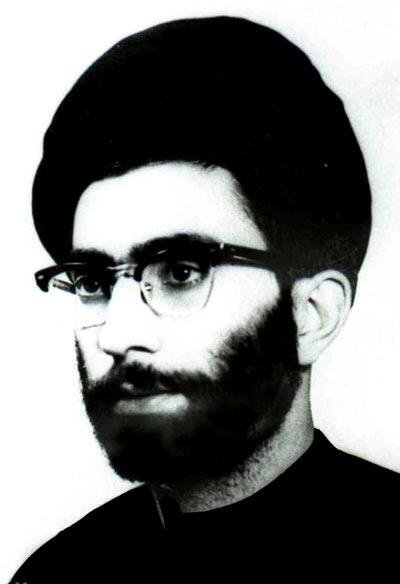
Ashkenazi beatnik from 1960s Greenwich Village -- or future Ayatollah of Iran?
That is WAY more what we mean by "looks Jewish" than, say, Yasser Arafat:
Just eye-balling, without whipping out the calipers, seems like Ashkenazis -- like other Indo-Euros from the Middle East -- have higher and more prominent cheekbones, compared to Saharo-Arabian groups (whether Semitic, Egyptian, Berber, etc.).
High and prominent cheekbones are most typical of East Asians, but "Ancestral North Eurasians" ("Paleosiberians") intermixed with the Steppe pastoralists to the west, just north of the Caucasus, who went on to become the Indo-Europeans. Part of the East Asian heritage of Indo-Euros is our higher and more prominent cheekbones.
Could be other phenotypic similarities, just one that popped out to me.
I'm more interested in the ancestral DNA and cultural similarities, but it's worth a brief visit to the skull-measuring lab in order to clarify what we mean by someone "looking Jewish" -- Michael Tracey (who's half Southern Italian) says he gets mistaken for being Jewish. And so could a young Ayatollah Khamenei.
It's an Indo-Euro look, from the central region of the meta-family (not West Euro, not Indo-Aryan).
This is also related to Ashkenazi braininess and intellectual / cultural accomplishment. Sure, when they settled in Europe, they underwent positive genetic selection for such traits when they were restricted to economic niches that required being brighter than the average bulb, for centuries, and with little gene flow in or out (by that point). The Cochran, Hardy, and Harpending story.
But that story is a lot more plausible if they already began somewhat higher on average, compared to other groups. And if they had deep cultural traditions for intellectual and cultural creativity.
In the "selection for Ashkenazi IQ" article, they mention that nobody ever commented on how smart the Sephardic or other Jewish groups were -- only the Ashkenazis.
But also, that people *did* comment that Greeks were smart, Armenians were smart, and Persians were valued so much in empires of Semitic origin (like the Abbasid Caliphate) that they made up a large share of the scientists, mathematicians, poets, philosophers, etc.
If Ashkenazis started off smack dab in the middle of these various groups who were famous for being smart, and if they played a key role in mercantile activity in that part of the Silk Road (similar to their later niches in Europe), then maybe they were already halfway toward their final state, during the Khazar Empire.
Slavs, particularly East Slavs, punch above their weight intellectually as well -- although it requires societal institutional support of the kind found in empires, in order for these traits to be expressed in actual scientific discovery, musical composition, etc. Point being -- the minority of Ashkenazi genes + culture that are Slavic, would also give them a boost creatively.
Iranians punch above their weight in the International Math Olympiad, and chess (youngest grandmaster to have a 2800 rating is an Iranian Zoomer). Both fields that Ashkenazis (but not other groups of Jews) have a penchant for as well.
Twins separated at birth!
"This is what Tehran looked like before the Islamic Revolution" -- or host of Cosmos?
Susanna Hoffs, ageless super-babe rocker chick from the Bangles, is Ashkenazi on both sides of her family. She has an exotic Middle Eastern look -- but the Middle East is a vast place, with a major division between Saharo-Arabian and Indo-European regions.
So which side of that divide does she resemble? Why, she looks just like half-Armo super-babe Kim Kardashian, especially pre-plastic surgery!
Amazing similarity! Like Kim Kardashian, who is also half-British, Ashkenazi Jews are minority Slavic -- not exactly West European, but still from the Euro side of Indo-Euro.
She doesn't look like a Levantine Semitic super-babe like Fairouz or Bella Hadid (half-Palestinian, half-Dutch).
Again, I'm not whipping out the calipers to analyze which specific features are responsible for these distinctions -- cuz they're obvious at the first-glance, gestalt level.
Ashkenazi Jews are the only supposedly non-Indo-Euro group who perform egg-tapping games during their springtime new year holiday.
All sub-regions of Indo-Euros perform this game, and they are the only ones who do so. It's heavily concentrate from the British Isles all the way through Iran, but it is also attested in the far northeast of India (Assam).
The holiday may be adapted to various developments that came after the original Indo-Euro culture -- Easter and Christianity in the West and Caucasus, a cattle holiday (Goru Bihu) in Assam, Nowruz in Iran, and Hidirellez in Turkey. But all are springtime renewal holidays, putting the long difficult times of winter behind, looking forward to a newly reborn world with the arrival of spring.
The counterpart to Easter in Judaism is Passover (putting a long difficult time behind, looking optimistically toward a renewal to come), particularly the Seder dinner and ritual. Wiki claims without citing any source that Jews are known to play the egg-tapping game on this occasion, but I did track down some sources that confirm it.
They may also do a minor variation, where the game is to crack a hard-boiled -- not raw -- egg on someone's head.
All of these references are to Ashkenazi Jews, not Sephardic or Mizrahi or other Jews of the broad Middle East.
While you could claim that the Ashkenazis picked this game up from the Indo-Euro societies that they settled among, that is not necessary -- anymore than it is to suppose that the British picked it up from contact with the French, or the Serbs from contact with the Greeks, or the Greeks from contact with the Armenians, or the Armenians from contact with the Persians, or the Assamese from contact with the Persian-ified Mughals.
The distribution of the game plainly fits the Indo-European territory, so the default assumption is that Ashkenazi Jews belonged to this territory as well when they first practiced the tradition, and that they all stem from a very deep ancient common ancestor game played among the Indo-Europeans during their springtime renewal New Year holiday.
It doesn't specify which sub-region of Indo-Euro territory they came from, but it does rule out a Saharo-Arabian territorial and cultural origin.
Also linking Passover Seder rituals with Nowruz rituals is the similarity between the Seder plate and the Haft-sin ("7 S's") plate, which even the midwits at Wikipedia have noticed.
Both accompany the major meal for the springtime renewal holiday. Both have the magical number 7 elements (sometimes counted as "6 + matzot" for the Seder plate), arranged in separate small containers around a plate, each one having a detailed rationale and narrative that is overtly pointed out and discussed during the ceremony. Other key items are present at the table, but not on the plate itself. Many of these items overlap or are similar (boiled / roasted egg, herbs, sweet pudding / mashed dessert, etc.). And a key sacred religious text is physically present, and read from during the ceremony.
Unlike the egg-tapping game, this ritual is far more localized within the Indo-Euro territory -- mainly Iran, with partial attestations in neighboring Armenia (boiled eggs, growing sprouts from wheat, lentils, etc. ahead of time to place on the table), and Afghanistan (the "Haft Mewa" or 7-item dessert salad made of fruit and nuts).
This narrows down the Ashkenazi origins to somewhere with a heavy Iranian influence, which have historically stretched westward to south of the Caucasus and bordering eastern Anatolia. That was the furthest extent of the Sasanian Empire and the Abbasid Caliphate, from the relevant time periods.
Encyclopedia Iranica says the nature of Haft Sin has changed over the centuries:


...Sasanians greeted Nowruz by growing seven kinds of seeds on seven pillars (setuns) and placed on their Nowruz table trays containing seven branches of vegetables (wheat, barley, peas, rice, etc) as well as a loaf of bread made from seven kinds of grain (Ketāb al-maḥāsen wa’l-ażdād, p. 361)...
They argue for a narrow view of what counts as Haft Sin, ruling out the obvious similarity to this Sasanian practice. If we're taking the broad view, this goes back to Sasanian times, but the form today must have originated later, perhaps as early as the Abbasid era but possibly as late as the Early Modern / Safavid era.
The Passover rituals were only first standardized during the Dark Ages / Talmudic era in Judaism, alongside the Sasanian era in Iran. The main Talmud historically has been the so-called Babylonian Talmud -- composed near historical Babylon, but by that time, under Persian / Iranian occupation and influence.
But much like the Haft Sin, Passover rituals seem to have varied much over the centuries. At least by the Early Modern era in Europe, Ashkenazi Jews are shown performing fairly contempo-looking Seder dinners, long after they lived anywhere near Iran or Babylon.
The two rituals are not identical, and the "four glasses of wine that punctuate the ceremony at intervals" seems to be an older, specifically Judaean practice. But it does incorporate other elements that bear an uncanny resemblance to the Haft Sin of Persian Nowruz -- which, again, is not even broadly shared outside of present-day Iran among their close cultural neighbors.
This points to a Persian (not ethnically Semitic, not religiously Jewish) origin specifically for the group whose ethnogenesis sometime in the late 1st millennium / early 2nd millennium would result in the Ashkenazi Jews (when they adopted Judaism).
Finally, there's egg decoration, which is mainly associated with the Indo-Euro springtime renewal holiday.
There is only one key area outside the Indo-Euro territory that practices this ritual for their springtime renewal holiday -- Egypt. But by all accounts, it originally was introduced to them by Christians (whose center of gravity was the Byzantine Empire, part of the Indo-Euro region), during the Dark Ages. It was maintained by Muslims as well, after the Muslim conquest. There doesn't seem to be any proof of it existing in the Bronze Age in Egypt, when it was totally Saharo-Arabian, before Hellenization and later Christianization.
And since Christianity is a global religion, and Egypt was conquered and influenced by the Byzantine Empire, I conclude the Egyptian practice is a foreign import from the Indo-Euro Byzantines.
Oddly enough, another Jewish sub-group enjoys eggs whose shells are colored / dyed / marbled -- Sephardic Jews and huevos haminados. However, these eggs are not prepared specifically for the springtime renewal holiday, but for the typical weekly Sabbath stew. So although they have a similar appearance to Easter / Nowruz eggs, they don't share the links to the important once-a-year holiday with the arrival of spring. So they seem to be a separate development altogether.
It's also not clear that they deliberately altered the appearance of the eggs -- they were just one of many items thrown into the stew pot, and after hours of slow cooking, they changed color -- like many other kinds of food after slow-cooking. Easter / Nowruz eggs are deliberately altered in appearance, to indicate it's a special ritual occasion.
By now, Sephardic Jews have been heavily influenced by Indo-Euro cultures of various types, including by the Ashkenazi Jews in Israel. (And as outlined in the next post, Sephardic Jews are local converts as well, with a substantial Indo-Euro source from Iberia, but this post is about the non-Judaean origins of the Ashkenazis specifically.) So they may presently do the more deliberate altering of the egg's appearance, but still, not limited to the springtime renewal holiday alone -- that's the only time that Christians, Nowruz celebrators, and pagan Slavs decorated them prior to eating.
Ashkenazi Jews include a roasted egg on the Seder plate for Passover, and after roasting, the shell does take on an unusual and special color and pattern. And because this is the only time they do this during the year, their ritual is similar to Easter and Nowruz, not to the Sephardic weekly Sabbath stew (and the start of Passover does not necessarily land on a Sabbath day, further severing any link between the two Jewish practices).
Although egg decoration for the springtime renewal holiday is widely attested among Indo-Euros, it isn't 100% -- no mention of it among ancient Greeks or Romans or Celts, and it doesn't seem to be present in India, even where the egg-tapping game is played (all the pictures from Goru Bihu show normal white eggs).
So this would seem to localize it to the Balkans or more likely Anatolia, through the Caucasus, including the Slavs to the north, and eastward into Iran.
Those are just the groups that other evidence points to the Ashkenazi Jews as descending from. So their special-looking ceremonial egg for their springtime renewal holiday is in agreement with a mixed Iranian and Slavic origin, and goes against a Levantine or broader Saharo-Arabian origin.
November 8, 2023
After non-Halloween October, skipping right to New Year's Eve, eliminating Thanksgiving, Black Friday, and Christmas, as American imperial collapse wipes out its major holidays
It snowed a bit on Halloween (i.e. Oct 31, not "The Saturday Before Oct 31"), and the workers in the thrift store at the time broke out with "Are you kidding me???" and even a reference to it already being Christmas. I thought that was jumping the gun a bit -- don't we still have Thanksgiving and/or Black Friday in the way?
But that proved to be symptomatic of a larger trend this year, in which people are paying no mind, and presumably no effort or activity, to Thanksgiving, Black Friday, or even the once-mighty Christmas. As far as they're concerned, after Halloween the next milestone holiday is New Year's Eve.
I noticed both Mumei and Irys independently speaking this way during some of their recent streams, off-handedly mentioning "Wow, I can't believe the year is almost over / It's almost 2024". I assume others are as well, but these are two I tune into frequently enough to hear what's on their mind.
So I used google to search reddit for the phrase "almost 2024," and indeed there are lots of comments to that effect, with the vast majority from October (and now into November). Curiously, they didn't all hit after The Saturday Before Halloween, when the energy for that holiday would've begun dissipating. There are plenty from earlier in the month, as though they were ignoring Halloween as well, and heading straight for New Year's Eve.
Well, that ignoring of Halloween manifested all over the place this year, as I described in a series of comments to the last post, beginning here. Halloween spirit was dead throughout the entire month, in radical contrast to just a few years ago when all the stuff would've gone up at the start of the month or earlier.
Now that we've seen Halloween not-happen, we can also easily see that Thanksgiving, Black Friday, and Christmas will not-happen this year either.
Thanksgiving has become weakened and parasitized by Black Friday since the 2000s, to the point where Thanksgiving had become debased into Black Friday Eve, and the real excitement and emotional investment was for the anti-social shopping free-for-all on Friday, Saturday, and Sunday. I covered that over the 2010s.
I also commented in the past few years how even Black Friday has died. When you think of those videos or Drudge live-blogging the chaos, that was only from the late 2000s and 2010s. When the vulnerable phase of the 15-year excitement cycle had set in, from 2015-'19, it was already pretty tame compared to the previous manic phase, 2010-'14, when most of those intense Black Fridays occurred.
But by now, the holiday is completely dead, and it is not restoring any energy back to Thanksgiving -- everything is being wiped out together.
But surely Christmas will still stand! Nope. I remember how non-eventful it was last year, possibly the least emotional Christmas in world history. It will pass with even less activity this year, with a rising number of people ignoring it altogether to build up suspense for New Year's Eve instead.
In a series of comments beginning here, I explained the point behind celebrating holidays on fixed calendar days, rather than wimping out and celebrating them only on weekends. Weekends are expected times for cutting loose, whereas major holidays require turning over the usual order of things -- for a brief time -- and that includes celebrating them on weekdays, when people usually go to school or work.
I noted that only New Year's Eve has a built-in defense against the Millennial anti-American culture-destroyers who canceled Halloween in favor of The Saturday Before Halloween. The suspense leading up to a holiday is even more relevant to New Year's Eve because there's a literal countdown on that night until the new calendar year begins.
It's difficult to shift all that suspense and excitement to some night before New Year's Eve, since the contradiction is too glaring between celebrating a new year and everyone knowing the actual countdown is still days away.
Likewise if they tried to shift it to some night after, the suspense will already have dissipated. So, its celebration is much more sticky to its calendar date, despite lamewad Millennials who would love nothing more than to celebrate it on The Saturday Before New Year's Eve.
Labor Day and Memorial Day stopped being real holidays awhile ago. July Fourth keeps getting weaker and ho-hum. Easter might as well not exist, and ditto for Valentine's Day. With the elimination only beginning now of Halloween, Thanksgiving / Black Friday, and Christmas, that leaves New Year's Eve as the only holiday that Americans will celebrate as a major, big deal, FOMO kind of holiday.
In no previous year did we start getting itchy to discuss the wrapping up of the year, the beginning of a new year, how crazy time flies, what we're going to resolve to do differently, etc. -- in October. That literally began in 2023.
But it has all the hallmarks of the earlier destruction of holidays. Remember when Christmas stuff, energy, thoughts, feelings, etc., began happening before Thanksgiving / Black Friday, eventually going up at the start of November?
Which is what happened this year as well, right after Oct 31, the Halloween candy got replaced -- and not by autumnal or harvest or Thanksgiving-related things like candy corn, caramel apples, or pumpkin-themed stuff (indeed, pumpkin spice latte coffee has already been dumped into the clearance section in the supermarkets). Rather, it got immediately replaced with Christmas candy.
If only New Year's Eve had some sweets associated with it, *that* would have gone up on Nov 1 this year, bypassing Christmas candy entirely. But then, maybe that's the direction our moribund culture is headed toward, repurposing all sweets from Halloween, Thanksgiving, and Christmas, which are scarcely celebrated anymore, into a New Year's Eve smorgasbord of sweets.
The new rationale will be similar to Carnival / Mardi Gras -- one final binge on stuff that's bad for you, before purging and purifying and rebuilding in the new year, tying it into the existing tradition of New Year's resolutions (which is similar to giving things up for Lent -- and people adhere to them just as long).
Maybe we will fold the trick-or-treating / masquerade tradition back into the New Year holiday, which is where it ultimately began, before American culture shifted it to Halloween, to distinguish ourselves from our European -- and even Indo-European -- relatives.
Who can say what precise form these changes will take? All I know is our culture is evaporating right before our very eyes, as the social cohesion that upheld our mega-society has entered terminal decline, now that its raison d'etre -- uniting against a common meta-ethnic nemesis (mainly the Indians and later Mexicans) -- has unraveled.
June 17, 2023
The Midcentury tiki / caveman origins of the iconic low "mansard" roof for McDonald's, Pizza Hut, etc.
The recent posts about Googie and tiki styles co-existing, as well as the primitive style of the Polynesian Village Resort at the founding of Disney World, got me thinking about American roof styles.
There's a group of small office buildings I drive by that are only 1 story -- and a low story at that -- but have tall roofs, like an extra 1 1/2 stories, that dominate the height of the building. However, they don't have windows in the roof, and they don't appear to be used as a second floor. The total height is still low, so it looks more like a primitive hut or longhouse -- prominent but low roof, squat main floor. The roofs are pitched and clad in shingles, not metal or slate or terra cotta tiles or whatever else.
That's when it hit me -- those iconic "mansard" roofs that distinguished every McDonald's, Burger King, Pizza Hut, etc., were not really mansard! They were tiki! It was a carry-over or evolution of the tropical longhouse-inspired roof from the Polynesian craze, after the overtly Polynesian elements had outgrown the fashion cycle, for the time being, before future tiki revivals (tiki statues & torches, leighs, hula dancing, ukuleles, and so on).
First, for examples of these "mansard" roofs in American popular architecture, see this discussion in general, and this history from Pizza Hut. McDonald's and Pizza Hut independently pioneered this style in 1969 (both in the Midwest-to-West, following our meta-ethnic frontier against Indians and later Mexicans), and it became ubiquitous during the '70s and '80s.
Really only the McDonald's and Pizza Hut have a noticeable change in the angle between the central part (steep) and the outer part (shallow). Wendy's had a changing angle, from steep to shallow from center to edge, but it was smooth and curved, not quite as striking. And Burger King and KFC had a single large "outer" part with a constant slope, and a short vertical perimeter around the "center" -- not really that noticeable of an angle change.
Now contrast with examples of actual mansard roofs -- and crucially, the rest of the building that they are a part of.
These roofs consist mostly of the steep vertical central part, with the outer more horizontal edge being almost a flourish or afterthought. The American roofs are more about that outer edge, less about the vertical central part. Mansard roofs have windows (dormers), whereas the American roofs do not. The cladding is sophisticated stone, usually slate tile, whereas the American roofs do not use stone and do not even try to imitate it -- it looks more like primitive wooden tiles (shake), even if it's technically asphalt. (Later revisions made the American roofs metal, too sleek compared to the original style.)
And most importantly, mansard roofs do not dominate the height of the building. Especially where they came from, in Early Modern French chateaus, there are two stories below -- with very high European ceilings on each floor. The roof is still prominent, but not dominating. The dormer windows show that the top floor was either a full floor unto itself, or at least an attic with high ceilings (for an attic) and lots of light coming in.
The American roofs dominate the height of the entire building, there is only one story below, and even that main floor has low ceilings, as is typical of Midcentury buildings (like ranch homes in the residential sector). They are not grand imposing hulks of mass -- that would be Brutalist buildings of the same time period -- but short squat huts, tapping more into the primitive than the futurist side of the American style of architecture.
And unlike the buildings with real mansard roofs, the American buildings are fairly open around their main story. Sometimes a wall-o'-windows straight out of Googie, though more often broken up by columns or piers, still opening up the main space on three sides (the back one closed off for the drive-thru).
Therefore, the American buildings read more as open outdoor structures like a primitive hut or a beach tent, without proper sturdy walls to enclose the interior (materially or visually). The columns or piers are just the supports for the deeply overhanging roof -- much like the porch-area columns holding up the roof of a Craftsman bungalow. In fact, the columns on the Pizza Hut buildings have the same shape as Craftsman bungalow columns -- wide at the base and tapering toward the top. Very distinctly American all around -- but what else would you expect from Pizza Hut?!
Although the pseudo-walls are windowed, from the outside and inside alike there is no feeling of the "light and airy" environment of Early Modern Euro imperial styles, such as a French chateau. Low ceilings, dark-tinted windows, no dormer windows or skylights in the massive roof, all contribute to the cozy caveman hut environment that Americans crave. We are part caveman, part spaceman -- and nothing in between (that's the Europeans, who we are not).
See this gallery for tiki architecture of the Midcentury, just before the mass adoption of the not-mansard roof style in commercial American buildings. (There are 3 other galleries on tiki, at the bottom of the page, but this one shows off the dominant roofs.) Looks pretty familiar, eh?
However, perhaps these roofs did not emerge directly from tiki, but from the broader caveman developments to our collective identity during the early and mid-20th C. It's too bad the Flintstones had homes that were like Midcentury ranch homes, with comparatively flat roofs that do not dominate the height. True Stone Age roofs would cover most of the height (and be thatched, not stone slabs), sometimes reaching all the way to the ground, so that the hut is really just one great big roof (ditto for an igloo).
In either case, these Pizza Hut type roofs derive from the primitive theme that came from within American cultural evolution, not from importing or copying a European style. How anyone can look at a 1970s McDonald's and see a French chateau, rather than a caveman hut, is beyond me -- why the use of the term "mansard", then? Probably just status-striver branding, I dunno.
McDonald's itself began with an iconic Googie design -- as did many restaurants and coffee shops of the time -- tapping more into the futuristic side of American culture, before eventually changing over to the primitive hut style. But in both cases, it was distinctly American, not European. A little more Jetsons at the start, then more Flintstones later.
Googie already had a heavy primitive theme, with its flagstone walls and tropical vegetation inside and outside. Very few vernacular styles of the supposedly more optimistic '50s and '60s were purely futuristic -- and so the shift to more earthy primitive hut styles in the '70s and '80s does not represent a turn toward the pessimistic or dystopian regarding the future and technology. Brutalism was still in full force, and it would dominate commercial architecture in the '70s and '80s -- in the grand scale buildings, with malls, not with the smaller detached hamburger stands.
When you think about it, a hi-tech space-rocket style for a burger joint is a little out of place. That should be for a grander scale, like the airport terminals and later the malls -- symbols of our growing societal complexity and industrial / technological progress. A standalone pizza parlor, which is not even connected to other stores as in a strip center, is too small-scale to merit the Universe of Tomorrow treatment. So just go with the cozy caveman theme instead -- just like detached homes, which never got the Brutalist treatment but the cozy caveman treatment (ranch homes).
Some new McDonald's are getting the retro Googie look, which is also fine -- at least it's part of American culture, albeit still a little out of place for a burger joint. But I'd rather have one of those than, well...
I don't want to dwell too much on the desecration of American architecture during the neoliberal era. But in this case, it was not a sudden explosion during the woketard iconoclasm of the 2010s, although it certainly got exponentially worse during that decade as well. The main change in the 2010s was to paint everything dull gray, as shown in this overview from 2012, right as that wave of desecration had begun.
But earlier in 2006, McDonald's got rid of its caveman hut roofs, and radically shifted to a more Euro look overall -- sophisticated stone facades, bland agoraphobic light-and-airy interiors, etc. And sometime before that (the '90s?) they began replacing the primitive-themed brown shingles with sleek metal roofs that were ketchup red. At least they left the caveman hut proportions mostly intact, though.
The later styles removed the roof nearly entirely, made the facades more filled-in and, well, facade-like instead of the wraparound wall-o'-windows broken up only by columns (not proper walls). They appear too tall, not like the cozy squat huts dominated by a massive roof like an extra-heavy blanket.
"But aren't you OK with them being blocky and boxy with sturdy walls? Isn't that the American style?" In those two senses, they still do look American, but they don't do the proportions right. They don't use a variety of scales a la the Prairie School or Art Deco or Mormon temples. And they don't use massive scale, imposing heights, and repeated geometric motifs, like Brutalism did to create a sublime rather than beautiful atmosphere. And none of those iconic American styles are literally just a dull gray box!
That is way more in the vein of Bauhaus -- utilitarian with throwaway gestures at sophistication through stone materials. We beat Bauhaus to the punch on post-Euro imperial architecture, beginning with Frank Lloyd Wright and the original Chicago School. And once Bauhaus did exist, we managed to prevent infection of it into America (other than Cesca chairs, with their use of wood and reed, atypical for Bauhaus materials). These dull gray functional boxes only sprang up during the neoliberal era, pretty late in the era for that matter -- the late 2000s for McDonald's.
But then, we have rapidly approached the stage in the imperial lifespan that Bauhaus came out of. Our neolib era was one of stagnation and plateau-ing, and only since 2020 have we entered the full-on collapse stage. Euro empires reached stagnation by the late 19th C, and only began collapsing during the 1910s. So, the closer that we come to their social and political environments, the more our cultural output will resemble theirs -- including god-awful utilitarian bores.
Once America's current civil breakdown has reached its nadir, and reconstruction begins -- not a new wave of imperial expansion, LOL, those days are over -- the first architectural task is to restore the American styles to American buildings. No more pseudo-Bauhaus burger joints or any restaurant -- we're going right back to cozy caveman huts!
June 5, 2023
Googie architecture: primitive futurism, with upswept roofs from Frank Lloyd Wright
No exploration of American culture's distinctive "primitive futurism" would be complete without a look at Googie architecture of the Midcentury period -- usually defined by its Space Age and other futuristic elements. Off-kilter angles, cantilevered upswept roofs, Industrial Age materials of glass and steel and neon lights, shapes and motifs (like starbursts) suggesting rockets or spaceships or space stations, and an overall busy frenetic energy level.
And yet it just wouldn't be American without pronounced primitive elements as well. Rarely does the discussion about this Midcentury style emphasize them, and their seeming contradiction with the Space Age elements.
Googie came from the same time and place -- the Midcentury, out West -- as tiki culture, which was purely primitivist, an attempt to root our still-developing identity in the ancient times of the New World, including Polynesia, rather than the Old World (just as the Mayan revival style of the '20s had done, or the ahead-of-its-time Book of Mormon's genesis narrative had done circa 1830). Googie fused this primitive / tropical theme with the also contemporaneous Space Age / Industrial Age / Streamline theme.
In the Penguin coffee shop below (built in 1959), the dramatic upswept roof (being cantilevered, and so appearing to defy gravity and take flight), wall-o'-windows, neon lights on the sign, and the busily off-center placement of items on the sign, give this building a futuristic feel that could not have even been imagined 100 years earlier.
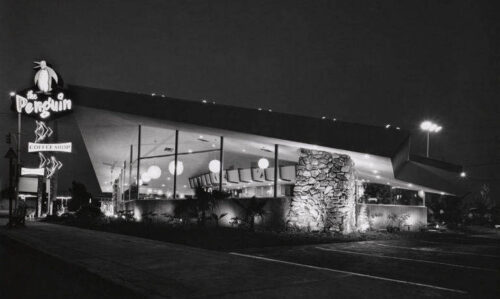
However, Americans have never defined ourselves as strictly futuristic, progressive, etc., hence the need for the ancient and primitive elements -- tropical vegetation, and massive piers faced in flagstone to support the roof. The stones are not finely cut into rectangular prisms and then laid in regular courses like advanced stonework -- they appear to be used as they were found, with human ingenuity only playing a role in fitting them together like puzzle pieces.
This is not the masonry of an advanced civilization of several thousand years ago -- let alone one capable of splitting the atom and sending rockets to escape Earth's orbit. This far cruder form of assembling the stones together leavens the head-spinning futurism of the other elements. Crude and raw -- yet also advanced and sophisticated -- in its construction. That's what American identity is all about.
In fact, from some angles, these Googie buildings primarily consist of primitive elements and crude techniques, not so Space Age-y after all:

This combination of primitive with futuristic continued on the inside, where large expanses of flagstone walls gave a familiar cozy feel to the starkly-angled interior space, with rough natural textures and earthy colors balancing the smooth and dyed-any-color synthetic materials. Just as the woodgrain tabletops balanced the gleaming stainless steel / chrome pedestal supports.
* * *
I was glad to find one quote to this effect already out there: "these were places where George Jetson and Fred Flintstone could meet over a cup of coffee" (Alan Hess, Googie: Fifties Coffee Shop Architecture, quoted here). The Jetsons and the Flintstones were both highly popular TV shows, and helped define American identity of the time and ever since. Their co-existence is no accident: Americans are part caveman, part spaceman, with no stage of material cultural development in between -- that would be Europeans, and because we are not European, we have had to define ourselves as belonging to the time periods outside of the heyday of European empires.
There were never mighty empires and advanced civilizations where Americans landed and settled, and we have always had to wrestle with the absence of counterparts to Ancient Greek temples, Medieval castles, and Early Modern cathedrals in our newly settled land. Part of our response was to borrow from those civilizations in the New World that did build monumental architecture that was still easily visible and tangible, like the Maya of Central America or the later Easter Islanders off the Pacific coast of South America.
But mainly our response was to go with the obvious theme, that we were bringing an advanced civilization to a mostly primitive environment. Not necessarily like taming a desert environment to make it suitable for agriculture. We didn't build spaceships out of the primitive environment we found on arrival -- it's more like the advanced technology appeared to have been dropped from the sky by some civilizational stork.
Americans project that founding myth back onto other civilizations, when we assume that the Ancient Egyptians must have had their advanced tech for pyramid-building dropped upon them by ancient aliens. It may sound silly, but it makes sense when you consider our historical path, and the absence of intermediate stages of material development between the primitive and industrial in America. We just assume that every civilization in history has been dropped from the sky, mostly pre-fabricated, like ours was.
* * *
Finally, where *did* all of these dramatically upswept roofs, heavily cantilevered, come from -- if not aliens? You should already know the answer by now, given his all-encompassing influence on American architecture, but -- that's right -- they were invented by Frank Lloyd Wright himself, back in the Midwest. As far as I can tell, anyway, from searching around for "upswept roofs", and I'm happy to be corrected.
I don't know from my limited study of Googie examples which one was the first to employ the upswept roof, but Wright had all of them beat anyway -- the Robert and Rae Levin House from 1949, in Kalamazoo, Michigan. While most of the roof is flat, as was his style, a pronounced section of it soars up toward one of the edges, is not supported vertically at the outer edge, and contains a wall-o'-windows underneath, exactly as would become the norm with Googie in the next decade.
Even more Googie than that is the Elam House from only one year later, 1950, in Austin, Minnesota. This one has the doubly upswept roof, rising toward opposite edges and having a low-point in the middle of the roof, which is off-center / asymmetric. It's also cantilevered, supported by massive stone piers -- the only difference from Googie being their finer level of cutting and dressing, instead of being used as they were found, in the cruder Googie fashion, and so not looking quite as primitive. (But then, this is only the Midwest, not the Pacific coast, where the tropical primitive environment is more evident.) It has a wall-o'-windows underneath as well.
In 1952, at the Reisley House in Pleasantville, New York, he added a bit of functionality to the upswept roof, turning it into the cover for a carport. (He also changed the material to be cypress wood panels, adding to the primitive side of the balance.) The pier supporting the cantilevered roof is again stone, though more Googie-esque in using stones of uneven size, albeit still in rectangular outlines. It really did take the Googie movement to make them look unaltered and crudely assembled at varying angles.
I couldn't easily find other examples throughout the '50s, perhaps because he had seen it evolve into Googie -- and then elevated Modernist airport terminals from Eero Saarinen, like Dulles and the TWA Flight Center at JFK -- and figured his pioneering work was done. However, he was still at it circa 1960, when he built the Don Stromquist House in Bountiful, Utah. One corner of the roof rises toward the edge, is cantilevered, and contains a wall-o'-windows underneath.
California Googie architect John Lautner had apprenticed under Wright in the '30s, though I don't know if he was still keeping tabs on what his mentor was up to circa 1950 with three out of dozens of Usonian homes. It's possible that the moment for upswept roofs had come, and Wright was simply an early pioneer, while it came to others later but independently as part of a general zeitgeist. But there is a potential direct channel from Wright to Googie-style roofs that is worth looking into (for someone else).

* * *
And we must remember to hit on the other big-picture lesson from my survey of modern architecture -- the non-existent role played by the Europeans, whether affiliated with Bauhaus or otherwise. Clueless and embarrassed-to-be-American East Coast academics may hear "upswept roof" and "Modern architecture," and think of Notre-Dame du Haut by Le Corbusier. But that was built in 1955 -- half a decade after Wright pioneered the look in the American Midwest with multiple examples, as usual. It's also not as cantilevered as Wright's proto-Googie buildings, being supported at the outer corner.
For that matter, the supposed avant-garde of Bauhaus had been beaten to the punch by literal McDonald's, whose 1953 oldest building in Downey, California employed an upward-sloping roof -- along with prominent parabolas over a decade before Saarinen's Gateway Arch was built.
Civilization-shaping cultural creativity comes from expanding empires, and by the 20th century, the Euro empires had all bitten the dust, except for Russia, which didn't start its collapse until the final decade of that century. America was still rising, expanding, and innovating. If something cool or inventive happened, just assume that we did it (or maybe a Russian counterpart), not the collapsed empires with no gas left in the tank. Their heyday was several centuries earlier.
Whether trad or mod, Europeans simply had nothing to invent during the 20th C., although if they came under American aegis post-WWII, they could jump on our bandwagon and contribute that way -- which many of them did, enthusiastically, since our cultural scene was the only game in town, aside from Russia's.
We can't get too triumphalist, though, since our empire has begun collapsing as well. We aren't going to invent anything else ever again. That means our job is to preserve what has already been built in our national distinctive style, such as Googie (or Brutalism, Art Deco, Streamline, Prairie School, Mission, etc.). And if anything new needs to be built, then produce new examples of those established styles. That's how the Mormons are treating their temples -- old and new alike -- and that's how we should treat our buildings as an entire nation.
Fortunately in the case of Googie, it was most prolific in Southern California, which is the most preservationist region of the country, to their envy-making credit. If there's even a rumor about someone taking down the giant donut from what used to be a roadside vernacular diner, City Council will block them. And they have probably already made a preemptive move by getting the building legally protected as a landmark, making it sacrosanct, untouchable, and inviolable.
Nowhere else in the country conserves its American culture like L.A., which is why Brutalism is being systematically razed all along the East Coast, while UC Irvine will always look like it's from the Planet of the Apes, primitive yet futuristic at the same time -- and for all time.
March 31, 2023
Pizza is American (Midwestern), not Italian, not East Coast
Lone food post here as I'm investigating other topics in greater detail. But my comment about Pizza Hut providing a public space back in the good ol' days got me thinking -- what is the role of pizza in American ethnogenesis? I'm really trying to avoid the topic of food for now, but I couldn't help it.
Everyone knows the hamburger is an American invention, and so distinctive of us that foreigners call us "burgers". I already reviewed (perhaps in a comment) that burgers fit the usual pattern of American cultural creation -- belonging to the out-West region (from the Midwest to the West Coast), and taking shape after the Civil War & Reconstruction era.
If either sub-section of the back-East region were the definers of American standards, we would have nationally adopted either fish / seafood or chicken as our national meat, instead of beef (and hamburgers specifically).
But what about pizza, which ranks right up there with hamburgers in defining American tastes? Doesn't that have an Italian name, and wasn't it brought here by immigrants from Italy? Doesn't it stretch back into time immemorial, at least in the Olde Worlde, and we are just the most recent group of people to enjoy this ancient meal?
Not at all -- this is America we're talking about here. But it's really true of every empire, whose expansion accompanies (is driven by) a rise in collective cohesion (asabiya), which has been raised so high by the people finding themselves on a meta-ethnic frontier. In banding together and cohering so intensely, they produce a whole new culture, no longer the culture they used to be before they had been tested and transformed by their engagements with the meta-ethnic Other.
Claims about the invention of pizza go back no earlier than the 1800s, which is not even Early Modern. And because none of the claimants can agree, it means they're mostly making it up, to boost their regional hometown pride. Otherwise everyone would know where it came from, and perhaps even when -- like haggis being Scottish rather than from southern England.
The one specific claim of which individual or which establishment is Raffaele Esposito, who supposedly invented it in 1889 in Naples. If it had an older provenance, no one -- not even a southern Italian -- would have the gall to try and claim personal credit for its invention. So, something like pizza was being made at least by one guy in one city in Italy in the very late 1800s.
But the first pizzeria in America was opened in 1905 (Lombardi's in NYC), and several regional styles were already under way by the 1920s (such as New Haven style). Because pizza was not even widely established in Naples circa 1900 -- having been invented by one guy, or at least being a new trend, just 10 years earlier -- it makes no sense to treat it as an origin, and the American styles as derivatives or carry-overs.
They were contemporaries, or siblings, or peers -- not parents and children. It's just that some of those siblings were growing up in southern Italy, and other siblings were growing up in America (by people genetically related to the former, but becoming culturally assimilated into their new country, like dropping their Romance language).
And much like other forms of sibling rivalry, some siblings excel more than others, are more popular, and so on. Ultimately, by the mid-1900s, American pizza won over its southern Italian sibling. The whole world treats American pizza as the standard, for the unqualified term "pizza", and its former rival has to be qualified with "Neopolitan" or "Sicilian" or whatever. Americans are responsible for spreading pizza around the world by now, not anyone from any region of Italy.
We can go further than that, though, and trace the triumph among varying styles of pizza within America. Neither of the East Coast styles became the standard, and both are closer to the Neopolitan sibling style.
New Haven pizza does not require cheese -- and spiced tomato sauce on a baked flatbread is not pizza. It does not require meat or vegetable toppings of any kind. And the crust is thin, chewy, and easily foldable, similar to New York pizza.
New York pizza does require cheese, and it is spread over most / all of the surface -- unlike Neopolitan pizza, where spaced-apart hunks of mozzarella are treated as a topping rather than a base layer. But it also tends to avoid meat and vegetable toppings. The crust is very thin, chewy, and foldable -- and indeed, that is how it is actually eaten, folded over into what is actually a kind of two-faced sandwich. The mouthfeel is bread on the top of your mouth, bread on your tongue and lower mouth, with the tomato sauce and cheese oozing out of one side like a filling.
It's like a calzone, with some assembly required by the user. Literally nobody else eats pizza that way, and no one bakes the crust to accommodate that form of eating it. This is also why their slices are so huge -- they're meant to be folded in half, so they aren't so unwieldy in the hand, unless you mistakenly eat it like standard pizza (without folding, trying to hold up the entire lower crust with one hand).
Just like their low back rounded vowels that they refuse to give up after a national -- and by now, international -- standard has been settled upon, New York pizza eaters refuse to give up their "calzone with some assembly required" model of pizza. And they refuse to cover it with meat and/or vegetable toppings, preferring it with the base layer of cheese only.
Also in the first half of the 1900s, getting started sometime between the '20s and '40s, came the Chicago style. The timing makes it another sibling of the early period of innovation, not a derivative from another preceding style. Although not quite the national standard, this is much closer to what became the standard, and if any single style is the origin of the standard, it's Chicago style.
It's circular, cut into wedges, has a thick enough and solid enough crust that it doesn't bend or fold much in the hand, the perimeter has a noticeable height to it (helping to grip it), it's more of a deep-dish or pan thickness, and indeed it is baked in a pan (with walls to shape the outer crust upwards) rather than on a totally flat sheet. Most importantly, though, it added whole new categories of key ingredients -- meat and/or vegetable toppings, like pepperoni.
Pepperoni is so necessary for pizza, that it's hardly pizza without pepperoni -- or some other meat in its place, but ideally as close as possible, like Italian sausage, not ground beef (fine for burgers, but totally out of place on a pizza). And vice versa -- Americans almost only eat pepperoni on pizza, not as an all-purpose lunch meat (that would be salami).
The incredible thickness of Chicago pizza must be linked with the appearance of loads of meat & veg toppings, since it can withstand all that extra weight, and the perimeter is walled, so they're less likely to spill off over the side.
You simply can't pile toppings onto New York pizza, given how flimsy the crust is. You could hypothetically pile toppings onto one half of the slice, meant to be the lower side of the eventual calzone, and then leave the other half with no toppings, which would fold over the topping side like a blanket. If toppings were on both halves of the slice, they would spill off of the top half of the calzone when turned upside down to fold over the other half. Toppings on only half of each slice requires too much fussing around when spreading the toppings -- you'd have to slice it first, then spread toppings on half of each slice at a time, instead of spreading the toppings over the whole surface at once, then slicing it.
Similar to Chicago style is Detroit style, invented in the '40s, which is rectangular (and cut rectangularly), but also baked in a pan with high walls, making it deep-dish, the crust is not flimsy, and requiring meat / veg toppings. The only difference is the cheese is spread from edge-to-edge, forming a hard crispy edge of cheese around the perimeter where it's contacting the baking pan. Other than the lack of a familiar un-cheesed perimeter, it's close to the standard.
Quad Cities style, on the Iowa / Illinois border, and invented in the '50s, is another type close to the standard. It has a dense enough crust to support ample toppings, requiring meat (such as sausage), there's an un-cheesed and raised lip of bread around the perimeter, and the only notable difference is the cheese going on top of the sauce and meat, rather than between those layers. It's circular and cut into strips, not wedges.
St. Louis style is similar to the standard as well, only having a much harder and crispier crust, like a cracker, since the dough is unleavened. And so, despite being thin-crust, it's still sturdy enough to carry tons of meat & veg toppings without folding and spilling them. It's circular and cut into strips or squared-off pieces. I can't easily find when it first came out, but the main chain for this style -- Imo's -- was founded in '64, so no later than then.
There is still enough variation in pizza that it can be thin-crust or deep-dish, as long as the crust is strong enough to support lots of toppings. Even Chicago, famous for the deepest-dish style, also has a thin-crust style, but it too is sturdier and piled with toppings, unlike the East Coast and Neopolitan styles.
* * *
To recap -- it's all about the meat (and possibly vegetables). Neopolitan pizza does not require meat toppings, nor do New Haven and the usual New York styles (at most, New York style has some sparse pepperoni, not multiple / piled-high toppings). This transforms what would have otherwise been a mainly bread meal into something with animal protein and fat (some of which renders out into the cheese and sauce -- mmmm). It gives it a savoriness, crispiness, and well-roundedness that would not be there without the meat.
Sicilian style comes somewhat close to this concept, since it often (but not necessarily) includes anchovies -- yes, that's where this strangest of toppings came from. There's nothing more non-standard than putting fish on pizza, even though it is a meat. It's not the right kind, because it wasn't created in the right region of the world for pizza innovation -- the American Midwest. Perhaps related to the Midwest not having tons of seafood available, marking anchovies as suspiciously East Coast -- and by that mere fact, not feasible as an all-American standard.
Neopolitan pizza doesn't even cover most or all of the surface with a single vast expanse of cheese -- even New York pizza manages that!
Claiming that American pizza is merely Neopolitan pizza "with meat / veg toppings", as though it's a slight variation on an existing theme, is like saying a slice of bread with onions, lettuce, and tomato, and ketchup & mustard, is a "hamburger" -- the American hamburger merely adding the beef patty onto the existing, traditional "hamburger" that had no meat at all. Yeah sure. No meat, no burger. No meat -- especially pepperoni -- no pizza. And if there's no meat, it had better be loaded with olives, onions, and other vegetables to make up for it -- not a lack of toppings altogether!
* * *
Having established what makes pizza pizza, and roughly when and where it was invented, let's take a quick tour through the biggest pizza chains today, some of which are internationally dominant, and see where they're from.
Pizza Hut is by far *the* American pizza maker, and it's not from any of the 4 major Midwestern pizza regions -- but Kansas! Even further out West. But still resembling the other Midwestern styles, not the East Coast or southern Italian styles.
It was founded in 1958 by Dan and Frank Carney -- doesn't sound like their ancestors brought a recipe with them from Italy. Pizza is American, anybody can innovate on the basic concept, regardless of where their bloodline traces back to. And of course even with Italians, it isn't their genes that cook the pizzas, since their genes have been there forever, and Neopolitan pizza only showed up around 1890. But even broadening "family background" to mean culture, not genes, pizza is still open to anyone, even if your ancestors were culturally Irish.
Next is Domino's, hailing from Michigan, although not reflecting the Detroit style very much. It's similar to Pizza Hut, but with a less thick crust. Founded in 1960 by two brothers whose last name is Monaghan -- not very Italian, again. They did, however, acquire their first store from Dominick DeVarti, who is of Italian background.
Third by number of US locations is Little Caesars. Perhaps you thought of this chain when reading about the Detroit style, and in fact they were founded in Detroit in 1959, by Mike Ilitch -- a first-gen American whose parents were Macedonian (i.e. southwest Bulgarian). Although they do offer the standard style, they have usually included a Detroit style as well -- Big! Big! Cheese, Pizza by the Foot (some of the best pizza I have ever eaten), Pan! Pan!, etc. Their standard style was good, but their Detroit style rivaled Pizza Hut for deep dish goodness, without the "grease sponge" texture that Pizza Hut was known for. And that crispy caramelized ring of cheese around the perimeter really does add something crunchy and burned-y that standard styles don't have.
Next-biggest chain is Papa John's, founded in southern Indiana (on the border with Louisville, KY), much more recently than the others, in 1984, by John Schnatter -- not an Italian-American. It's in the standard style, with a pronounced lip of dough around the edge, mimicking the look and feel of a deep-dish style (which they do offer separately).
After them is Papa Murphy's -- another non-Italian name -- which hails from all the way out West on the Pacific Coast, originating in a 1995 merger of one store from the Portland area and another from the San Francisco area, now headquartered in Vancouver, WA. They offer a standard array of styles, and their distinction is the take-and-bake model instead of baking them in-store with ovens and equipment that only a specialized pizzeria could afford (you use your own oven and sheet).
The last chain with over 1,000 stores is Marco's, from the Toledo, OH area. It was founded by an Italian immigrant, Pasquale Giammarco, somewhat earlier than Papa John's (1978), but looks pretty similar to it or Domino's. Standard style.
Several rungs below in the ranking is Sbarro, with about 300 locations in America, which is the only East Coast style pizza that most Americans have ever had, due to its staple status in mall food courts. It was founded by immigrants from Naples to New York City, who opened their first pizzeria in 1970 in Brooklyn. It's more likely to have meat toppings, and less flimsy in its crust, than the typical New York slice, but it's still squarely within that style. Even when we were at the all-American food court, at an all-American mall, we could still tell that this was not all-American pizza -- it had to be qualified with "New York style" or whatever.
Americans treat New York pizza like a curious and amusing novelty, not as the ur-form to be revered as sacred -- much like how we treat New York accents (or Southeast accents, for that matter).
Ranking right up there with hamburgers, the most all-American of foods -- pizza -- is not an Italian creation, not something that originated on the East Coast and spread out from there, not something even created by people of Italian genetic or cultural ancestry. The inclusion of meat and/or vegetable toppings, especially the practice of piling on multiple toppings, and the requisite durable crust (thick / deep-dish, or cracker-like thin-crust), marks this as an entirely distinct meal from the flimsy flatbread + tomato sauce + scattered hunks of mozzarella.
It is fundamentally Midwestern American, particularly near the Great Lakes, but extending through the Plains all the way out to the West Coast. And it was invented in the early-to-mid 1900s.
This all lines up with the ethnogenesis of the Americans -- strongest where the frontier with the Indians had been most intense (including the Old Northwest, where Indian Wars were still being fought post-Independence), and taking place after our Civil War & Reconstruction, i.e. from the late 19th C. onward. That determined which Americans were the most American of all Americans, to set a national standard -- those out West, including the Midwest, not those back East.