Showing posts with label Age. Show all posts

March 5, 2025

Treehouses, and friends entering your 2nd-story room through the window, as tropes from the rising-harmony phase of the 50-year civil stability cycle

While preparing a post on friends vs. frenemies during the rising-harmony vs. rising-strife phases of Turchin's 50-year cycle in civic cohesion vs. breakdown, I came across one of the fondest memories that late Gen X-ers have of the peak of social harmony circa the mid-'90s -- friends entering each other's rooms through the bedroom window, rather than going through the usual doors on the ground floor.

To clarify, this rarely happened in real life and is mainly a trope from pop culture. And yet, even as a pop culture trope, it didn't exist long before the '90s, and ceased afterwards. Pop culture is dynamic, not static, and it reflects the broader zeitgeist -- not only within the cultural domains, but in the IRL social domains like families, friends, communities, and so on.

In order to pay proper homage to this cultural phenomenon, and to understand it properly, and to trace its origins or spiritual ancestors, I'm putting together this standalone post instead of relegating it to the comment thread.

First, as a summary for those who remember or as a whirlwind tour for those poor unfortunate souls who weren't part of that world, here is a compilation video of the trope from Slate's YouTube channel. It's not meant to be exhaustive, and I will add more examples below and in the comments as I come across them.

We have to clearly delineate what the trope is -- it's not the very broad definition from TV Tropes or IMDB, where it's merely entering the home through a window. That covers criminals breaking & entering, or spies and snoops, frenemies trying to sabotage each other, etc.

But more importantly, this *does not* cover an existing romantic couple, or between two people where there's already romantic tension or sexual intent -- that trope is already fairly well established. For example, Romeo observing Juliet on her balcony, serenades in the same spatial position, princes scaling the walls of a tower to reach the princess' window a la Rapunzel, and many other fairly old and pre-American examples.

The distinctly all-American 20th-century trope covers friends, acquaintances, peers, and similar relationships. They might escalate into romantic relationships, or they might not, that's not crucial. And since it's about friendship and camaraderie, it is not restricted to an opposite-sex pair -- it could be two guy friends, or two girl friends, or a mixed-sex pair.

A few further examples:

Here is a short compilation just from Clarissa Explains It All (1991-'94), to emphasize how frequently this trope appeared in that show -- just about every episode, often multiple times per episode. Whenever Sam meets up with Clarissa at her home, there's a thud of the ladder against the window, Clarissa says "Hi Sam," a leitmotif guitar chord strums, and he enters.

Here is an example from a '95 episode of Boy Meets World, where friends Cory and Topanga start to declare their romantic feelings for each other. At other times in the show, guy friends Cory and Shawn enter through the window. It's not just for mixed-sex or potentially romantic partners.

Here is an example from a '94 episode of Married with Children, where Bud is paid a visit by an acquaintance, the niece of his next-door neighbor, and things escalate from there. (In the same clip, one of Kelly's bf du jour guys accidentally climbs up the same ladder, thinking it's her room, before being told it's the next window over.)

Here is a pic from Doogie Howser (unknown year, but '89 or the early '90s) showing Doogie's best friend Vinnie entering through the window. Another guy friend example.

Unfortunately, the show that probably started, but at the very least was the first popularizer of this trope -- Saved by the Bell -- doesn't have any video clips or images of the many times that friends entered through the bedroom window. But it was common, for both same-sex friends like Zack and Screech, and mixed-sex friends like Zack and Jessie.

Doogie Howser is the other contender for first example, since it and Saved by the Bell both began airing in the fall of '89, a couple years ahead of Clarissa and Boy Meets World. I'd have to start watching my Saved by the Bell DVDs to see when the first instance was, but there's a 1st season clip of Screech being pushed out the open window by Zack in a panic. So I'm guessing the trope began in its 1st season. IDK about Doogie Howser, and won't watch episodes just to see.

In any case, Saved by the Bell was by far the more popular and influential of the two, not just among teen shows of the time, but their legacy ever since. So for the time being, I'm going to declare it the originator of this trope. Earlier examples of "entering through the window" from the '80s involved romantic couples, like A Nightmare on Elm Street and Heathers. Maybe those could be considered proto-examples.

Saved by the Bell, in fact, might be the originator of so-called postmodern TV comedy shows, with frequent and lengthy addresses to the audience (breaking the 4th wall), cut-away imagination sequences, cut-away homages / pastiches of classic and contempo pop culture, and other self-aware / meta-commentary techniques that would come to define comedy shows of the '90s and even the 21st century.

How long did the trope last? Not really beyond the '90s, except as a target for send-up and pastiche as in Kickass (2010), or as a callback to the original show during a sequel show (like Girl Meets World from the mid-2010s). The last major show to do it was Dawson's Creek from the late '90s -- the examples were frequent, involving various friends, not necessarily romantic in tone, and still participating in the trend itself, without being a self-aware reference or allusion. And that was a popular / influential teen show.

The most notable later example is not a TV show or movie at all, but the iconic music video for "You Belong with Me" by Taylor Swift from 2008. Admittedly, the two mixed-sex neighbors don't enter each other's rooms, but they do socially interact, emotionally connect, and play supportive roles in each other's lives, across the narrow gap between their homes. They start out not romantically involved, "just friends," although it does eventually escalate to romance, after the girl-next-door gets rid of her mean-girl rival (his current, then ex-gf).

I appreciate the honesty of this video for acknowledging that the peak of social harmony was over by the 2000s, so it would've been inauthentic to LARP as teens from 1993 and directly enter each other's rooms through the window. The interaction across the gap while still in their separate rooms conveys the same spirit, albeit at a lower intensity since friends, and the sexes, are no longer as close as they used to be back in the '90s. And it is still their personal rooms where they're connecting -- not their living rooms, kitchens, rec rooms, etc., so the intimacy and just-the-two-of-us-ness is preserved.

Cute. ^_^

Also worth noting that she takes the initiative in their relationship: she's the first to start communicating through notes between their windows, at the dance she tracks him down, and most importantly she is the first one to show him her note that says "I love you", and he only shows his note saying the same thing after she has already done so. Very '90s vibe -- the song could easily make a good soundtrack for a "Pete and Ellen" compilation video using scenes from The Adventures of Pete and Pete.

* * *


This is a very '90s trope, and it's no coincidence that appeared and spread around the peak of social harmony. How did it channel the harmonious social mood?

It's mainly about the directness of the friends' interactions -- they don't have to knock at the front door, then wait in the living room, then hang out for a snack in the kitchen, and then ultimately wind up in the privacy of the person's personal room. It's not as though those various checkpoints along the way always led toward a hanging-out session in the personal room -- they're all various places where the guest can be turned away.

Knocking on the front door? Maybe they'll be ignored by someone pretending not to be home, or they'll be greeted at the door, but not invited in -- "I'm kinda busy right now..." Or maybe defused by hanging out on the front porch / patio for a bit, and once the convo is over, time to head on back home, without even stepping foot inside.

Hanging out in the living room, perhaps while watching some TV? Well, that's a great big time-suck and energy-exhauster right there. You can while away hours vegging out on the living room couch in front of the TV. After getting your fill of that activity, it's time to head on back home, without going to the personal room.

Sitting down at the kitchen table for a little snack or maybe doing some homework together? Well, you can have a brief little chat there, and after the homework is done, and the meal is starting to fill your belly, might as well head on home, without going to the personal room.

Ditto for a trip to the basement rec room, gamer station, or dad's den / man cave. It diverts the social energy into an activity like playing games, and after you've spent an hour or so doing that, you're feeling a little exhausted, might as well head on home.

There's just something about hanging out in the personal room that you can't get from those other spaces -- especially those that don't even let you inside, like chatting on the front porch, shooting hoops in the driveway, and so on.

It's more intimate, more private, the door is closed and it's just the best buds in their own little world, whereas the rest of the household may show up in the other non-personal spaces in the home, like the living room, kitchen, or basement rec room. Hell, if it's an outside space, the general public might show up unannounced!

Nothing is cozier, socially and spatially defended against outside forces and surveillance, than hanging out in the personal room. There's not even a distinct and dedicated material thing there to define your activity, like the couch or TV in the living room, or the fridge and table in the kitchen, or the video game console or pool table in the rec room. It's just the person's bed -- which as friends you won't be sharing -- and their closet and clothing-related furniture, and various personal thingies strewn about.

And that's just it -- it lacks any other material purpose that could divert your attention away from just hanging out, having a convo, sharing secrets, giving advice, venting frustrations, coming up with plans, and in general opening up to and supporting each other. No distractions.

The material things that are present, heighten the sense of intimacy and personal closeness -- that's the bed the person sleeps in, that's the closet where their clothes are stored, that's their book collection they browse while bored-in-their-room-alone, and so on. The person is opening themselves up just by letting you be around these personal things, more so than by merely inviting you inside their home while remaining in a non-private room with distractions that could divert the interaction away from interpersonal bonding.

So, by entering the personal room directly via the window to the outside, all these other non-private spaces are avoided, and none of the social energy is dissipated by the room-specific material focal objects. And there is virtually no chance of just being sent away, unlike at the other checkpoints -- the visitor is taking a literal physical risk of falling and injuring themselves or dying, by appearing at the second-story window -- you can't send such a vulnerable person away!

Oh, forgot to mention -- the window is always above the ground floor! That introduces the physical risk, and what makes it a costly and therefore honest signal, of the visitor's need to come in, preventing any chance of rejection. A visitor who isn't a close friend isn't going to take those physical risks, only to appear rude and presumptuous to the resident -- so the only person who ever makes these trips is a close and trusted friend.

Aside from saving all the social energy for the close bonding space, it also clears away any sense of the two friends playing petty and pointless games with each other, to assert dominance or put the other in their place, etc. The entrance to the personal room is direct, immediate, and unquestioned. No need to jump through any hoops (other than climbing up there, of course), pass inspections, receive permission slips, or other manner of checking off boxes on an application form, as though you were being hired for a job rather than invited to hang out by a friend.

I deny the claim that it's related to doing an end-run around parental supervision -- often enough, the parents aren't even home at the time, nor are any other siblings or household members. But if you're just watching TV in the living room, supposedly all alone, those parents or siblings could show up at any moment and spoil the intimacy, given how close the living room is to the doors, and given its expectation as a non-private space, so whoever shows up won't think anything about going right to the living room where you're already hanging out on the couch. Ditto for doing homework or having a snack at the kitchen table.

If you entered an otherwise empty home through those rooms, your privacy could be interrupted before you get to the personal room. By heading straight to the personal room, you're not bypassing an existing third party in the home -- you're removing even the potential future interruption, by not slow-rolling your presence through various non-private rooms in the home, even when no one else is home for the time being.

In these various ways, it's intensifying or elevating the guest-host relationship, where guests are never turned away, but hosts are never put upon or betrayed by those guests. But it's a small number involved -- just those two, not multiple guests coming over for dinner or having a place to sleep. It's the two friends, with the rest of the world kept outside (even if they're inside the same home -- outside of the personal room, at any rate).

It's camaraderie, but also intimacy, not the bonds among a large team of people (which may be shown in other ways in the TV show).

The roles are complimentary rather than identical -- a guest, and a host. And although seemingly setting up a dominance hierarchy with a requester at the mercy of the space-controller, the unquestioned and unconditional access levels this potential hierarchy, and emphasizes the egalitarian nature of social relations when harmony rather than strife and competition is the norm. Roles are complimentary, but egalitarian.

* * *


So far, so good -- but remember, there's a cycle at work here. It's not enough to show how the social mood and pop culture were related during the most recent peak of social harmony -- ideally, we'd observe a similar match from the peak before that one (roughly the second half of the '20s through the mid-'40s). And even more ideally, a similar decline in the trope during the previous rising-strife phase (roughly the late '40s through the early '70s, tied together by the strands of second-wave feminism, African-American civil rights, and students vs. the school authorities).

Well, there's no 100% match to the Radio Days environment -- no pop culture trope of friends entering each other's personal rooms through the window. But there was a closely related one, so closely related, in fact, that the '90s trope incorporated a key element of it that was not needed for the purposes of "friends entering a 2nd-story window" -- but *was* necessary to signal its spiritual origins in the earlier trope born in the '30s and '40s.

I tried to think of what other scenarios and architectural forms the "friends entering through the window" trope resembled, so I could check their origins and cyclic popularity. At first I was misled by the "scaling the castle / tower walls" scenario -- again, that's mainly in the context of a princess and her suitor, not friends. And it also relies on the external walls being a defensive obstruction, and bypassing parental supervision, and the personal room being a prison cell rather than a sanctuary, and so on.

Then it hit me -- the rooms from the '90s were like treehouses! Then it all fell into place. But before analyzing the similarities, let's note one similarity that is not necessary structurally, and only serves as a reference to the earlier example.

Quite often, including the most iconic examples like Clarissa Explains It All and Saved by the Bell, outside the window is a huge tree, visible through the window, lying no more than 10 feet away. In the '90s trope, the tree is not typically used as the means of ascending the walls -- usually it's a ladder, as in Clarissa. Why is this huge tree trunk and large branches and abundant foliage taking up most of the view through the window to the outside?

They could have left the space blank -- blue skies, sunsets, warm sunlight, etc. could be pouring in. They could have put some remote natural landscape, like rolling hills and mountains, as is typical for California where these shows tend to be filmed. They could have made the view of the neighboring house (a la the Taylor Swift video).

Even if there was a tree in view, they don't have to make it so massive and place it so close to the window -- why, it's like the room practically sits within the tree itself. But that's just it! They're making the room look like a treehouse, and none of the other choices for "what's outside the window" would have given it a treehouse vibe.

The ladder that the visitor climbs up to the window is not a scheming mechanism used to counteract a defensive obstacle in warfare or imprisonment -- it's just this trope's version of an entry staircase that leads to a door on the ground floor, or an even grander exterior staircase that leads to a 2nd-story door. Or more to the point, like the ladder used to enter a treehouse -- and it usually was a ladder, not a climbing rope or a spiral staircase around the tree trunk or whatever else.

Climbing a ladder, 5 feet away from a massive tree trunk, to enter a residential sanctuary among close friends -- that's a treehouse. The only twist in the '90s version is that the treehouse is not attached to the outdoor tree, but belongs to the indoor section of the house. It's an internal treehouse, or a home within the home. After all, this room has its own entrance to the outside world, its own staircase of sorts connecting the ground to the entrance -- it's a smaller home, nested within a larger home.

The personal mini-home may not have a stove, sink, shower, TV set, laundry machines, and other things that are necessary to consider it a full home. Then again, neither does a treehouse. But this room is also a home of its own in its spatial and social relation to the outside world and to people who live outside the household.

Also, both a treehouse and the '90s teen room hit on the theme of social harmony in assuming a lack of paranoia by the dwellers, regarding the general public. Couldn't some random stranger, perhaps one with malicious motives, just plop the ladder against the wall, and barge through the unlocked / open window? There's no security guard or other checkpoint to ensure that this doesn't happen.

So the tropes are clearly saying that the dwellers do not expect such anti-social behavior to be common or even existent at all. Once the trope starts to fade from popularity, that is therefore a signal of the fraying trust among strangers or community members or neighbors. Suddenly, the mood becomes, "You never know who might climb that ladder into your window".

That is not connected to the crime rate, BTW, since the late '80s and early '90s were the peak of the homicide rate in America, right when this trope was born and spread like crazy. Also right around the origin of helicopter parenting. The previous trope, of treehouses, was born during a falling-crime period (the mid-to-late '30s, as discussed below). So there's no similarity between the two trope's relation to the crime rate.

And just as in the '90s teen room, the treehouse has a primary dweller or owner, and everyone else is a visitor -- potentially setting up a hierarchy, but entry into the treehouse is unquestioned, and the owner does not lord it over the requester. It's physically risky to climb up the ladder, lest you fall and injure yourself, so there's the same honest signal of need to enter.

There's a similar level of seclusion and intimacy, at least for treehouses that have a roof / ceiling and walls enclosing all the space between the floor and the ceiling. A few examples, mainly from circa 1960, are *not* houses in that sense, but more like a perch with only a floor and some low guard-rails (more on that later).

In addition to their physical / architectural seclusion, there's the presumption of social seclusion in that parents and other members of the household or the general public don't have an open invitation to just barge on in and interrupt the hanging-out session. At most, they can knock on the door, give a quick message like "dinner's in 15 minutes," and then leave them alone again.

Last but not least, the relationship among those who frequent the space is friends, peers, acquaintances, etc., perhaps same-sex and perhaps mixed-sex, not the obligatory mixed-sex pair for a "scaling the castle walls to the princess' room" trope. Even if there's a mixed-sex pair in the treehouse, it implies nothing about their romantic or sexual interaction -- only that they're close friends, acquaintances, etc., which may -- or may not -- lead to something more. It's a sanctuary for friends, not a makeshift motel for lovers -- exactly like the '90s teen room.

* * *


Having established not only the analogy between the '90s teen room and the treehouse, but the additional and unnecessary element of the massive tree right outside the window, which clearly makes the '90s teen room a revival of the treehouse concept, let's explore the origins and changing popularity of the treehouse trope.

As hard as it may be to believe about an architectural form, there is almost no history of treehouses, at least not easily available over the internet. Not even online references to books that are relevant.

In true midwit fashion, most "histories" of the treehouse lie that the treehouse has been a constant presence in human dwellings from ancient, even prehistoric times, up to the present, and universally present in every culture around the world.

That's obvious BS -- otherwise they would fill in all the gaps between "21st century America" and "Ancient Egypt" or whatever other remote example they point to. Did America have treehouses in the 19th C, 18th, 17th, 16th? Nobody will say.

Well, I will say it -- there don't seem to be treehouses in America until the early 20th C, right as we're undergoing our ethnogenesis into a new and distinct culture from our Euro forefathers, after wrapping up our integrative civil war (as always).

As for IRL structures, I can't find any references to when it began, although presumably there are off-hand mentions of them in newspapers from the 1910s or '20s or so. Unlike detached houses or apartment buildings or schools or churches, backyard treehouses were not pre-fab and did not involve architectural firms and contracted construction crews. So they were not big business, and left less of a money trail and paper trail. They were a labor of love by the father, maybe some other male relatives or neighbors.

That leaves us with pop culture portrayals of treehouses. I had a hunch that these would go back to the Midcentury or earlier, so I didn't bother with TV Tropes, which has poor coverage of that period. Instead, I went to IMDb and searched for TV shows and movies that have been tagged with "treehouse", which gives this list.

This relies on someone tagging the entry with this particular tag, so there are false negatives -- examples with a treehouse that have not been tagged with that term on their IMDb entry. But these taggers are pretty obsessive, and their range is pretty broad across time. So this'll have to be the best overview of the history of the trope in pop culture.

There are no examples whatsoever before the '30s. The first one, Our Blushing Brides, has a very elaborate full home in the treetops, for an adult bachelor courting an adult woman -- not this trope. The next one, So This Is Africa, is set on safari -- treehouse as the primitive residence of jungle-dwellers, not a modern American sanctuary for friends.

But then we hit the jackpot -- a short film in the "Our Gang" series (later known as Little Rascals), called "Hi, Neighbor!" from 1934. You can watch the full episode here. Around 1:40, several friends are rounding up their peers, and pay a visit to one who is inside his treehouse. And this has 99% of the elements that the later mature form would have.

It has a roof and walls, not just a floor and guard rails, it has a clear entrance opening to separate interior from exterior, not to mention some other openings with shades of a sort (animal hides). It's mostly made from wood planks, but animal hides as well. It's located up in a tree, with a means of getting up and down (a rope, not a ladder), and this tree is located in the yard of his house in a typical suburban residential neighborhood.

The only minor differences are the use of the rope instead of ladder to climb up, and the wooden planks of the walls being stacked vertically instead of laid horizontally. The mature form would take the "horizontal wooden slabs" inspiration from log cabins, another distinctive American building type, and equally rugged and home-made and down-to-earth (and yet up in the air), rather than pre-fab or urban or sophisticated.

The social relations are the same as in later examples -- there's a primary dweller or owner of the treehouse, but anyone is free to visit him at any time, if they're a friend. This example doesn't show the other friends climbing up there with the owner, but given their ongoing bonds of friendship, and the others' familiarity with this spot to call on their friend, it is implied that they sometimes hang out in his treehouse, without having to show it on camera.

And it fits the theme of the series overall, which follows a group of friends or peers or neighborhood kids, who feel part of a single collective social unit that is not related to each other -- "Our Gang".

Moreover, there are early hints at what other aspects of American identity the treehouse was channeling -- the owner has a pet monkey hanging out with him in the treehouse, there are animal hides as window coverings and doors / curtains, and he lets out a primitive nonsense call to announce his descent...

Much like Tarzan! That's right, the treehouse stems directly from Tarzan and the grandfather of American mythology, Edgar Rice Burroughs. American identity is that we are part caveman, and part spaceman -- perhaps cavemen traveling to outer space, or perhaps cavemen who were visited and guided by an outer space civilization. But cavemen, at any rate, and Tarzan is one of the earliest avatars of this facet of our identity.

Interestingly, though, early film portrayals of Tarzan do not show him living in what we now consider a prototypical treehouse. See this review of the changing nature of his treehouse in film portrayals. The first novel in the Tarzan series came out in 1912, but as late as the first two movies where he's played by Johnny Weismuller, from '32 and '34, his tree "house" is more of a perch or platform in the treetops, without a clear roof or walls or door. It's not until Tarzan Escapes from '36 that it becomes a proper house in the treetops.

Also, Tarzan's treehouse is not shown as the gathering-place or social sanctuary for a group of friends, peers, and acquaintances -- but his domestic space with his mate, Jane. So it's in the romantic vein rather than friendship vein. And if anything, it post-dates the "treehouse for friends," which debuted in the 1934 short from Our Gang.

Nevertheless, the parallels are clear -- the neighborhood friends, whether male or female, are a bunch of little Tarzans and Janes, so their living space must also be in the trees, and requires a roof and walls and entrances just like any house. So the makers of Our Gang were not directly imitating a treehouse from Tarzan-related pop culture, since that came a few years later in Tarzan-world. But they were channeling the Tarzan lifestyle and identity, then applying it to contemporary suburban America -- with the primitive roots being only half-obscured by modernity, and the other half proudly displayed in full view!

Wow, it all traces back to Our Gang -- why didn't I think of that to begin with?! I'm just not that immersed in pre-WWII culture, I guess. At least it clicked once I saw it, but I should've suspected it would trace back to them.

After a questionable example in the Disney animated short "Orphans' Picnic," where the house is more the tree trunk itself, with a hole bored into it and a little wooden plank platform outside, the next major example of a proper house built in the treetops -- and set in contempo America -- is also an animated short. In the Mighty Mouse series, "Wolf! Wolf!" from 1944 shows Mighty Mouse's main home being a treehouse, although we don't know if it's the focus of a peer group.

I can't find a video clip or still image, but in the live-action movie The Yearling from 1946, there's a treehouse that the protag sleeps in overnight. IDK if it's the focus for a peer group, though.

In the final major example from the '40s, and rounding out the maturation of the trope, is the Disney animated short "Donald's Happy Birthday" from 1949, with all the elements of what we now consider a treehouse. The only wrinkle is that its owners are three brothers (Huey, Dewey, and Louie), and it's shown as their own sanctuary, not necessarily one for a broader friend circle. But given that these brothers are also each others' closest friends, it doubles as a friend-based building too.

From there, the trope begins to fade in prominence, until the next major example of the TV show Dennis the Menace, which ran from '59 to '63. I used to watch that all the time on Nickelodeon in the '80s, when they still showed classic Midcentury shows. And I do remember him having a treehouse, or at least that fitting in with his world.

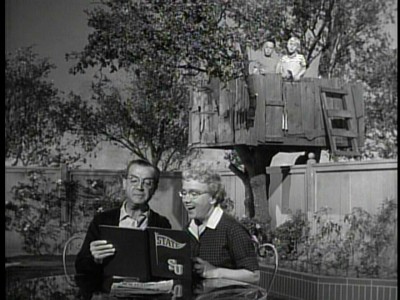
But it's not exactly a house anymore -- see this pic. It does have a floor, and low walls that only go up to waist height on children, but not walls that go over the kids' heads, and no ceiling or roof. It's a fairly open structure, more like a stand or perch or nest. And so, the door is more of a part of the low wall that swings open, like the gate of a residential fence, not an opening in a wall that separates an enclosed space from the outside world. It is built in a treetop and does use a ladder for climbing up. And it does involve friends (same-sex) -- that's his pal Tommy up there with him.

Still, you can see how less of a secluded sanctuary it is compared to the examples from the '30s and '40s. But then, that's only to be expected, giving the rising levels of social strife during the '50s and '60s, even somewhat beginning in the late '40s. Just cuz 1960 wasn't at the explosive peak of chaos of 10 years later, doesn't mean it was a harmonious stress-free kumbayah circle. I'll be revisiting this fact for other domains of society later. Suffice it to say that it was less socially harmonious than the '30s and '40s.

There's even an entire episode from 1960 about his tree house ("Dennis' Tree House"), which makes it into a social obstacle instead of a source of harmony. The treehouse is built right on the boundary with the yard of his neighbor, Mr. Wilson, who is upset that it might scare the birds away and he won't be able to enjoy his hobby of bird-watching. Things work out in the end, but it's part of a trend of the rising-strife phase that portrayed treehouses as sources of problems rather than unalloyed wholesomeness.

In a 1956 episode of Lassie ("The Tree House"), two friends Jeff and Porky get excited about building a treehouse and becoming blood-brothers -- seemingly off to a good start on the whole "treehouse as sanctuary for friends" theme. It's built in Jeff's yard with the help of his family. Unlike in Dennis the Menace, this is a proper treehouse with a roof, walls, doors, ladder, etc.

But then when they both spend the night in it, they bring their dogs along, and Porky's dog won't stop howling, keeping Jeff awake all night and making him so angry that he kicks out both the dog and his supposed blood-brother and guest Porky. When Jeff goes to apologize the next day for being a poor host / blood-brother, he finds the interior of the treehouse has been trashed, and assumes Porky did it as revenge -- more anti-social paranoia and suspiciousness and bad faith.

Later, there's a loud noise coming from the treehouse, and when Jeff goes to investigate -- there's a bear inside trashing the place even more. So that's what trashed the place before, not Porky -- but still, setting up the treehouse as a space that's vulnerable to roaming nomadic outsiders, including animals. Jeff's mom says no more treehouse. But it turns out the bear was escaped from the circus, not a wild one, so the mom says it's OK again. That makes no sense, there could still be wild bears or other troublesome animals roaming around that could climb up the ladder -- but the paranoid point has already been made. Beware! Caution! Risk!

The last of these problematizing examples is from 1970, from The Brady Bunch ("What Goes Up..."). In it, there's another proper treehouse, but it is still portrayed as a source of danger -- Bobby tries to climb up into it, but falls and sprains his ankle, leading him to develop a fear of heights on top of it.

What happened to treehouses just being wholesome sanctuaries for friends? Well, '56, '60, and '70 were all part of the rising-strife phase of the cycle. It wasn't the harmonious '30s and '40s anymore. So anything that might bring people together socially, like a treehouse sanctuary, had to be cast in a more negative and threatening light, as though it might introduce more strife than it would relieve. Not just physically, like scaring away the birds or posing a risk of falling injuries, but sowing the seeds of suspicion and resentment despite the promise of bringing camaraderie and appreciation, like driving a wedge between supposed blood-brothers.
* * *


It wasn't until after the peak of social chaos circa 1970 that that wary attitude began to wane, and treehouses regained their wholesome innocent pro-social connotations. Only a few years after the Brady Bunch episode, there was a renaissance of rural-themed TV shows, epitomized by The Waltons and Little House on the Prairie.

In a first-season episode of The Waltons (from '73), their treehouse makes its debut and would become a familiar fixture in their environment for years. It's a proper treehouse, not problematized, and since the show is set in the Depression, it revives the original wave of treehouse-mania from the '30s and '40s.

Our Gang was renamed Little Rascals, and given an animated format in 1982, which not only included a treehouse as a gathering spot for the friend circle, it was emphasized by being included in the intro sequence, to set the premise and sense of place and tone.

And from there, treehouses began to explode in popularity, although more so in movies that were set in the past, like Stand by Me and The Sandlot. Both of those are set in the early '60s, and so a proper treehouse and thriving friend circle would've been anachronistic for that time -- it would've been more appropriate for a movie set in the '30s or '40s. But still, by that time they were starting to swirl together all sorts of "pre-1968" periods of 20th-century America. A little bit of the '30s, a little bit of the late '50s or early '60s, always an unintended dash of the year in which it was made, it's all good.

Dennis the Menace was made into a movie in 1993, and it upgraded the treehouse to a proper one, again unlike the era in which the original TV show was made. Little Rascals was made into a movie the next year, although without a prominent treehouse.

The Simpsons had a treehouse in their backyard as a gathering spot for friends, and although I don't know when its first appearance was, the "Treehouse of Horror" series for Halloween began in 1990. The only episode from '89 was the very first one, so unless it's in that episode, it first appeared sometime in '90.

The revival of the wholesome and non-threatening treehouse trope during the '80s and '90s reflected the rising-harmony phase of the cycle, before merging with or enhancing the new trope of "teen's room as treehouse within the home itself".

After the '90s, the treehouse trope begins to fade once again, not to mention picking up the connotation of danger and threats, right back to Lassie and Dennis the Menace and The Brady Bunch. But that's only natural, as the social mood swung away from harmony and toward strife once again, and anything that would cement social bonds among friends would have to come under suspicion and then get eliminated altogether.

However, now that the pendulum is finally swinging back toward harmony, as of the past couple years, maybe treehouses, teen's room as a treehouse within the home, or some new variation on this perennial American theme will emerge -- assuming we still had a thriving pop culture production sector, which we do not at all. American culture -- meaning, all-American, appealing to and paid attention to by all -- has been extinct since 2020.

But in whatever fragmented niche-demo remains of American-ish culture that remain going forward, we're likely to see a gradual revival of this theme, likely peaking in the early 2040s.

Maybe in video games? Minecraft is still thriving, despite coming out in 2010, so perhaps treehouses will become the hot new thing to build. Mumei made a cozy little one for herself a couple years ago, Fauna made the huge sun-obscuring World Tree during that time (which was not just a tree, but had home-like architecture at the top), so... maybe it's the start of a new trend?

It'll probably be more visible in new games, where there's a prominent treehouse built into it, but it'll be some niche indie thing that not the whole world knows about, or something. But the urge to hang out with friends in treehouses -- or their present-day descendants, perhaps in a form not yet invented -- will become overpowering in the next two decades. Plenty of time for it to find some kind of realization in the cultural realm.

Look forward to seeing what it is, while still knowing in advance it won't top, as it were, the examples from the '30s and '40s or the '80s and '90s. ^_^

February 12, 2023

Girls think dreams are real, guys think they compete against reality (childlike vs. grown-up nature)

Well, I wrote a whole 'nother post in the comments section again, but this time it's quite a bit off-topic and something I normally don't write a whole lot about, so figured I'll draw your attention to it here in a new post, if you don't read the comments.

I won't copy-paste it, just link to the first comment in the chain. You can react here or there.

It's the mixture of tones you expect from the most interesting person on the internet -- comical, serious, pop cultural, academic, totally unexpected yet immediately relatable, etc.

And it all started with a little vignette from a vtuber's stream -- aside from their entertainment value, and social-emotional bond, good streamers provide inspiration for discussion. Couldn't have done it without you babes. ^_^

September 29, 2022

"Weird" aesthetics over the decades: From unifying youth rebellion against authority, to anti-social warring against peers, as imperial collapse sets in

Although I like the '90s the least among decades I'm familiar with, they were still formative for me, and they're currently undergoing a revival (along with y2k), so I might as well chime in on some of the key features of that decade, and how they're different or similar to today's.

This recent reflection was sparked by Mumei singing "Basket Case" during her recent karaoke stream, instead of the 2000s emo era Green Day songs that are more popular nowadays. (Unless Zoomers get back into the '90s for real, and not just in clothing styles?)

Green Day has had one of the saddest trajectories of any musical group, regarding their role in the overall zeitgeist -- from purely (counter-)cultural actors back in the apathetic '90s, to the stirrings of the red state / blue state culture wars of the W. Bush 2000s, to full blown politicized witch-hunting of the woke 2010s and 2020.

Punk proved itself to be the most authoritarian-loving genre, with not only Green Day but the Offspring, the Dead Milkmen, Rage Against (now, For) the Machine, and worst of all the Dead Kennedys outright fangirling on Twitter with the CIA's anti-Trump electoral pointman McMullin. The common theme was that the half-or-more of the country that doesn't support your political program -- bailing out Wall Street, waging war against Cold War boogeymen, and mandating worthless vaccines for a bad flu -- are literal Nazis who must be concentration-camped in order to preserve freedom.

The only punk to pass this test with flying colors is Avril Lavigne, who never once posted anything political during the crucible of 2020 and after -- BLM, Antifa, boo Trump, vaccines, masks, etc. The princess of much-derided "mall punk" aced the test of anti-authoritarianism, while the critical darlings all failed pathetically. Score another W for all things mall-related.

As punk and "alt" culture in general became more authoritarian, its symbols went fully mainstream, to the point where you can walk into any drugstore and pick up hair dye in rainbow colors, Millennials are obligated to have tattoos, and marijuana is sold openly in every strip center around the country.

* * *


But enough about the recent past, which is all still fairly fresh in everyone's minds. The point here is to contrast how different the non-polarized '90s were. Hardly anyone had weird hair colors, tattoos and piercings other than in the ears were hard to find, and there were "3 strikes and you're out" laws about drugs and related crimes.

Now, someone who wasn't there might think that the relative normie-ness of the '90s meant that the alt culture was ignored, shunned, or suppressed by the majority of young people. But in fact they were fully accepted, even elevated at times. Just because you were a preppie or jock didn't mean you didn't have alt friends, didn't listen to gangsta rap or grunge, and never smoked a joint. Youth culture had its diverse sub-cultures, but they were all aware of each other and more or less friendly toward each other -- in their common struggle against The Man, The Powers That Be, The System, etc.

And far from that anti-authority sentiment being a vague vibe, it was explicit. White suburban alterna kids used to openly shout, "What smells like bacon?!" when the police were nearby. Preps didn't want to get hassled by The Man for smoking pot, joyriding, or whatever other mischief they were getting into. And being anti-police goes back even further among African-Americans. All this came together in the scene from Airheads -- where a metal band hijacks a radio station in order to play their demo tape for exposure -- in which the metalheads begin chanting, ROD-NEY KING! ROD-NEY KING! in order to get the crowd to swarm the bumbling cops.

This anti-authority attitude was not limited to local police, while praising the feds as witch-hunters against political enemies, as has become the norm over the past 5 years. Black leaders openly began talking about the role of the FBI in the MLK assassination, and the CIA for introducing crack into the ghettos. It was also the heyday for what the Deep State would brand as "conspiracy theories" among white people, too -- blaming the CIA for the JFK assassination (famously in the blockbuster Oliver Stone movie), the X-Files, the origins of Alex Jones, and so on and so forth.

* * *


To outwardly express these shared interests against authority, they adopted core elements of each other's aesthetics and style. Alterna kids flirted with dreadlocks (Linda Perry of 4 Non Blondes, Dexter Holland of the Offspring), wore baggy jeans (including from Afrocentric brands like Cross Colors), and even if they were anti-sports, still sought out Charlotte Hornets gear by Starter. The preppy girls wore Doc Martens shoes. All white people adopted some degree of black slang.

The gangsta rap kids had as many drawers of plaid flannel as the grunge kids, and were bigger consumers of Tommy Hilfiger and Polo than even the preps. The '90s were the heyday of both the wigger and the... bleppy? Blunge? They weren't "Oreos" -- those were black kids trying to act WASP-y and yuppie in general, not just adopt the plaid flannels or Polo logo shirts from white kids.

The two counter-cultural camps -- alternative and gansta rap -- shared the pot leaf as a symbol (on hats, shirts, scrawled onto their textbook covers, etc., even if they never smoked a joint in their lives). In fact, they bought their counter-cultural clothing from the same store in the mall -- Spencer's.

Although I've never done any drugs, that didn't stop me from buying and occasionally wearing a black hat with a white skull in front, which had a vivid green pot leaf on its forehead. You couldn't buy that stuff at Abercrombie, Marshall's, or Walmart -- you had to go to Spencer's. That was before white counter-culture split off from black counter-culture and re-camped in the Hot Topic store, during the 2000s.

But back in the '90s, multiculturalism was the rule -- not only across races, but within white sub-cultures, like alterna and preppy, or alterna and country. The lineup for Woodstock '99 was heavy on the alterna sub-cultures within whites, but it also had George Clinton & the P-Funk All-Stars, James Brown, DMX, and Ice Cube. Not to mention multiple bands in the popular black-white fusion genre of rap-metal. Along with Willie Nelson, Creed, Sheryl Crow, and the Dave Matthews Band for normie / conservative-coded white audiences.

The shared interests against authority, and their cultural expression, came together in the censorship of music -- mainly by putting the sales-killing "Parental Advisory" label on the album cover. That effort was spearheaded by the non-partisan PMRC (Parents Music Resource Center) back in the '80s, but continued into the '90s. And whereas the leader of the crusade, Democrat Tipper Gore, had earlier been the wife of a Senator, she was now the Second Lady.

There were also local measures across the nation to suppress counter-cultural symbols in public schools -- the pot leaf, the Charles Manson t-shirt popularized by Guns N' Roses frontman Axel Rose, piercings other than in the ear, and wild hair colors. But I'll cover those in a separate post, looking back on my own experience as a purple-haired 8th-grader in '95.

For now, suffice it to say that the role of those symbols was to unify the youth culture against the grown-up authorities. They were unifiers because they were already shared across a broad range of youth sub-cultures, and because the authorities were targeting their expression no matter who was displaying them. So it really was youth rebellion vs. power-tripping authorities.

This anti-censorship attitude meant to unify all of youth culture against the overbearing authorities, while still being non-partisan and indeed remarking on the political apathy of young people, was best expressed in the grunge anthem "Pretend We're Dead" by L7 from '92. (In the woke era, you'd have to add "all-female band", but that wasn't a rare thing before wokeness killed off the spirit of cooperation, including among women themselves.)

I didn't hear it at the time, but the jangly tambourine adds a nice Sixties counter-cultural touch, without being hamfisted or "boo Nixon" about it. Probably absorbed through the non-political Paisley Underground scene of the '80s, in their native SoCal area, which bore fuller fruit with fellow '90s icons Mazzy Star.


* * *


After over 200 years of rising, our empire's social cohesion (asabiya) had already hit a state of plateau by the 1980s and '90s, although it had not yet started its shallow decline, as it did during the blue state / red state culture wars of the 2000s, let alone the complete and total meltdown by the woke nadir of 2014-'20.

In the cultural domain of society, this breakdown manifested in the creative crowd -- whether the actual creators, their funders, their distributors / platformers, or the diehard consumers, or the commentators -- severing bonds with everyone who was not 100% identical to themselves. Obviously that unglued the whites from all non-white groups, since the creative crowd is overwhelmingly white. But it's not a racial thing, and pointing to 2000s emo and Hot Topic as a "whites-only" space is retardedly missing the bigger picture -- the creative crowd was severing itself from all other white cultures, like the preppies and normies and country fans.

Indeed, this dissolving of social bonds is so intense that even the alternative sub-cultures keep fragmenting into smaller groups, even though 100% of them are on the Democrat / liberal side of the political divide. They can't help but corrode the cohesion that would otherwise hold them together into a semi-big tent.

And as the creative crowd have abandoned their fight against overbearing authority, and turned on their fellow citizens instead, the overt and Deep State at the highest levels have come out in favor of them, and they in favor of it. Neither the FBI nor the local school principal will suppress a woketard student from sporting green hair, a lip piercing, pot leaf on their hat, etc.

Both the woketards and the authorities have discovered a common interest -- suppressing the unruly rabble during a crisis of legitimacy for the central authorities and elites in general, especially after the 2008 depression from which we have never recovered. The woketards because they feel they're superior to normies, who must be humiliated for their heretical culture. And the Deep State as part of a divide-and-conquer strategy against a would-be organized populace.

The central theme of anarchy has been re-branded for this new alliance, exemplified by the Black Bloc of the early 2000s anti-globalization movement being re-worked into a woketard paramilitary of the Deep State, now branded as Antifa. Whereas before it meant anti-authoritarian, now it means dissolving all social-cultural bonds for the woketards (to purify the culture of heresy), and preventing higher-level organization among the rabble in the eyes of the central state's security apparatus. Chaos, confusion, every man for himself, pure and total social breakdown -- not the put-upon banding together against The Powers That Be. In the new configuration, organization and teamwork = fascism, hence if you're anti-fascist, you're committed to dissolving every social unit in society.

And yes, that includes their own political team's units -- not the bizarre notion from right-wingers that the Dems or libtards or the Deep State have a well-oiled machine dominating a fractured GOP / conservatard enemy. The Democrats could not even produce enough cohesion to nominate Biden and Harris legitimately in 2020 -- the party leaders shut down the primary when it was clear nobody wanted Biden and would stay mired in a Bernie vs. not-Bernie civil war through the convention, like their 2016 convention on steroids (when Bernie representatives were boo-ing their "fellow" Dems from the convention floor!).

Every institution in the American Empire is coming apart at the seams, even the libtard ones. Hollywood can't make new movies, TV series, or music anymore. The video game industry can't do anything more than what they did 10 years ago, as Minecraft and GTA V are the most popular "new" games. The premier streaming platform, Twitch, is currently melting down from within. The general public does not believe the media, nor "peer-reviewed research" from the universities. The finance sector is collapsing again, with double-digit inflation on top of the problems of 2008.

Sure, there's an oasis here or there in every institution, but the overall trend is one of anti-social greed rotting them out from the inside, until they ultimately collapse. This is the opposite world of the Mid-20th Century, when people trusted the news & "studies," when the military could still win a world war, the FBI could coup a sitting president from the shadows with no one the wiser, when cultural production was still flourishing, when our manufacturing was first in the world, and when we didn't have rolling finance collapses with double-digit inflation and 0% interest rates and infinite money-printing.

*That* was the world of well-oiled machines -- here and now, we are in unrestrained breakdown and chaos, on all sides at once.

* * *


Contrary to clueless right-wingers who say that the creative crowd were always this bad, or always had this goal in mind, or are only now taking the mask off, this is in fact a 180-degree corruption of who they were in the '90s. And they themselves are openly embarrassed and ashamed of who they were back then, confessing their sins, promising to atone and "do better", and in all other ways disowning their previous selves. That's the opposite of celebrating their '90s selves as the tip of the spear, Trojan Horse, initial seed, Patient Zero, cuckoo's egg, long march through the institutions, or whatever other dum-dum metaphors the right-wing cultural commentators use to describe it.

Nor can we lazily say that they're the same as who they were back then because "the '90s led to the 2010s" -- sure, and so did the '50s, and the 1770s. We've gone through various phases of having little cohesion, rising, plateau-ing, then declining, yet to reach a new minimum. As far as cultural cohesion goes, the '90s were in a qualitatively different phase of this multi-century cycle. It was the multicultural consolidation of all our empire's earlier conquests, as well as unifying the sub-cultures within the imperial natives. The End of History -- no further left to go, unless history turns out to be non-linear...

Anyone likening the multicultural Nineties to the woke 2010s is from outer space -- they're totally out-of-touch with America, at least, and might as well be foreigners.

Next up: my 8th-grade battle for purple hair -- waged not against my normie peers (or even my parents), but against the literal authorities of the school. And other episodes involving my friends wearing the Charles Manson shirt, etc. I'll also elaborate on some other themes that I didn't get to chance to here, like individual vs. collective identity.

Millennials and Zoomers won't believe it, but that's because only Gen X and Boomers remember the reality of the '90s. Millennials and Zoomers retroactively insert way too much of the their own formative years in the 2000s and 2010s, back into the '90s or '80s, when it was not only absent, but often the polar opposite of the environment they imprinted on.

September 10, 2022

In a socially fragmented world, guys would LOVE to get friend-zoned (and streamers as friend simulators)

Just wrote an entire post's worth of content in the comments section, as usual. I'll copy & paste it below.

It started with a reaction to Gura's stream tonight, but then got carried away on a number of related tangents. But the basic theme is what the title of this post says. If you're not much of a stream-watcher, give that link a try. It's short by streaming standards (under 3 hours), pretty conversational (not just video gameplay), covering a range of topics, and a spicy meme moment from the chat. You can treat it as a podcast, to play in the background while you do other things, if the game itself doesn't interest you.

Only thing I'll add is that, based on her saying that she likes the clothing styles of cottagecore and dark academia, she is clearly a former or current Tumblr girl (maybe as it migrated to TikTok as well). Like most, or maybe all, of the other Hololive girls, in fact. During the woketard purges of the mid-late 2010s, these girls gradually went into hiding. Now that the woke culture war is dying out in the broader society, and there's a whole new entertainment format that woketards don't control -- livestreaming, especially when they're hired by Japanese companies -- these Tumblr refugees can come out of hiding and bless the world with their cursed-yet-cute personas.

A few years ago, "Tumblr" had only negative connotations, because Tumblr demons had taken over the platform. But now that the Tumblr angels have a safe space, as it were, maybe the brand can be rehabilitated.

* * *


Awww, Goobi hosted an unhinged hang-out party for us, even though she's been in a "head hurty" mood this week. We'll always be there as an audience when you need someone to unload your emotionally drained brain on. I'm pretty sure it was her monthly debuff (as Wolfabelle phrased it), not anything threatening, thank God.

I really like this aspect of girly-girl streamers -- they let you into their lives by going through the things that have been bugging them lately, and whether you actively respond or just provide them with an all-ears audience, it lets them work the frustration out of their system.

Just like being actual friends with them. :)

One of the things I really despise about the girl-hating culture is complaining about when girls complain to guys about the mundane goings-on of their life. "Oh great, what's it about now?" And complaining about not being sure what to say, or whether to say anything at all. Just be an audience, then, they're just looking for some support, so they can get better and be the supportive girly-girl in your life once her head is back on straight.

I really don't understand the girl-hater ignorance toward this behavior -- she's *chosen you* to be her audience, not just any old schmo. That means she values your relationship, otherwise she'd either be talking to someone else, or would just clam up altogether out of paranoia and distrust.

It's really the twin phenomenon to the whiny man-haters (who are also girl-haters, or "female misogynists") who complain about having to do "emotional labor" to support a guy in their social circle. As though it's unpaid therapy, and she gets nothing else out of it from him.

But the reward to the listener is that the person working out their problems is not going to just leave afterward, like the patient of a therapist, who don't see each other outside of their sessions. Rather, they're both involved in each other's lives, so by helping out someone with a problem (even just feeling cruddy during shark week), you're helping to get back a source of support for yourself.

You both depend on each other, so helping the other is also helping yourself. It doesn't require further compensation. But the girl-haters and man-haters (again, the same type of people -- people-haters, misanthropes, etc.) act like it's a burden, and they would need something further.

That's because misanthropes don't actually value social bonds with other people, so helping another person is *not* helping the misanthrope -- who doesn't feel like they ever get anything out of the other person, even when that other person is in a good mood and full of confidence.

All of which is to thank Gura for providing a good role model for the other side, our side. She's a girl-liker and guy-appreciator, not a depressed misanthrope.

Thank you for trusting us and relying on us when you need it -- we'll always be there for you, Goob. :)

* * *


"Emotional tampon" -- that's the phrase the functionally-gay manosphere girl-haters used. Exactly the same as "emotional labor" used by the feminazi whiners. Two sides of the same misanthropic coin.

Imagine thinking you'll ever get a girl to trust you enough to feel comfortable being physical with you, without seeing you be supportive in low-stakes everyday situations like "listening to me go over what's been bugging me lately".

They thought there was a video game cheat code that would allow them to circumvent actually developing a social-emotional bond with a vagina-haver, before getting her into bed. That's what they spent all that time in the manosphere doing -- studying tips, memorizing lists, doing homework. They treated it like it was GorlFAQs.

"Emotional tampon" referred to the suckers who were doing things the hard way, the old way. The ones who didn't have the secret knowledge of what cheat codes to enter into the computer program of the female brain. That knowledge belonged to the geniuses.

Turns out, no, there's no cheat code, and you'll never get laid or have a steady gf or wife (unless you're really hot, which they are not). That's when the real bitterness and girl-hating took off. Back in the 2000s or early 2010s, they were fine to just gripe about women on the internet, if they could enter the cheat code for casual sex each weekend. When the cheat codes didn't work, all that was left was their own bitterness and misanthropy.

The whole "mens rights activists," etc., just the flipside of being a man-hating feminazi. Trying to out-woke or reverse-woke the feminists. Sadge.

* * *


I'll go out on a further limb and say that most guys under 30 or 40 today would be *ecstatic* to be "friend-zoned" by a girl, or several girls at once (ooh la la).

The pejorative sense of getting put in the friend zone is that you stood a decent chance at getting into a bf / gf relationship, or maybe just a fuck-buddy relationship. But like Chris Rock said, you took a wrong turn somewhere, and ended up in the Friend Zone -- NOOOOOO!!! Now you're just her Platonic friend.

Back when people actually did have sex with each other, especially in a casual hook-up way, then yes, that would've been a huge failure, and it would've stung bad for awhile. You might never stop regretting that one time you got friend-zoned by your crush, speculating forever in your own mind what you could've done differently to have gotten into the other f-zone with her.

But now that young people have stopped having sex, especially on a frequent basis (not just a one-night stand or two to last all year), the alternative to getting friend-zoned is not becoming fuck buddies. It's not a missed opportunity at casual sex. If you're not in her friend-zone, you're not in her any-zone.

Fewer young people have enduring friendships than ever, some literally don't have a single close friend who they confide in, and who confides back in them. In this new dystopian reality, yesterday's nightmare is today's paradise -- "Wow! A girl actually wants to be close friends with me?!?!?!!!!"

I think the girl streamers sense this shift in what guys are looking for when they interact with girls online. Aside from a minority of coomers (close to zero with the Hololive girls), they're not there in a girl's chat to hit on them, ask for nudes, or otherwise act like the platform is a fuck-buddy finder. The chat and the streamer both know that Tinder etc. already exist for that. And those platforms are already done for, among the majority of guys, since by now it's an open secret that only the really hot guys will get anywhere using them.

Instead, they're there actively seeking out a friend zone! Because the alternative is not the fuck-buddy zone, it's the no-friends-zone, the worst of all.

And as the girl streamers occasionally confess, during a momentary lapse in their self-monitoring (hehe), they appreciate the chat acting as a collective friend group to them as well. The friendship simulator feeling all-too-real goes both ways. :)

June 12, 2022

Today's public booba flashing report, and the return of outgoing / rising-crime times (Feral Girl Summer)

Tonight I received further confirmation that the outgoing, wild, rising-crime climate is indeed back in full swing, after having been in a cocooning / falling-crime phase from roughly 1990 to 2020. Now it's back to the climate of 1960 to 1990, starting at the beginning of course, not the climax of that wave.

As I was driving through the city, traffic was slow -- after 10pm on Saturday night, on the main avenue for nightlife. Coming down the other lane, there's someone on top of a car -- no, hold on, as it pulls closer, it's a young babe hoisting her crop-top all the way up to her collarbone, jumbo jugs just a-jumblin', up and down, up and down, above her smooth slender tummy, beating against her ribcage like a primate pounding its chest.

She's standing straight up through the sun-roof, big hair waving off to either side of her face.

And she's not looking down at any of the pedestrians, but staring coolly ahead, like a fighter advancing toward some ring further down the street, eyes narrowed to intimidate her opponent. The audience is cheering on their hero from the stands within the arena of the main drag, all whipped up for this Saturday-night showdown.

Only there is no scheduled main event, no street festival, no outdoor concert, no occasion of any kind that would encourage this kind of spectacle. She is doing it because she just felt like it, and couldn't contain herself. She came out to hype up the crowd for the return of public exhibitionism -- not to thirst-trap or horny-post IRL, but simply to feed the do-what-you-feel zeitgeist.

She was lowering the inhibitions of the crowd by leading by example: if she can do that, then surely anything just shy of that is OK as well for us to do, if we're not as adventurous as she is. Before long, it will become totally normalized, in a way that would've seemed to come from some alternate dimension just five years ago, during the depths of the #MeToo hysteria -- "Yep, there goes another booba-bouncer who's standing through the roof, it must be Saturday night..."

I have not seen anything like that in my life. Maybe if I'd gone to Mardi Gras in New Orleans, or whatever, but not just coming down the main street of a flyover city, with no external reason for debauchery. And even the flashers at Mardi Gras are only doing it momentarily, directed at specific individuals, to get those beads -- not leaving them exposed indefinitely, to the crowd in general, slamming repeatedly against their body, for nothing at all in exchange.

Nor was it a case of a sloppy drunk whose top was falling down, which she was too dazed to fix. She held her balance standing up in a moving car, deliberately lifting her top -- purely for exhibitionism.

Also unlike garden-variety exhibitionism, neither she nor anyone else was taking pictures or recording video for uploading to a social media platform. I'm sure that as a Zoomer she was inspired by the "Feral Girl Summer" trend on TikTok, but she clearly could not post what she was doing to any online platform (too salacious for social media, not sexual enough for porn sites). This is a purely IRL phenomenon.

Wild times are coming back, people.

* * *


If you started reading this blog anytime after 2012, you might not have read my extensive, in-depth series on the outgoing / rising-crime vs. cocooning / falling-crime cycle. I began that in late 2009, and made it the main theme through 2012, with occasional posts after that.

I predicted, from the timing of past cycles, that cocooning and falling-crime would last through about 2017, and rise after that. Off by only a year or so, as I distinctly remember all the public catcalling toward me by young babes in their cars in late 2019 (wrote a few posts on that at the time). And the soaring crime rates as of 2020 speak for themselves.

This is more than just the shifting of phases within the 15-year excitement cycle, from vulnerable to restless, as of 2020. The last restless phase, 2005-'09, did not feature this level of public exhibitionism, even remotely.

I covered pretty much every social and cultural topic, high and low, big and small, in the context of the crime-and-cocooning cycle. And sure enough, public exhibitionism and nudity was one such topic.

Here is the first one, on the disappearance of flashing and streaking.

Next one on the cohort effect, where nudism in cocooning times was only being kept alive by increasingly older people, who were young when it was in. That's the crucial difference for tonight's spectacle -- no way was she over 25, let alone a Boomer of 65 who had done some flashing and streaking back in the '70s.

Follow-up on the increasingly gray-haired clientele of swingers' clubs. Give current trends a decade or so, and it'll be 20- and 30-somethings again.

Lastly, not about exhibitionism per se, but public nudity, where showering naked in public (such as after gym class in schools) disappeared quickly.

There's all kinds of related topics I covered back then -- just navigate through the archives by year on the sidebar at the right, pick any month at random, and skim through the post titles. If you can think of it, I've already written about it, over a decade ago. :)

Butts vs. boobs, thicc vs. skinny, douching and shaving down there vs. going au naturel -- you name it, I covered it. I covered all sorts of non-sexual topics, too, but in case this post piqued your curiosity.

Incidentally, it's also relevant that tonight's girl was skinny and flashing her boobs -- not a thicc PAWG twerking her bare buns. Outgoing / rising-crime climates focus more on boobs than butts, and idealize skinny rather than thicc girls (this is reflected in actual body shapes as well, not just what is considered attractive).

It's bittersweet for an assman like moi, since I enjoy the outgoing climate better. However, judging from the last rising-crime period, there were still fairly thicc butt-girls through the first decade of the wave, i.e. the '60s. But their numbers were declining, and by the '70s, '80s, and early '90s, the voluptuous va-va-voom women of the falling-crime Midcentury were nowhere to be found.

We hate to see them go, but love to watch them leave...

June 9, 2022

Gen-Z echo-ing Gen-X in having mature tastes, not perpetual adolescents

As often happens, I started riffing in the comments section until it turned into a full post, starting with this comment. Read it all there.

I've noted before how charming it is to hear Gura performing mature songs during karaoke, and not only youth-culture hits. But I think it's part of a broader difference between Zoomers like her and Millennials, while being quite similar to Gen X-ers. Another example of the generational pendulum swinging.

Inspired by her recent inclusion of "Torn" by Natalie Imbruglia. BTW, if the sharky chanteuse is looking for a similar song for next time -- or just her own enjoyment -- there's "Sway" from 1997 by Bic Runga (New Zealand rather than Australia, but close enough). It was not an international hit like "Torn," and I first heard it from a YouTuber covering it in the late 2000s (Ana Free).


In general, the adult contempo side of the '90s doesn't get enough awareness. But I think Zoomers would resonate with it, perhaps more than the Eurodance anthems of the time that they're familiar with.

The '90s were such a chilled-out decade, I spent far more hours watching the iconic video for "Take a Bow" by Madonna than any house / Eurodance / techno hit. The latter simply were not as ubiquitous on MTV, while Madonna was. And she was not in high-energy danceclub mode at that time. I didn't pick up on the song's Far Eastern motif back then, but it's comforting to hear some good ol' multiculturalism from the pre-wokeness era, which would have prevented it as an example of "cultural appropriation". Enjoy it before it gets retroactively scrubbed by Silicon Valley censors:

May 31, 2022

Rebirth of the fertility cycle, as girls liberate themselves from hormonal birth control

A sea-change in the relations between the sexes has taken place within the last 5 years, largely without public commentary, as it did not fit into any of the dominant take-cycles (MeToo, Trump Derangement Syndrome, or wokeness in general).

Namely, girls have started to ditch hormonal birth control, en masse, for the first time since it became widespread among teens and young adults in the '90s and 2000s. The realities of the fertility cycle, which is suppressed by HBC, are going to flood the society and culture like a tidal wave that has not been felt in several decades.

True, girls are going to go through greater cramping pain during the PMS phase of their cycle, and along with that, greater irritability, snappy talk, and lashing out. But that's only a few days out of the month -- they're also going to be soaring to far higher highs during the fertile phase of their cycle, being more extraverted, excited, flirtatious, smiling laughing & giggling, and flush full of positive vibes.

Trading a couple days of crabbiness for a couple WEEKS of merrymaking? Yeah, I think we'll manage somehow. If you're a girl-liker, you're in for a real exciting change of pace, probably for the first time in your life. If you're a girl-hater, you're going to be contemplating suicide like you've never known before, as unbridled feminine hormones come crashing against your flimsy "no girls allowed" cardboard fort.

And right as the 15-year excitement cycle has entered its restless warm-up phase (as of 2020), and dudes and dudettes feel eager to come out of their shells and start mixing it up with each other again! I actually think this is part of the even longer 60-year cycle of cocooning mood / falling-crime vs. outgoing mood / rising-crime. But those are all topics for future posts in what must become an ongoing series.

For now, let's first take a look to see what THE DAYTA tell us. I first had this hunch a few weeks ago, when I noticed how full-throttle hormonal my favorite streamers are -- both during their PMS lows and their ovulating highs. I didn't recall any previous era of pop culture having young girls in such a state of nature, except my kid memories from the '80s, back before every teen was on the pill, and when there was still an outgoing mood and rising crime.

Millennials when they took over YouTube, movies / TV, music, podcasts, etc., did not show this profound cycle between snappy lows and pheromone-radiating highs. And even when the excitement cycle was restless and danceclub-friendly, such as the late 2000s, there was a pervasive message of "look but don't touch" (e.g., "My Humps"). That is, she was excited to get out of the house and go dancing, but was not actually boy-crazy or horny, so don't read that into her booty-shaking moves on the dance floor.

In the 2020s, the message is going to be, "Look -- and if you're hot, please, come touch". That doesn't mean only hot guys are going to be in demand, since the plain-looking girls will have to settle for the plain-looking guys. But they will still be boy-crazy and horny for half of their lives now, unlike earlier when the plain-looking girls wouldn't have settled for their male counterparts, having been lobotomized by HBC to feel no urge to connect with *somebody*.

* * *


Sadly, there are no data on how prevalent hormonal birth control is by age and year. Maybe if you lump all females 15-49, but that's not relevant. And maybe if you just want a snapshot here or there. But it's not tracked like the prevalence of STDs, live births, marriages, or anything else in the kinship / dating-and-mating domain.

They really don't want people to know what's going on with it, which is also why the effects of the pill are never discussed during the now-obligatory sex ed classes in high school, despite all of the girls going on the pill around that time and lasting until menopause, if they don't decide to reverse course.

And I don't mean the rare side-effects like blood clotting -- I mean the 99% common effects like flattening out your moods like an efficiently programmed robot, draining your libido, making you withdrawn, prone to migraines and depression, and the rest of what happens when your body is tricked into thinking you're pregnant, while not actually having a pair-bonded mate to support you through the process, and no actual new family life to look forward to.

So I went to the place where women might actually announce their life decisions -- Twitter. If it can fit into some kind of discourse or take-cycle, just blurt it out, and see if it goes viral. So far, no luck with going viral, but we can still track how common the decision has become.

I searched "going off hormonal" to make sure they're referring to the types of BC that disrupt the natural hormone levels and cycles, and not condoms or whatever. And while there are other variants on this phrase (like "go" off), the pattern is clear enough with this one exact phrase. And there are media reports confirming the shift during this time period, so it will do fine.

Since there are only in the single or low double digits per year, I read through each one, and weeded out those that are irrelevant (like trannies talking about going off a different kind of hormonal intervention). And when I say there's a "post" on Twitter, I mean it's about their own personal decision or debating process, not all the separate posts that are linking to the same article or YouTube video. I want to know how many different individuals are gabbing about their decision, or near-decision, to go off the pill.

* * *


From 2009 to 2014, there are only a handful of posts per year with "going off hormonal", no more than 5. And no articles on other media sites that are being linked to. This is the steady baseline, since even when HBC is common, some girls here and there are going to ditch it.

In 2015-'16, there are still only ~5 posts per year, but now there are also articles at other sites being linked to. In 2015, 3 articles: one from Pinterest, one from Facebook, and crucially, one from the feminist outlet Jezebel, which is a both-sides attempt to please the rear-guard pill-poppers and the au naturel avant-garde.

(BTW, someone in the Silicon Valley tech cartel has crippled Google's search engine so badly that that article does not appear when you specify the year of publication in your search for it. I figured it would help to narrow down the results. And yet requiring "2015" totally hides the article, while removing the year reveals it as the first result. Just another reminder that the internet is disintegrating more and more all the time, and that you cannot rely on Google's search engine for much of anything these days.)

In 2016, there are links to a fear-mongering article about going off the pill, scaring you into thinking that your vitamin D level could drop. Right, women suffered from low vitamin D levels for all of human history, until the pill became widespread in the past couple decades. Part of the knowledge-destroying, authoritarian movement known as I FUCKING LOVE SCIENCE. ("You'll ovulate nothing, and you'll feel indifferent.)

In 2017, the number of posts rises above 10 for the first time and has stayed at that order of magnitude, rising ever since. There are 12 posts, and links to a YouTube personal essay video. In 2018, 14 posts, and links to another YouTube personal essay video. In 2019, 19 posts.

By 2020, the number of posts clears the 20 mark, at 28. In 2021, there are 23 posts. And in 2022 so far, there are 17 posts -- easily clearing 20, maybe even 30, by the end of the year.

Obviously, these numbers are just the tip of the iceberg for the general population. For every Twitter user who spontaneously blurts out, "I'm off the pill!" -- there are thousands or millions more who are doing so IRL, without posting about it. The important thing is the soaring trend in these numbers, as well as the attendant rise in the number of articles reacting to that trend. That means it's real, not just a handful of weirdos on Twitter.

In fact, there's only a few counter-cultural / socialist / etc. types who are part of this trend. It's mainly the normies, bluechecks, and political moderates. That means it generalizes far more broadly, than if it were only the hammer & sickle, BPD art ho, or other niche demographic. Likewise for the last period of going natural and embracing each other, during the '60s, '70s, and '80s -- it was not just a niche demo of Beatniks, but a fully mainstream phenomenon in every school and town across America.

* * *


As this mother of all vibe-shifts has taken place, the articles have surrendered in the battle to finger-wag women into staying on the pill. Now they're at the bargaining and acceptance stages, like "So you're going off hormonal birth control -- *insert audible groan here* -- Here's what to expect".

Another change has been the nature of women's comments about going off HBC. During the vulnerable phase of the excitement cycle (2015-'19), when people were in a touch-me-not refractory state, they were mainly about improved mental / emotional health. But right on schedule, as the restless phase kicked off in 2020, they've begun gushing about how horned-up their libido has become -- and not in a despairing tone either! LOL.

"Why didn't somebody warn me my sex drive was going to kick into overdrive??!?! [devil horns] [starry eyes] [tongue out] [devil horns]"

None of this shift has to do with planning to get pregnant, only a handful of posts ever mention that. They simply don't want to have their minds and bodies neutered any longer, and if that means they need other forms of birth control, so be it.

And a large share of young women aren't even fucking anyway -- a topic for a future post, about how HBC was not about birth control per se, but rather part of the broader trend of psych drugs to domesticate young people's wild-and-crazy behavior, during the cocooning phase of the '90s through the 2010s, along with Adderall, Prozac, and the rest of it. That mirrored the mood-flattening drug craze of the cocooning Midcentury, epitomized by "Mother's Little Helper" -- Valium.

I don't think most guys, of any generation, understand how widespread the pill had become by the 2010s. The medical establishment was forcing it onto girls at 16, when they were never going to have sex for years, and they have stayed on it for decades. Until now -- Millennials are going to finally feel what it's like to be a real feminine agent of chaos -- and creation.

And Zoomer girls are not going to get sucked into that sterilizing vortex in the first place. Maybe they were on it for a little bit, but likely not long at all, and they're never going to spend several decades warping their nature with it. Not at a mass scale anyway.

Social life has been so dull while half the population has been given next-level lobotomies, in addition to the drugs that the boys were put on. If you're a Millennial or Zoomer, and don't have crisp memories of the entire decade of the '80s, you're in for a real surprise. It's going to start off more like the '60s, and will take several decades of these changes before it reaches '80s levels of party-time all the time.

It's not only the wild-and-crazy behavior that's going to come roaring back to life, though. Feminine outgoing-ness supports and sustains all other sorts of relationships, connections, and social networks. Friends, acquaintances, colleagues, families -- all these social domains are going to become flooded with hormonal women searching for an outlet for their skyrocketing drive for engagement with others. Certainly online, where everything social is migrating to, but presumably also in whatever remnants of IRL there will be.

Secure your harness, raise your hands into the air, and get ready to shout with excitement -- these pill-killing women are about to take us on one hell of a rollercoaster ride, for the next several *decades*. Girl-haters, watch out: you better have built a bunker of misogyny, rather than that little cardboard fort. The boy-crazy barbarianettes have already begun to rampage the countryside, and they're not going to take any prisoners if you impotently try to block their libidinal path!

May 15, 2022

Catcall report, woketards killing off boy bands, pent-up female desire channeled into pseudo bi-curiosity

Wow, first Saturday night of the spring where I went cruising down the main drag in the city with music blasting out of the windows.

Haven't been since maybe New Year's -- everything has gone virtual, I haven't even bothered to check in on the would-be Saturday night revelers. But there was actually a decent crowd! Not as big and bustling as it should be, but compared to other public spaces, this was not as devoid of bodies. Some experiences are way less replaceable with a virtual simulation.

In pre-virtual times, this crowd would have been totally representative of the population at large. But now, when everything has gone virtual, these seemingly ordinary people are actually a self-selected elite -- the top 10% of the population for fun-loving-ness, outgoingness, and corporeality, who just cannot feel fulfilled from the simulations of The Real Thing.

So I decided to turn up the dial on the life-of-the-party behaviors that I normally roll out on such occasions. I don't need to be gentle with them, they can handle it -- they *want* it that high, that's why they came out IRL instead of staying plugged into their simulations.

First was of course some catcalling, or rather wolf baying, since I had "She Wolf" on repeat and howled out during that part of the chorus (a proper AWOOOOOOOO, not the dainty little "awoo" that she does).

Got some good looks, although since it's dark at night, it takes girls longer to figure out that it's a hot guy making the sounds, so no calls back. Will try this again in the afternoon sunshine, tomorrow or some other day. I miss getting catcalls back, performers feed off the energy of the crowd. Summer of last year and 2020 were perfect for that, so we'll see about this year.

Are they so used to online interactions that it doesn't even occur to them to call back, even if they wanted to? Is their instinctual muscle memory by now to grab their phone and tap out a text message? They'd better not be *that* online. We'll see...

Anyway, on the way back from the main drag, I fumbled around for a new CD to put in the player, and there it was -- One Direction's debut album. I'd picked it up for a couple bucks at a thrift store, and decided to put it on for the ride home. But I didn't make it more than 30 seconds into it before singing along, and thought -- I have to turn around and go back, to serenade the babes!

Just think of how deprived their senses are of that crucial experience -- it's not right to just let them wither on the vine like that. Not that I'm a professional singer, but I can belt it out if I need to, for a little while anyway. And the hits on that album do get pretty intense, they're not mellow '70s ballads or anything. The early 2010s were one of the most intense zeitgeists in human history, and One Direction was a central part of that.

The absolutely pulsating teenage yearning that was provoked by the boy band to end all boy bands... and the phenomenon only just got going with the endless trail of humped pillows left in its wake. It was more about the feeling that they were actually desired as The Only One by some hot guy, who not only wouldn't keep them their dirty little secret, but was proud to shout it to the rooftops.

So I cycled through the three songs that struck me as the most apropos -- their mega-hits "What Makes You Beautiful" and "One Thing", along with one that I was surprised was not released as a single or a music video, the wholesome party anthem "Up All Night" (I heard it for the first time tonight, but the lyrics are simple enough to pick up fast).

By the end, my voice was getting pretty shouty, and I needed some nice rosehip & hibiscus tea after getting home, but it was totally worth it. Again, it's not a technical recital for American Idol or anything -- they're just excited to be part of that level of a party atmosphere.

And those girls were just the right age to be One Direction's fanbase 10 years ago, so there was no risk of "Hmmm, I wonder if the audience will know this one or not..." They knew. It's like singing "I Want It That Way" to 24 year-olds in 2008 -- of course they remember that one! Few songs have the ability to instantly, and fully, transport you back to an earlier time and place. One of the most powerful types are those that made you feel noticed and desired as someone special, for the first time.

No amount of likes on your social media posts -- or, God forbid, donos to your OnlyFans account -- can recapture that feeling of Mr. hot guy serenading you, and as far as you were concerned, only you. (He doesn't *really* mean it toward those billion other girls in the audience...)

Aaaaaain't nothin' but a heaaaaartaaaaache

Aaaaaain't nothin' but a miiistaaaaake


The response was amazing. Not like applauding or anything fake like that, it's not the occasion to applaud a performance. It's to jump on the trend, let go of your inhibitions, and do what the singer is provoking you into doing. Smiling, running like the wind, and all that other crazy wholesome hormonal behavior.

At one point, when "Up All Night" was blasting, two cute girls in sundresses dropped whatever they were doing, to bounce and dance around on the sidewalk, each with one arm raised up to link their hand with the other's. For that pagan dancing-around-the-Maypole vibe (it is the time of the season, after all).

It's so heartwarming and rewarding to see them respond like that, and to know that a bunch of others nearby saw that duo dancing, and felt what they were feeling vicariously. Good enough, since it wasn't a club, where everyone is expected to be dancing. I can get catcalled or followed around a store some other night -- picking up everyone else's spirits is something that is usually limited to festive occasions like this.

Toward the end of the cruise, it had suddenly begun to pour buckets -- but I refused to roll up the windows. The car seats can withstand a little water, my shirt sleeve and arm that are hanging out the window will dry out. The show must go on -- even more so, when everyone's mood is tempted to go all negative, getting poured on during their Saturday night out.

So I kept the music up, the singing going, and still pounded the outside of the driver's door like a drum during the right moments. While not able to distract them from the pouring rain, this activity at least makes it feel like it's all part of one great big crazy party atmosphere, taking them out of their ordinary experiences. Not just a bummer or a downer.

BTW, I think the average guy -- at least the type willing to go out and have fun on Saturday night -- enjoys hearing One Direction's girl-crazy anthems, too. When they were teens, these songs gave voice to their own intense crush on that one special girl, who they were internally debating whether or not to reveal their feelings for.

Listening to these songs, they got to imagine themselves in the aspirational position of being a confident (and hot) guy who opens up, in hopes of winning the girl. Not just girls, sluts, or thots in general. Not interchangeable accounts on the hook-up apps. But her, the only one he can't stop thinking and feeling about.

It's risky and takes courage to sing songs like these to a girl, so the guys are imagining themselves in a courageous role, something that would motivate them to take on a confident, masculine behavior. Sorry, but sliding non-committally into a girl's DMs, or God forbid, Venmo-ing her some cash on her OnlyFans, is not courageous. Not public, for one thing. But also non-committal, almost passive-aggressive. Girls want a guy who's got guts. Nothing risked, nothing gained.

* * *


Sadly, these kinds of songs will never be made again, as our empire disintegrates, and along with it, our cultural production industries. In this case, it's not only the general breakdown of trust and cooperation at the institutional level -- and remember, there are no Trump voters in these industries, it's 100% Democrat-on-Democrat suspicion, paranoia, hate, and violence.

On top of that, there was the jihad that these puritanical libtards waged against "toxic masculinity" over the course of the woke 2010s. These boy band songs came out right at the beginning of the decade, before the avalanche of wokeness had really gotten rolling during the 2nd Obama term and after.

How can the culture industry go back on that, and make One Direction / Backstreet Boys / New Edition songs again? For the woketards, such songs are instilling in vulnerable young girls the notion that they're only worth anything via the male gaze. Wanting to be desired by a special guy, is just internalized patriarchy. Their sense of self-worth isn't supposed to react to whether, how much, or by whom, they're being desired.

Even worse, if girls react positively to such songs, they are not merely neutral bystanders on the sidelines -- they are enabling the toxic forces, and are thus guilty themselves of perpetuating the social pollution. So even if you felt like reacting positively, you have to keep a lid on it, lest the witch-hunters come after you, as a 2nd-degree troublemaker, i.e. as an enabler of the 1st-degree troublemakers (99% of the male population, who aren't gay and want to win over the girl they're crushing on).

This is like daughters who are raised by insane feminist parents, who have to play down their desire to play with dolls and bake pastries, since for the parents that's just the first baby step toward reproducing the toxic pollution of the patriarchy. Only now, it's not just a fringe group of insane parents -- it's the entirety of the culture industry, academia, and media.

The current situation is a radical break from all previous eras of our history, and contra lazy right-wing "minds", it is not only the latest in a series of such changes since The Sixties. Girls blew off the insane feminists and kept crushing on boys, and wanting to be the crush of those boys. The pressure from the culture industry was not simply lighter in degree, it qualitatively was not telling them to be ashamed for liking their crush and wanting their crush to like them back. That's why decades of boy bands were produced by that industry.

And the same dynamics are at play for the young guys listening to these songs. They're not supposed to be encouraged by such songs, because wholeheartedly and without warning letting a girl know how you feel, is non-consensual and on the slippery slope toward literal rape. If you do feel the urge to follow the model of these songs, clamp down on it, don't let it break loose where it could infect or pollute innocent victims.

Woketards pathologize what is healthy and natural, and normalize what is sick and twisted. They don't care if a guy Venmo's an OnlyFans girl some money after jerking himself off to her videos. That's transactional, financialized, virtual, mediated, and animalistic -- not romantic, fully-human, IRL, and part of the wide array of normal behavior that is not consensual.

The OF girl did ask to get paid by coomers, whereas the average high school girl does not ask for any ol' guy, perhaps someone she doesn't even know, to reveal his feelings toward her. But it happens, it's natural, it's permissible, and dealing with awkward social experiences like that is part of growing up.

* * *


So where does that leave girls' desires? They can't unabashedly express them in their natural way, because that would be enabling toxic masculinity. Well then, how about if they got horny for other girls? That would seem to be compatible with the anti-hetero agenda of the 2010s, epitomized by the gay marriage Supreme Court ruling of the 2nd Obama admin.

Per se that case was not anti-hetero, but huge decisions like that are never standalone things, they're part of a broader cluster of things happening. And in this case, it was the jihad against toxic masculinity, all those rape hoax stories in Rolling Stone and the like, Slutwalk, mattress girl, #MeToo, and by now the trans agenda.

Not only are young people feeling pressure from the culture industry, schools, etc. -- but from the very highest levels of the government, who are weighing in on one side of the culture war. And about something as non-political, and biologically basic, as feeling crushes and wanting to be crushed on by their crush.

This is what's behind the cohort of girls born after roughly 1994, frequently mentioning how hot they find other girls, etc., while keeping a lid on any feelings they have for guys. They are not actually going to eat another girl's pussy, fall in love with another girl, introduce another girl to their parents as "my new girlfriend," or get married to / raise kids with another girl.

Lesbians cannot stand this trend, since they feel like they're being led on and faked out -- oh great, yet another performatively bi-curious, yet 100% straight girl, only fooling me into thinking we could have shared something together.

But we have to understand why this is happening, and it's very understandable. These girls are straight, but they can't express those desires without painting a target over their heads for the woketard witch-hunters. You want to get into a monogamous relationship with a guy whose reciprocation of feelings would mean all the world to you? Wow, someone's suffering from internalized patriarchy, internalized misogyny, not to mention enabling toxic masculinity instead of breaking the cycle of pollution.

I reject the idea that it's these girls acting like badass girlbosses and not wanting to make themselves vulnerable or weak in any way. We've had girlboss careerists in this society for many decades, and they didn't trigger a widespread trend of silencing your hetero female desires in favor of performative bi-curiosity. If anything, they wanted to be wooed as well. They wanted to have it all, the '80s yuppie woman's dream.

And if it were about not wanting to appear weak, then that would apply to expressing desires for their fellow girls as well. After all, the other girl might reject you, might laugh in your face, might gossip about the whole deal with the other girls.

However, if the desire is not genuine, and the intention to reveal her feelings to another girl is not truly there inside of her, then there's nothing to worry about. She can call other girls hot, since they know nothing is actually going to happen. It's just the only outlet they have for expressing their desires, during a jihad against toxic masculinity.

Female sexuality may be more plastic than male sexuality, but not that much. If these changes in overt expression were reflecting a deeper change in desires, then what's stopping these girls from getting it on with another girl, dating another girl, or marrying / raising kids with another girl? If anything they're being encouraged to do so.

And yet, as lesbians will testify, these girls are not genuinely bi-curious. Lesbians can't even get the initial stages started, where they're hanging out, going on dates, and getting mildly physical, despite the bi-curious girl calling it off after a bit. That was from the old days. These days, 99% of girls who talk about other girls being hot are not even bi-curious in behavior. They just need a societally sanctioned outlet for their sexual and romantic desires, in a climate of oppressive wokeness.

So blame the woketards, not the performative bi-curious girls, who have forced others to channel their expressions in this way, however misleading it is to everyone.

I think the late '90s births are the last generation to have gotten to enjoy unfettered, natural sexuality during their formative adolescent years. As evidenced in part by the One Direction craze. That may have changed as they got into their late teens and 20s, but they at least enjoyed it during their high school years.

Girls born in the 2000s imprinted during their formative years on a different environment, where the jihad against toxic masculinity had been launched. They're never going to enjoy that crucial early round of validation from a chart-topping boy band. There won't be any more, and boys IRL and online are not going to step in to fill that gap in pop culture. I mean, I will, but I'm not from their generation.

It looks like core cohorts of Millennials, the late '80s and early '90s, will be the last generation to go through both adolescence and early adulthood under natural circumstances, before the jihad against toxic masculinity, which only struck by the time they were around 25 and fairly done with forming impressions. They imprinted instead on the 2000s, defined by America's Next Top Model and American Apparel ads. If those girls talk about other girls being hot, they truly are horny for them, and they may very well act on it.

That would seem to be the last cohorts of guys who are comfortable revealing how they feel to girls, not just mutually swiping right on an app. That includes One Direction themselves (even though some of them are gay, they were still comfortable in the role of serenading a girl).

What remains to be seen is whether these trends ever reverse, like the backlash against feminism by the late '70s and '80s -- but that was when we still had a cohesive, resilient society. During imperial disintegration, we can't rely on society's immune system kicking in when needed. In that case, the plummeting birth rates, indefinite celibacy, and performative bi-curiosity will be hallmarks of our population contraction during societal disintegration.