April 15, 2013

The social mood toward cops -- informal vs. deferential

Nowhere is the creeping level of everyday authoritarianism more visible than in the general public's relationship with cops, how they think and feel about them, and how they interact with them.

Elsewhere I've touched on popular culture portrayals of the police, and how they change with the trend in the crime rate. To sum up: rising crime rates prove that cops are not omniscient, omnipotent, and omnibenevolent. People realize that they're human after all, so their portrayals run the gamut -- bumbling, overly skeptical, confidante, vigilante, loose cannon (but not a vigilante), by-the-book, corrupt, whistle-blower, goofball, working stiff, naif, charming sex symbol, good cop, bad cop... See Dirty Harry, Beverly Hills Cop, Serpico, CHiPs, Miami Vice, Lethal Weapon, etc.

Falling crime rates make people think that whatever law enforcement has been doing, it's working. It's such a dramatic decline in such a short time, it's like they have access to some magic wand that the rest of us don't. The simpler reality is that people just start avoiding public spaces a lot more, so they're not as vulnerable as they used to be. Plus the population gets more gray-haired and less hotheaded. But that makes for a pretty boring narrative, where it's more enjoyable if there has been a clash between two sides, and the good guys are winning.

Portrayals of cops become more heroic and sanctifying -- they have the skills to figure it all out, they face few obstacles in executing their plans, and their motives are nearly pure. They're not quite gods, but more like demi-gods, saints, or angels, who act as intermediaries between us mortals and the higher-level forces (secular or supernatural), fighting on the side of the good. We're not interested in watching cops at the movies anymore, but see Law & Order, Law & Order: SVU, CSI, Cold Case, etc.

What other ways allow us insight into people's thoughts and feelings toward the police, aside from the cop-related pop culture that resonates with them?

First, there's slang terms for cops. That's part of the orally transmitted culture at the grassroots. When folks feel that cops are only human, they can acquire nicknames, including derogatory ones. Or not even derogatory, but still tending to put them in their place, and remind ourselves that they can be our adversaries as well as our helper-outters.

Mid-century slang terms for cops is almost non-existent. Not until the '60s do the terms start to accumulate in number and spread in prevalence, culminating in the '80s. The fuzz, pigs, Smokey, the five-O, the po-po, bacon. In the mid-'90s when teenagers tried to cultivate an image of always being hassled by The Man, we still couldn't come up with new slang words for his foot soldiers. "Po-po" was still somewhat fresh, having started in the late '80s, and a new take on "pigs" was someone in the group asking, "Hey guys, do you smell bacon?" when the cops were nearby. Pretty lame, though.

However, by now there are not only no new terms for cops, but the old ones have dropped out of common usage. The only person in a long while who I've heard mention "having to shake Smokey off my tail" is my dad, born 1954. I don't think a Gen X-er could refer to "the five-O" without feeling self-conscious. There are new terms like rent-a-cop and mall cop that put private, petty security guards in their place, but nothing about law enforcement.

Now onto some real-life pictures of cops on the beat. Here is an awesome set of photos of rollerskaters taken around Venice Beach during the late 1970s and early '80s. Several are pictures of the police, and they are always interacting and socializing with the civilians, usually in a pleasant mood, and sometimes lowering their guard to goof around with the civilians (ex). They never try to look intimidating, more like unflappable when they're around the types they want to keep an eye on (ex).

The cops themselves didn't have any delusions back then that they were superheroes or mighty authority figures. Trying to go on a power trip would have alienated the normal people and baited the psychos into striking first. You can tell they're a little nervous, though showing thick skin.

Only during a falling-crime period do they try to distance themselves from civilians and act in a more power-tripping way. Most people have become more socially avoidant, and see law enforcement officers more as demi-gods, saints, and forensic wizards, so they don't really feel like approaching or getting along with the cops face-to-face in the first place. And with the crime rate so much lower, and still falling, compared to the '80s, they're not under as great of a threat from thugs and crazies. They're not as likely to provoke them into retaliating if they seem to be going too far.

Let's take a quick look at the differences between Venice Beach beat cops circa 1980 and circa 2010:


Cops back in the good old days sure were more social, weren't they? The central set of taboos and regulations governing human social behavior relates to dating and mating, so everyday pictures of cops fraternizing with beach babe civilians shows how porous the boundaries were between the two groups. The cutie on the right has a hand on each of the cops' bikes, what today would be a clear violation of the personal space of authority figures. It's even more striking in the pic on the left: one girl is touching the arm of one cop's shirt, with a worry-free look on her face, while the other girl is almost right against the second cop, also touching his arm or clothing.

Cops in the 21st century tend to group themselves apart from the civilians, and you never see people touching their property, clothing, or person. Their facial expressions are more suspicious and scowling, like some group of pro wrestlers hamming it up for the cameras.

Notice also how casually the cops are dressed in the good old days. They've got shorts, a ringer t-shirt, jogging shoes and socks, and ball caps. Their sunglasses are the semi-transparent type, and not always worn.

These days they're still wearing shorts and running shoes, and have a similar utility belt, but otherwise look more serious and formal. The shirt has buttons and looks more like a uniform, they aren't wearing casual socks, the hats look more specially made and not just a generic ball cap, while the bike helmets are the high-performance type. Cops used to wear a light-colored shirt and dark bottoms, like the rest of us. Even more formally dressed cops back then could be seen in a white or light blue shirt, with or without a dark necktie, and dark blue pants, just like a civilian's clothing if they worked in an office (ex). Now their colors are uniform, and uniformly dark. Yeah, we get it: ALL DARK = INTIMIDATING.

Then there's all the insignia markings on the new cops that you don't see on the old ones. In the '80s, they wore a badge on their belt and had inconspicuous "LAPD" letters on their hat and left chest part of the t-shirt. I guess they figured that normal people and criminals alike had enough brains to tell them apart from the civilians, what with the belt holding a gun, night-stick, and walkie-talkie, and their cop-stache. Their uniforms were thus purely utilitarian -- look only different enough for folks to easily tell you apart from civilians -- not symbolic (look even more different to remind them that you come from two separate worlds).

Nowadays cops have all kinds of shit going on with insignia. The badge is larger and has moved more noticeably to the chest pocket, and there's a set of letters over the other chest pocket. The formerly bare shirt-sleeves are now emblazoned with two large markings, while "POLICE" takes up a good quarter of their backs. And now the sunglasses are the 100% reflective type, worn almost always. Yeah, we get it: WE'RE COPS, DEAL WITH IT.

Rising crime rates not only send a wake-up call to civilians about the human nature of law enforcement, but instill a good deal of humility in the police themselves. We're all in the same boat, and we have to be each others' eyes and ears. Remember that the variable most responsible for clearance rates in a police department is interviewing witnesses, not CSI wizardry. Also remember that in a real-world social experiment in Kansas City during the early '70s, beefing up the visibility of police patrols didn't accomplish anything in terms of preventing crime or making civilians feel safer. The per capita level of policemen actually fell during the 1990s in Canada, which didn't stop their crime rate from steadily falling just as it did across the Western world.

It is the quality of the interactions between the police and civilians that makes a difference. They have to be given a fair amount of leeway to fuck up the dangerous ones out there, while being encouraged to mix with the rest of us as though we weren't coming from two separate worlds.

The past 20 years have seen just the opposite trend, toward hamstringing and hysteria about police brutality -- "Rodney King! Rodney King!" "Free Mumia!" "Don't taze me bro!" -- and toward a sharp segregation between cops and law-abiding civilians. That only goes further to confirm how little of the decline in crime has to do with changes in law enforcement itself or in popular attitudes toward law enforcement.

Rather, people just don't venture out into vulnerable situations in public spaces anymore, and lock up their kids indoors until age 25. Not to mention the drastic decline in how lopsidedly youthful -- i.e., hotheaded -- Western populations have become after the Baby Boomers aged out of their crime-prone years.

Once the crime rate starts rising again, perhaps within the next 10 years, we certainly will have more to worry about as far as danger goes, though not plunging us back to Medieval times or whatever hysterical people imagine. On the other hand, our social and cultural lives will return to a state that's more fully human and less insectoid. And the melting away of everyday authoritarianism, like we saw during the '60s through the '80s, will be one of the most fulfilling changes.

April 12, 2013

Evil Dead re-make, torture porn, and lack of empathy

There's no way I'm going to see another terrible re-make of an old horror movie, AKA random people you can't care about get tortured.

But it's worth taking a brief look at the characterization, trailer, and poster to appreciate how different horror movies have become since the '90s. You used to be able to relate to the victims, and their troubles gave a little stimulation to the empathy lobe of your brain. Now you don't relate to them, so you only feel like a voyeur, as though they were examples of some other species.

The original isn't that great, though it's at least watchable. The set-up is pretty simple -- a small group of fun-loving college students head off to a cabin in the woods for a wild weekend, stumble upon a book that unleashes some kind of demonic possession spirit, and have to work as a team against it, with the normal ones having to turn against their unfortunately possessed friends.

The key here is that the characters are portrayed in a likable fashion before they come under attack. Otherwise, who cares what happens to them, no matter how gory? You can learn about people getting tortured all over the world if you want, but unless you already perceive them as part of your in-group, you don't respond emotionally.

Young people must be shown to be driven by an impulse toward socializing and making friends, dating and mating, and rambunctiousness. That tells us that they're normal and healthy adolescents, that they're wholesome. Youngsters who are asocial, sexless, and boring tell us that they're defective in some way, so a normal audience can't relate to them as easily, plus we feel like it's not so great of a loss if they perish.

That doesn't mean that in the good old days, it was only the popular crowd who were the targets of the killer's attacks and our empathy. That was back when there were a lot more "troubled teenagers," and social misfits often showed up in slasher flicks during the '80s, most notably in A Nightmare on Elm Street 3: Dream Warriors, which is set in a hospital for troubled teens. Even though they're misfits, they're shown to have a basic interest in forming relationships, though going about it somewhat ineptly, and turning to desperate measures in frustration. Still, that gives us the impression that their drive toward socializing and courtship are normal and intact.

Fast-forward to 2013, where the Evil Dead re-make is set up by a 20-something girl who's retreating to the woods as part of a de-tox effort, with her friends tagging along for support. Well, we've already left normal-and-healthy behind, so it'll have to rely on the troubled teen trope to make us care.

Yet when was the last time you heard anyone described as a troubled teenager? They're too risk-averse to get into much trouble these days, so this character is not an instantly recognizable type -- like, "Oh, she's one of those troubled teenagers..." She's just some random chick with an opiate addiction. If they'd shown her struggling under the pressure of getting into a good school, and turning to Adderall and alcohol, it might have been somewhat believable. But an opiate addiction in the 21st century? Um, random.

Without a believable set-up, we cannot buy into the more fantastic events that follow. But energetic co-eds set off for a wild weekend, high school camp counselors pair off to get it on in the woods -- that's believable.

How else can we distinguish believable from unbelievable characters? Let's turn to the trailers and have a look at the characters' facial expressions. Here is a very gory trailer for the re-make, and here is the original. In the re-make, when the possessed girl warns her friend, she has her eyes wide open, eyebrows reaching up to her hairline, and mouth agape. It couldn't look more exaggerated and fake. It's like some 4 year-old child self-consciously struggling to make a shocked face when they're not truly shocked, but egocentrically trying to manipulate another child or their parent into believing they are. She comes off like the boy who cried "wolf."

Note to half-children -- you can't show a shocked expression for more than a moment, after that your body (including your face) launches into action to deal with the threat. In the original movie, it never occurred to the actors to plaster a shocked look on their faces throughout their performances. Rather, when the girl is getting raped out in the woods, she's pressing her eyes shut and making a crying/disgusted expression with her mouth. It looks like she's truly in pain, and because she's convinced us earlier that she's a normal healthy person, we feel bad when we see it.

Sadly, the kabuki masks in the re-make are part of a much broader trend over the past 20 years toward self-aware exaggeration in facial expressions, a topic I brought up here and elaborated on a bit more here. It prevents us from sympathizing with the person.

Aside from the trailer, what about the movie poster that's supposed to hook the audience's attention? Here are the original and re-make:


We can't even see the girl's face in the re-make, because her back is turned to us and her head is turned down. Without being able to see it, we know that her eyes are downcast as well, like she's trying to hide it from us. Well, OK then, you dorky awkward wallflower -- don't expect us to give a shit about you when you get demonically possessed and mutilated by your own friends. A self-conscious "don't look at me" pose is just as emotionally distancing as the overly exaggerated kabuki mask.

The poster for the original shows a girl whose mouth isn't agape like on so many horror posters these days. Her lips are open and pulled downward, and her rows of teeth are fairly close together, while her eyelids are squinting and inner eyebrows pinched upward, all creating a clear crying expression. The hand reaching out is something you won't see these days either, since people are so creeped out and/or embarrassed by asking others for help. Or the other hand scratching the earth to resist being dragged down. It shows a normal and healthy will to stay alive, whatever it takes.

Now all you see in horror posters (or the movies themselves) are disconnected individuals, either resigning themselves with a "don't look at me" face, or shrieking out in futility. Again we see their defective will to stay alive in the face of death. Not stoic either, just collapsing in on themselves. But you have to understand that for people in the Millennial era, atomization feels less creepy than reaching out, and self-collapse doesn't risk open failure like making an effort does.

Will our culture ever pull its way out of this swamp of sadistic voyeurism and fatalism? Well, sure: it did before, after the previous nadir during the mid-century, shown most nakedly in the widespread horror / crime comic books of the time. See here and here for a reminder. Horror movies of the mid-century weren't any better at stimulating our empathy, even if they were less gory than comic books. The characters are bland, unlikable, unbelievable, or fake, so again, who cares what nasty things happen to them?

Starting in the '60s with Psycho, and then Rosemary's Baby and Night of the Living Dead, we could connect with the characters for a change. That would continue toward a peak in the late '70s and '80s -- Halloween, Alien, The Thing, A Nightmare on Elm Street, Child's Play, Twin Peaks. Some of those have better character development and acting than the others, but they all convince us that we're watching normal and healthy people like us -- or troubled young people who we could have turned out like, if we hadn't been so fortunate. Not some out-of-the-blue intrusion, some fluke that is of no larger or lasting significance to us.

The key driver behind these social-cultural changes is the trend in the crime rate. When the world's getting more dangerous, we're better at portraying that convincingly on screen, and better at empathizing in the theater. Rising crime is a force that affects us all, and binds us together as we try to help each other through dangerous times. Before the '60s-'80s crime wave, there was the 1900 - early '30s crime wave, and sure enough that was another era of well-made horror movies.

Falling crime makes us feel safer and less in need of others' support, as well as putting the threat of predatory death so far off into the land of make-believe that we can't portray it or resonate with it very well.

April 10, 2013

Schools ban hugging

Here is a 2007 article from Time on the trend of middle schools to give detention or suspension to students who hug on school property. When did it begin? Sounds like the early '90s:

Experts say anti-PDA policies have existed for nearly two decades, although it's not known how many schools and school districts have imposed such rules.

Have things lightened up since 2007? Not as far as I can tell. I googled "detention" "display" "affection" and immediately found many examples of current school handbooks that spell out the consequences for hugging, holding hands, kissing, etc. It ranges from a warning up through suspension, depending on how many times you've offended. One school even allows for expulsion upon the sixth offense. (Here, here, here, here, here, here, ... you get the idea.)

Enforcement must have been lax or only just getting started in the early '90s. I remember girls hugging each other, and guy friends hugging their chick friends. My first French kiss was in 6th grade, spring of '93, inside the cafeteria after school. Groups of us used to hang out in the cafeteria, outside, wherever, without belonging to a club or other activity. And I don't remember getting harassed about it. If they had been dead set on preventing the slightest hint of inappropriate behavior, we definitely would not have been allowed to hang out like that.

Then there was the time when we were coming back from a field trip on a chartered bus, and as usual me and my friends are sitting way in the back. Across the aisle is a couple, and out of the corner of our eye we see her slip her hand into his pants. Word must have somehow reached the front, because after a couple minutes a teacher marched back and asked the guy to move up to the front and leave his gf where she was. He didn't get detention or anything either. That was 7th grade, spring of '94.

I also remember the chaperons trying to impose a certain distance between us when a boy and girl partnered up at the school dances. But we went right back to wherever we felt comfortable once the chaperon had moved on. They don't have to worry about that now because young people have no interest in dancing with each other -- indeed, would feel creeped out by letting another person into their personal space like that, especially with their hands touching your hands or maybe even your body. Ewww, like omigosh -- creepy!

That's only what I remember from direct experience. I'm sure the other kids who went to middle school with me have similar memories. Our group was more rebellious (by middle school standards, mind you), but that couple who got caught on the bus were part of the preppie crowd. I think the only ones who wouldn't have memories like that were the nerdy/dorky groups.

BTW, have you noticed that it's always the dorkies, uglies, and fatties who commit PDA after high school? Not like normal stuff, but exhibitionistically trying to rub everyone else's face in it. Like, "You thought we'd never find anybody else -- BUT WE DID." You know? Like, "Take that, society." Yeah well you're still losers, so go away before you make us barf.

Anyway, my hunch is that the ban on touchy-feely behavior really ramped up once the Millennials hit middle school in the late '90s. Gen Y didn't have helicopter parents -- not only during the '80s when the breed didn't exist, but right through high school and college, when they did. It's like your parenting style congeals forever in the immediate lead-up to the kid's birth and just after, although it may therefore vary from one of your kids to the next.

So our parents weren't too paranoid about us huggin' and a-kissin' in middle school, even though the helicopter parent phenomenon had already taken off among parents of younger children. Once the helicopter parents were parents of middle schoolers, though, it was game over. It seems like the same with high school -- it was definitely lamer in the late '90s compared to the '80s, but not because of meddling parents so much. The whole culture, including young people, was dulling down. Once the Millennials got into high school, though, in the 2000s -- fuhgeddaboutit. Then the helicopter parents could trash high schools as well. Ditto with colleges starting in the mid-2000s.

The Time article does say that there was a surge in writing up anti-contact codes in 1999 and afterward, though they attribute it to a then-recent Supreme Court decision that said schools were responsible for maintaining a harassment-free environment.

Sure, schools must have felt like they were liable and needed a CYA policy, but that didn't need to wait until 1999. That whole anti-harassment witch hunt had been brewing since the early '90s at least. But parents in the early or perhaps even mid-'90s weren't the type to sue over Bobby and Susie hugging each other. Only when the school board met the helicopter parent army did they piss their pants about students hugging on school grounds.

It really is striking and sickening how far the parents of Millennials have been willing to go in order to prevent all outside influences from corrupting the code that they've spent their life programming into their robotic child. You can lock them indoors until they're 25, and keep them from going out on dates -- but what about if they wanted to "date" somebody at school, and get close to each other there, away from your watchful eye? Send in the principals, and crack down. If you've ever wondered why you never see young people falling in love with each other anymore, here's part of the reason.

April 9, 2013

The good old days in one picture


Let me count the ways...

- Tons of people outside in a public place.

- No cocooning gizmos (iPod, cell phone, etc.).

- Kid allowed to hang out in public with no shirt on.

- Chick with no bra on, and it's neither shameful nor attention-whoring because nobody notices (including her).

- Wholesome daisy dukes too.

- Sports / athletics part of everyday life, and they're fun rather than a chore.

- Three apparently unrelated children, and not a parent in sight.

- And no helmets, pads, etc.

- Teenage girl mock-flirting with pre-adolescent boys to help them grow to feel comfortable around girls.

- Whites and blacks hanging out in the same space, not a black ghetto / SWPL refuge configuration. Mostly due to whites having more backbone and keeping real-life blacks under closer watch, rather than abandon their space altogether.

- No sunscreen.

- Clothes that fit the body, not Victorian trash-bags.

- No slobs or obese people, and no overly fussy or anorexic people either.

...what else did I leave out?

April 8, 2013

Doom vs. GoldenEye in broader perspective

You can learn a lot about social and cultural change from looking at popular entertainment. It takes place within the larger social context, and typically is part of a more general cultural zeitgeist. Few observers or historians include video games within their review of popular / mass culture, even though they're (sadly) bigger than TV and movies for young people, and video game nerds themselves tend to either get all gushy or vitriolic in their reviews, taking things personally rather than charting the course of history.

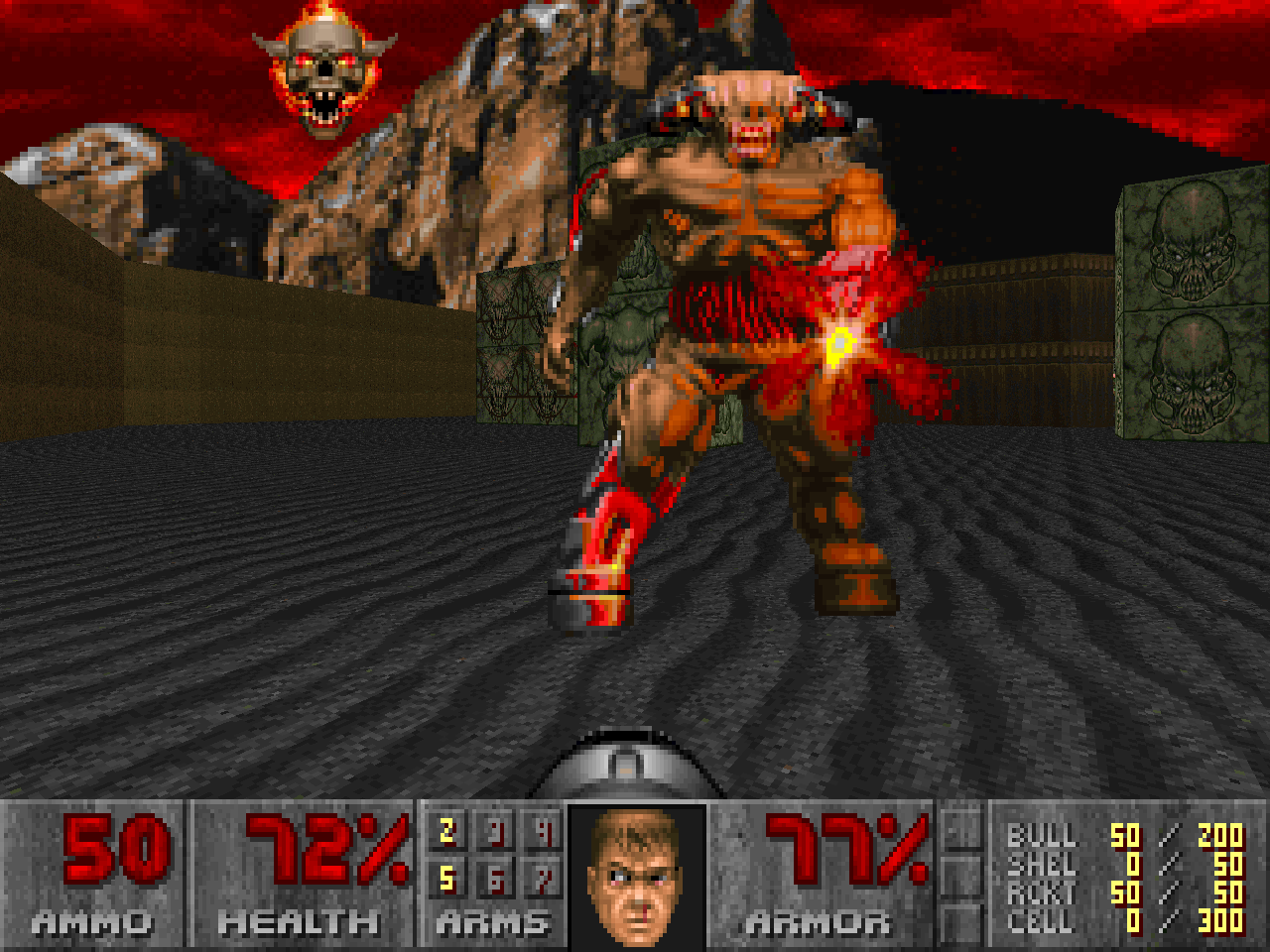
An earlier post took a look at how shifts in both the visual culture and social interaction were reflected in the dominance of fighting games in the style of Mortal Kombat over the earlier Street Fighter. This post will run a similar comparison between first-person shooter games that shows the same overall social and cultural changes. The most successful early first-person shooter games were Doom and Doom II (1993 and '94), before GoldenEye 007 and its imitators took over (1997).

First, though, it's worth noting that the very popularity of first-person shooter games signals a shift away from sociability, just as the rise of player-vs.-player fighting games did. Throughout the '80s and early '90s, games where you beat up other people had the player beat up characters controlled by the computer, and if another person joined in, they teamed up with the first person to take on the computer. Player-vs.-player fighting games pitted two people against each other.

For games where you shoot people up the whole time, the norm during the '80s and early '90s had you shoot lots of characters controlled by the computer, and if another person joined in, they teamed up with the first person against the computer. This included games like Contra, Ikari Warriors, and Operation Wolf. First-person shooter games grew to focus primarily on player-vs.-player gameplay, where two or more people try to shoot each other up.

When the Doom games came out, there was some interest in shooting up other players, though most people found that boring and wanted to take on the far greater number of enemies in the normal one-player mode. Still, these were the first to introduce player-vs.-player, so even by 1993 the shift away from team gameplay had already begun.

This trend continued with the Quake series, the next series from the developers of Doom. By the time GoldenEye and the similar Perfect Dark took over, I'd say most people chose player-vs.-player if there was someone else in the room to play against. Once home consoles allowed players to shoot each other up over an internet connection in the 2000s, this became by far the most common way that people played first-person shooters.

We can see other major behavioral changes reflected in the replacement of Doom style games with GoldenEye style games, such as the shift toward OCD, collecting/hoarding, and joyless treadmill progress toward 100% completion of boxes in a checklist.

In Doom, your only goal in a stage was to reach the exit. In GoldenEye, you were given a list of specific objectives to carry out before reaching the exit. More, you were given the option of three levels of difficulty, so you could complete three different checklists per stage. In Doom, you only had one player you could play as. In GoldenEye, you were encouraged to meet certain characters in the one-player mode so that you could play as those new characters in the player-vs.-player mode. In Doom, special abilities were gotten by simply typing in a cheat code. In GoldenEye, such abilities could only be had by performing certain objectives in a stage, usually under a time limit. Often this meant replaying the same stage over and over, going through the exact same motions, hoping to shave off a few seconds here or there. The now common treadmill practice of "unlocking achievements" began with GoldenEye.

The trend toward over-the-top extreme-ness shows up as well. You only kill aliens and monsters in Doom, although they do look gory when they're dead. GoldenEye has you killing people, and there are far many more opportunities for sadistic humiliation. For example, once they're dead, you can shoot them in the head, sending it jerking back while a pool of blood pours out. Although the entire dead body did not yet resemble a rag doll in this way (as it would come to), you could still pump the corpse full of lead, making it bleed.

You could also torture the enemies to death by targeting a limb and watching them hobble around in pain and frustration, before tagging them again, until they finally took enough hits and keeled over. Players even fucked around with unarmed bystander characters in that way. It was even easier to pull this off when you targeted them through a sniper rifle at a safe distance where they couldn't see you or shoot back.

These features -- torture, sadism, overkill, voyeurism -- recall the unwholesome nature of mid-century comic books, which as a medium video games have largely taken the place of. While they do not lead to higher crime rates, they do warp the minds of young people and encourage them to pretend they're a sick badass when in reality they're just some sheltered dork. None of these features were included in the Doom games.

Another staple of lurid mid-century comics shows up in the GoldenEye and Perfect Dark style games, which is absent in the Doom games -- butt-kicking babe characters, both ones you can play as or play against. I forgot to mention that in the Mortal Kombat vs. Street Fighter post, but the shift occurs there as well. There's only one girl character in Street Fighter, but several in Mortal Kombat II and later fighter games that offer shower nozzle masturbation material for nerds.

Sportsmanship has fallen off a cliff during the Millennial era, and that's very clear in the course of first-person shooter games. Since most people didn't play Doom as a player-vs.-player, there wasn't much room for poor sportsmanship. But when people played GoldenEye in player-vs.-player mode, few to none of them respected any kind of ground rules.

The most common form of acting like a wuss was when another player re-spawned after dying. When you start out, you have little or no firepower, no shield, armor, or other type of defense, so that if someone else who's spent time collecting those things feels like notching an easy kill, they'll find someone who's just re-spawned. There are only a handful of locations where a player can re-spawn, so it's not hard to hang around them and mow down more-or-less hopeless adversaries. The now common cowardice of "spawn-camping" began with GoldenEye.

You could also booby-trap items that other players would want to pick up, simply by placing a proximity mine nearby. That way, when someone else goes to increase their defense by picking up a vest of body armor, they're blown to pieces instead. Whoever put it there would then cackle like a jackass. They'd also put proximity mines next to the re-spawn points, so that you wouldn't even have a chance to play that life. Right when you re-spawned, you got blown up.

Finally, moving on to the graphics, you see the same change in the overall visual culture reflected in this increasingly popular video game genre. Some of the major changes are explored here. In general, the Doom games are closer to the more striking '80s visual culture, and the GoldenEye type games to the duller '90s and 2000s visual culture.

GoldenEye has minimal contrast in lighting and looks too dark (ex), little variety of color, let alone combining hot and cold hues (ex), occasionally features exotic locations but never the fantastic (ex), the characters are all the same scale (ex of the largest enemy, a tall person), the colors are washed-out (ex), and the environment and architecture has no repeated design motifs (ex). This has to be one of the worst-looking video games ever made, certainly among those that were blockbusters.

The Doom games are hardly spectacular in the character graphics, although some of the environments give a halfway decent impression of an apocalyptic painting by John Martin (ex). You can find light-dark contrast both within the matte-style backgrounds (ex) and within the playable areas (ex). Color variety isn't so great, but there are frequent combinations of blue and red, for both the setting and the characters (ex). The imagery is a mix of familiar (ex) and exotic/fantastic (ex). Enemies range from the size of a human skull to three or four times human scale (ex). Colors are not very saturated, but not washed-out either. The environments show repeated design motifs whether the surface is some weird alien thing (ex) or stone (ex). Simple things like signs of masonry or veins over a natural surface make the Doom environments hold your interest more than the flat and homogeneous surfaces that make up the environments in GoldenEye.

I don't think I'll do another extended comparison since the iconic video game genres of the '90s and 21st century were player-vs.-player fighting games and first-person shooters, respectively. So as far as looking at video games to see how broadly the social and cultural changes have reached, that seems to cover the big picture.

April 7, 2013

The Breakfast Club, and growth from cathartic interactions

Just saw this movie again for the first time since high school. Now that it's been nearly 30 years since it was filmed, what jumps out at you while viewing it isn't the quotable dialogue, but how much social relations have changed among young people in the meantime.

It would be impossible to imagine remaking this movie with Millennials in the 21st century because they're so avoidant, whether of the fearful/mousy type or the dismissive/I love haters type. Generation X was actually willing to open up and just be themselves, not constantly monitoring their self-image and only letting others meet their PR representative. And they're not throwing themselves in front of someone else to divulge their darkest secrets -- secrets just come out spontaneously, in the natural course of normal people wanting to figure each other out.

Young people were also more comfortable with taking risks in the social world, since the characters come from all walks of teenage life. Social circles are so tiny these days that even college students, who are free from direct parental supervision, hardly know who people from another group are, let alone mix it up with them every once in awhile, like at a party. Now it's only small house parties, where the attendees can be guaranteed that no unknowns will enter into the social formula.

Adolescents are always worried about whether they enjoy the approval of their peers, and movies like The Breakfast Club make it palpable how cathartic it is to socialize with others outside of your own narrow little group.

If you are a total cocooner, you only have your own self-biased views to consult regarding your own worth. Deep down everyone is aware of the impossibility to evaluate yourself honestly, so this quickly leads to self-doubt and then OCD thoughts and behavior to try to cope with the anxiety. Keep checking the likes on your Facebook posts, keep looking up from your "work" at the library to check if anyone else will return your eye contact, keep checking the mirror to see if your pecs are ripped enough, or if your hair is straightened enough, for you to be seen out in public.

One step above that is if you have a social circle but they're all close to being your identical clones. Again, deep down everyone knows that in this case their approving feedback doesn't amount to much more than your own.

You don't have to constantly mingle with people from quite different backgrounds from your own, but when you do, their approval feels a lot more honest and meaningful. The more independent data points you can collect, the more robust the results are. It's such a relief to the teenage mind -- like, "Phew, glad to know it's not just me and my echo chamber who think I'm all right."

The only clear exception to the current trend of avoidance and anxiety is when young people gauge how good-looking or ugly they are. You don't need to socialize, open your mouth, or even stand near someone else. Just parade yourself around and tally up what percent of all eyeballs turn your way. Attractiveness is the only dimension where adolescents know how they measure up these days. It's depressing to the ugly because they have nothing else, that they're aware of, that could make up for their looks. And it's stunting for the attractive because that's all they have to solidly base their identity on, and by becoming full of themselves, they ruin their good looks with a repulsive personality.

And of course, in order to make any real contact across such wide social distances, you have to give them a sign of good faith -- you have to open up yourself, and let them open up too, without weirding them out. You make that leap of faith and realize that other people (typically) are not going to take advantage of your openness and try to humiliate you then and perhaps later on as well.

These sorts of cathartic social interactions strengthen your character the way that a good burst of intense, challenging activity strengthens the body. It's remarkable how grown-up the teenagers of the 1980s were, whether in real life or in fiction, though not so surprising when you take into account how much they were willing to put themselves through -- not out of masochism or recklessness (well, not always), but out of a normal willingness to take a risk in order to enjoy a reward.

The result is no less pleasing for the audience. Firing up a teen classic from the '80s is such a breath of fresh air because at last you can watch teenagers that you don't feel like choking the life out of. And despite the occasional heavy or sentimental moments, even more lightheartedness and cheerfulness shows through, like the scene where all five of the high schoolers in detention are dancing carefree around the library to loud new wave music.

As the '90s wore on, that free-wheeling resilience began to wane, visible already in the 1994 cult classic TV show My So-Called Life, the closest imitation of a Breakfast Club-like social milieu for the Alternative age. The show had its upbeat and laugh-out-loud moments, but was more mopey and grungy than a John Hughes movie.

More importantly, the social range has been severely restricted, with nobody from the various popular / preppie / jock groups represented among the main characters. The protagonist's best friend is the new Ally Sheedy character, her nerdy and depressed neighbor is the new Anthony Michael Hall character, and her crush is the new Judd Nelson character. But she herself, while pretty, is socially awkward and unknown, unlike the popular Molly Ringwald character. And Emilio Estevez's jock character has been totally replaced by a Puerto Rican faggot who's always on the verge of a nervous breakdown.

Like, "Look at us, we're all such weird outcasts…" In The Breakfast Club, the message was not that everyone was a weird outcast in their own way, but that there was more than meets the eye to people from all walks of life, popular and dorky alike. In this age of diversity worship, it's striking how narrow the range of characters are in fiction (and among real-life youthful conformists). It's all variations on the weirdo theme, and if anyone from the rest of the spectrum is included, the audience won't allow the writers to make them sympathetic.

So if you haven't seen the classics in awhile because you think you've already enjoyed them enough, pop them in again and enjoy them as a welcome relief to the current state of young people, where your options are limited to mousy and haughty.

April 6, 2013

Poetic meter and the breakdown of the bicameral mind

People who have not yet undergone the psychological revolution of self-awareness / introspection are so surprisingly different from us. This change unfolded sometime during the 1st millennium BC, perhaps unevenly across places, though becoming unmistakable by about the middle of the millennium.

Earlier we saw that before self-awareness hit mankind, women's clothing left the breasts visible. We associate that with primitives in National Geographic, not with the great civilizations of the Bronze Age. But in many ways, those people were still psychological primitives.

From a totally different domain of human life, there's the strange fact that "poetry" did not use meter during the 2nd millennium BC. I put "poetry" in quote marks since I take it to mean something musical and visceral, hence driven by a rhythm or regular beat. Without it, there can still be prose that is lofty in tone, repetitive in word or phrase structure, and ornamented in figures of speech -- but it would still be prose without something special in its prosody.

And just look at the range of languages spoken in major civilizations that were literate and numerate, that produced literary as well as oral texts. Sumerian, the oldest written language, is unrelated to all others, and it didn't use meter. Neither did Akkadian, the oldest recorded Semitic language. Probably not for Ancient Egyptian either, which is distantly related to the Semitic languages by being part of the larger Afro-Asiatic family. [1] No luck with Hurrian either, yet another completely unrelated language to the others, and spoken in the Mitanni state. [2]

What about something Indo-European? Those guys were born bards, so surely they must have. Nope, not them either. The oldest attested Indo-European language is Hittite, and their literature didn't use meter. Actually, there's one section of four verses with a regular meter within a larger work -- and that's it. It's more like a brief shift to song-singing mode for whatever purpose, and then returning to (elevated, repetitive, ornamented) prose.

The Rigveda dates to somewhere in the 2nd millennium BC as well, and it does show meter, although since it wasn't written down for so long, I'm not sure how strong the evidence is that the use of meter goes back to the original of 1400 BC (or whenever). Also, it is not a single over-arching work but a vast collection of hymns. So I'm sure for shorter-length compositions, especially in a musical context, meter was used. But not to unify a larger composition. Because the Rigveda is a vast collection, it does not have a meter that's used for just about all of it. Different sections have their own, and choosing from a wide variety of options among the older hymns. Even within such a section, there's plenty of wiggle room around what the rhythm ought to be. [3]

Mycenaean Greek, the oldest written form of the language, has left no record of their poetry or even "poetry" to study, so we can't say for certain that they didn't use meter. But given how much they psychologically and culturally resemble other groups from before the dawn of self-awareness, I'm pretty sure they didn't use meter in extensive works either.

Meter as a core, pervasive element doesn't really show up until the epics of Homer in the 8th century BC and the Indo-Aryan epic the Mahabharata, from around the middle of the 1st millennium BC. The oldest Chinese poems, from the Classic of Poetry, are in a regular meter and come from the first third of the 1st millennium BC. We can't compare that to earlier stages, as these are the oldest in Chinese. The central books of the Old Testament, also from the mid-1st millennium BC, don't show as much concern with meter as the Indo-European epics, but still more so than their Semitic literary ancestors.

Why the sudden preoccupation with meter, at least relative to the status quo ante? Well, now that people are more self-monitoring, they need new tricks that will lull them into a more spaced-out mindset, so that they can get fully absorbed in the tale-telling, both as a performer or audience member. Following along to a regular beat is one of the most widespread solutions. There's some external pulse, not coming from within your own mind, and following along takes your attention off of your own internal state.

You see that also in contexts of physical group-bonding, like drilling in sports or the military, or group dancing. See McNeill's Keeping Together in Time. Not surprisingly, the mid-1st millennium BC seems to be the starting point for the tradition of military drill, marching in cadence, and so on, from Sun Tzu's China to Classical-era Sparta. People who are not primarily outward-focused need an activity like marching in step to lull the self-aware part of their brain to sleep, and let the animal-like decision-making program take over.

The extensive use of poetic meter would then fall under the range of new tricks that Julian Jaynes saw as attempts to get us back into a bicameral mindset once we'd left that way of thinking and acting. For example, before, people feel some kind of hunch about how to proceed, and go with it, like an animal does; after, they look inside themselves and find uncertain answers, so they turn to increasingly baroque methods of divination. [4]

So, while bicameral or pre-self-aware people may have had little use for poetic meter, all of us since then need it to get us in the mood, to dial off the spotlight of self-monitoring so that we can get absorbed in the experience. It's like how tapping along to a beat can somewhat take your mind off things, though in a more subtle way so that it doesn't call so much attention to itself as a stylistic device. After all, what would be the point if each swing of the hypnotist's pendulum kept smacking you right on the nose?

[1] From Foster's Ancient Egyptian Literature: An Anthology (excerpted here):

The major remaining gap in our knowledge of ancient Egyptian poetics concerns prosody. [...] we do not know for sure if it was composed of feet or if it employed some freer means of determining accents and stresses. I would suggest the verse line was analogous to the free verse of Walt Whitman or the modernist American poets. In fact, I think the stylistic texture or flavor of ancient Egyptian poetry can best be described as a fusion of the free-verse rhythms of those poets just mentioned with the rhetorical and structural regularities—the strict attention to patterns of likeness and difference—of Alexander Pope's eighteenth-century heroic couplets (without the end-rhyme or meter).
[2] For Sumerian, Akkadian, Hurrian, and Hittite, see A Companion to Ancient Epic.

[3] From Arnold's Vedic meter in its Historical Development (here):

There are few parts of the verse in which the poets do not consider themselves free at times to depart from the usual rhythms, so that it may perhaps be said that there are no 'rules' of rhythm in the Rigveda. On the other hand, there is no considerable part of the verse in which certain rhythms are not steadily favoured, and others avoided : everywhere there exist metrical preferences.
[4] Jaynes suggested that the hunch we used to feel was experienced as an auditory hallucination, a command from our own personal god that we obeyed. Most people who either get really drug-trippily into his work, or those who dismiss it without reading it or reading little of it, seem to latch on to this admittedly wackier part of the entire argument, which is about the shift toward psychological self-awareness.

April 4, 2013

Many more differences between light-skinned and dark-skinned blacks

Earlier we saw that light-skins are smarter by about 8 IQ points. Let's see what other differences there are. I'm lumping the lighter half of the skin tones together, and the darker half of the tones together.

Years of education -- no difference (13 years each on average).

Average income -- about $23,100 for light-skins vs. about $17,800 for dark-skins. Since their education levels are the same, it must be the greater smarts of the light-skins that earns them more money.

Political views -- liberals are 44% of light-skins but only 29% of dark-skins, moderates are 40% vs. 46%, and conservatives are 17% yet 25%. (Numbers rounded, don't spazz.)

Tough-on-crime views -- 63% of light-skins vs. 76% of dark-skins think the government isn't doing enough to halt the rising crime rate (it's not rising, but you what what they mean).

Afraid to walk their neighborhood at night -- 47% of light-skins vs. 36% of dark-skins. Unfortunately I can't control for urban / suburban / rural setting because they didn't ask that question in 2012.

So light-skins are more liberal, softer on crime, yet still more afraid to walk their streets at night, which probably aren't as dangerous given that they are higher-income. Maybe they're more fearful of the same threats that dark-skins face, or maybe they feel like they'll be singled out more as targets by the mostly black criminals in their area, among whom lighter skin is seen as a signal of weakness.

Gun ownership -- 24% of light-skins vs. 16% of dark-skins (by household). Not related to hunting, as 0% of light-skins hunt vs. 4% of dark-skins. We already saw that light-skins are more afraid of their neighborhood, so this is for self-defense against their darker-skinned neighbors.

Church attendance -- rare attenders are 34% of light-skins vs. 23% of dark-skins, occasional attenders are 35% and 34%, while frequent attenders are 32% yet 43%. *

Sure of God's existence -- 76% of light-skins but 85% of dark-skins.

Bible is the word of God -- 53% of light-skins but 64% of dark-skins. Those who think it's a book of fables are 14% of light-skins but only 6% of dark-skins.

Homosexual sex is always wrong -- 57% of light-skins vs. 64% of dark-skins.

Let gays marry -- 46% of light-skins and 42% of dark-skins agree. However, more dark-skins take a negative stand -- 45% of them disagree vs. only 33% of light-skins.

Reproductive success -- light-skinned women average about 2.0 children vs. 2.7 for dark-skinned women. Childless women make up 24% of light-skinned women, but only 14% of dark-skinned women.

Promiscuity -- equal numbers for those who had 0 partners in the past year, and for 1 partner in the past year. Dark-skins more likely to have 2, but light-skins are more likely to have 3+ partners -- 14% vs. 8% for dark-skins.

...Obviously a lot more could be looked at and reported, but I'm going to cut it here for length. This may wind up being an ongoing investigation. Overall it looks like light-skinned blacks are between whites and dark-skinned blacks on just about any trait. I didn't see where whites stood on these traits, to see whether light-skins are closer to whites than to dark-skins, which was the case for IQ. Maybe that'll be the next entry. Too bad the GSS didn't ask if you drive a Prius, shop at Whole Foods, or sport an ironic moustache.

* Rare = never, less than once a year, once a year. Occasional = several times a year, once a month, 2 to 3 times per month. Frequent = nearly every week, every week, more than once a week.

GSS variables used: race, ratetone, educ, realinc, polviews, natcrime, fear, owngun, hunt, attend, god, bible, homosex, marhomo, childs, partners

April 1, 2013

Who avoids going to parks, and why?

One of the earliest things that tipped me off to the social-cultural differences between rising vs. falling-crime times was data from the National Park Service showing a steady decline in overnight park visits, and in recreational as opposed to other kinds of park visits. They took off during the '60s and wiggled around until the early '90s, falling afterward.

But they aren't going completely unused. Here are some patterns I've noticed about park use these days.

Teenagers and young adults are almost never there. Hanging out in public spaces has vanished off the map of activities that young people pursue. I mean, why have fun around new people when you could be jogging on one of your many virtual treadmills? Liking status updates, leaving prissy/bitchy comments, leveling up video game characters, checking your texts, etc.

Mostly the age groups are parents of children and their children. Adolescents and young adults probably feel too embarrassed to show up with their folks, while the children are happy to get out and do something for once. Children don't play with one another, only their family members. If Millennials weren't so awkward and dorky, they'd just show up on their own, without their parents. I remember the older Gen X kids doing that in the '80s -- totally normal. But what can you expect from kids who are uninterested in even getting a driver's license?

I detailed some of the places that young people do like to hang out at here, like the library. (Hold on to your hats, folks.) Continuing the ideas in that post, I think Millennials don't like hanging out at the park because they're so self-conscious about their image. What are all those strangers going to think if you're not wearing the right brand of earbuds as you block out the outside world? And forget hanging out with your shirt off -- unless you've leveled yourself up to swole hulk status, you'd be too pathetic for everyone else to see. Or whatever the equivalent is for girls -- your legs wouldn't look like the Victoria's Secret models.

Back in the '80s, no one gave a second thought to taking off that uncomfortable shirt during a warm or hot afternoon. Children playing outside, teenagers socializing at the park, grown men doing yard work. Millennials really are more psychologically paralyzed about how strangers will evaluate their body. Seems to go along with their perfectionism, like how OCD people wouldn't have anyone over unless the house looked 100% spotless. Anything less is shameful.

And it's not as though they're responding thoughtfully to actual evaluations from others. Like if you were fat and gross and took your shirt off, and everyone looked at you weird, and you decided not to do so in the future. They're not even putting themselves out there in the first place. They're over-protecting themselves from hypothetical -- imaginary -- evaluations, not responding to real-life feedback from others. Just like how they rarely talk to, flirt with, or ask out someone of the opposite sex -- fear of potential rejection.

Don't mean to always be ragging on the neo-Silent Generation, but they do show the most striking changes from their counterparts of just 20 years ago. I can't help noticing all this stuff because they're not that much younger than my generation, yet they seem to come from another planet.

Moving into the mid-to-late 20-somethings (the early Millennials), you don't see too many of them either. They're generally doing something in isolation, like jogging laps or pretending to be social by sitting in a public area, though with earbuds jammed in their head and staring down at some screen the whole time. They've already turned coffee shops into campus computer clusters, so why not the park? Yep, even parks are free wi-fi zones nowadays.

Adults without children are not as conspicuously absent as adolescents, but still under-represented. You hardly ever see senior citizens either. They used to be everywhere -- the park, the mall (all day, every day), the cafeterias, interacting with schoolchildren through partnerships with the local senior center. Now old people are totally cut off from the rest of society. Public spaces are supposed to bring together all generations, and not seeing old people at the park limits its communal feel.

The exceptions in these age groups, when they aren't odd individuals, tend to be couples, rather than peer groups. A famous eye-opening study detailed the drastic decline in the number of friends that people have, comparing 1985 to 2004 in the General Social Survey. Here, a "friend" is someone who you discuss important matters with. Aside from the quantitative drop in number of friends, there was a qualitative shift away from peers and toward family members and spouses / partners.

That change stands out very loudly at the park. There are only a handful of peer groups playing sports, and the occasional group of attention whores doing wacky-zany activities. Even among these few groups, they're rarely socializing, kicking back, hanging out. And then there are those engaged in clearly isolated activities (jogging laps, etc.).

So, the park now mostly belongs to families and potential families. There's partner-partner interaction, and parent-child interaction, but hardly anything else. Certainly very little family-family interaction. Not with helicopter parents. Your kid is a potential corruptor of all the years of hard work they've put into perfectly programming their own kid. There are occasional superficial exchanges between family units, but actually making new friends and acquaintances -- um, that would be kind of creepy.

When we took my nephew to Chuck E. Cheese's over Christmas vacation, I felt the exact same vibe. The park in the 21st century is a great big McDonalds Playland, ringed by a treadmill for the childless not-so-youngsters. It used to include people from all walks of life, like the pool scenes from The Sandlot (set in the early '60s) or the mall scenes from Saved by the Bell (in the early '90s). But when nobody trusts anybody else, they'll only venture out into public spaces with their kin or their partners. Paranoia and awkwardness are simply too pervasive to allow solid peer groups to form.