With the topic of locker room bullying in the headlines, former tight end Cam Cleeland reveals the details of a hazing incident from 1998 when he joined the New Orleans Saints. It started out as a "running the gauntlet" initiation with a pillowcase over his head, but then ended when his teammate Andre Royal walloped him in the face with a sock full of coins, shattering his eye socket and nearly costing him his vision in that eye.
Sounds more like the beginning of a revenge killing than of closer team solidarity.
Yet many commentators, whether they're sports fans or not, feel compelled to defend hazing, pointing to the greater solidarity it builds among those who pass through the initiation rites. A quick reality check points to the opposite conclusion -- that in this sports culture of free agents and widespread shameless showboating, hazing cannot be a solidarity-building rite, but must be another example of "let the Devil take the hindmost" morality.
Normal initiation rites are highly circumscribed in what they do and do not allow to happen. The participants must adhere so rigidly to the formulas that we speak of thoughtless and mechanical processes as "ritualistic." That doesn't mean that the initiates won't suffer pain -- often they do. However, what they'll suffer is predictable from the ritual tradition. Any one of the pain-givers who wanted to escalate would be seen as violating a sacred tradition. This keeps sociopaths in check, and the predictability provides a certain amount of trust on the part of the initiates.
The fixed formulas also ensure that what is happening to the initiates has already been endured by the tormentors themselves, back when they were the grunts. "I had to go through it -- now it's your turn." Fair is fair.
Hazing has neither of these features because it is not a rigidly defined and adhered to set of formulas. What is being suffered by today's grunts was not necessarily suffered by their tormentors back in their time. As a new teammate, Andre Royal didn't have his eye socket smashed in with a sock full of coins. That's something that he cowardly inflicted on another without enduring it himself first.
And hazing is more free-form: those who deviate from the tradition by escalating will not be shamed for violating a tradition that is more sacred and important than their individual fleeting whim. If anything, it sets up a contest among the senior members to see who can push the envelope the most in dealing out pain to the initiates. Which one of us seniors can out-lash the others? And which one of us can come up with the most creative individual performance in lashing the grunts?
Hence, not only does it not build solidarity among the newer group and the established group, it opens up an individualistic status contest even within the senior pain-givers.
A larger reality check over all of American history shows the pattern more tellingly: hazing became more common and more talked-about during periods of widening societal divisiveness, and declined when such divisiveness began to narrow. Here is an excellent overview article by Peter Turchin on the dynamics of inequality in America since its founding. He views the over-production of elites and their consequent intra-elite competition as the driver behind economic inequality and political polarization.
After a quiet period most associated with the Era of Good Feelings circa 1820, inequality began to grow during the mid-19th C, became distressingly wide by the Gilded Age, and only peaked around 1920. From then until the mid-1970s, inequality fell dramatically. And since then, it's been taking off like a rocket again.
Here is a graph showing how common the phrase "hazing" has been in the books in Google's digital library (Ngram):
It lines right up with the inequality dynamics, which are closely tied to intra-elite competition.
Next, see this historical list of hazing-related deaths compiled by people who research these things. Who knows how complete it is, but at least they were ignorant of the historical ideas being put forth here. They too seem to rise and fall in waves. The first one begins in the mid-19th C and peaks in the mid-1910s to early '20s.
There are already proportionally fewer by the second half of the '20s, and none at all listed for the '30s, with only 3 in the '40s. There's a handful in the '50s and only 2 in the '60s. They also tend to be indirect effects of hazing rather than cruelty or humiliation. Most of the small number from the '50s involve getting dropped off far from campus and then getting hit by a car while walking back on the side of the road.
By the mid-'70s, that lull is over, and we enter the wave of hazing that our culture is still in.
Wikipedia has a similar list of milestones in hazing history. Note that during the Gilded Age (1873), the New York Times ran an article titled, "West Point.; "Hazing" at the Academy – An Evil That Should be Entirely Rooted Out." They didn't run an article like that during WWII, which by all of these measures was near a low-point in hazing. We think of that period as being near the height for self-sacrifice and camaraderie in the military, suggesting again that hazing is corrosive to solidarity.
During times of over-production of elites, the established ones fight nastier to hold onto their positions against the aspirants. That is the simplest way to interpret hazing in the broader context -- the entrenched elite struggling to keep out so many would-be usurpers. They shamelessly co-opt the language of preserving tradition and promoting solidarity, while fooling around with the ritual as it pleases them, sowing the seeds of resentment within the group, hiring themselves out like a mercenary rather than a committed lifelong team member, and putting on the most theatrically self-aggrandizing displays for ordinary achievements in their line of work.
Touchdoooown! BOO-ya! In your FACE! SUCK it! Who's the best? Uh-huh, that's me! Uh-huh, that's me! Dance to the right, to the left! To the right, to the left! But not you, you didn't score! Not you, you didn't score! WHEW!!!
Is it any wonder that normal people with healthy minds have become disgusted with the big-time sports culture over the past couple decades? About as uplifting and motivating to watch as a pitbull free-for-all in the black ghetto, or a cockfight in some brown slum.
November 9, 2013
November 8, 2013
Irony, and irony-squared: Or, transparent vs. opaque irony
The corrosion of sincerity since the Nineties has seen not only a quantitative change -- with irony becoming steadily more pervasive -- but also a qualitative shift from what I'll call transparent irony of the '90s and early 2000s, to the opaque irony of the 21st century.
Both forms involve a mapping from inner feelings to outward expressions that is disingenuous. With transparent irony, an observer can still work their way back from expression to feeling, whereas opaque irony leaves the observer puzzled and confused about what feeling they should infer from a given expression.
Beginning in the early-to-mid '90s, ironic behavior primarily took the form of layering a veneer of distaste, ridicule, etc., over top of a feeling of enjoyment or approval. If you liked the guitar solo from "Sweet Child O' Mine," you had to re-enact it with the most caricatured air guitar solo of all time -- every time it played. Otherwise you were just plain old enjoying it, and that was suspicious -- you don't want the Expression Police to knock on the door, do you? Then do the ridiculous air guitar thing, and it'll provide a fig leaf of plausible deniability if they show up on your front porch. "Nah man, I was just like, *making fun of* those cheesy '80s guitar solos. You don't think I'd actually dig something so ridiculous... so uh, am I cleared to go back inside now?"
That was also the time when we started to cultivate an anti-style, wearing things that were so far from our inner, core identity that it was like going out in blackface. Rebellious teenagers wearing musty-looking cardigans -- wacky! But, not confusing, no more so than a well-heeled white performing in blackface during the Jazz Age. I had an anti-authoritarian streak in high school, so the first election season that I could vote, 1998, I found some old Nixon/Agnew pins to wear on my field jacket.
So, we made fun of the stuff we liked, and appeared to endorse things we wanted nothing to do with. Once you knew that shift in mindset, though, you could then figure out how we felt from what we expressed -- just infer the opposite of what you normally would. Why did we make observers go through this mental rotation task every time they wanted to figure out what we really meant? Again, it provided plausible deniability when the Expression Police came to our door.
In times when normal behavior becomes criminalized, and warped behavior elevated, being a normal rebellious young person was suddenly like being a dissident in an authoritarian state. Plaster the outside of your business with posters in support of the stodgy old leader, and put up dissident posters inside -- that have been suitably yet not blasphemously defaced. That was a fine line to walk back then -- how to poke enough fun in order to evade detection as a true supporter, while not going so far as to defile or disrespect your idols.
I associate this transparent irony with Family Guy and the early Simpsons on TV, and grunge and alternative music, both how they sounded on the radio / album, and how their videos looked on MTV. Family Guy and bands like Weezer show how this form might lead toward the sentimental -- when you have an official cover of not liking something, you might give yourself free rein to (inwardly) indulge in it way more than if you were just being sincere.
Irony-squared, or opaque irony, is a different beast altogether. Any given expression of enjoyment is as likely to have come from a positive as a negative feeling. And any expression of ridicule could just as well come from truly enjoying it as it could from truly hating it.
Does that selfie of you with a kabuki "angry" expression mean you're truly angry or just goofing around? Who can tell -- you make that face equally often in angering and in uplifting circumstances. Expressions are indiscriminate. Ditto for the kabuki "elated surprise" face -- you make that when you just found out you got a pay raise, as well as when you're at your own mother's funeral.
I picked up the same vibe from Millennials who got into the whole '80s revival in the mid-to-late 2000s. Were they wearing those clothes from American Apparel because they really liked the style, or was it another case of blackface ("check it out, cheesy '80s fashion")? It was as likely to be one as the other.
Emotional expression in indie music is indiscriminately neutral and "bleh," and it is indiscriminately angsty in emo. Most singer-songwriter stuff takes the form of indiscriminate attention-seeking through constant signals of needing to be rescued -- the musical equivalent of "the boy who cried wolf."
This impossible-to-pin-down character is not just a switcharoo to fool the authorities. In the '90s, we were all in on the joke -- whether we thought the put-on was subversively cool or just plain annoying, we could still decode the underlying feeling from the expression. Young people these days can't figure out how the hell anybody else is feeling, what they actually like, what they truly despise, and what they really mean. Plausible deniability is no longer a smoke-screen for when the Expression Police roll up, but a pervasive fog that atomizes the entirety of the younger generation (and anybody attempting to interact with them).
You see this especially clearly in their awkward "social" lives. They prefer gathering together in a hive, like a computer cluster at the campus library, or any of the other public spaces that have been converted to that purpose, like coffee shops. They'll make glance at / make eye contact with people they're interested in, but will then look randomly around the room too -- as though to suggest that nothing in particular steered their eyes to the person they made eye contact with. Then they stay hunkered down over their glowing screens, whether there's someone there they're interested in or not. It's indiscriminate looking-around or indiscriminate shutting-the-blinds.
Same thing on Facebook and texting, where they prefer even more to "interact." Does some boy like some girl? Well, maybe Boy will work up the courage to leave an interested yet non-committal comment on Girl's wall (or whatever that retarded thing is called now). But wait, will Girl interpret that as an honest signal of Boy's interest? Uh... uh... shit, I know, let's leave a cover-your-ass comment, too, just in case. "....hashtag unintentionally awkward Facebook comments." Great! Now she'll never know how I really feel about her! Dodged a bullet there...
And it's not just pussified boys who act that way. If random Millennial boys came up to talk to a Millennial girl at Starbucks, she'd get creeped out. Whether they were subtle or obvious wouldn't matter, and would only determine how quickly she'd scurry away. If they went on Facebook / texted her, openly telling her how they felt about her, she'd get creeped out if it were "attracted," and outraged if it were "concerned and critical." Better just shut up about how you really feel, no matter what that may be.
The inscrutable nature of Millennial signal-sending leads to profound confusion not only of what others feel, but about one's own worthiness. If you can't tell where your peers truly rank you for attractiveness, trustworthiness, fun-loving-ness, etc., then what are you to do? You can try to make up the answer yourself -- "obviously I'm in the top 1%, just like everybody else" -- but your brain isn't that stupid. It knows that the answers must come from peers, not family or ego, in order to not be biased, and particularly from a wide range of peers, rather than only those who have a motive to kiss your butt, or only those who want to tear you down.
With no signals coming in that can be at least somewhat pinned down, the data are simply not entered at all. It's as though all the surveys about you came back filled entirely with "Chose Not To Answer." This is worse than having a wide margin-of-error -- that at least provides an estimate in the center somewhere. This is like all blank answers, or maybe "illegible" answers is more apt.
This is at the root of all sorts of dysmorphias among young people today. Not just body dysmorphia from not knowing how attractive your peers find you. Any quality of yours is subject to self-doubt and unending anxiety about what all those missing answers would have contained if people would just say what they honestly felt.
Kids these days are hesitant to approach and reluctant to respond, and it's a positive feedback loop. As the signal-sender, they give indiscriminate signals, which tells the other side not to get involved with them -- no point if you can't tell what they mean. Then, even if someone else gave them a clear signal for a change, as the signal-receiver they wouldn't know how to respond. With greater experience, you develop a knack for how to respond in situation A, B, C, and so on. And you judge how appropriate your response was by how the other party responded in turn. But since you've never gotten feedback on your feedback, you don't know how to react even when the situation is clearly A. So you just pick a response at random -- another indiscriminate choice, when you have no clue what to do.
That clumsiness frustrates the other side -- "I open up for once, and this is what happens. I'm such an idiot for bothering in the first place. Guard up forever." Interpersonal awkwardness will never go away so long as the drive toward opaque irony remains in place.
Millennials do occasionally get together as friends or boyfriend-girlfriend. But none of the "courtship" can refer to feelings. It's all about how "we would make sense together." (Feel the passion sizzling off of the page.) It's just a fact that your qualities and my qualities would produce a mutually beneficial arrangement. I think some of them are hoping that after the initial agreement has been made, they can shed the contractual / for-hire way of interacting with each other and talking about their relationship. But once you've chosen that mindset, it's hard to choose another. Cognitive dissonance, fear of the unfamiliar, general awkwardness, etc.
So they stay in relationships as long as they agree to renew their contract, or as long as they can convince one another that they still "make sense" as a couple. They do lapse into the occasional expression of genuine affection, and given how rare it is, they'll likely remember that for the rest of the relationship. On the whole, though, the contractual frame of mind makes for a spirit-crushing atmosphere, and they are easily estranged from each other.
It should be clear that I trace both forms of irony back to the cocooning trend of the past 20 or so years, and that openness and sincerity came back starting in the late '50s or so and peaked in the '80s. What about before then? I pick up the same vibes from the mid-century as from today. The hipsters today are incredibly marginal figures, and an observer from 60 years in the future might have trouble tracking them down. But everybody knows about the Beatniks from the mid-century. Was their malaise just a put-on (transparent), or were they indiscriminately disaffected (opaque)? Beats me, seems like both, though.
And then there was all that cracking wise -- was the wise-cracking a put-on, or did they crack wise no matter whether they enjoyed or loathed what they were commenting on? Was the wise-cracking dame truly interested in you, or was she as likely to crack wise if she hated your guts too? Ditto all the wise-cracking from the fellas. In that environment, better to just not show much feeling at all, and hunker down in your own little world (The Man in the Gray Flannel Suit, The Feminine Mystique). Mid-century Americans have an inscrutable quality, where they're either indiscriminately chipper (campy ads where the whole family is wearing a big gay smile), or indiscriminately morose (the Existentialist, Hopper, Age of Anxiety, Beatnik crowd).
Inequality and competitiveness were falling and near a low-point, so at least they didn't make status contests out of ironic displays like we do. Or at least not to the same extent -- they still had all those layers upon layers of wise-cracking between men and women in both film noir and in screwball comedies, to see who would gain the upper hand. Just give it a rest already, you buncha fast-talkin' broads...
* * *
I considered including a helpful mathematical analogy in the main post, then I figured it wouldn't be that helpful to most people -- would drive them away. If that's you, you can split now.
For those who remember functions from algebra class, we can think of sincerity, irony, and irony-squared as three simple types of functions that map feeling (on the x axis) into expression (on the y).
Sincerity is something like f(x) = x, an increasing function through the origin. The only important thing is that positive feelings lead to positive expressions, negative feelings to negative expressions. It passes both the horizontal and vertical "line tests," so it is invertible -- from a given expression, you can tell what feeling produced it.
Transparent irony is like f(x) = -x, a decreasing function through the origin, and orthogonal to the sincerity function. We can rotate the axes 90 degrees and obtain the sincerity function, and then we're back to the first case. It's as though people rotated the axes, then applied the sincerity function. OK, we'll just rotate the axes back, and then invert the sincerity function.
So we can still recover the feeling that produced a given expression. It just requires an extra step that makes it annoying for most people to bother with, especially strangers who don't really care much about how we really feel. The orthogonality of these first two functions gives the second one a shock value, but one that wears off quickly as we learn to apply a simple axis rotation first.
Opaque irony is like f(x) = x^2 (or -x^2), and f(x) = |x| (or -|x|), concave up (or down) with a minimum (or maximum) on the y axis, and symmetric about it. This passes the vertical line test -- every feeling leads to a certain expression. But it fails the horizontal line test, and so is not a one-to-one correspondence that would let us invert it. For any expression, there are two possible feelings that could have produced it -- and they're opposite in sign and equal in magnitude.
Axis rotation is no help this time: rotating 90 degrees would yield something that wasn't even a function, a relation that took a given feeling and was equally likely to express it in a positive as a negative way. We are stuck with expressions only, uncertain whether a positive or a negative feeling produced them.
This isn't just a nerdy exercise, an analogy for its own sake. I think each of these formal properties of the model reflects something real about how the mind works. Like doing mental rotation of the axes when transforming the transparent irony function into the more familiar sincerity one. That rotation would also swap which one was feeling and which one was expression -- part of that whole post-modernist playing around with / questioning of / inversion of the surface and substance that was a big thing at the time, at least among those who were also pushing the (transparent) irony thing at the same time.
Both forms involve a mapping from inner feelings to outward expressions that is disingenuous. With transparent irony, an observer can still work their way back from expression to feeling, whereas opaque irony leaves the observer puzzled and confused about what feeling they should infer from a given expression.
Beginning in the early-to-mid '90s, ironic behavior primarily took the form of layering a veneer of distaste, ridicule, etc., over top of a feeling of enjoyment or approval. If you liked the guitar solo from "Sweet Child O' Mine," you had to re-enact it with the most caricatured air guitar solo of all time -- every time it played. Otherwise you were just plain old enjoying it, and that was suspicious -- you don't want the Expression Police to knock on the door, do you? Then do the ridiculous air guitar thing, and it'll provide a fig leaf of plausible deniability if they show up on your front porch. "Nah man, I was just like, *making fun of* those cheesy '80s guitar solos. You don't think I'd actually dig something so ridiculous... so uh, am I cleared to go back inside now?"
That was also the time when we started to cultivate an anti-style, wearing things that were so far from our inner, core identity that it was like going out in blackface. Rebellious teenagers wearing musty-looking cardigans -- wacky! But, not confusing, no more so than a well-heeled white performing in blackface during the Jazz Age. I had an anti-authoritarian streak in high school, so the first election season that I could vote, 1998, I found some old Nixon/Agnew pins to wear on my field jacket.
So, we made fun of the stuff we liked, and appeared to endorse things we wanted nothing to do with. Once you knew that shift in mindset, though, you could then figure out how we felt from what we expressed -- just infer the opposite of what you normally would. Why did we make observers go through this mental rotation task every time they wanted to figure out what we really meant? Again, it provided plausible deniability when the Expression Police came to our door.
In times when normal behavior becomes criminalized, and warped behavior elevated, being a normal rebellious young person was suddenly like being a dissident in an authoritarian state. Plaster the outside of your business with posters in support of the stodgy old leader, and put up dissident posters inside -- that have been suitably yet not blasphemously defaced. That was a fine line to walk back then -- how to poke enough fun in order to evade detection as a true supporter, while not going so far as to defile or disrespect your idols.
I associate this transparent irony with Family Guy and the early Simpsons on TV, and grunge and alternative music, both how they sounded on the radio / album, and how their videos looked on MTV. Family Guy and bands like Weezer show how this form might lead toward the sentimental -- when you have an official cover of not liking something, you might give yourself free rein to (inwardly) indulge in it way more than if you were just being sincere.
Irony-squared, or opaque irony, is a different beast altogether. Any given expression of enjoyment is as likely to have come from a positive as a negative feeling. And any expression of ridicule could just as well come from truly enjoying it as it could from truly hating it.
Does that selfie of you with a kabuki "angry" expression mean you're truly angry or just goofing around? Who can tell -- you make that face equally often in angering and in uplifting circumstances. Expressions are indiscriminate. Ditto for the kabuki "elated surprise" face -- you make that when you just found out you got a pay raise, as well as when you're at your own mother's funeral.
I picked up the same vibe from Millennials who got into the whole '80s revival in the mid-to-late 2000s. Were they wearing those clothes from American Apparel because they really liked the style, or was it another case of blackface ("check it out, cheesy '80s fashion")? It was as likely to be one as the other.
Emotional expression in indie music is indiscriminately neutral and "bleh," and it is indiscriminately angsty in emo. Most singer-songwriter stuff takes the form of indiscriminate attention-seeking through constant signals of needing to be rescued -- the musical equivalent of "the boy who cried wolf."
This impossible-to-pin-down character is not just a switcharoo to fool the authorities. In the '90s, we were all in on the joke -- whether we thought the put-on was subversively cool or just plain annoying, we could still decode the underlying feeling from the expression. Young people these days can't figure out how the hell anybody else is feeling, what they actually like, what they truly despise, and what they really mean. Plausible deniability is no longer a smoke-screen for when the Expression Police roll up, but a pervasive fog that atomizes the entirety of the younger generation (and anybody attempting to interact with them).
You see this especially clearly in their awkward "social" lives. They prefer gathering together in a hive, like a computer cluster at the campus library, or any of the other public spaces that have been converted to that purpose, like coffee shops. They'll make glance at / make eye contact with people they're interested in, but will then look randomly around the room too -- as though to suggest that nothing in particular steered their eyes to the person they made eye contact with. Then they stay hunkered down over their glowing screens, whether there's someone there they're interested in or not. It's indiscriminate looking-around or indiscriminate shutting-the-blinds.
Same thing on Facebook and texting, where they prefer even more to "interact." Does some boy like some girl? Well, maybe Boy will work up the courage to leave an interested yet non-committal comment on Girl's wall (or whatever that retarded thing is called now). But wait, will Girl interpret that as an honest signal of Boy's interest? Uh... uh... shit, I know, let's leave a cover-your-ass comment, too, just in case. "....hashtag unintentionally awkward Facebook comments." Great! Now she'll never know how I really feel about her! Dodged a bullet there...
And it's not just pussified boys who act that way. If random Millennial boys came up to talk to a Millennial girl at Starbucks, she'd get creeped out. Whether they were subtle or obvious wouldn't matter, and would only determine how quickly she'd scurry away. If they went on Facebook / texted her, openly telling her how they felt about her, she'd get creeped out if it were "attracted," and outraged if it were "concerned and critical." Better just shut up about how you really feel, no matter what that may be.
The inscrutable nature of Millennial signal-sending leads to profound confusion not only of what others feel, but about one's own worthiness. If you can't tell where your peers truly rank you for attractiveness, trustworthiness, fun-loving-ness, etc., then what are you to do? You can try to make up the answer yourself -- "obviously I'm in the top 1%, just like everybody else" -- but your brain isn't that stupid. It knows that the answers must come from peers, not family or ego, in order to not be biased, and particularly from a wide range of peers, rather than only those who have a motive to kiss your butt, or only those who want to tear you down.
With no signals coming in that can be at least somewhat pinned down, the data are simply not entered at all. It's as though all the surveys about you came back filled entirely with "Chose Not To Answer." This is worse than having a wide margin-of-error -- that at least provides an estimate in the center somewhere. This is like all blank answers, or maybe "illegible" answers is more apt.
This is at the root of all sorts of dysmorphias among young people today. Not just body dysmorphia from not knowing how attractive your peers find you. Any quality of yours is subject to self-doubt and unending anxiety about what all those missing answers would have contained if people would just say what they honestly felt.
Kids these days are hesitant to approach and reluctant to respond, and it's a positive feedback loop. As the signal-sender, they give indiscriminate signals, which tells the other side not to get involved with them -- no point if you can't tell what they mean. Then, even if someone else gave them a clear signal for a change, as the signal-receiver they wouldn't know how to respond. With greater experience, you develop a knack for how to respond in situation A, B, C, and so on. And you judge how appropriate your response was by how the other party responded in turn. But since you've never gotten feedback on your feedback, you don't know how to react even when the situation is clearly A. So you just pick a response at random -- another indiscriminate choice, when you have no clue what to do.
That clumsiness frustrates the other side -- "I open up for once, and this is what happens. I'm such an idiot for bothering in the first place. Guard up forever." Interpersonal awkwardness will never go away so long as the drive toward opaque irony remains in place.
Millennials do occasionally get together as friends or boyfriend-girlfriend. But none of the "courtship" can refer to feelings. It's all about how "we would make sense together." (Feel the passion sizzling off of the page.) It's just a fact that your qualities and my qualities would produce a mutually beneficial arrangement. I think some of them are hoping that after the initial agreement has been made, they can shed the contractual / for-hire way of interacting with each other and talking about their relationship. But once you've chosen that mindset, it's hard to choose another. Cognitive dissonance, fear of the unfamiliar, general awkwardness, etc.
So they stay in relationships as long as they agree to renew their contract, or as long as they can convince one another that they still "make sense" as a couple. They do lapse into the occasional expression of genuine affection, and given how rare it is, they'll likely remember that for the rest of the relationship. On the whole, though, the contractual frame of mind makes for a spirit-crushing atmosphere, and they are easily estranged from each other.
It should be clear that I trace both forms of irony back to the cocooning trend of the past 20 or so years, and that openness and sincerity came back starting in the late '50s or so and peaked in the '80s. What about before then? I pick up the same vibes from the mid-century as from today. The hipsters today are incredibly marginal figures, and an observer from 60 years in the future might have trouble tracking them down. But everybody knows about the Beatniks from the mid-century. Was their malaise just a put-on (transparent), or were they indiscriminately disaffected (opaque)? Beats me, seems like both, though.
And then there was all that cracking wise -- was the wise-cracking a put-on, or did they crack wise no matter whether they enjoyed or loathed what they were commenting on? Was the wise-cracking dame truly interested in you, or was she as likely to crack wise if she hated your guts too? Ditto all the wise-cracking from the fellas. In that environment, better to just not show much feeling at all, and hunker down in your own little world (The Man in the Gray Flannel Suit, The Feminine Mystique). Mid-century Americans have an inscrutable quality, where they're either indiscriminately chipper (campy ads where the whole family is wearing a big gay smile), or indiscriminately morose (the Existentialist, Hopper, Age of Anxiety, Beatnik crowd).
Inequality and competitiveness were falling and near a low-point, so at least they didn't make status contests out of ironic displays like we do. Or at least not to the same extent -- they still had all those layers upon layers of wise-cracking between men and women in both film noir and in screwball comedies, to see who would gain the upper hand. Just give it a rest already, you buncha fast-talkin' broads...
* * *
I considered including a helpful mathematical analogy in the main post, then I figured it wouldn't be that helpful to most people -- would drive them away. If that's you, you can split now.
For those who remember functions from algebra class, we can think of sincerity, irony, and irony-squared as three simple types of functions that map feeling (on the x axis) into expression (on the y).
Sincerity is something like f(x) = x, an increasing function through the origin. The only important thing is that positive feelings lead to positive expressions, negative feelings to negative expressions. It passes both the horizontal and vertical "line tests," so it is invertible -- from a given expression, you can tell what feeling produced it.
Transparent irony is like f(x) = -x, a decreasing function through the origin, and orthogonal to the sincerity function. We can rotate the axes 90 degrees and obtain the sincerity function, and then we're back to the first case. It's as though people rotated the axes, then applied the sincerity function. OK, we'll just rotate the axes back, and then invert the sincerity function.
So we can still recover the feeling that produced a given expression. It just requires an extra step that makes it annoying for most people to bother with, especially strangers who don't really care much about how we really feel. The orthogonality of these first two functions gives the second one a shock value, but one that wears off quickly as we learn to apply a simple axis rotation first.
Opaque irony is like f(x) = x^2 (or -x^2), and f(x) = |x| (or -|x|), concave up (or down) with a minimum (or maximum) on the y axis, and symmetric about it. This passes the vertical line test -- every feeling leads to a certain expression. But it fails the horizontal line test, and so is not a one-to-one correspondence that would let us invert it. For any expression, there are two possible feelings that could have produced it -- and they're opposite in sign and equal in magnitude.
Axis rotation is no help this time: rotating 90 degrees would yield something that wasn't even a function, a relation that took a given feeling and was equally likely to express it in a positive as a negative way. We are stuck with expressions only, uncertain whether a positive or a negative feeling produced them.
This isn't just a nerdy exercise, an analogy for its own sake. I think each of these formal properties of the model reflects something real about how the mind works. Like doing mental rotation of the axes when transforming the transparent irony function into the more familiar sincerity one. That rotation would also swap which one was feeling and which one was expression -- part of that whole post-modernist playing around with / questioning of / inversion of the surface and substance that was a big thing at the time, at least among those who were also pushing the (transparent) irony thing at the same time.
Categories:
Cocooning,
Design,
Dudes and dudettes,
Generations,
Health,
Language,
Literature,
Music,
Pop culture,
Psychology,
Television
November 5, 2013
Sanitizing, skin allergies, anti-scratch mittens... hand deformities?
My dad posted a picture of me as a newborn on Facebook, and my sister-in-law left a comment about "Back before every child wore mittens to prevent them from scratching their face." I thought I'd heard about or seen all of the ways that helicopter parents have been bubble-wrapping their kids these days, but apparently not.
That was my first thought anyway -- more paranoid, pointless shock absorption. Still, it didn't sound like the rest of the examples, where kids used to get exposed to some shock that made their bodies and minds respond by becoming stronger. Scratching at your face wasn't something that "kids used to do" in the good old days. I asked my parents, and they confirmed that none of us clawed at our own faces when we were little.
Amazon sells a wide variety of no-scratch mittens for babies, such as these. One customer review says that her baby "tends to scratch his face a lot and I never seem to be able to keep his nails short enough." And from the comments section to a post on the topic at babycenter.com: "My kids have all scratched themselves to bleeding at some point! It happens so fast."
Why do such a large fraction of babies today scratch themselves bad enough and frequently enough that there could be a thriving industry selling no-scratch mittens?
My hunch is that the worse itching is part of the rise in skin allergies and of overly sensitive skin that doesn't meet the clinical definition of allergy, sensitivity vs. robustness being a continuum. The CDC has been collecting data on childhood allergies since 1997, and skin allergies show the greatest increase, from 7.4% to 12.5% around 2010. Treating skin sensitivity as a normal distribution, that translates into a rise in the average by 0.3 standard deviations -- a huge change for less than 15 years. It's as though the average kid had shrunk in height by 9/10 of an inch during that brief period.
Here is the CDC's report, and here is a US News article with quotes from doctors saying, Yeah, this rise in allergies is real, we see it every day. Such widespread skin allergies do not extend far into the past; the fact that the CDC only started collecting data in 1997 suggests that the epidemic began in the early or mid-1990s.
That was right when the society in general, and parents in particular, began to show severe symptoms of hygiene-focused OCD, in a note-for-note revival of the mid-century and Victorian periods. Suddenly antibacterial soap was the norm, hand sanitizer was everywhere, and housebound women took out their disinfectant arsenal and began conducting daily napalm raids on all surfaces in the home (as well as expecting -- and hence receiving -- the same treatment of surfaces in the public spaces that they patronized).
Locking kids indoors all day and requiring shoes outside also kept them from reaping the health benefits of normal human skin contact with grass, dirt, leaves, tree bark, and so on. It's not as though there was an epidemic of hookworm in white suburban front yards during the '90s; it was pure paranoia.
So these no-scratch mittens may be responding to a real, new need, but it is a problem that the helicopter parents created themselves. Of course, setting up yet another barrier between the kid's skin and the environment will only worsen the problem of over-sanitization as they age.
Not to mention deforming their hands in subtle or perhaps gross ways -- no way to know until it's too late. Wearing mittens prevents you from gripping, holding, lifting, manipulating, probing / exploring... well, just about everything your hands and fingers were meant to do, other than striking. Preventing such fundamental activities during the sensitive window of childhood development will likely have the same effects as forcing kids to wear shoes all throughout childhood -- namely, flatfoot. Barefoot children never have flat feet, while shod children do (at high rates if the shoes are close-toed and ill-fitting).
Getting banged up a little bit is good for your bones. Otherwise your body assumes they don't need to be strong and doesn't invest much resources in maintaining their strength. And sure enough, the data show that children's bones became tougher against accidents from 1970 to 1990, then got weaker in 2000, and presumably worse still by 2010. Kids these days can easily shatter both hands by taking a simple fall -- it's pathetic.
Their parents could have saved the costs of treating broken hands and wrists by just letting their kids be kids. A scrape here and a bruise there go away by themselves, no costs at all to the parents. That is, unless the parents are the type who can't stand the psychological pain of witnessing their kid take a hard fall. Get over it, I don't know what else to say. Stop blubbering like a hysterical woman about protecting them from harm. You took plenty of hard falls yourself when you were growing up, and you're not only still here, you were stronger than your wimpy kids are at the same age.
Prudent parenting says don't change the regime to the total opposite of what you had, if that seemed to work just fine. It's possible, even likely, that an opposite upbringing will have the opposite effect.
Helicopter parenting is therefore an extreme form of the Progressive, blank slate, engineering approach to human development. There is nothing conservative about it whatsoever,. It emphasizes harm avoidance over everything else (Haidt), and it presumes to know better than God's plan, Mother Nature, adaptation by natural selection, the wisdom of tradition, or whatever else you want to call it.
In the view from the '80s, a child was a new person with their own internal nature who had to be accommodated within the family and integrated into the wider community (socialization). Their nature would see to altering their personality and behavior as they worked their way through this process. In the new view, he's just a hunk of raw material to be micro-sculpted by the technocratic parents, and who needs to be regularly dusted and sterilized like a dinner table, as though his nature had no way of responding to and building up resistance to foreign debris.
That was my first thought anyway -- more paranoid, pointless shock absorption. Still, it didn't sound like the rest of the examples, where kids used to get exposed to some shock that made their bodies and minds respond by becoming stronger. Scratching at your face wasn't something that "kids used to do" in the good old days. I asked my parents, and they confirmed that none of us clawed at our own faces when we were little.
Amazon sells a wide variety of no-scratch mittens for babies, such as these. One customer review says that her baby "tends to scratch his face a lot and I never seem to be able to keep his nails short enough." And from the comments section to a post on the topic at babycenter.com: "My kids have all scratched themselves to bleeding at some point! It happens so fast."
Why do such a large fraction of babies today scratch themselves bad enough and frequently enough that there could be a thriving industry selling no-scratch mittens?
My hunch is that the worse itching is part of the rise in skin allergies and of overly sensitive skin that doesn't meet the clinical definition of allergy, sensitivity vs. robustness being a continuum. The CDC has been collecting data on childhood allergies since 1997, and skin allergies show the greatest increase, from 7.4% to 12.5% around 2010. Treating skin sensitivity as a normal distribution, that translates into a rise in the average by 0.3 standard deviations -- a huge change for less than 15 years. It's as though the average kid had shrunk in height by 9/10 of an inch during that brief period.
Here is the CDC's report, and here is a US News article with quotes from doctors saying, Yeah, this rise in allergies is real, we see it every day. Such widespread skin allergies do not extend far into the past; the fact that the CDC only started collecting data in 1997 suggests that the epidemic began in the early or mid-1990s.
That was right when the society in general, and parents in particular, began to show severe symptoms of hygiene-focused OCD, in a note-for-note revival of the mid-century and Victorian periods. Suddenly antibacterial soap was the norm, hand sanitizer was everywhere, and housebound women took out their disinfectant arsenal and began conducting daily napalm raids on all surfaces in the home (as well as expecting -- and hence receiving -- the same treatment of surfaces in the public spaces that they patronized).
Locking kids indoors all day and requiring shoes outside also kept them from reaping the health benefits of normal human skin contact with grass, dirt, leaves, tree bark, and so on. It's not as though there was an epidemic of hookworm in white suburban front yards during the '90s; it was pure paranoia.
So these no-scratch mittens may be responding to a real, new need, but it is a problem that the helicopter parents created themselves. Of course, setting up yet another barrier between the kid's skin and the environment will only worsen the problem of over-sanitization as they age.
Not to mention deforming their hands in subtle or perhaps gross ways -- no way to know until it's too late. Wearing mittens prevents you from gripping, holding, lifting, manipulating, probing / exploring... well, just about everything your hands and fingers were meant to do, other than striking. Preventing such fundamental activities during the sensitive window of childhood development will likely have the same effects as forcing kids to wear shoes all throughout childhood -- namely, flatfoot. Barefoot children never have flat feet, while shod children do (at high rates if the shoes are close-toed and ill-fitting).
Getting banged up a little bit is good for your bones. Otherwise your body assumes they don't need to be strong and doesn't invest much resources in maintaining their strength. And sure enough, the data show that children's bones became tougher against accidents from 1970 to 1990, then got weaker in 2000, and presumably worse still by 2010. Kids these days can easily shatter both hands by taking a simple fall -- it's pathetic.
Their parents could have saved the costs of treating broken hands and wrists by just letting their kids be kids. A scrape here and a bruise there go away by themselves, no costs at all to the parents. That is, unless the parents are the type who can't stand the psychological pain of witnessing their kid take a hard fall. Get over it, I don't know what else to say. Stop blubbering like a hysterical woman about protecting them from harm. You took plenty of hard falls yourself when you were growing up, and you're not only still here, you were stronger than your wimpy kids are at the same age.
Prudent parenting says don't change the regime to the total opposite of what you had, if that seemed to work just fine. It's possible, even likely, that an opposite upbringing will have the opposite effect.
Helicopter parenting is therefore an extreme form of the Progressive, blank slate, engineering approach to human development. There is nothing conservative about it whatsoever,. It emphasizes harm avoidance over everything else (Haidt), and it presumes to know better than God's plan, Mother Nature, adaptation by natural selection, the wisdom of tradition, or whatever else you want to call it.
In the view from the '80s, a child was a new person with their own internal nature who had to be accommodated within the family and integrated into the wider community (socialization). Their nature would see to altering their personality and behavior as they worked their way through this process. In the new view, he's just a hunk of raw material to be micro-sculpted by the technocratic parents, and who needs to be regularly dusted and sterilized like a dinner table, as though his nature had no way of responding to and building up resistance to foreign debris.
Categories:
Age,
Cocooning,
Design,
Generations,
Health,
Over-parenting,
Psychology
"Selfies at funerals puts last nail in society's coffin"
Couldn't have said it better myself (here). There are now ongoing Tumblr pages for Selfies at Funerals and Selfies At Serious Places.
Notice how Millennials are incapable of even half-way normal facial expressions when taking their picture. I touched on this theme awhile ago, but I've noticed a turn for the worse recently. The current crop of high school and college kids were born around 1992 or later -- and have spent their entire lives in the repugnant Millennial era.
The early Millennials are all pretty much fucked too, but they must have inhaled at least some trace particles of the zeitgeist from their infant days during the late '80s and very early '90s -- before American culture grabbed at its chest and dropped dead, rotting on the ground for 20 years now. But this new crop is absolutely hopeless and irredeemably autistic. I do notice a jump between Millennials born up through 1990 and those born in '92 and after (not sure where the '91 births go).
Can it come as any surprise, then, that they don't have the slightest intuition for what is inappropriate, what is disrespectful, what is blasphemous? Their paranoid helicopter parents, especially their smothering mothers, have kept them from ever coming into contact with the real world and its moral codes, especially social interactions outside of the nuclear family. Fuck, these funeral selfies prove they don't even know how to show their families any respect, and that's all the social world they've ever known!
"Awesome job," helicopter parents -- you've produced an entire generation that act like ingrates to their own family and like obnoxious brats to society at large. Spewing so much pollution into the social atmosphere requires us to do the honorable thing and make you pay for it, one way or another. If they only fouled up your own nuclear household, then sucks to you. But releasing them into the wider social environment where folks outside your nuclear family will become burdened by the costs of interacting with entitled, self-centered spergs -- that's shameful and disrespectful.
It's easy enough to take pot shots at the little dorks and put them in their place, but how do we redirect the costs back to their parents for cleaning up after these snot-noses? If they wanted to quarantine their children from all external contact, and thereby stunted their kids' psychological growth, then their mentally misshapen spawn can go right back to their quarantine bubble and pester their parents for the rest of their lives.
You showed no trust or faith in the rest of us while your kids were (quasi-)developing, and now you want us to shower them with praise, welcome them onto the team, and go to bat for them so they can get ahead? Do it yourselves -- we're not your unpaid servants.
Notice how Millennials are incapable of even half-way normal facial expressions when taking their picture. I touched on this theme awhile ago, but I've noticed a turn for the worse recently. The current crop of high school and college kids were born around 1992 or later -- and have spent their entire lives in the repugnant Millennial era.
The early Millennials are all pretty much fucked too, but they must have inhaled at least some trace particles of the zeitgeist from their infant days during the late '80s and very early '90s -- before American culture grabbed at its chest and dropped dead, rotting on the ground for 20 years now. But this new crop is absolutely hopeless and irredeemably autistic. I do notice a jump between Millennials born up through 1990 and those born in '92 and after (not sure where the '91 births go).
Can it come as any surprise, then, that they don't have the slightest intuition for what is inappropriate, what is disrespectful, what is blasphemous? Their paranoid helicopter parents, especially their smothering mothers, have kept them from ever coming into contact with the real world and its moral codes, especially social interactions outside of the nuclear family. Fuck, these funeral selfies prove they don't even know how to show their families any respect, and that's all the social world they've ever known!
"Awesome job," helicopter parents -- you've produced an entire generation that act like ingrates to their own family and like obnoxious brats to society at large. Spewing so much pollution into the social atmosphere requires us to do the honorable thing and make you pay for it, one way or another. If they only fouled up your own nuclear household, then sucks to you. But releasing them into the wider social environment where folks outside your nuclear family will become burdened by the costs of interacting with entitled, self-centered spergs -- that's shameful and disrespectful.
It's easy enough to take pot shots at the little dorks and put them in their place, but how do we redirect the costs back to their parents for cleaning up after these snot-noses? If they wanted to quarantine their children from all external contact, and thereby stunted their kids' psychological growth, then their mentally misshapen spawn can go right back to their quarantine bubble and pester their parents for the rest of their lives.
You showed no trust or faith in the rest of us while your kids were (quasi-)developing, and now you want us to shower them with praise, welcome them onto the team, and go to bat for them so they can get ahead? Do it yourselves -- we're not your unpaid servants.
Categories:
Age,
Cocooning,
Design,
Dudes and dudettes,
Generations,
Media,
Morality,
Over-parenting,
Pop culture,
Psychology,
Religion,
Technology
November 3, 2013
Will actresses today take one for the team while filming?
Reading through the items at Blind Gossip gives you some interesting "behind the scenes" details that you would normally hear on a DVD commentary. But, not liking many of these movies, I'd never get to hear that commentary track, which might shed light on what exactly is crippling the world of film-making (distinct from money-making).
Here is a solved item about how Scarlett Johansson responded to Eric Bana showing wood during a kissing scene for The Other Boleyn Girl:
Actors usually don’t have a problem staying in control during love scenes. Since romance is blocked and rehearsed and shot under the hot lights and in front of a large crew, even the most intimate scenes are usually little more than a carefully choreographed, technical exercise.
However, on the set of this one period film, things got a little out of control. During a kissing scene between a handsome, foreign-born actor and a sexy American actress, the actress suddenly stopped and backed away a few paces from her co-star. The actor was left standing there alone. Well, he wasn’t exactly alone. He was accompanied by the incredible bulge in his pants. Filming had to be halted for several minutes while the actor cooled off...
When Bana started getting excited during a love scene, Johansson simply backed away and waited for assistance. According to our source on the set, Johansson was totally professional about the whole situation, and went right back into the scene after a brief “cool down” period.
What, was that the first boner she'd ever seen in her life of 23 years? She had to back away like he had cooties, or like any sign of red-blooded male libido is a threat of rape, and could only resume filming "several minutes" later, once he'd lost his lust? Warning: spontaneity level rising, initiating emergency cool down sequence. Wouldn't want the audience to feel that what they're seeing is real. Minimizing your awkwardness over a trivial surprise is more important.
I could see if she had been startled, like "Holy shit, there's an actor still left in Hollywood who would get hard making out with a chick," then composed herself and got back into the moment. But standing around for several minutes while the dude's dick deflates totally kills whatever they had going. Even a single incident like that while filming sends the message loud and clear to the other party: I don't want to open up to you, and you opening up to me is creepy, so let's please stick to just going through the motions.
Do actresses know how to "be adults" anymore? How to "suck it up," "take one for the team," etc.? I suspect this is a big reason why so many on-screen interactions feel so fake. There's an implicit understanding that each party has strewn all these mines around the field of their being, so that all the other parties don't even bother trying to let it all hang out and fully get into their roles without asking questions about "Can I go here? May I go there?" etc.
When actresses give off such a strong vibe of "omigod, i can't believe you just went there," it makes the other side close themselves off, and the result is two people talking at each other across a vast interpersonal chasm. It's lifeless.
If you listen to the commentary tracks on any of your favorite movies from the '70s or '80s, you'll regularly hear people tell stories about how much more trusting everyone used to be back in those days. They were willing to give more of themselves if they sensed it would make a better movie. And both the cast and crew were hungry, and not just financially -- there was a greater sense of urgency in the social atmosphere of the time. Give it your all since you might not get another shot. Cast and crew these days come off more complacent and even entitled.
What periods come to mind when you think of "Hollywood divas"? Obviously our Millennial era, but also the mid-century (Golden Age, Hollywood Glamour). Femme fatales on-screen, divas off-screen. They were comparatively rarer during the Silent period / Jazz Age, and during the New Wave Age.
I'm scratching my head trying to think of an "it's all about me" major actress from the '80s... Kathleen Turner, maybe? And she didn't project that vibe all too strongly anyway. Back then they were more giving toward the project they were working on, whether they were younger ones like Elisabeth Shue or more mature ones like Sigourney Weaver. They're more about "go with the flow" than grinding production to a halt over something trivial. They'd only stop things if they felt that what was going on wouldn't be true to the character, and had suggestions for how it might be improved -- not because it made the actress personally mildly uncomfortable. Or so I gather from all those commentaries I've listened to.
What accounts for these cycles in other-focused vs. self-focused acting styles? The part about trust goes along with cocooning, higher trust and more sociable vs. lower trust and more withdrawn. The hunger and feeling of urgency comes from the trend in the crime rate, rising crime making people feel like they'd better piss or get off the pot before it's too late, and falling crime making them feel like they've got all the time in the world to get around to their goals, so why invest very much energy in this particular one they're working on now? Cocooning and crime cycles are closely linked to each other, so no matter which influence is stronger, crime/cocooning carves history into the right cultural periods.
Categories:
Cocooning,
Dudes and dudettes,
Generations,
Morality,
Movies,
Psychology
November 2, 2013
Hidden homos: Killer Bob from Twin Peaks
Time for an old school example. If you've seen the episodes of Twin Peaks where Bob shows up, you can't forget the air of menace that his performance brought to the show. An eternal evil spirit taking present-day form as a serial killer in small-town America.
What ever happened to him anyway? Seems like he should've been able to get more incarnation-of-pure-evil roles after playing Killer Bob.
I never suspected that, but then he was playing such an extreme type that everyday mannerisms aren't going to show too well. And you never saw him out of character. Here he is in real life, clearly showing the gay "surprised baby" face, with mouth agape and eyebrows raised straight up.
David Lynch is known for going strongly by his intuition when casting, as well as when filming. Was it any accident that one of the most intuitive minds seized upon casting a gay man in the role of a serial killer? He was not tested before filming began -- he was part of the crew -- but Lynch found him creepy and terrifying enough to make a snap decision to put him in the role of the embodiment of evil.
Recall an earlier post which estimated that queers are 2 to 7 times over-represented among serial killers who are infamous enough to have their own Wikipedia entries. Adam Walsh, the 6 year-old boy whose brutal kidnapping and murder led his father John Walsh to found America's Most Wanted, was killed by a homosexual and sometimes transvestite, Ottis Toole. And perhaps the last of the most notorious serial killers to stick in our memory -- Jeffrey Dahmer -- was also a homosexual.
In these falling-crime times we only see gays as harmless little pets, of the type that are collected by childless women. But when the crime rate was rising near its peak, we were better able to discern the pattern of homosexuality as mental abnormality -- and if you were abnormal in one part of the mind, you were probably abnormal in some other part of the mind too.
None of us had crunched the numbers on the sexual orientation of serial killers back then, but we could still sniff out that the homosexual mind had a perverted, narcissistic, and unhinged quality to it. Not the type of guy you'd want to babysit your children. Sadly, it'll take another wave of serial killings to remind folks of how much more warped the faggot mind is compared to ours. As it stands, the average American today -- certainly under age 30 -- would boycott a re-release of The Silence of the Lambs for promoting homophobic stereotypes.
What ever happened to him anyway? Seems like he should've been able to get more incarnation-of-pure-evil roles after playing Killer Bob.
Frank Silva died on 13 September 1995, aged 44, from complications of HIV.
I never suspected that, but then he was playing such an extreme type that everyday mannerisms aren't going to show too well. And you never saw him out of character. Here he is in real life, clearly showing the gay "surprised baby" face, with mouth agape and eyebrows raised straight up.
David Lynch is known for going strongly by his intuition when casting, as well as when filming. Was it any accident that one of the most intuitive minds seized upon casting a gay man in the role of a serial killer? He was not tested before filming began -- he was part of the crew -- but Lynch found him creepy and terrifying enough to make a snap decision to put him in the role of the embodiment of evil.
Recall an earlier post which estimated that queers are 2 to 7 times over-represented among serial killers who are infamous enough to have their own Wikipedia entries. Adam Walsh, the 6 year-old boy whose brutal kidnapping and murder led his father John Walsh to found America's Most Wanted, was killed by a homosexual and sometimes transvestite, Ottis Toole. And perhaps the last of the most notorious serial killers to stick in our memory -- Jeffrey Dahmer -- was also a homosexual.
In these falling-crime times we only see gays as harmless little pets, of the type that are collected by childless women. But when the crime rate was rising near its peak, we were better able to discern the pattern of homosexuality as mental abnormality -- and if you were abnormal in one part of the mind, you were probably abnormal in some other part of the mind too.
None of us had crunched the numbers on the sexual orientation of serial killers back then, but we could still sniff out that the homosexual mind had a perverted, narcissistic, and unhinged quality to it. Not the type of guy you'd want to babysit your children. Sadly, it'll take another wave of serial killings to remind folks of how much more warped the faggot mind is compared to ours. As it stands, the average American today -- certainly under age 30 -- would boycott a re-release of The Silence of the Lambs for promoting homophobic stereotypes.
Categories:
Crime,
Gays,
Psychology,
Television,
Violence
October 31, 2013
Halloween round-up
I won't repeat what I've said before when covering the changing nature of Halloween over the last 20 years, and you can search this blog for "Halloween" to find what's already been said.
It sounds odd to write a "round-up" of Halloween even though as I write this it's only 2am the morning of. But a major shift in how we celebrate holidays these days is in stretching them out from a concentrated day into a diluted period or season. The day and night of will feel anti-climactic because we saw signs of its presence coming a mile away, weeks ahead of time.
And it feels like everything there is to do about Halloween has already been done -- and for awhile now. It's like spoiling your appetite for what's supposed to be a special meal, like munching on Hot Pockets and ramen noodles all throughout the morning and afternoon of Thanksgiving. Or putting up birthday decorations two weeks early and singing "Happy Birthday" every day for weeks ahead of time.
Put simply, we are a culture that has become awkward with feeling anticipation, release, and winding down. We have made the intensity level constant or flat over time, never reaching the intended peak level, and extending over a longer time. This allows us to still make a token display of participating in the holiday spirit, without actually going on the roller-coaster ride. Nobody wants to feel swept up in the holiday spirit, because that means loss of control, and a constantly self-monitoring person would die of fright if their internal security camera were shut off for just one day while they allowed themselves to get lost in the festivities.
It seems like a fait accompli that the parties now take place, not on Halloween night, but the Saturday before. Why? Well, what if like most years it falls on a work day or a school night? The consequences would be dire. Up-ending our routine for even one day is anathema to an OCD society. We're not saying you can't get dressed up and go party -- just make sure it doesn't interfere with your rat race routine. It neuters Halloween of its intended carnivalesque inversion of ordinary social structure.
How fun do you think it will be to celebrate with a bunch of people who are too timid to party on a week night? I didn't even bother this year, for the first time in awhile.
I did, however, carve two jack-o-lanterns, something I haven't done in years. There have been many changes in this tradition as well, reflecting the same themes as elsewhere in Halloween culture. Three examples:
- The pumpkin piles are out at retail stores way early, and they show up on porches way early. While strolling around the neighborhood last Saturday, I saw some that showed signs of decay suggesting they'd been out for a week -- and this was still roughly one week before Halloween. This deflates the spectacle on Halloween itself, by making us accustomed to their presence weeks ahead of time.
My vague memories were that in the '80s, we carved them the night before, not many days or weeks before. So I searched Google Images for Halloween pictures from the '80s, and the ones with jack-o-lanterns all show ones that are more or less freshly carved -- no puckering, no dulling of the yellowish color inside, and so on. Examples: here, here, here. The last one has a date stamped on it, 10/29, and they look newly carved. So maybe a few days before at the most.
- At least around here, maybe 1/3 of all pumpkins on display were uncarved, unpainted, unadorned in any way. It only takes less than 30 minutes to carve, and everyone has at least that much screw-off time in their day. It's part of the move away from supernatural and superstitious fun, and toward the mundane and naturalistic. More in the vein of "harvest spice granola latte" than mask-wearing and candle-lighting.
- A good fraction, under one-half, of carved pumpkins were made with a cookie-cutter stencil. OCD folks just can't handle anything other than the paint-by-numbers approach to arts and crafts, can they? Stencils also allow for more elaborate and often pretentious designs, tying into the individualistic status contests that now run rampant around the holiday. How long before they become like tattoos -- choosing the perfectly unique stencil to tell the world about your special snowflake lifestyle? Jack-o-lanterns by Banksy? These were in the minority, though.
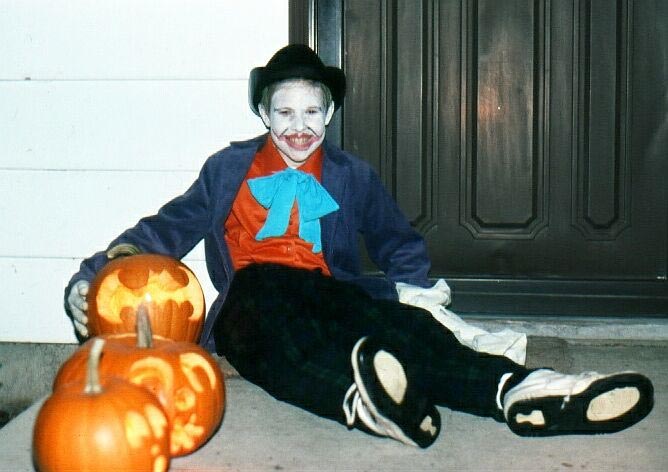
Does the absence of parental supervision that we all remember show up in those old pictures? I couldn't put my finger on it at first, but do an image search for Halloween and some specific year. Notice how all the pictures are taken inside the house, on the front porch / driveway, or front yard. That's because the parents weren't following them around once they got to the sidewalk, hence no pictures of kids at someone else's house. Only before they left and when they got back home, where the parents stayed put. Examples: here, here, here.
Recent pictures do show trick-or-treaters at someone else's doorstep, typically shot from the height of a grown-up, providing photographic proof of how closely parents hover over their kids even on a holiday where they're supposed to be allowed temporary freedom. Examples: here, here, here, here.
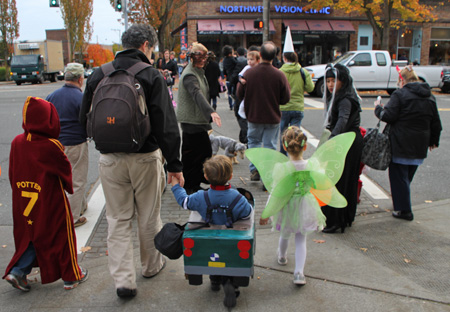
It's not uncommon to see scenes where the grown-up to kid ratio is even, or perhaps where the grown-ups outnumber the kids. Like this one. Also, unlike pictures from the '80s, recent ones are more likely to be taken earlier in the day before it gets dark, spoiling their fun even more.
As the last picture shows, helicopter parents may not trust any of their own neighbors, but they are more comfortable trick-or-treating in an institutionally controlled setting -- a business district, a mall, a zoo, and so on. Some place where there's a management team planning, coordinating, and supervising everything (in addition to parental hand-holding).
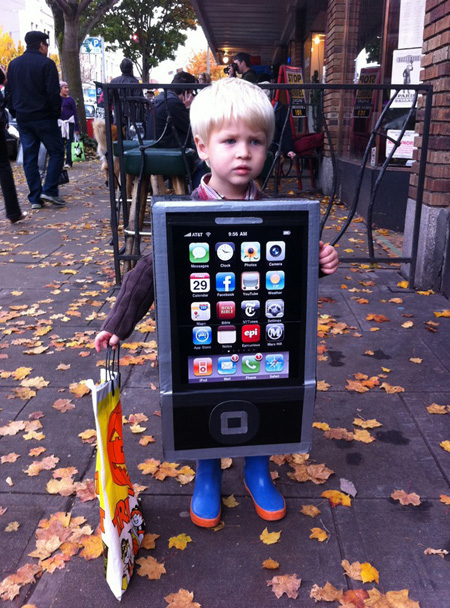
Did you notice how unpretentious the costumes were in the '80s? There isn't much to "get" about them, and they aren't meticulously detailed. They're supposed to be nondescript so that you can easily melt into the crowd, losing your individuality and stepping into a different role. Costumes now are much more thought-out, fussed-over, and attention-grabbing -- like this poor kid whose parents made him into an iPhone. (He sure looks excited.) This produces the opposite result -- the kid is too aware of how on-display he is that he can't forget himself and join the mob. It's more of a fashion show.
The tradition of trick-or-treating must be nearing a low point when there are people like this woman who will be handing out a condescending lecture note to those children who she judges to be too overweight to deserve candy on Halloween. She bald-facedly tries to rationalize her slap-in-the-face behavior as good for the community. She's done with helicopter parenting her own kids, now it's time to ruin the fun of everyone else's too. No surprise that it's in North Dakota. Damn Scandinavians place nanny-ism over community cohesion. I hope there are some adults nearby with enough honor to find out where this rude bitch lives and go egg her house, smash pumpkins on her driveway, and TP her trees.
And the damn liberals reporting on this, or weighing in from her neck of the woods, can only frame the matter in terms of health, harm, self-esteem, etc. How about being a disrespectful host to her guests, threatening the sense of togetherness in the community? Like, what did she hand out as party favors for her kids' birthdays? -- notes that read, "Sorry, but in my judgement your child is nearing obesity, and did not need to share in the birthday cake which would only worsen his health condition. Step up your game as a parent, and next year he can share in the cake with the others." Someone please find this condescending crone and give her a good slap across the face.
My prediction for number of trick-or-treaters tonight -- no more than 5 children in no more than 2 separate groups, and perhaps one group of less than 5 adolescents.
Any other major changes I've overlooked?
It sounds odd to write a "round-up" of Halloween even though as I write this it's only 2am the morning of. But a major shift in how we celebrate holidays these days is in stretching them out from a concentrated day into a diluted period or season. The day and night of will feel anti-climactic because we saw signs of its presence coming a mile away, weeks ahead of time.
And it feels like everything there is to do about Halloween has already been done -- and for awhile now. It's like spoiling your appetite for what's supposed to be a special meal, like munching on Hot Pockets and ramen noodles all throughout the morning and afternoon of Thanksgiving. Or putting up birthday decorations two weeks early and singing "Happy Birthday" every day for weeks ahead of time.
Put simply, we are a culture that has become awkward with feeling anticipation, release, and winding down. We have made the intensity level constant or flat over time, never reaching the intended peak level, and extending over a longer time. This allows us to still make a token display of participating in the holiday spirit, without actually going on the roller-coaster ride. Nobody wants to feel swept up in the holiday spirit, because that means loss of control, and a constantly self-monitoring person would die of fright if their internal security camera were shut off for just one day while they allowed themselves to get lost in the festivities.
It seems like a fait accompli that the parties now take place, not on Halloween night, but the Saturday before. Why? Well, what if like most years it falls on a work day or a school night? The consequences would be dire. Up-ending our routine for even one day is anathema to an OCD society. We're not saying you can't get dressed up and go party -- just make sure it doesn't interfere with your rat race routine. It neuters Halloween of its intended carnivalesque inversion of ordinary social structure.
How fun do you think it will be to celebrate with a bunch of people who are too timid to party on a week night? I didn't even bother this year, for the first time in awhile.
I did, however, carve two jack-o-lanterns, something I haven't done in years. There have been many changes in this tradition as well, reflecting the same themes as elsewhere in Halloween culture. Three examples:
- The pumpkin piles are out at retail stores way early, and they show up on porches way early. While strolling around the neighborhood last Saturday, I saw some that showed signs of decay suggesting they'd been out for a week -- and this was still roughly one week before Halloween. This deflates the spectacle on Halloween itself, by making us accustomed to their presence weeks ahead of time.
My vague memories were that in the '80s, we carved them the night before, not many days or weeks before. So I searched Google Images for Halloween pictures from the '80s, and the ones with jack-o-lanterns all show ones that are more or less freshly carved -- no puckering, no dulling of the yellowish color inside, and so on. Examples: here, here, here. The last one has a date stamped on it, 10/29, and they look newly carved. So maybe a few days before at the most.
- At least around here, maybe 1/3 of all pumpkins on display were uncarved, unpainted, unadorned in any way. It only takes less than 30 minutes to carve, and everyone has at least that much screw-off time in their day. It's part of the move away from supernatural and superstitious fun, and toward the mundane and naturalistic. More in the vein of "harvest spice granola latte" than mask-wearing and candle-lighting.
- A good fraction, under one-half, of carved pumpkins were made with a cookie-cutter stencil. OCD folks just can't handle anything other than the paint-by-numbers approach to arts and crafts, can they? Stencils also allow for more elaborate and often pretentious designs, tying into the individualistic status contests that now run rampant around the holiday. How long before they become like tattoos -- choosing the perfectly unique stencil to tell the world about your special snowflake lifestyle? Jack-o-lanterns by Banksy? These were in the minority, though.
Does the absence of parental supervision that we all remember show up in those old pictures? I couldn't put my finger on it at first, but do an image search for Halloween and some specific year. Notice how all the pictures are taken inside the house, on the front porch / driveway, or front yard. That's because the parents weren't following them around once they got to the sidewalk, hence no pictures of kids at someone else's house. Only before they left and when they got back home, where the parents stayed put. Examples: here, here, here.
Recent pictures do show trick-or-treaters at someone else's doorstep, typically shot from the height of a grown-up, providing photographic proof of how closely parents hover over their kids even on a holiday where they're supposed to be allowed temporary freedom. Examples: here, here, here, here.
It's not uncommon to see scenes where the grown-up to kid ratio is even, or perhaps where the grown-ups outnumber the kids. Like this one. Also, unlike pictures from the '80s, recent ones are more likely to be taken earlier in the day before it gets dark, spoiling their fun even more.
As the last picture shows, helicopter parents may not trust any of their own neighbors, but they are more comfortable trick-or-treating in an institutionally controlled setting -- a business district, a mall, a zoo, and so on. Some place where there's a management team planning, coordinating, and supervising everything (in addition to parental hand-holding).
Did you notice how unpretentious the costumes were in the '80s? There isn't much to "get" about them, and they aren't meticulously detailed. They're supposed to be nondescript so that you can easily melt into the crowd, losing your individuality and stepping into a different role. Costumes now are much more thought-out, fussed-over, and attention-grabbing -- like this poor kid whose parents made him into an iPhone. (He sure looks excited.) This produces the opposite result -- the kid is too aware of how on-display he is that he can't forget himself and join the mob. It's more of a fashion show.
The tradition of trick-or-treating must be nearing a low point when there are people like this woman who will be handing out a condescending lecture note to those children who she judges to be too overweight to deserve candy on Halloween. She bald-facedly tries to rationalize her slap-in-the-face behavior as good for the community. She's done with helicopter parenting her own kids, now it's time to ruin the fun of everyone else's too. No surprise that it's in North Dakota. Damn Scandinavians place nanny-ism over community cohesion. I hope there are some adults nearby with enough honor to find out where this rude bitch lives and go egg her house, smash pumpkins on her driveway, and TP her trees.
And the damn liberals reporting on this, or weighing in from her neck of the woods, can only frame the matter in terms of health, harm, self-esteem, etc. How about being a disrespectful host to her guests, threatening the sense of togetherness in the community? Like, what did she hand out as party favors for her kids' birthdays? -- notes that read, "Sorry, but in my judgement your child is nearing obesity, and did not need to share in the birthday cake which would only worsen his health condition. Step up your game as a parent, and next year he can share in the cake with the others." Someone please find this condescending crone and give her a good slap across the face.
My prediction for number of trick-or-treaters tonight -- no more than 5 children in no more than 2 separate groups, and perhaps one group of less than 5 adolescents.
Any other major changes I've overlooked?
Categories:
Age,
Cocooning,
Design,
Food,
Generations,
Morality,
Mythology,
Over-parenting,
Pop culture,
Psychology
October 30, 2013
Hidden Homos: Harry Potter?
The chickens of this whole "family values" revolution of the past 20 years are finally coming home to roost. Helicopter parents' perfect plan was to lock their children indoors all day long, and scrupulously filter their media / entertainment for Negative Outside Influences. "No daughter of mine is going to buy Lada Gaga's music -- it sets a bad example." So anything that goes over-the-top in its "fun for the whole family" appeal gets a pass as wholesome entertainment.
But what if the players in this squeaky clean package that you've naively swallowed whole, aren't all they appear to be? What if are even more fucked up than Lady Gaga, but their influence is less obvious than hers (it would hard to be more obvious), and they've slowly warped your kids' minds?
With Lady Gaga, she couldn't put out a more blatant signal of how unworthy she is for kids to emulate, so most normal kids will vomit her influence out of their system right upon ingesting it. It leaves such a bad taste in the mouth, you can't even gag it down. With more diluted poisons, though, all they need to corrode the kid's mind is to be administered more frequently. They don't start off thinking there's anything weird about him, steadily take cues from his as one of the cool crowd, then suddenly they're emulating a petty emo faggot.
Or as we saw with Tim Allen, the guy who wants a man's man to emulate winds up acting like a hyperactive Peter Pan who's been given access to power tools. But hey, it was board-certified family friendly entertainment -- and the image-makers at the top of the media monopoly would never just tell you want you wanted to hear, would they?
The more I look into it, the more this seems to be the way that the supporters of "alternative lifestyles" have soaked young brains in The Big Lie -- not sending Pink and Lady Gaga with a battering ram through the front, but sneaking the homo-enablers in through the back door, as it were. Glee, the Jonas Brothers, Disney... and the most triumphant success of all, Harry Potter.
I wonder how many of these naive helicopter parents have seen the publicly available pictures of Harry Potter getting all buddy-buddy with a gaggle of drag queens. And even if he did, just don't let the kids see them, let them continue to consume the wholesome image they know and love. It's not as though the actor would want to weave his preferences, albeit subtly, into the movies themselves, right? Wrong:
Yep, totally normal. "Well, hey, it's not as though some of the big stars of our day never dressed up in drag for comedic effect." Right, but it was a caricature for shock value, like that scene in Armed and Dangerous when John Candy dons full drag and Eugene Levy wears an S&M outfit. Not like how Harry Potter in drag actually turned out in the movie, enjoying the role way too much. He was letting part of himself come out, rather than stepping into a different role for shock value. But hey, it's family friendly entertainment -- board-certified -- so what is there to be suspicious about?
I've only seen the first movie during an in-flight showing, while half-asleep, and I don't follow celeb news. But if I had kids who were into these movies and followed the actor in the celeb-obsessed media, my gaydar would've gone off, I would've been sure to get in a jibe here or there about "What a bratty emo faggot..." (Although I don't think I'd embarrass my kids enough to say "No secret where he likes to wave his magic wand..." in a crowded theater.) But parents these days are too dumb to notice an obvious queer, a charge they would only believe if a gay sex tape came out.
Let's take a look at some of his distinctively gay expressions and mannerisms.
Awkward lower-teeth smile: here, here, here, here. Note the upper lip is never pulled back-and-up but pulled sideways or even bowed slightly downward, lower lip is pushed down-and-out, and his lower row of teeth is always showing. Only babies smile like that, and queers are defined by their Peter Pan-isms.
The other awkward gay smile: here, here, here. Lips pressed together, holding back a smile, eyes wide open, eyebrows raised. Actually, not holding back a smile -- about to burst out with a case of the giggles.
Surprised infant face: here. Eyebrows reaching for the hairline, mouth agape. He doesn't make this face often, though; he's sneakier than flaming gays.
Campy-vampy seduction stare: here, here, here. Eyebrows subtly raised, eyes narrowed, head sometimes bowed forward. He isn't shot like this too often either, I assume because they're not marketing him as a sex symbol like the obvious man-munching werewolf from Twilight.
Now, even if you couldn't use those traits to identify him as gay, wouldn't you as a parent still find it weird and unwholesome that the guy can't make any kind of normal face? Narrowed eyes and a nervous smile can't be good, or so my gut tells me. But the head has to over-ride the gut these days, and they stamped their approval on this family friendly entertainment.
It's not like your kid's idol would move on to filming a gay sex scene while playing NAMBLA supporter and Beat poet Allen Ginsberg. And then get worked up into a hissy fit when audiences looked a little cockeyed at his performance:
He's been active in supporting a variety of causes to normalize abnormality, under the banner of gay rights (see details here). Here's what your kids' role model has to tell them about such perversion: "I have always hated anybody who is not tolerant of gay men or lesbians or bisexuals." Huh, even a normal guy who supported fag lib wouldn't go so far as to "hate" such people -- let alone "always." Obviously he takes it personally. I wonder why?
But, we can't find anything wrong with our kids looking up to a vindictive gay crybaby, since his PR handlers told us he was an icon of family friendly entertainment. He passed their inspection, so why ask any questions?
But what if the players in this squeaky clean package that you've naively swallowed whole, aren't all they appear to be? What if are even more fucked up than Lady Gaga, but their influence is less obvious than hers (it would hard to be more obvious), and they've slowly warped your kids' minds?
With Lady Gaga, she couldn't put out a more blatant signal of how unworthy she is for kids to emulate, so most normal kids will vomit her influence out of their system right upon ingesting it. It leaves such a bad taste in the mouth, you can't even gag it down. With more diluted poisons, though, all they need to corrode the kid's mind is to be administered more frequently. They don't start off thinking there's anything weird about him, steadily take cues from his as one of the cool crowd, then suddenly they're emulating a petty emo faggot.
Or as we saw with Tim Allen, the guy who wants a man's man to emulate winds up acting like a hyperactive Peter Pan who's been given access to power tools. But hey, it was board-certified family friendly entertainment -- and the image-makers at the top of the media monopoly would never just tell you want you wanted to hear, would they?
The more I look into it, the more this seems to be the way that the supporters of "alternative lifestyles" have soaked young brains in The Big Lie -- not sending Pink and Lady Gaga with a battering ram through the front, but sneaking the homo-enablers in through the back door, as it were. Glee, the Jonas Brothers, Disney... and the most triumphant success of all, Harry Potter.
I wonder how many of these naive helicopter parents have seen the publicly available pictures of Harry Potter getting all buddy-buddy with a gaggle of drag queens. And even if he did, just don't let the kids see them, let them continue to consume the wholesome image they know and love. It's not as though the actor would want to weave his preferences, albeit subtly, into the movies themselves, right? Wrong:
"I think part of me would love to play a drag queen, just because it would be an excuse to wear loads of eye make-up."
Yep, totally normal. "Well, hey, it's not as though some of the big stars of our day never dressed up in drag for comedic effect." Right, but it was a caricature for shock value, like that scene in Armed and Dangerous when John Candy dons full drag and Eugene Levy wears an S&M outfit. Not like how Harry Potter in drag actually turned out in the movie, enjoying the role way too much. He was letting part of himself come out, rather than stepping into a different role for shock value. But hey, it's family friendly entertainment -- board-certified -- so what is there to be suspicious about?
I've only seen the first movie during an in-flight showing, while half-asleep, and I don't follow celeb news. But if I had kids who were into these movies and followed the actor in the celeb-obsessed media, my gaydar would've gone off, I would've been sure to get in a jibe here or there about "What a bratty emo faggot..." (Although I don't think I'd embarrass my kids enough to say "No secret where he likes to wave his magic wand..." in a crowded theater.) But parents these days are too dumb to notice an obvious queer, a charge they would only believe if a gay sex tape came out.
Let's take a look at some of his distinctively gay expressions and mannerisms.
Awkward lower-teeth smile: here, here, here, here. Note the upper lip is never pulled back-and-up but pulled sideways or even bowed slightly downward, lower lip is pushed down-and-out, and his lower row of teeth is always showing. Only babies smile like that, and queers are defined by their Peter Pan-isms.
The other awkward gay smile: here, here, here. Lips pressed together, holding back a smile, eyes wide open, eyebrows raised. Actually, not holding back a smile -- about to burst out with a case of the giggles.
Surprised infant face: here. Eyebrows reaching for the hairline, mouth agape. He doesn't make this face often, though; he's sneakier than flaming gays.
Campy-vampy seduction stare: here, here, here. Eyebrows subtly raised, eyes narrowed, head sometimes bowed forward. He isn't shot like this too often either, I assume because they're not marketing him as a sex symbol like the obvious man-munching werewolf from Twilight.
Now, even if you couldn't use those traits to identify him as gay, wouldn't you as a parent still find it weird and unwholesome that the guy can't make any kind of normal face? Narrowed eyes and a nervous smile can't be good, or so my gut tells me. But the head has to over-ride the gut these days, and they stamped their approval on this family friendly entertainment.
It's not like your kid's idol would move on to filming a gay sex scene while playing NAMBLA supporter and Beat poet Allen Ginsberg. And then get worked up into a hissy fit when audiences looked a little cockeyed at his performance:
"I fucked a horse on stage when I was 17 but gay sex is more of a big deal!" ...
"It is just the fact that it's sex, and it's sex with a man, I guess. It's amazing how shockable the world still is." ...
"What's graphic is the emotion of the scene. It's a very vulnerable, slightly afraid moment. It's beautiful and tender as a consequence of that."
He's been active in supporting a variety of causes to normalize abnormality, under the banner of gay rights (see details here). Here's what your kids' role model has to tell them about such perversion: "I have always hated anybody who is not tolerant of gay men or lesbians or bisexuals." Huh, even a normal guy who supported fag lib wouldn't go so far as to "hate" such people -- let alone "always." Obviously he takes it personally. I wonder why?
But, we can't find anything wrong with our kids looking up to a vindictive gay crybaby, since his PR handlers told us he was an icon of family friendly entertainment. He passed their inspection, so why ask any questions?
Categories:
Age,
Cocooning,
Gays,
Media,
Movies,
Music,
Over-parenting,
Pop culture,
Psychology,
Television
October 29, 2013
Bygone left populism in music
Temple of the Dog, "Hunger Strike" (1991)
Neglected to include this in my list of '90s music worth saving from a fire. I was looking through Billboard Year-End charts for ideas, and this one slipped through the cracks.
Grunge was a short-lived fusion of populist heartland rock with intensity and ornament from heavy metal. Hence only possible once those two component styles had been developed well enough, and before sincerity and fellow-feeling (from heartland rock) and belting out your emotions (from metal) went out of fashion during the ironic, solipsistic, and minimalist Nineties.
At the time, fans of grunge arrogantly heralded it as the wave of the future, delivered from Rock Heaven to replace the overwrought hair metal Establishment. Those fans were in for a rude awakening: the new zeitgeist of meta-self-awareness would only snicker at anything that came from someplace genuine, and that did not interrupt its connection with the audience by constantly winking at itself.
Worse, in contrast to Live Aid, Farm Aid, Hear 'n Aid (the metal benefit concert), etc., populism and charity went nowhere in the '90s. How many new fans did Pearl Jam gain by taking on the fleecing monopoly of Ticketmaster? Music fans couldn't even get worked up by injustice in an industry that they cared a lot about -- obviously caring about anything further still from their own little world would only fail more pathetically.
I never understood all the hate that the grungers kept dumping on hard rock from the late '80s and earlier. At least among my friends, we were still listening to Guns N' Roses, AC/DC, and Aerosmith, while enjoying the Big New Thing of grunge. That didn't really include power ballad hair metal, but we didn't dump on it either. By striving to distance themselves from their near relatives of the '80s, grunge die-hards only hastened the demise of any style that sincerely delivered emotion.
As far as I know, grunge fans have never taken partial blame for the sudden suckiness of "rock" music from the mid-'90s onward. Like, "Y'know, we really exaggerated how bad music was in the '80s, and foolishly ignored the chance that new music would get real bad real fast. And we're sorry for setting fire to a house that was already becoming abandoned by audiences." It's never too late to atone for your sins, dudes.
Related: what the Left focused on in the 1980s.
Neglected to include this in my list of '90s music worth saving from a fire. I was looking through Billboard Year-End charts for ideas, and this one slipped through the cracks.
Grunge was a short-lived fusion of populist heartland rock with intensity and ornament from heavy metal. Hence only possible once those two component styles had been developed well enough, and before sincerity and fellow-feeling (from heartland rock) and belting out your emotions (from metal) went out of fashion during the ironic, solipsistic, and minimalist Nineties.
At the time, fans of grunge arrogantly heralded it as the wave of the future, delivered from Rock Heaven to replace the overwrought hair metal Establishment. Those fans were in for a rude awakening: the new zeitgeist of meta-self-awareness would only snicker at anything that came from someplace genuine, and that did not interrupt its connection with the audience by constantly winking at itself.
Worse, in contrast to Live Aid, Farm Aid, Hear 'n Aid (the metal benefit concert), etc., populism and charity went nowhere in the '90s. How many new fans did Pearl Jam gain by taking on the fleecing monopoly of Ticketmaster? Music fans couldn't even get worked up by injustice in an industry that they cared a lot about -- obviously caring about anything further still from their own little world would only fail more pathetically.
I never understood all the hate that the grungers kept dumping on hard rock from the late '80s and earlier. At least among my friends, we were still listening to Guns N' Roses, AC/DC, and Aerosmith, while enjoying the Big New Thing of grunge. That didn't really include power ballad hair metal, but we didn't dump on it either. By striving to distance themselves from their near relatives of the '80s, grunge die-hards only hastened the demise of any style that sincerely delivered emotion.
As far as I know, grunge fans have never taken partial blame for the sudden suckiness of "rock" music from the mid-'90s onward. Like, "Y'know, we really exaggerated how bad music was in the '80s, and foolishly ignored the chance that new music would get real bad real fast. And we're sorry for setting fire to a house that was already becoming abandoned by audiences." It's never too late to atone for your sins, dudes.
Related: what the Left focused on in the 1980s.
Categories:
Cocooning,
Economics,
Music,
Politics,
Pop culture,
Psychology
Subscribe to:
Posts (Atom)