June 19, 2023

Dinosaurs, cavemen, and volcanic disaster: America's prehistoric genesis myth

The root problem in American ethnogenesis is that we just got here, and where we came from was host to rival empires with their own already elaborated cultures. The solution has been to push into the background the period of time when those empires grew. So, ignore the Early Modern and most of the Medieval periods, and a good amount of the Ancient world as well.

As I've detailed earlier, American culture does allow some exceptions -- provided they avoid our European lineage. Mainly, this means drawing on our imagined connections to the Saharo-Arabian sphere rather than the Indo-European one. Ancient Egypt and Israel / Judah are more fundamental to American identity than Ancient Rome or Greece, and not because we're all Christian fundamentalists -- none of the Egyptian part of our culture is from Greco-Roman times or later, it's from the times of the pyramids, mummies, death masks, scarab beetles, hieroglyphics, etc.

But even Ancient Egypt falls within the historical record -- where did we come from before then? What is our prehistoric genesis myth?

Not in the Garden of Eden, not Adam and Eve, or anything else that is distinctly Old World-oriented, let alone from an existing Old World genesis myth (from the Old Testament). That would contradict our New World identity. Sure, maybe we ultimately came from the Old World, but our origins back there must somehow feel as though they were also right here. More lush and tropical, more beachy. And so far back in time that it trumps the Old World vs. New World population split -- perhaps so far back that the continents were all one big Pangaean landmass anyway, where the Old vs. New World distinction doesn't even exist.

But in any case, a stylized imaginary location much like the Garden of Eden, which does not come with a latitude & longitude measurement to pinpoint it for the audience. Shrouded in the mysteries of prehistory, but clear enough to be seen in its outlines.

In the American genesis myth, the land is lush and tropical, along with rocky mountainous areas, ringed by beaches, with no seafaring technology to take anyone far off into the ocean. Crucially, there is a volcano somewhere, whether it is prominent in the landscape or its downstream effects are (like cooled & hardened lava making up the rocky terrain).

Our primitive caveman ancestors do not inhabit this island alone -- an endless variety of dinosaurs tower over us, mainly as apex predators who prey on the cavemen (and lesser dinosaur species). Our caveman ancestors didn't have very advanced technology, for defense or offense, so they / we were always underdogs, unlikely Davids against the terrifying Goliaths.

In fact, there were other human-like primates there as well -- depending on the telling, some far more primitive and ape-like than our caveman ancestors, some a bit more advanced. But not human, in either case -- a rival hominid species.

As though there were not enough drama from the negotiations and battles among caveman tribes, and cavemen woo-ing cavewomen, and the struggle for survival against the dinosaurs -- when a climactic, apocalyptic event is called for, it is not water-related like the flood of the Old Testament, and there is no water-related vessel like an ark to navigate it.

Rather, it is fire-based -- a massive volcanic eruption, with lava flowing freely, fireballs raining down from the sky, the earth splitting apart to open fiery pits below, and depending on how long the event is followed, ash and smoke clouding the sky, depriving the lush vegetation of sunlight, and wreaking havoc on the landscape long after the initial explosion. In this large-scale destruction, the lumbering dinosaurs are left with nowhere to hide and sadly go extinct, while the nimble and clever cavemen -- some fortunate subset of them, anyway, who lend a helping hand to each other -- eke out an existence in the aftermath, ultimately to populate the entire world with human beings. (Likewise the other cute and clever mammals, though little attention is given to their fate.)

* * *


There is no single author or work that provides the outline for this genesis myth, but legends rarely do trace back to a single author. Similar stories are told, they catch on, are reworked, and nobody remembers exactly where they came from, or who they came from.

But in the interest of scholarly documentation, this genesis myth comes -- when else? -- after the integrative civil war in American imperial expansion, when our ethnogenesis really gets started. The earliest example I can find is D.W. Griffith's short film "Primitive Man" (AKA Brute Force), from 1914, following up on his dinosaur-free short film "Man's Genesis" from 1912. In a comical vein, there was also the 1915 short, "The Dinosaur and the Missing Link: A Prehistoric Tragedy". Later animated shorts include "Felix the Cat Trifles with Time" from 1925, and "Daffy Duck and the Dinosaur" from 1939.

The myth would not be fleshed out in feature-length form until 1940, in the American movie One Million B.C., which was later remade in 1966 in American-occupied Britain, as One Million Years B.C., with Raquel Welch and Martine Beswick (now that'll get the ol' caveman nature a-goin'). The Brits, still under American influence after their own empire and culture bit the dust after WWI, followed up on their remake with a new example of their own, 1970's When Dinosaurs Ruled the Earth (starring recent Playboy Playmate of the Year, Victoria Vetri).

In between then, from 1960 to '66, the iconic TV series The Flintstones standardized the key element of dinosaurs and homo sapiens co-existing.

By the time of the 1983 Iron Maiden song "Quest for Fire", about primitive man, it had become obligatory to introduce the story with, "In a time when dinosaurs walked the earth..."

In later media, Japanese video games series of the 1990s like Bonk's Adventure and Joe & Mac depict cavemen and dinosaurs side-by-side, with dinosaurs as predators upon cavemen, and prominent volcanic landscapes (Bonk's transformation animation shows his head exploding like a volcano, too).

By now, this myth is so widespread and taken for granted that Wikipedia editors feel the need to "correct the record" -- to no avail -- by stating that it's an anachronism to depict hominids and dinosaurs living in the same time period. So clueless -- in American cultural works, it is *required* to show dinosaurs and cavemen side-by-side! They are fiction, legends, myths, not claiming to be pedantic documentaries or audio-visual textbooks. And so, the "dinos and grugs" image remains.

* * *


The stark differences between the American genesis myth and all others from our closest historical relatives (actual, not imagined) are obvious. That includes the Garden of Eden, the World Tree, or the Titans (dinosaurs only bearing a weak resemblance to them, due to their sheer size and ferocity, not in being proto-gods or super-humans).

But it also differs crucially from other European stories about dinosaurs and hominids found together, such as Jules Verne's Journey to the Center of the Earth (1864-'7) or Arthur Conan Doyle's The Lost World (1912).

For one thing, those stories never spawned an endless chain of development within Europe. Instead, they took root and multiplied in America, beginning with Edgar Rice Burroughs, author of Tarzan (*not* a dino-centric series), who developed them in his Pellucidar series and Caspak series of pulp novels during the 1910s. He also pioneered the other side of our primitive-futurist cultural identity, in his Barsoom series, also from the 1910s, about life and adventure on Mars (including dinosaur-esque prehistoric beasts).

The main difference, though, is that the Europeans were not writing genesis myths -- they were set in the contemporary world, albeit in some undiscovered part of it, where prehistoric creatures had managed to survive into the present day. Perhaps far under the Earth's crust, perhaps some remote island -- but still, today. The American works I mentioned in the last section are all set in the very distant past, as part of an origin story. Lost world vs. prehistoric genesis.

Why didn't Jules Verne or other Europeans hit on the genesis approach? Because they already had secure genesis myths, from the Garden of Eden, the Roman Empire, Medieval chivalry, Early Modern gunpowder, global exploration, etc. They had no need to set their origin story 1 million years ago.

But Americans, needing to obscure our European and even Indo-European lineage, had to set our genesis myth in the very distant past, when dinosaurs walked the earth, alongside our caveman ancestors, with that volcano always looming in the background.

It also played up our out-West cultural origins, following the meta-ethnic frontier between us and the Indians, and later the Mexicans in the Southwest. There are no volcanoes back East, but there are closer to the Pacific Ring of Fire, Yellowstone, etc. Crucially, there are no active volcanoes in Europe proper, only in some Mediterranean islands. There are hardly any inactive volcanoes in Europe, for that matter. Western America is also where the dinosaur bone beds are. Not to mention earlier stages of human culture and civilization, among the Indians. Whether or not a given Indian tribe is hunter-gatherers, it's a hell of a lot closer to "primitive man" than any group of people in former European empires.

* * *


The centrality of these elements in our conception of who we are and where we came from, is shown by what questions we start asking about the Christian genesis myth, which itself is borrowed from the Second Temple Judaic myth.

What does the Bible have to say about dinosaurs, huh? Or "the fossil record" -- which means "dinosaur bones," not fossils of intermediate stages in evolution. Adam sure doesn't seem like a caveman -- are you *sure* this is the first human being? And what's all this about a catastrophic flood -- everyone knows the dinosaurs were wiped out by a meteor impact and/or volcanic eruptions.

This is not a midwit attempt to defeat mythology with empirical facts, evidence, science, reason, etc. -- it is one myth vs. another myth. Skeptics and atheists foolishly thought that Americans not buying into the Garden of Eden or Great Flood myths meant that they were fellow reddit-brains, when it really meant Americans had developed their own genesis myth that was sharply at odds with the Old World one. That's why we ignore the Wikipedia nerds complaining about the aNaCHroNiStIC depiction of cavemen and dinosaurs in the Stone Age!

Mormonism, the distinct American religion, still relies on the Garden of Eden myth, although being a young religion, perhaps they have enough time to issue "clarifications" or addenda to work the "cavemen and dinosaurs and/or other hominids" into their canon. They are much more neutral about evolution and missing links and our relationship with primates, and do not have many Young Earth types. So they could probably work dinosaurs and cavemen into their mythology better than Christians could.

Instead of Lucifer tempting Adam and Eve in the Garden of Eden, he's influencing one tribe or another among the population of One Million Years B.C., to act in evil ways to benefit themselves while harming others, acting in defiance of God's will in order to get a leg up in the competition against other tribes... perhaps killing too many dinosaurs, without being able to eat their meat, use their bones for construction, and so on. Irresponsible relationship with animals, especially if God had told them the dinos were sacred and not to be messed around with unnecessarily.

And by this point, dinosaurs *are* sacred animals in American culture, not only from our genesis myth, but lost world stories from King Kong to Jurassic Park, not to mention other icons like Godzilla (imported from Japan, who understands us more than any other foreign nation does), Barney, Yoshi (another one from Japan), the all-American '90s family sit-com Dinosaurs, "rawr means 'I love you' in dinosaur," and even the Dino Gura costume for the most famous vtuber (rivaling her shark theme in popularity).

Not too long ago, kids' snacks were made to resemble zoo animals -- but by now, they have to be dino nuggets, dino chips, dino egg candies, and so on and so forth. All part of enculturating our future generations into respect for the dinosaurs.

More than the bald eagle -- our nominal national mascot -- it is the dinosaurs who are our spirit animals. No one else had claimed them, since they had only recently been understood, as of the late 19th century, especially during the American "bone wars" between rival paleontologists (a term that still refers to "dinosaur bones" in common speech). Just the right opportunity for a young nation that wants to mythologize its prehistoric origins!

June 17, 2023

The Midcentury tiki / caveman origins of the iconic low "mansard" roof for McDonald's, Pizza Hut, etc.

The recent posts about Googie and tiki styles co-existing, as well as the primitive style of the Polynesian Village Resort at the founding of Disney World, got me thinking about American roof styles.

There's a group of small office buildings I drive by that are only 1 story -- and a low story at that -- but have tall roofs, like an extra 1 1/2 stories, that dominate the height of the building. However, they don't have windows in the roof, and they don't appear to be used as a second floor. The total height is still low, so it looks more like a primitive hut or longhouse -- prominent but low roof, squat main floor. The roofs are pitched and clad in shingles, not metal or slate or terra cotta tiles or whatever else.

That's when it hit me -- those iconic "mansard" roofs that distinguished every McDonald's, Burger King, Pizza Hut, etc., were not really mansard! They were tiki! It was a carry-over or evolution of the tropical longhouse-inspired roof from the Polynesian craze, after the overtly Polynesian elements had outgrown the fashion cycle, for the time being, before future tiki revivals (tiki statues & torches, leighs, hula dancing, ukuleles, and so on).

First, for examples of these "mansard" roofs in American popular architecture, see this discussion in general, and this history from Pizza Hut. McDonald's and Pizza Hut independently pioneered this style in 1969 (both in the Midwest-to-West, following our meta-ethnic frontier against Indians and later Mexicans), and it became ubiquitous during the '70s and '80s.

Really only the McDonald's and Pizza Hut have a noticeable change in the angle between the central part (steep) and the outer part (shallow). Wendy's had a changing angle, from steep to shallow from center to edge, but it was smooth and curved, not quite as striking. And Burger King and KFC had a single large "outer" part with a constant slope, and a short vertical perimeter around the "center" -- not really that noticeable of an angle change.

Now contrast with examples of actual mansard roofs -- and crucially, the rest of the building that they are a part of.

These roofs consist mostly of the steep vertical central part, with the outer more horizontal edge being almost a flourish or afterthought. The American roofs are more about that outer edge, less about the vertical central part. Mansard roofs have windows (dormers), whereas the American roofs do not. The cladding is sophisticated stone, usually slate tile, whereas the American roofs do not use stone and do not even try to imitate it -- it looks more like primitive wooden tiles (shake), even if it's technically asphalt. (Later revisions made the American roofs metal, too sleek compared to the original style.)

And most importantly, mansard roofs do not dominate the height of the building. Especially where they came from, in Early Modern French chateaus, there are two stories below -- with very high European ceilings on each floor. The roof is still prominent, but not dominating. The dormer windows show that the top floor was either a full floor unto itself, or at least an attic with high ceilings (for an attic) and lots of light coming in.

The American roofs dominate the height of the entire building, there is only one story below, and even that main floor has low ceilings, as is typical of Midcentury buildings (like ranch homes in the residential sector). They are not grand imposing hulks of mass -- that would be Brutalist buildings of the same time period -- but short squat huts, tapping more into the primitive than the futurist side of the American style of architecture.

And unlike the buildings with real mansard roofs, the American buildings are fairly open around their main story. Sometimes a wall-o'-windows straight out of Googie, though more often broken up by columns or piers, still opening up the main space on three sides (the back one closed off for the drive-thru).

Therefore, the American buildings read more as open outdoor structures like a primitive hut or a beach tent, without proper sturdy walls to enclose the interior (materially or visually). The columns or piers are just the supports for the deeply overhanging roof -- much like the porch-area columns holding up the roof of a Craftsman bungalow. In fact, the columns on the Pizza Hut buildings have the same shape as Craftsman bungalow columns -- wide at the base and tapering toward the top. Very distinctly American all around -- but what else would you expect from Pizza Hut?!

Although the pseudo-walls are windowed, from the outside and inside alike there is no feeling of the "light and airy" environment of Early Modern Euro imperial styles, such as a French chateau. Low ceilings, dark-tinted windows, no dormer windows or skylights in the massive roof, all contribute to the cozy caveman hut environment that Americans crave. We are part caveman, part spaceman -- and nothing in between (that's the Europeans, who we are not).

See this gallery for tiki architecture of the Midcentury, just before the mass adoption of the not-mansard roof style in commercial American buildings. (There are 3 other galleries on tiki, at the bottom of the page, but this one shows off the dominant roofs.) Looks pretty familiar, eh?

However, perhaps these roofs did not emerge directly from tiki, but from the broader caveman developments to our collective identity during the early and mid-20th C. It's too bad the Flintstones had homes that were like Midcentury ranch homes, with comparatively flat roofs that do not dominate the height. True Stone Age roofs would cover most of the height (and be thatched, not stone slabs), sometimes reaching all the way to the ground, so that the hut is really just one great big roof (ditto for an igloo).

In either case, these Pizza Hut type roofs derive from the primitive theme that came from within American cultural evolution, not from importing or copying a European style. How anyone can look at a 1970s McDonald's and see a French chateau, rather than a caveman hut, is beyond me -- why the use of the term "mansard", then? Probably just status-striver branding, I dunno.

McDonald's itself began with an iconic Googie design -- as did many restaurants and coffee shops of the time -- tapping more into the futuristic side of American culture, before eventually changing over to the primitive hut style. But in both cases, it was distinctly American, not European. A little more Jetsons at the start, then more Flintstones later.

Googie already had a heavy primitive theme, with its flagstone walls and tropical vegetation inside and outside. Very few vernacular styles of the supposedly more optimistic '50s and '60s were purely futuristic -- and so the shift to more earthy primitive hut styles in the '70s and '80s does not represent a turn toward the pessimistic or dystopian regarding the future and technology. Brutalism was still in full force, and it would dominate commercial architecture in the '70s and '80s -- in the grand scale buildings, with malls, not with the smaller detached hamburger stands.

When you think about it, a hi-tech space-rocket style for a burger joint is a little out of place. That should be for a grander scale, like the airport terminals and later the malls -- symbols of our growing societal complexity and industrial / technological progress. A standalone pizza parlor, which is not even connected to other stores as in a strip center, is too small-scale to merit the Universe of Tomorrow treatment. So just go with the cozy caveman theme instead -- just like detached homes, which never got the Brutalist treatment but the cozy caveman treatment (ranch homes).

Some new McDonald's are getting the retro Googie look, which is also fine -- at least it's part of American culture, albeit still a little out of place for a burger joint. But I'd rather have one of those than, well...

I don't want to dwell too much on the desecration of American architecture during the neoliberal era. But in this case, it was not a sudden explosion during the woketard iconoclasm of the 2010s, although it certainly got exponentially worse during that decade as well. The main change in the 2010s was to paint everything dull gray, as shown in this overview from 2012, right as that wave of desecration had begun.

But earlier in 2006, McDonald's got rid of its caveman hut roofs, and radically shifted to a more Euro look overall -- sophisticated stone facades, bland agoraphobic light-and-airy interiors, etc. And sometime before that (the '90s?) they began replacing the primitive-themed brown shingles with sleek metal roofs that were ketchup red. At least they left the caveman hut proportions mostly intact, though.

The later styles removed the roof nearly entirely, made the facades more filled-in and, well, facade-like instead of the wraparound wall-o'-windows broken up only by columns (not proper walls). They appear too tall, not like the cozy squat huts dominated by a massive roof like an extra-heavy blanket.

"But aren't you OK with them being blocky and boxy with sturdy walls? Isn't that the American style?" In those two senses, they still do look American, but they don't do the proportions right. They don't use a variety of scales a la the Prairie School or Art Deco or Mormon temples. And they don't use massive scale, imposing heights, and repeated geometric motifs, like Brutalism did to create a sublime rather than beautiful atmosphere. And none of those iconic American styles are literally just a dull gray box!

That is way more in the vein of Bauhaus -- utilitarian with throwaway gestures at sophistication through stone materials. We beat Bauhaus to the punch on post-Euro imperial architecture, beginning with Frank Lloyd Wright and the original Chicago School. And once Bauhaus did exist, we managed to prevent infection of it into America (other than Cesca chairs, with their use of wood and reed, atypical for Bauhaus materials). These dull gray functional boxes only sprang up during the neoliberal era, pretty late in the era for that matter -- the late 2000s for McDonald's.

But then, we have rapidly approached the stage in the imperial lifespan that Bauhaus came out of. Our neolib era was one of stagnation and plateau-ing, and only since 2020 have we entered the full-on collapse stage. Euro empires reached stagnation by the late 19th C, and only began collapsing during the 1910s. So, the closer that we come to their social and political environments, the more our cultural output will resemble theirs -- including god-awful utilitarian bores.

Once America's current civil breakdown has reached its nadir, and reconstruction begins -- not a new wave of imperial expansion, LOL, those days are over -- the first architectural task is to restore the American styles to American buildings. No more pseudo-Bauhaus burger joints or any restaurant -- we're going right back to cozy caveman huts!

June 7, 2023

Disney World's Brutalist and primitive futurist origins

Although discussion of Brutalist architecture in America, where it was born, focuses only on its more elevated settings -- civic buildings, libraries, universities, research labs, and so on -- it was just as widespread of a style in suburban office buildings and malls. Before getting there, though, let's take a quick look at another mass-market, working and middle-class, all-American, consumer-driven setting, to establish how popular and populist it was -- not at all an elitist style reserved for ivory tower eggheads.

Disney World itself was founded on Brutalism in 1971, in the form of the Contemporary Resort, which was offered along with the Polynesian Village Resort in order to hit both the primitive and futuristic themes that define American cultural identity. Notice the continuation of the Midcentury tiki / Googie theme of Polynesia in particular to stand in for "New World primitive" as opposed to various Old World primitive environments.

And yet, even the Contemporary has a pyramid-esque shape -- albeit stepped only side-to-side, not also front-to-back like the later Luxor in Vegas -- to evoke New World ancient civilizations like the Maya. This continued another enduring theme in American culture, using the Maya instead of Rome or Athens to represent the RETVRN to ancient times. The gigantic mosaic inside the Contemporary also depicts New World native cultures, to reinforce the combined theme of "ancient and futuristic, entirely within the New World".

These were the only two places to stay, and set the tone for the entire amusement park. For extensive picture galleries, along with verbal histories that you can skip if you just want the overall impression, see here and here for what it was like during its New Deal utopian heyday (and here for how it has evolved since then). Then there's this old promo, which showcases both resorts until the 4-minute mark, and this old home movie from the same time.

There are shots of the exterior, interior atrium, leisure spaces, the Midcentury Modern rooms, and the Top of the World Lounge -- we'd usually associate being on top of the world with an unstable equilibrium, a delicate balance, not a place for a carefree lounge. But this was the Midcentury American utopia, so nothing sounded more natural than lounging around at the summit of existence. Just like the SkyCity restaurant, calmly revolving at 500 feet up the Space Needle tower in Seattle, built less than a decade earlier.

Much of the finer details of the original Contemporary atmosphere have been steadily adulterated during the neoliberal era, but we cannot judge Brutalism for what it was corrupted into later -- only by what it was.

If you never got to experience such a place during the good ol' days, including those that kept going even during the neoliberal era, nothing can prepare you for it. The warm color palette, the plush carpeting, the simple-not-busy geometric lines and arrangements of elements, the dark cozy intimate lighting, the lush vegetation and water elements, not to mention the futuristic atmosphere -- nothing could make us feel so welcomed, integrated, and belonging to a singular utopian American culture.

Notwithstanding the mixture of primitive and futuristic within the Contemporary, and the park as a whole with the Polynesian as well, it was the monorail transportation system, that decisively tilted the balance in favor of the futuristic and Brutalist theme. Its concrete supports, sleek cars with streamline profiles, dark tinted glass windows, with simple bands of warm colors on the shell to make this futuristic mode of transport feel lively and exciting rather than cold and utilitarian.

Integrating the monorail system so that it traveled right into the main concourse / atrium of the resort, only heightened the futuristic feel -- who ever saw a train pull right up to the base of your residence, so you don't have to hike, hop a cab, or drive to the station? It was not merely a matter of convenience and efficiency -- it proclaimed that this is a utopia, where there are no trade-offs from a single rail system having to service a wide network of residential areas. Everybody was staying at the Contemporary compound, so there was no need to build a station between it and dozens of other neighborhoods, towns, and cities. The resort was so removed from competing residential sites that the public transit could almost pull right up to your front door!

Nobody among the blinkered Bauhaus blackpillers could've dreamed up such a visionary utopian thing.

In fact, the Contemporary was designed by prolific architect Welton Becket, who was at the time participating in the Brutalist movement (Xerox Tower and the Gulf Life Tower, just a few years earlier). It was only natural for Disney World's inspiring foundational resort to be built at monumental scale, out of concrete, shaped as though it were a single large sculpture, casting an imposing and sublime presence from the outside, while filling the interior with a warm, lush, sophisticated, and dynamic atmosphere.

This was standard practice for Brutalism, and all complaints about how cold and alienating it is come from people who have never explored the interior of these buildings that are austere fortresses on the outside, but soothing and even sultry social happening-spaces on the inside. Perhaps they are not quite so seductive nowadays, after decades of neglect and outright desecration, but then it's your responsibility to see what it was actually like when it was created.

Haters of Brutalism never show the "before" pictures or the interior pictures, because that would blow up their arguments for why these structures must be demolished and replaced with fishbowl flex-spaces instead (barf-o-rama). That's why I linked to those other sites with extensive galleries -- to set the record incontrovertibly straight.

Steadily over the course of the neoliberal era, Disney World has headed toward making every attraction, resort, etc., a branding opportunity for pop culture figures. But Disneyland and Disney World, when they were under Walt Disney's New Deal vision, hardly included Disney characters or other characters from outside the park at all, only as an afterthought.

These parks were built to celebrate America's past, present, and future as a unique and special civilization and culture, and the rides and resorts reflected that purpose. Be sure to watch the entire promo video linked earlier, "The Magic of Walt Disney World" from the early '70s, to see what all it encompassed -- and what it did not include even remotely.

There is nothing more all-American than Disney World, and the fact that a Brutalist style was chosen for its foundational resort reflects the sense of marvel and wonder that Americans felt in the presence of buildings in that style. It was not an unwanted oppressive style foisted on them by PhD's -- it was a style that resonated with their desire for a monumental expression of the utopian zeitgeist of the Midcentury, as the American Empire had reached its all-time peak, or perhaps plateau.

And they did not have to travel to Ivy League campuses to enjoy it -- it was built for them in their own neighborhoods, and at affordable mass-market tourist destinations. There was nothing stuffy or elitist about it -- it was enshrined at literal Disney World!

June 5, 2023

Googie architecture: primitive futurism, with upswept roofs from Frank Lloyd Wright

No exploration of American culture's distinctive "primitive futurism" would be complete without a look at Googie architecture of the Midcentury period -- usually defined by its Space Age and other futuristic elements. Off-kilter angles, cantilevered upswept roofs, Industrial Age materials of glass and steel and neon lights, shapes and motifs (like starbursts) suggesting rockets or spaceships or space stations, and an overall busy frenetic energy level.

And yet it just wouldn't be American without pronounced primitive elements as well. Rarely does the discussion about this Midcentury style emphasize them, and their seeming contradiction with the Space Age elements.

Googie came from the same time and place -- the Midcentury, out West -- as tiki culture, which was purely primitivist, an attempt to root our still-developing identity in the ancient times of the New World, including Polynesia, rather than the Old World (just as the Mayan revival style of the '20s had done, or the ahead-of-its-time Book of Mormon's genesis narrative had done circa 1830). Googie fused this primitive / tropical theme with the also contemporaneous Space Age / Industrial Age / Streamline theme.

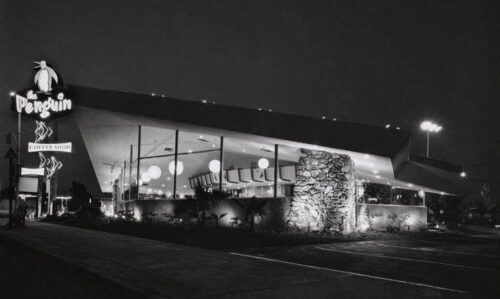
In the Penguin coffee shop below (built in 1959), the dramatic upswept roof (being cantilevered, and so appearing to defy gravity and take flight), wall-o'-windows, neon lights on the sign, and the busily off-center placement of items on the sign, give this building a futuristic feel that could not have even been imagined 100 years earlier.


However, Americans have never defined ourselves as strictly futuristic, progressive, etc., hence the need for the ancient and primitive elements -- tropical vegetation, and massive piers faced in flagstone to support the roof. The stones are not finely cut into rectangular prisms and then laid in regular courses like advanced stonework -- they appear to be used as they were found, with human ingenuity only playing a role in fitting them together like puzzle pieces.

This is not the masonry of an advanced civilization of several thousand years ago -- let alone one capable of splitting the atom and sending rockets to escape Earth's orbit. This far cruder form of assembling the stones together leavens the head-spinning futurism of the other elements. Crude and raw -- yet also advanced and sophisticated -- in its construction. That's what American identity is all about.

In fact, from some angles, these Googie buildings primarily consist of primitive elements and crude techniques, not so Space Age-y after all:


This combination of primitive with futuristic continued on the inside, where large expanses of flagstone walls gave a familiar cozy feel to the starkly-angled interior space, with rough natural textures and earthy colors balancing the smooth and dyed-any-color synthetic materials. Just as the woodgrain tabletops balanced the gleaming stainless steel / chrome pedestal supports.

* * *


I was glad to find one quote to this effect already out there: "these were places where George Jetson and Fred Flintstone could meet over a cup of coffee" (Alan Hess, Googie: Fifties Coffee Shop Architecture, quoted here). The Jetsons and the Flintstones were both highly popular TV shows, and helped define American identity of the time and ever since. Their co-existence is no accident: Americans are part caveman, part spaceman, with no stage of material cultural development in between -- that would be Europeans, and because we are not European, we have had to define ourselves as belonging to the time periods outside of the heyday of European empires.

There were never mighty empires and advanced civilizations where Americans landed and settled, and we have always had to wrestle with the absence of counterparts to Ancient Greek temples, Medieval castles, and Early Modern cathedrals in our newly settled land. Part of our response was to borrow from those civilizations in the New World that did build monumental architecture that was still easily visible and tangible, like the Maya of Central America or the later Easter Islanders off the Pacific coast of South America.

But mainly our response was to go with the obvious theme, that we were bringing an advanced civilization to a mostly primitive environment. Not necessarily like taming a desert environment to make it suitable for agriculture. We didn't build spaceships out of the primitive environment we found on arrival -- it's more like the advanced technology appeared to have been dropped from the sky by some civilizational stork.

Americans project that founding myth back onto other civilizations, when we assume that the Ancient Egyptians must have had their advanced tech for pyramid-building dropped upon them by ancient aliens. It may sound silly, but it makes sense when you consider our historical path, and the absence of intermediate stages of material development between the primitive and industrial in America. We just assume that every civilization in history has been dropped from the sky, mostly pre-fabricated, like ours was.

* * *


Finally, where *did* all of these dramatically upswept roofs, heavily cantilevered, come from -- if not aliens? You should already know the answer by now, given his all-encompassing influence on American architecture, but -- that's right -- they were invented by Frank Lloyd Wright himself, back in the Midwest. As far as I can tell, anyway, from searching around for "upswept roofs", and I'm happy to be corrected.

I don't know from my limited study of Googie examples which one was the first to employ the upswept roof, but Wright had all of them beat anyway -- the Robert and Rae Levin House from 1949, in Kalamazoo, Michigan. While most of the roof is flat, as was his style, a pronounced section of it soars up toward one of the edges, is not supported vertically at the outer edge, and contains a wall-o'-windows underneath, exactly as would become the norm with Googie in the next decade.

Even more Googie than that is the Elam House from only one year later, 1950, in Austin, Minnesota. This one has the doubly upswept roof, rising toward opposite edges and having a low-point in the middle of the roof, which is off-center / asymmetric. It's also cantilevered, supported by massive stone piers -- the only difference from Googie being their finer level of cutting and dressing, instead of being used as they were found, in the cruder Googie fashion, and so not looking quite as primitive. (But then, this is only the Midwest, not the Pacific coast, where the tropical primitive environment is more evident.) It has a wall-o'-windows underneath as well.

In 1952, at the Reisley House in Pleasantville, New York, he added a bit of functionality to the upswept roof, turning it into the cover for a carport. (He also changed the material to be cypress wood panels, adding to the primitive side of the balance.) The pier supporting the cantilevered roof is again stone, though more Googie-esque in using stones of uneven size, albeit still in rectangular outlines. It really did take the Googie movement to make them look unaltered and crudely assembled at varying angles.

I couldn't easily find other examples throughout the '50s, perhaps because he had seen it evolve into Googie -- and then elevated Modernist airport terminals from Eero Saarinen, like Dulles and the TWA Flight Center at JFK -- and figured his pioneering work was done. However, he was still at it circa 1960, when he built the Don Stromquist House in Bountiful, Utah. One corner of the roof rises toward the edge, is cantilevered, and contains a wall-o'-windows underneath.

California Googie architect John Lautner had apprenticed under Wright in the '30s, though I don't know if he was still keeping tabs on what his mentor was up to circa 1950 with three out of dozens of Usonian homes. It's possible that the moment for upswept roofs had come, and Wright was simply an early pioneer, while it came to others later but independently as part of a general zeitgeist. But there is a potential direct channel from Wright to Googie-style roofs that is worth looking into (for someone else).

* * *


And we must remember to hit on the other big-picture lesson from my survey of modern architecture -- the non-existent role played by the Europeans, whether affiliated with Bauhaus or otherwise. Clueless and embarrassed-to-be-American East Coast academics may hear "upswept roof" and "Modern architecture," and think of Notre-Dame du Haut by Le Corbusier. But that was built in 1955 -- half a decade after Wright pioneered the look in the American Midwest with multiple examples, as usual. It's also not as cantilevered as Wright's proto-Googie buildings, being supported at the outer corner.

For that matter, the supposed avant-garde of Bauhaus had been beaten to the punch by literal McDonald's, whose 1953 oldest building in Downey, California employed an upward-sloping roof -- along with prominent parabolas over a decade before Saarinen's Gateway Arch was built.

Civilization-shaping cultural creativity comes from expanding empires, and by the 20th century, the Euro empires had all bitten the dust, except for Russia, which didn't start its collapse until the final decade of that century. America was still rising, expanding, and innovating. If something cool or inventive happened, just assume that we did it (or maybe a Russian counterpart), not the collapsed empires with no gas left in the tank. Their heyday was several centuries earlier.

Whether trad or mod, Europeans simply had nothing to invent during the 20th C., although if they came under American aegis post-WWII, they could jump on our bandwagon and contribute that way -- which many of them did, enthusiastically, since our cultural scene was the only game in town, aside from Russia's.

We can't get too triumphalist, though, since our empire has begun collapsing as well. We aren't going to invent anything else ever again. That means our job is to preserve what has already been built in our national distinctive style, such as Googie (or Brutalism, Art Deco, Streamline, Prairie School, Mission, etc.). And if anything new needs to be built, then produce new examples of those established styles. That's how the Mormons are treating their temples -- old and new alike -- and that's how we should treat our buildings as an entire nation.

Fortunately in the case of Googie, it was most prolific in Southern California, which is the most preservationist region of the country, to their envy-making credit. If there's even a rumor about someone taking down the giant donut from what used to be a roadside vernacular diner, City Council will block them. And they have probably already made a preemptive move by getting the building legally protected as a landmark, making it sacrosanct, untouchable, and inviolable.

Nowhere else in the country conserves its American culture like L.A., which is why Brutalism is being systematically razed all along the East Coast, while UC Irvine will always look like it's from the Planet of the Apes, primitive yet futuristic at the same time -- and for all time.

May 30, 2023

Exposed concrete: the American architectural style's defining material, from Frank Lloyd Wright through Brutalism and beyond

I had no idea how backwards the history of architecture & design from the 20th C. and after has been, until I began researching American ethnogenesis and its cultural reflections. This has led me to an Americanist defense of Brutalism, which will be an ongoing series.

The standard cluelessness from back-East academics (and their media-ite confreres), who are trapped in the least American region of the country, is that there is no such thing as a distinctive American culture, and that we inherited or imported everything from the Old World, primarily the Early Modern empires of Western Europe -- including in their degenerate collapsing stages, such as Cubist paintings and Bauhaus architecture and design.

The reality is that American pioneers beat the stultified Europeans to the punch, usually by several decades, and that Americans developed the superior standard of that form, whereas the Europeans could only manage an inferior copy of it, or didn't adopt it at all.

That's not a knock against European culture -- they just had their ethnogenetic heyday centuries before we did, so they already developed their own impressive standard forms. And as we see now, as the American Empire enters its degenerate collapsing stage of life, we too will become stultified non-creators having to either preserve / revive our previous foundational styles, or try to imitate others around the world if they are dynamic.

However, there are no other ascendant empires in the near future, undergoing an intense ethnogenesis, so there is in fact no one else for us to copy, as the Europeans finally managed to do with Midcentury Modern design (imported from America during the Pax Americana). So that leaves Americans with the task of preserving, reviving, canonizing, and celebrating what we have already made, and to limit any degenerate and warped extensions of it during our collapsing-empire stage of life.

* * *


One major example of the backwards thinking about 20th-C. architecture & design is the nature of Brutalism, which the received cluelessness of back-East cerebrals holds to be European. They may bicker over whether its parent is Swiss (Corbusier) or British (the Smithsons), but it's definitely -- and distinctly -- European, in their view. And they place the birth in the post-WWII 1950s time period.

They never overtly argue against an American origin, and not for cynical reasons -- like, they would have to give up their silly initial views -- but because "American culture" is simply a non-force in their model of historical dynamics. Because America has no culture of its own, it could not have influenced anyone else, let alone the Europeans, whose combined forces exceed everything else out there. So why even bother exploring that hypothesis?

As far as the time period of its birth, they might allow an earlier "influential" stage -- as long as it were European, e.g. Bauhaus practitioner Mies van der Rohe in the late 1920s (Barcelona Pavilion). They would never entertain the possibility of an American influence in that decade, let alone earlier -- earlier, in fact, than any other European contemporary in a Modern style.

But just cuz back-East ignoramuses wear these ideological blinders, doesn't mean we have to. We owe no allegiance to a sector of society whose raison d'etre is supposedly "figuring things out," yet who not only come up with the wrong answer, but sanctify it into unarguable dogma. Nor do we owe cultural deference to anyone from back East, the black hole of culture in America. They simply do not get American culture, and perhaps have never been exposed to it in their lives, outside of movie portrayals -- or a visit to Disney World, but that's the topic of another post on primitive futurism in American design, and Brutalism specifically.

* * *


While the exact criteria for Brutalism may vary somewhat, most people from any background agree on the central role played by the materials used -- and in particular, concrete, especially if it is exposed, i.e. not clad behind marble, ceramic tiles, brickwork, stucco, heavy coats of paint, or other materials that would disguise what the building is mainly made out of. It also cannot be assembled in such a way as to suggest it's not concrete -- e.g., if concrete is poured into individual blocks the size of traditional stone blocks, and those blocks are laid as in traditional masonry. That would be concrete imitating or disguising itself as masonry.

That is what this post will focus on, not other aspects of the style -- but those are distinctly American in origin as well, which contrast with European traditions, and which were pioneered in America long before they caught on among the avant-garde in Europe who were trying to rebel against their own centuries-old traditions (which we were not encumbered by in America, being a young nation undergoing ethnogenesis). For example, the blocky assemblage of masses, the rectilinear nature of lines, the relative sparseness of superficial ornamentation, the rough-hewn nature of shaping mass rather than delicate finesse -- these all go back to Chicago in the 1890s, not Berlin in the 1920s.

And so it is with the use of exposed concrete as not simply a utilitarian building material, which could be hidden by other ornamental materials, but as a surface-level one contributing to the aesthetic value on its own.

We'll start our exploration by exploding two related myths from the clueless back-Easterners -- from both the fanboys and the haters of the style. One, that Brutalism was an elitist style that only college graduates appreciated, or that was confined to their everyday territory. And two, more importantly, that it was pioneered by Europeans in the 1950s.

If you went to any park anywhere in America over Memorial Day weekend, you likely saw one of these, a drinking fountain made of concrete with its aggregate exposed, and whose metal parts are given a gleaming chrome finish, making it a textbook example of primitive futurism, something that looks like it's partly from the Stone Age and partly from the Industrial or Space Age:


It does not resemble European drinking fountains at all. They use metal (stone if fancy), and work it into fine-level shapes. The American style requires a more blocky, pure simple geometric volume, and the avoidance of European materials -- because we are not European, and had to create a new material for our new culture in our new empire.

Technically, the Romans created concrete 2000 years before we did -- and they did leave it exposed as an architectural / aesthetic element, and they even used it in a lattice of repeated simple geometric shapes (the coffered ceiling in the dome of the Pantheon, which the vaults of the Brutalist DC Metro stations perfectly resemble). But they did not expose the aggregate -- theirs looks like fairly smooth concrete, while ours has all those small pebbles adorning its surface.

Concrete is somewhat like masonry, where a large number of solid stones are held together by a connective network of binding material (cement for concrete, mortar for masonry). The main differences are the scale of the stones -- pebbles you can pinch between your fingertips, vs. stones hefty enough that you can only hold one in your hand.

And the assembly is totally different -- masonry lays down the stones (with or without mortar) in a planned, calculated, deliberate fashion. They don't have to be of uniform size and laid in a simple pattern (like rows of uniform height), but their placement is deliberate as each stone is set into the whole assembly. Whether you're looking at a brickwork facade of a house, or the impenetrable walls of Macchu Pichu, you can tell that the arrangement of individual stones into the whole was decided by human actors the whole way through.

The placement of individual stones within concrete is the opposite -- not even a single one was deliberately placed where it is, after deliberating about the others around it in the existing whole and where future ones would be placed after it. Rather, the stones are mixed up like balls in a hopper during the mixing process, and as the whole composite mass is poured (or sprayed or whatever else), the arrangement of stones does its own thing before settling into its hardened final state. Workers are not intervening to move this stone here, that stone over there, before the whole thing hardens. They wind up wherever they wind up.

And so, although the whole thing was made from human civilized technology, it has the look and feel and impression of a natural rock like sedimentary conglomerate. It doesn't look artificial because it is not artificial -- we introduced natural randomness during the mixing process, and did not intervene during the pouring and hardening process. It's somehow natural and the output of human technology at the same time -- maybe geological husbandry, like animal husbandry, not designing animals in a laboratory or factory.

At any rate, when the aggregate (the small gravel stones) in concrete is exposed, it looks like a Stone Age material, not an Industrial Age material -- not even a Metal Age material. It looks just as prehistoric in age, natural in formation, and organic in shape and texture, as traditional rocky materials like marble, granite, etc. But it's actually new, created by America -- not even the Romans exposed the aggregate like we do. We needed an ancient material to establish our primeval connection to this land, so we invented one that did just the job!

* * *


These days, you can't go to any public space in America without seeing at least one example of exposed aggregate concrete -- drinking fountain, trash can, cigarette ash receptacle, wall / column support, bench, sidewalk / pavers, curb, etc.

And you *won't* find those things in Europe or anywhere else in Ye Olde Worlde. Theirs are made out of metal or stone.

This material is not only distinctly American, it is ubiquitous in America. We take it for granted that any random strip center in any ol' American suburb will have a trash can made from this material, and that the drinking fountains in the same suburb will be made from it as well. No material is more all-American than exposed aggregate concrete.

This also shows how populist and popular the material is -- it is not restricted to elite university environments, appreciated only by eggheads, or expensive to use. It's very affordable, suitable for mass use.

In fact, as I mentioned earlier, the desecration of the American architectural traditions and standards, especially the anti-Brutalist iconoclasm, has been a crusade led by the professional class for the professional class, in blue states and blue cities, by government bureaucrats and academics and pharma research labs, and by women rather than men. It's every conceivable demographic that lives in order to carry out the will of the neoliberal Democrat party.

The only wrinkle is the meta-ethnic frontier one -- West Coast Democrats are far more conservationist of American culture than East Coast Democrats (Boston / Massachusetts being ground zero for Brutalist demolition). They're closer to the historical, defining frontier against the Indians, while the back-Easterners were never shaped into Americans by that frontier, so why would they want to preserve its cultural output? They're pseudo-European, and they want their culture to be that way, and stay that way.

* * *


However, we can't say that these ubiquitous concrete drinking fountains owe their existence to Brutalism -- that was just one stage within American architectural ethnogenesis. It goes farther back -- back to Frank Lloyd Wright himself! It's amazing, I don't plan to discover his foundational influence in everything I look into (like the swivel chair and cantilever chairs generally), but he really was America's first-mover genius. American architecture & design is just footnotes to Frank Lloyd Wright -- and that includes all areas absorbed into our empire over the 20th C., like Europe and Japan.

The work in question is the Horse Show Fountain from -- where else? -- Chicago, dating back to -- when else? -- 1909. Not Berlin, not London -- and not New York, for that matter. Not 1919 or 1929 or 1939 or 1949. Both the original and the current replica (made in 1969) are made from reinforced concrete, which is not clad behind any other material. It's a drinking fountain, for people and originally horses too.

Although the Wiki article claims that only the current replica has the grainy exposed aggregate surface (ubiquitous by the '60s), a gallery of images of the original, both photographic and illustrated, make it look about as aggregate-y as the later replica. Maybe in some areas more than others, like around the edge of the basin, where there are square indentations, but still, it doesn't look radically different and perfectly smooth.

And in fact, Wright used the exposed aggregate finish in the same year of 1909 in the same city of Chicago, for the Unity Temple. So, hardly a stretch of the imagination to believe the original fountain had some exposed aggregate as well.

Before getting to the Unity Temple, though, we have to consider earlier structures built elsewhere in America and Europe that claim to be the "first concrete / reinforced concrete buildings".

In 1853 in Denis, France, Francois Coignet built a reinforced concrete house -- but it was not exposed as an architectural element. Looks like it was covered by plaster (now peeling off in sheets), which was then painted. Because it did not take the material in a bold new direction, it spawned no imitators or movement within France. If you wanted painted plaster on the facade, you didn't have to use concrete underneath it -- any material from the French tradition would do.

Then in 1873, using a process designed by Coignet, the Coignet Stone Company Building in Brooklyn, New York used concrete blocks without any cladding. However, by casting them into blocks meant to resemble the cut stones of traditional masonry, and then either laid into place in arrangements also from traditional masonry -- or poured into molds meant to mimic that arrangement -- the concrete doesn't really show itself. If you didn't know beforehand, the viewer would probably think it was any ol' stone building. This is apart from the overall style being a Euro-LARP-ing style rather than a new American style. The raw material itself, and its assembly into the whole -- whatever style it is -- does not look new or different from European stonework.

The William E. Ward House of the same time period and metro area, has the same problems with it being the "first" in an ethnogenetic sense. It is made of reinforced concrete, which is not clad behind another material, but the material has either been cut and laid into place, or poured into a mold meant to resemble, the processes of traditional masonry. On the lower two stories, the corners where walls meet have simulated quoins, the most glaring example of trying to disguise its concrete nature as traditional masonry. Again, this is apart from the matter of the overall style being a Euro LARP.

The Highland Cottage from the same time and place has the same problems, and then some. Aside from simulating traditional masonry, the concrete is faced in stucco. Unlike the Ward House, this one is not reinforced concrete. The Coignet Stone Company Building has a reinforced basement, but not above that level. Wright's fountain and Unity Temple are reinforced. However, I don't think reinforcement is central to the development of a new American style and material vocabulary. It's not visible, and is only relevant on the utilitarian level -- allowing greater-scale structures to be built.

Aside from being in the wrong place for American ethnogenesis (back East), these three New York buildings are also from the wrong time -- still mired in the integrative civil war phase of imperial growth, which included the Reconstruction era. It wasn't until the 1890s that the winner of the civil war -- the industrial Midwest -- could hit the ground running with its creation and dissemination of a new national culture, after internal divisions had been sewn up. This would spread westward along with the meta-ethnic frontier, although places back East ended up adopting it to some extent as well. But it wouldn't last as long back East since they have always been reluctant participants in American culture.

In the right place at the right time -- Chicago in the first decade of the 1900s -- Wright built the Unity Temple. It was not only a new overall architectural style -- American Block Symphony, not Gothic, Baroque, etc. -- it used a new material, concrete with the aggregate exposed. The volumes do not resemble traditional blocks from masonry, are not laid into place in masonic ways, and do not simulate or mimic them via the molds into which the concrete is poured. Just monolithic slabs of concrete, of varying size, with more or less ornamentation built into the mold's shape. Not hidden behind anything else.

In addition to not hiding the concrete, and not mimicking masonry, the exposure of the aggregate within the concrete is a milestone in the history of American architecture. Now the material looked more like granite or marble or some other Stone Age material with patterns and textures within it -- not requiring their addition through mosaic techniques. It no longer looked so smooth and uniform and monolithic.

The techniques used to expose the aggregate are not relevant to its final state, but in this case the workers used wire brushes to gently grind away the outermost layers of the cement binder, like using a fork to flake away the outermost layer of a fruitcake to expose the individual globs of fruit suspended in the flour-y binder.

Like the Horse Show Fountain, the original Unity Temple showed signs of wear by circa 1970, and it was restored (not replicated) with an exposed aggregate finish (and then another major restoration in the 2010s, still using the exposed aggregate finish). But the original back in the 1900s had an exposed aggregate finish as well, as shown by contemporaneous pictures and Wright's own words (likening the appearance to granite). This makes me believe the original Horse Show Fountain also had a similar degree of exposed aggregate finish as its later replica.

* * *


By the time of a 1986 article from Concrete Construction Magazine, "Unity Temple: the Cube That Made Concrete History," the neoliberal backlash against the Progressive and New Deal eras had begun, as well as its cultural expression in the perversion, slandering, or outright demolition of America's distinctive culture. The central target for neoliberals was Brutalism -- too American instead of whatever Olde Worlde LARP / pastiche they preferred, too populist instead of elitist (affordable concrete vs. expensive masonry), too ubiquitous instead of confined to the bi-coastal top zip codes.

In that context, the authors cannot use the term Brutalism or refer directly to the 1960s and '70s as the extension of the history begun by the Unity Temple. The reader is left to fill in the blanks, but that's what they're getting at -- American Block Symphony styles, using exposed aggregate concrete, trace back to Frank Lloyd Wright, in Chicago, at the turn of the century.

They also do not overtly state what this means for other boneheaded theories -- like the myth that Brutalism as a camp, or the use of unhidden concrete, or blocky assemblages of volumes, grew out of Europe somewhere between the '20s and the '50s. Nope -- it's as American as apple pie, from the Midwest (and later, further out West), from the turn of the 20th century, from the American architectural Plato himself, Frank Lloyd Wright.

Europeans were simply a non-entity in endogenous cultural creation after their 18th and 19th-century plateau. They descended into chaos in the early 20th C, along with their empires collapsing in WWI, limping through the interwar period before the remaining fragments were then scooped up by the American Empire -- both politically and culturally. If they wanted to join the American camp, they were more than welcome, and by the Midcentury Modern moment, they were all aboard Team America.

Blaming Bauhaus for anything outside of Europe in the interwar period is just a cope -- and if you're American, a cope to hide your thinly veiled anti-American attitude toward our culture. "Wah, I identify as an 18th-C. Euro aristocrat / ancient Roman villa-owner" -- too bad you're just some American suburban-raised schlub from the 20th and 21st centuries. You're no more of a Baroque aristocrat than a man is a woman. Remember, if you're outside of Europe:

>ywn be European

And here in America, we have nothing to apologize for or feel embarrassed about. I do feel sorry for some parts of Europe, in Britain and Germany mainly, where "Brutalism" was de facto Bauhaus eking out another few decades of comatose existence, while wearing a concrete disguise in order to blend in with the new American style that was anything but Bauhaus-y.

But charmingly Stone Age meets futuristic chrome drinking fountains adorning and providing a public good at parks all over America? Sublimely primitivist yet futuristic buildings that connect us with the primeval grounded past, while somehow simultaneously enticing us through a portal to the optimistic utopian future? No, that is to our *credit* as Americans, with our own cool badass culture. There is no "blame" to go around in the first place.

If you hate on Brutalism, you hate on the entire American tradition, from Frank Lloyd Wright to public parks to our ultimate architectural activity-place -- the malls. Oh yeah, I'm just getting started on this crusade to vindicate Brutalism. All you faggy mall-haters better pack up and leave now. But just as a preview: both malls and Brutalism proper were derided and demolished during the same time period, by the same camp of people, with the same complaints, whereas the appreciation / celebration / nostalgia came from a similar group of people (opposed to the first camp).

* * *


To conclude this exploration into the origins of exposed concrete as America's defining building material, let's take a whirlwind tour through some major milestones along the way, between the Unity Temple and Brutalism in the '60s and '70s. To not stray too far from the main topic, and because he really was the one who organized everything into its major channels, we'll stick with good ol' Frank Lloyd Wright.

In the 1920s, he put in a stint in Los Angeles, where he built several houses using concrete blocks that were cast on site, but not in a recognizable Euro / Roman / Olde Worlde form. Rather, their rectilinear geometric impressions were inspired by Mayan temples and other New World civilizations.

The blocks were then arranged into place like usual masonry, in horizontal courses or stacked into columns, all contributing to the synthesis of Mayan step-pyramids and his own American Block Symphony styles. But they were clearly made from concrete, not stone that had been cut and carved, and not bricks. The designs are intricate and are used in a large number of blocks -- clearly telling us that they were all cast from a single, intricately shaped mold, not intricately carved each time. The latter would've taken so much labor, it could only be built by a legion of slaves for a monument for an imperial ruler -- not a house for a typical affluent American household.

You can watch a documentary on this episode of his career for free on YouTube. These buildings are the Storer House, the Millard House, the Samuel Freeman House, and most famously the Ennis House.

These blocks were later reincarnated, still in California but spreading elsewhere, in the decorative breeze blocks of Midcentury architecture. See here for an overview of the breeze block phenomenon -- one of the most identifiably American decorative elements, something unseen in Europe, but are everywhere out West (and somewhat back East), down to the most lowly apartment buildings, not restricted to elite circles. As you can see from the close-ups here, already in the '20s Wright used versions of his blocks that were perforated to allow light and wind to pass through, in addition to the totally solid versions.

In the 1930s, his Fallingwater house used massive horizontal cantilevered slabs of concrete, which although it has a slight sandy pigment to it, is still recognizable as concrete -- not clad in stucco, not employing or mimicking masonry, etc. The entire building is not made from concrete, but these slabs are its defining features.

Finally, and most important to establish the link to Brutalism, is the Guggenheim Museum, which was planned & revised during the late '40s and early '50s, and was built between '56 and '59. It is made from concrete that was poured -- or rather, sprayed from a gun -- in place, not cast into individual blocks used for masonry. It is not clad in any other material, nor was it hidden under heavy paint (although it did receive a light beige coat at first, which was later changed to white).

In fact, the paint is thin enough that you can still see with the naked eye the woodgrain impressions left by the boards that acted as the boundary or container ("formwork"), onto which the concrete was sprayed from the inside. See this post for the details. At first Wright wanted a smoother surface, but the head of construction argued that it was not only impossible, but that the impressions showed off the material better -- it's not stone, it's not going to look like stone.

Leaving the impressions of the formwork became a staple of Brutalism, and as far as I can tell, it all started (as always) with Frank Lloyd Wright, well into his senior career. Indeed, when first built the Unity Temple showed a kind of horizontal banding left by the various stages ("lifts") in which the concrete was poured from lower to upper heights (for the photo, see p.3 of the Concrete Construction Magazine article linked earlier).

Small-scale impressions of woodgrain, up to seams between successive lifts in the pouring process, are just like the natural imperfections in animal skins or quarried stone, and courses of masonry that are not perfectly level all the way across. It gives the concrete a primitive Stone Age feel, not a lab-perfected ultra-modern material with no variation of any kind or any seams.

So, Brutalism's "openness" about its construction process traces back to Wright, in the first decade of the 1900s -- not to Mies van der Rohe, who used no concrete at all in the Barcelona Pavilion several decades later, nor to any other Bauhaus-adjacent boogeyman / hero (depending on whether the clueless academic is a hater or lover of Bauhaus).

And not only did Wright pioneer the openness of the concrete construction process in the Guggenheim Museum, he also made the building a large-scale sculpture out of a few pure geometric volumes, and they're arranged into an asymmetric grouping to make for some movement of attention and off-kilter dynamism -- without warping the fabric of space, using distorted points-of-view, or fragmentation of the components, as would happen during the neoliberal era, most notably by Frank Gehry in another Guggenheim Museum (the one in Bilbao).

These defining traits of Brutalism were all there in the late '50s in America, but not in the '50s apartment blocks by Corbusier or the Smithsons, which are utilitarian Bauhaus boxes that use concrete instead of some other material. BFD -- it's still Bauhaus, not the style pioneered in America and later called Brutalism.

* * *


To reflect on where we started with exposed aggregate concrete, that not only became a staple in those ubiquitous drinking fountains, trash cans, benches, columns for shopping center covered walkways, etc. Exposed aggregate running in vertical corduroy bands was a staple in Paul Rudolph's buildings, e.g. the Yale Art & Architecture Building from the early '60s and the Boston Government Service Center from the early '70s. Much of the facade of the Xerox Tower (by Brutalist superstar Welton Becket from the late '60s) is exposed aggregate.

There is no such thing as the "good Brutalism" that was for a popular audience, and had the charming familiar exposed aggregate, vs. the "bad Brutalism" that was for elites and had clinically smooth texture and perfectionistically uniform color. The latter-day American Stone Age material, with aggregate exposed, adorns so many of the structures that the clueless haters never bother to look at, and just assume that because it's concrete, it looks like dried cement.

Nope, it has lots of texture, pattern, and color from all the various stones revealing their faces. They may not come in neon or jewel tones, but there's plenty of earthy yellows, reds, oranges, browns, blacks / grays, sometimes shading into blue tones. And that's the type of "color" that the haters have in mind anyway -- a brick facade, marble, etc. If it counts as colorful for standard red brick and marble, it counts for exposed aggregate concrete.

Why don't they know what these buildings look like? Because they've never experienced them. If they've been up close to one IRL, their senses are too weak to perceive what is right in front of their faces. But mainly they are into hating on Brutalism as one part of their Olde Worlde LARP, and because Brutalism is distinctly American, that's a ripe target. It doesn't matter if its facades are as colorful as brick and marble facades -- just tell a lie that it's uniform gray, and don't bother to look closely at pictures to tell for yourself, and trust that everyone else in the LARP will do likewise.

The "why no color?" complaint is really rich, given that another complaint from the clueless haters is that Brutalism ignored the desires and wills of those who actually utilized the buildings, and only pleased the distant cultural elite who viewed them through photographs in slick magazines.

Actually, it's the haters who only look at these buildings in far-away-shot photos over the internet! Any close-up photo would show the texture, color, variety of stones, etc. But they image searched the building, got a zillion copies of the same shitty stock photo shot from a million miles away, and that's all they need -- close-up shots might contradict their preconceived hate, so please, anything but close-ups! And definitely no IRL visits to see it unmediated -- it would contradict your beliefs, and put you so physically close to a contaminating heretical substance -- Americanism! Why, all that American stuff might just melt away years of effort to cultivate your Olde Worlde LARP -- can't risk the exposure!

But as I said before, most Americans don't hate Brutalism, concrete, or its exposed aggregate form. We take it for granted, as the physical stuff itself as well as its creation of a primitive-futurist environment that we as Americans find irresistible. That mood makes us comfy and familiar, because it's so deeply ingrained into our culture by this point.

It's only managerial-professional-class Euro LARP-ers who get incensed over these defining traits of our culture, for obvious reasons of status insecurity when they belong to a non-European culture. Sadly for our heritage, though, they do wield disproportionate decision-making influence, so they can and already have begun a campaign of anti-American desecration and demolition, particularly on the East Coast.

That is as good as any predictor for the boundaries of the future states of the post-collapse American Empire. Where they're demolishing the distinctive architecture of our nation / empire, they're clearly seceding. Where they're neither fighting to demolish it, nor pro-actively guarding it, is a border region. Where they're conserving it long in advance, will be part of the core of the new American state, post-empire.

Concretely, as it were, that means the whole back East region will secede, with central-southern Florida being a wild card that could become a somewhat reduced nation of Florida unto itself, or a non-contiguous piece of America, while the north of Florida joins the secession. The Midwest will mostly stay, although Ohio could be a wild card that would join the secession. Not surprisingly, Florida and Ohio are both the two constant swing states in presidential elections.

Obviously California will stay and become the new political core (it's already been the main cultural core for most of our ethnogenetic growth period, after Reconstruction). But other parts of the Southwest will stay, too, for the same reasons -- Vegas (AKA Nevada), Arizona, all of Mormonland, Texas, all of it.

In fact, Mormonland provides the most intense counter-signal to the back-East demolishers of American Block Symphony buildings. Mormons have standardized Block Symphony as the style for their temples, the most important building type for them (not the weekly meeting houses, but the ones where weddings, initiations, and so on, take place).

Mormon elites did eliminate the Midcentury / Space Age (not Brutalist) design of the Ogden and Provo temples (in 2014 and early 2020s), but they replaced them with Block Symphony designs from the American Modern period and geographic origin. Not glass-and-steel fishbowl flexspace abominations like the East Coasters have done post-demolition, nor an Olde Worlde LARP that the trad haters of Brutalism would want (but would never actually get, and would settle for getting cucked by a glass-and-steel Silicon Valley kindergarten instead, because they hate the New Deal politics and culture even more).

The last group in the world to make the contradictory concept of "Greco-Roman" architecture their standard would be the Mormons, whereas it would be the go-to for many East Coasters. That tells you all you need to know about who is gonna make it into the post-imperial-collapse nation of America, and who will be inhabiting small breakaway states riven by mutual mistrust, bitterness, and sinking deeper into the cultural black hole that they've always been.

May 22, 2023

Imperial competition fuels ornamental complexity arms race, unipolarity keeps things simple

The more I look at the history of American architecture, the more striking the parallels to Romanesque become -- beyond the obvious level, where we had a full-blown Romanesque revival here. Our own distinctive American style resembles Romanesque in many ways, whereas both are unlike the lineage of Gothic / Baroque / Rococo in the Late Medieval / Early Modern Euro empires.

Most notably in the stark transitional areas between major volumes, e.g. where columns or wall supports join with the roof, or the walls of two volumes meet up. Romanesque and American architecture leaves these joints fairly free of intermediate-sized volumes to soften or break up the transition, whereas Gothic etc. employ lots of volumes at various intermediate sizes to cover up the seam. That gives lots of ornamentation to Gothic etc., while Romanesque and American buildings are relatively less adorned.

That will be the focus of case studies around the world and over time, soon. For now, I just want to lay out the broad theoretical idea, with a quick review of several different cultural domains.

Our musical styles aren't as intricate in polyphony and counterpoint as the Gothic / Renaissance / Baroque / Classical lineage in Europe, which again makes us resemble the Frankish Empire and early French Empire (back when they were still carrying over the Frankish traditions, before their integrative civil war concluded circa 1200 and set them off on a whole new ethnogenetic journey with Gothic). Compared to 18th-C. German and Austrian imperial music, we've returned to monophonic Gregorian chant of the Frankish / early French era (again, beyond the obvious level where there was a full-blown popular revival of Gregorian chant during the '90s, in the American imperial sphere of influence).

And our literature is far less intricate, developed, and adorned compared to anything from the Gothic era of the 13th C onward in the Euro empires. Whether it's our poetry, novels, screenplays, stage plays -- it's far more naturalistic, less stylized, and therefore without as much ornamentation as our Late Medieval / Early Modern predecessors. But very much like our Scandinavian and Russian peers of the late 19th and especially 20th centuries, as reviewed here. And see here for the same comparison in architecture.

Russia is an even better example of the theory, since they used to have a much more ornamented literary output -- and more ornamented architectural style -- back when they were just one of many empires competing against each other. They only changed to the simplified styles in literature and architecture during the 20th C., when they suddenly had no imperial competitors after those competitors collapsed in WWI (except for America -- on the other side of the world, and so, not a real threat).

In this way we have yet again returned to the Frankish era, where despite recent attempts to rebrand their culture as a "Carolingian Renaissance," no one claims that their writers produced a Shakespeare, Dante, Goethe, etc. The closest that the Romanesque world got to such a work was the Song of Roland (about an episode from Frankish history), written in the 11th C, while the nascent French Empire was still thinking of itself as Frankish in nature. Most of those Late Medieval chansons and romances, however, were written as the French Empire's integrative civil war was wrapping up, in the late 12th C (e.g. Chretien de Troyes), and afterward -- along with the radical shift to Gothic architecture.

In the unrelated domains of architecture, music, and literature, American imperial culture resembles that of the Frankish Empire, while both are alien to the imperial cultures of Europe from the 13th to 19th centuries.

What other large-scale set of forces were similar for the Franks and the Americans, but the opposite for the French, British, Spanish, Germans, Austrians, Lithuanians, Ottomans, and Russians (for awhile)? Well, that's just it -- the jam-packed arena of rival empires in the latter group. The Franks were pretty much the only empire of their era. There was a foreign empire confined to Iberia (the Moors), and the Byzantines in the southeast of Europe, but the Franks were based in the northwest (which was still a huge amount of territory, including modern France, Germany, and northern Italy).

Likewise, from our early days, Americans have been mostly the sole imperial power, at least locally, and then globally. The French were not much of a bother in North America, we defeated our British overlords, and the Spanish were confined to Central and South America (and the Spanish colonies collapsed in the early 1800s anyway). Then after WWI, we had no European rivals either, whether geopolitically or culturally. Europe was over... aside from Russia, but that's too far removed to really count in the American mind (again, geopolitically or culturally).

China's most recent empire had collapsed at that time, too, India and Iran's empires had collapsed fairly recently, no empire emerged from the Ottoman territories -- except for the Saudi Empire, which began in the late 1700s, defeated the Ottomans in the Middle East, and kept going strong through most of the 20th C. But they're too far away from America to pose a serious threat to us, geopolitically or culturally.

All around the world, there was only America, Russia, and the much smaller-scale Saudi empires. What a relief!

Just cuz there wasn't literally one (1) empire in the entire world, doesn't mean it was a multipolar environment -- it was very far toward that end of the spectrum. Also close to the unipolar end was the Byzantine heyday, as well as the early Arabian / Muslim conquests (e.g. the Umayyad Caliphate). Also, the Maurya, Delhi Sultanate, and Mughal empires of India.

At the other end was Europe between 1300 and 1900, where multiple empires emerged and jockeyed for position, fighting countless wars with each other for supremacy, but never attaining it. Also at that multipolar end of the spectrum was much of North Africa and the Middle East, circa 1000 to 1300 AD (until the arrival of a unipolar Pax Mongolica). Also, the Gupta and Pala empires of India.

Needless to say, the very first empires like the Egyptians and Akkadians were on the unipolar side -- not enough time for multiple rival empires to emerge and arrive at their borders.

(I'll try to focus on East Asia some other time, since I haven't studied their architectural history very much.)

I'll do the architectural case studies later, but suffice it to say for now, the theory is that unipolar environments favor simple ornamentation, while multipolar ones favor elaborate ornamentation.

Why? Well, when you have multiple imperial rivals, you're not only competing over the military control of territory, or the economic trade networks, but also cultural influence. You think you can do intricate tracery? Ha! We'll make ours *even more* intricate! You can't compete over simplicity, because it has a hard boundary -- you can't get more minimal than minimal, but you can get orders of magnitude more maximalist.

This imperial cultural rivalry sparks an ornamental arms race among the competitors, as each struggles to keep up and out-do the others. In this way it is similar to runaway / Fisherian selection from evolutionary biology (e.g. the peacock's tail, from a polygynous species with intense competition among males for female mates, vs. the more drab robins who are at least monogamous within the breeding season).

Empires in a unipolar environment don't feel such a strong pressure to keep up with others, or out-do others, so why over-do it? Keep it simple. Make it impressive, monumental, awing, etc. -- sure, but without getting sucked into a ratchet of escalating complexity. This peacefulness of cultural forms reflects the peacefulness of geopolitics when there's only one empire in the neighborhood. That doesn't mean it's free from conflict -- it expands by conquering others, but these others are not also empires in their own right always trading territory back and forth.

Egyptian pyramids and obelisks, Akkadian ziggurats, Frankish / Romanesque and Byzantine churches, Umayyad mosques, Mauryan stupas, American Block Symphony -- all very simple groupings of volumes with minimal volumes of intermediate size to fill in the transition zones, leaving clearly visible seams. Relatively unadorned.

Gothic cathedrals, muqarnas-marked mosques, Gupta temples -- far more encrusted with ornamentation at the highest scale (filling transition zones between volumes).

But we'll see the details in another post. The important point for now is the dynamics underlying the emergence of these ornamental arms races, and why they only appear in certain times and places. It's worth emphasizing that there is no unilinear trend over history toward either greater or less complexity, nor is there a regular rhythmic cycle between the two ends of the spectrum. Periods of complexity do alternate with periods of simplicity, but it's not a regular repeating loop like a pendulum swinging, or weather seasons repeating.

And so, people who complain about the relative lack of ornamentation in 20th-century and later architecture, compared to Gothic through Rococo architecture, are correct on one level -- namely, noticing and describing the facts.

But they're wrong about there being a timeless Paradise that came before this current Fall -- go back to only 1100 AD in Europe, and you're right back to where you started in 20th-century America. Go back even further, in fact -- it was still Frankish and Byzantine. Even Roman architecture is not that heavily ornamented, owing to its unipolar environment (only serious imperial rival was Parthian Iran, leaving a zone of contest in the Levant and Armenia, but still very far removed from the age of Early Modern Euro empires).

And the ornament-likers are also wrong about our ability to intervene and alter the course of history. They complain that the less-adorned buildings come from crazed utopians who deliberately engineer the lack of ornament -- but they don't do that at all. Lack of ornament in 20th-C America, and its sphere of influence, comes from our unipolar environment. We can't will our entire creative class into producing heavy ornamentation in their output. They're subject to societal and geopolitical forces beyond anyone's control.

Rather, it is the would-be builders of latter-day Gothic cathedrals and Miltonian epic verse who are the delusional utopians trying to force a square peg through a round hole. Our environment doesn't support those forms any more than the Frankish and Romanesque environments did.

You can seethe forever about the relatively simpler styles we have, or you can learn to embrace our neo-Romanesque culture, if you require a trad LARP angle to your lifestyle choices.

May 20, 2023

Ethnogenesis shocks and disturbs with new cultural forms, until it reaches maturity, and becomes the accepted standard forever after

Before moving on to the review of Brutalism's place in the history of definitive American architecture, I'm going to take a detour through European history in order to address a major issue about new styles being shocking, abandoning their roots, etc.

By the time America is flourishing, the European architectural expression of ethnogenesis had already run its course, reaching its last stage with Art Nouveau (whatever it was called in various countries) in the early 20th C. This was an attempt to reinvigorate their culture with a bold new modern approach, but it still fell back into styles pioneered in the Early Modern period, when these nations were truly beginning to construct new collective identities. The lightness of mass, thin wispy lines, curvilinear, employing natural motifs (vegetable, human, and animal), elaborately ornamented, playful and romantic -- none of that would have been out of place in Rococo.

That's not to denigrate the style on an aesthetic level, just to establish that it was not revolutionary, as it was back in the late Medieval and Early Modern period, as European empires began defining themselves as post-Frankish politically, and therefore post-Romanesque architecturally. No more huge hulking slabs of mass, no more clean exteriors with simple lines, no more imposing windowless fortress facades, no more dark intimate cave-like interiors, no more haphazard grouping of differently shaped volumes, no more sober and quietly reflective mood, where the energy was potential rather than kinetic, no more restraint on the libido.

The first of these developments -- Gothic -- came from the ascendant French Empire in the late 12th C., just as it was concluding its integrative civil war -- the conquest of western and southern France by the northeast, pitting the House of Capet in Paris (especially under Philip Augustus) against the House of Anjou / Plantagenet in the west. Although the French Empire was founded circa 1000 by Hugh Capet, in its early stages it was still culturally very Frankish, and held onto the Romanesque style of architecture of that earlier empire.

That was just like the Romans still borrowing heavily from Greek architecture until the end of the 1st century BC, after their integrative civil war, when they revolutionized their new style through the use of concrete, arches, vaults, and domes, amphitheaters, triumphal arches, and so on and so forth.

Or in the same way that architecture in America before the late 1800s (wrapping up our Civil War & Reconstruction period) was still mostly a local copy of styles from the British and French empires (including the vogue in those Euro empires for Neoclassical and Roman styles).

Or in the same way that early Ottoman architecture (1300s and early 1400s) still resembles Seljuk styles, where they had come from before invading Anatolia. Their integrative civil war lasted for the first half of the 15th C., and pitted the Ottomans proper, centered in the northwest of Anatolia, against the elites of other Turkic principalities (beyliks) in the south and east. Only after that civil war was concluded did they revolutionize an entirely new style for themselves. They began borrowing (not copying) from Byzantine styles, rather than recreate Seljuk styles, just as Americans began borrowing (not copying) New World influences, rather than recreate the styles of our Euro imperial ancestors or peers, after our Civil War & Reconstruction were over.

This serves as a reminder that intense bouts of ethnogenesis, accompanying the rise of new empires, always lead to radically new cultures, and the shedding of past identities. They have been forged into a new people, by having to combat their meta-ethnic nemesis, lying on the other side of a meta-ethnic frontier. This banding together for self-defense, and then expansion in their own right, makes them feel like they're no longer who they used to be. Then it's only a matter of which We will define the new identity, and that is determined in the integrative civil war -- the side closest to the original meta-ethnic frontier, not those safely removed from it.

These radically new styles always strike a certain share of the population as disturbing, shocking, too much too fast, betrayal of their roots and traditions, and so on and so forth. From the kaleidoscope of light stimulation created by stained-glass windows, to the orgiastic chorus of polyphony in church chanting, to the thin wispy flying buttresses set off by harsh diagonals, the new French identity expressed by the Gothic zeitgeist was anything but a familiar comforting evolution of traditional styles.

But once the process had been going for long enough, it became second nature, taken for granted that the people of France were no longer Frankish, that Gothic -- not Romanesque -- was their defining style, and that they wouldn't have it any other way. So some trads were shocked early on -- big deal. As the French empire starts to cohere, its people wouldn't even regard those earlier trads as truly French anyway, but as people LARP-ing as Franks (or Romans, or Gauls, or whoever else), even as the earlier polity and culture was being thoroughly replaced by that of Capetian France.

This is not a futuristic, progressivist, airy-fairy speculative concept, to embrace a new identity just cuz it's wild and new. It is to acknowledge the cold hard material reality that We are no longer Franks, who were defined by their meta-ethnic nemesis of the Roman Empire, whereas We French have been defined by our meta-ethnic nemesis of the Vikings (and later the English). We are fundamentally defined by our relations with others, and the French of circa 1000 had no historical or current contact with the Roman Empire, but they did with the Vikings.

Likewise, Americans had no historical or current antagonism with the French, as the British did way back when their ethnogenesis began. We were shaped by relations with the Indians (and later the Mexicans). That intense and enduring exposure to a new meta-ethnic Other changed who We were, and the natural outcome is a new culture to express this new reality.

If it's shocking at first, it's shocking at first. Over time future generations will come to accept it as the standard, taken for granted. And contra the feverish delusions of libtards and conservatards, this process is not a never-ending ratchet that repeatedly replaces the old with the new and becomes accepted as a new standard.

Rather, the initial revolution becomes fossilized and canonized, hardening into place, unable to be altered afterward, similar to the brain development of an individual as they grow up. A person imprints on what is going on during a sensitive developmental window, and then that's it for the rest of their days. The sensitive window for an entire culture is the aftermath of its integrative civil war.

The inhabitants of Italy during the Renaissance still recognized the culture of their 1st and 2nd-century ancestors as the Roman standard, not whatever was created during and after the Crisis of the Third Century. Likewise we still recognize Block Symphony as our architectural standard, not the glass & steel fishbowl flexspace that the iconoclasts have tried to replace it with for 40 years now -- nor any other attempt at Euro LARP-ing (since the Silicon Valley style is just a variation on Bauhaus).

At any rate, the growing pains phase of our cultural development is over -- we went through metamorphosis during the early 20th C. We are now a mature culture that cannot be artificially sent back through puberty in order to imprint on a different environment while still plastic, and develop into something else in a would-be second adulthood. There is only one adulthood, and we've already gotten there.

Americans are who we changed into during our 20th-century heyday, whether you like it or not. At this point, further development is marginal or non-existent, so rather than innovation, we move into a period of conservation and canonization, which has been under way for several decades now.